Sunday, June 26, 2022

MIGRANT JUSTICE MEANS FACING ROOT CAUSES

MIGRANT JUSTICE MEANS FACING ROOT CAUSES
By David Bacon,
Truthout, 6/23/22
https://truthout.org/articles/migrant-justice-means-facing-root-causes-and-building-cross-border-solidarity/

MEXICO CITY - 10/2/14 - Students  and workers march from the Plaza of Three Cultures (Tlatelolco) to conmemorate the massacre of hundreds of students by the army in 1968.  Some marchers also were farmers who held corn and machetes to protest the impact of free trade agreements.


At the end of the just-concluded Summit of (some of) the Americas, President Joe Biden announced a “Los Angeles Declaration on Migration and Protection,” claiming that participant countries are “transforming our approach to managing migration in the Americas … [recognizing] the responsibility that impacts on all of our nations.”

Recognizing that the U.S. has some responsibility for addressing the causes of migration is important. But President Biden stopped well short of acknowledging the U.S.’s two centuries of intervention in Mexico, Central America and the Caribbean, which lies at the root.

Biden pledged $300 million to help U.S. “partners in the region continue to welcome refugees and migrants” augmented by further World Bank loans. World Bank loans are often tied to demands for austerity and reforms to attract corporate investment, and therefore themselves are a cause of poverty and displacement. Aid and loans will not stop the flow of migrants because dealing with the root causes of migration requires fundamental, structural change in the relationship between the U.S. and Latin America.

When we go to the border and listen to people in the migrant camps, or talk with the families here who have members in immigration detention centers, we hear the living experiences of people who have had no alternative to leaving home. Escaping violence, war and poverty, they now find themselves imprisoned, and we have to ask, who is responsible? Where did the violence and poverty come from that forced people to leave home, to cross our border with Mexico, and then to be picked up and incarcerated here?

Overwhelmingly, it has come from the actions of the government of this country, and the wealthy elites it has defended.

It came from two centuries of colonialism, from the announcement of the Monroe Doctrine in 1823, when this government said that it had the right to do as it wanted in all of the countries of Latin America. It came from the wars that turned Puerto Rico and the Philippines into direct colonies over a century ago.

It came from more wars and interventions fought to keep in power those who would willingly ensure the wealth and profits of U.S. corporations, and the misery and poverty of the vast majority of their own countries.

Smedley Butler, a decorated Marine Corp general, told the truth about what he did a century ago, writing, “I was a racketeer, a gangster for capitalism…. I helped make Mexico and especially Tampico safe for American oil interests in 1914. I helped make Haiti and Cuba a decent place for the National City Bank boys to collect revenues in. I helped in the raping of half a dozen Central American republics for the benefit of Wall Street.”

When people in El Salvador, Guatemala, Honduras and Haiti tried to change this injustice, the U.S. armed right-wing governments that made war on their own people. Sergio Sosa, a social activist during Guatemala’s civil war who now heads a workers’ center in Omaha, Nebraska, told me simply, “You sent the guns, and we buried the dead.”

Over 1 million people left El Salvador in the 1980s and an estimated half million crossed the border to the U.S. at that time. How many more hundreds of thousands crossed from Guatemala? How many more after the U.S. helped overthrow Jean-Bertrand Aristide in Haiti? How many from Honduras after Manuel Zelaya was forced from office in 2009, and U.S. officials said nothing while sending arms to the army that used them against Honduran people?

Since 1994, 8 million Mexicans have come as migrants to work in the U.S. In 1990, 4.5 million Mexican migrants lived in the U.S. In 2008, the number peaked at 12.67 million. About 5.7 million were able to get some kind of visa; another 7 million couldn’t but came nevertheless. Almost 10 percent of the people of Mexico live in the U.S.

The poverty that forced 3 million corn farmers, many of them Indigenous, from Mexico to come here was a product of the 1994 North American Free Trade Agreement (NAFTA), making it impossible for them to grow the maize they domesticated and gave to the world. Archer-Daniels-Midland and Continental Grain Company used NAFTA’s stolen inheritance from Indigenous Oaxacans to take over the Mexican corn market. One of the most important movements in Mexico today is for the right to stay home, the right to an alternative.

What has produced migration from rural parts of Mexico is the same thing that closed factories in the U.S: Green Giant closed its broccoli freezer in Watsonville, California, and 1,000 immigrant Mexican workers lost their jobs when it moved to Irapuato in central Mexico, where the company could pay lower wages.

In a Tijuana factory assembling flat panel televisions for export to the U.S., a woman on the line has to labor for half a day to buy a gallon of milk for her children. Maquiladora workers live in homes made from pallets and other materials cast off by the factories, in barrios with no sewers, running water or electrical lines.

Because our two economies are linked, Mexico suffers when the U.S. economy takes a dive. When recessions hit the U.S., customers stop buying the products made in the maquiladoras, and hundreds of thousands of workers lose their jobs. Where do they go?

When the U.S. sought to impose the Central American Free Trade Agreement (CAFTA) on El Salvador in 2004, then-U.S. Assistant Secretary of State for Western Hemisphere Affairs Otto Reich told Salvadorans that if they elected a government that wouldn’t go along with CAFTA, the U.S. would cut off the remittances sent by Salvadorans in the U.S. back to their families at home.

Young people, brought from El Salvador as children, joined gangs in Los Angeles so they could survive in the city’s most dangerous neighborhoods. Then they were arrested and deported back to El Salvador, and the gang culture of L.A. took root there, with the drug trade sending cocaine and heroin back to the U.S. barrios and working-class neighborhoods here.

When people arrive at the U.S. border, they are treated as criminals. John Kelly, the dishonest general who advised Donald Trump in the White House, called migration “a crime-terror convergence.”

Yet people coming to the U.S. are part of the labor force that puts vegetables and fruit on the table, cleans the office buildings, and empties the bedpans and takes care of people here when they get old and sick. Turning people into criminals and passing laws saying people can’t work legally makes people vulnerable and forces them into the lowest wages in our economy.

To employers, migration is a labor supply system, and for them it works well because they don’t have to pay for what the system really costs, either in Mexico or in the U.S. Trade policy and immigration policy are inextricably bound up with each other. They’re part of the same system.

NAFTA didn’t just displace Mexicans. It displaced people in the U.S., too. In the last few decades Detroit lost 40 percent of its population as the auto industry left. Today many Ford parts come from Mexico. But the working families who lost those outsourced jobs didn’t disappear. Instead, hundreds of thousands of people began an internal migration within the U.S. larger than the dustbowl displacement of the 1930s.

Knowing where the violence and poverty are coming from, and who is benefitting from this system, is one step toward ending it. But we also have to know what we want in its place. What is our alternative to detention centers and imprisonment? To the hundreds of people who still die at the border every year?

The migrant justice movement has had alternative proposals for many years. One was called the Dignity Campaign. The American Friends Service Committee proposed A New Path. What we want isn’t hard to imagine.

We want an end to mass detention and deportations, and the closing of the detention centers. The militarization of the border has to be reversed, so that it becomes a region of solidarity and friendship between people on both sides. Working should not be a crime for those without papers. Instead, people need real visas that allow them to travel and work, and the right to claim Social Security benefits for the contributions they’ve made over years of labor.

But we also want to deal with the root causes of migration.

U.S. auto companies employ more workers in Mexico now than in the U.S. Every flat-panel TV sold here is made in Mexico or another country. While the workers at General Motors’ Silao factory in Guanajuato, Mexico, recently voted courageously for an independent union and negotiated a new contract with important wage gains, a worker in that factory still earns less in a whole day than a U.S. autoworker earns in an hour.

Decades of trade agreements and economic reforms have created that difference and forced people into poverty. For many, that makes migration involuntary, the only means to survive. We need hearings in Congress that face that history squarely — its impact on both sides of the border.

We have a long history of solidarity with progressive Mexican unions in our own labor movement. That’s a big part of the answer to the problems of NAFTA and free trade that we’ve always advocated. Our unions on each side need to support each other, so that we can lift up workers regardless of the location of their factories.

We also want an end to military intervention, to military aid to right-wing governments, and to U.S. support for the repression of the movements fighting for change.

U.S. companies have been investing in Mexico since the late 1800s. They are not simply going to abandon their investment in Mexico, and the U.S. government is not going to abandon its effort to control the Mexican economy because wages rise. The key elements in how we fight against what this means for workers on both sides of the border is unity and coordinated action.

In both countries copper miners have been on strike against the Mexican conglomerate Grupo Mexico in the last decade. Their unions see solidarity as the answer. So do the United Electrical Workers and the Frente Auténtico del Trabajo, and my union, Communications Workers of America, with the Sindicato de Telefonistas de la República Mexicana, and others.

If you think this isn’t possible or just a dream, remember that a decade after Emmett Till was lynched in Mississippi in 1955, the U.S. Congress passed the Civil Rights Act. (That same year, Congress put the family preference immigration system into law — the only pro-immigrant legislation we’ve had for 100 years.)

That was no gift. A civil rights movement made Congress pass that law. When that law was passed we had no detention centers like the ones that imprison migrants today. There were no walls on our border with Mexico, and no one died crossing it. There is nothing permanent or unchangeable about these institutions of oppression. We have changed our world before, and a people’s movement can do it again.

Thursday, June 23, 2022

REVIVING THE BRACERO PROGRAM IS THE WRONG ANSWER FOR WORKERS

REVIVING THE BRACERO PROGRAM IS THE WRONG ANSWER FOR WORKERS
By David Bacon
The Nation, 6/23/22
https://www.thenation.com/article/politics/bracero-h-2a-farmworkers-immigration/

Farm workers and their supporters march in August 2019 to protest the H2-A guestworker program and the death of Honesto Silva, on the anniversary of his death two years earlier. (photo: David Bacon)


Ninety-six years ago, J.W. Guiberson, a San Joaquin Valley cotton grower, explained a primary goal of the country's biggest agricultural interests. "The class of labor we want," he said, "is the kind we can send home when we get through with them."

For 22 years, during the era of the bracero program (1942-64), growers had exactly what Guiberson wanted. According to immigrant rights pioneer Bert Corona, braceros were brought from Mexico "to serve as cheap labor and to be used against the organized labor movement in the fields and the cities." Growers brought hundreds of thousands of contract laborers from Mexico every year-until Cesar Chavez, Ernesto Galarza, Larry Itliong, Dolores Huerta, and others activists organized to halt the program at the height of the civil rights movement.

More than half a century later, however, little has changed. Not only is the bracero program not dead; President Biden wants to use its modern iteration to channel migration from Mexico, Central America, and the Caribbean. At the Summit of [some of] the Americas in Los Angeles earlier this month, Biden warned the hundreds of thousands who cross the border with Mexico every year: "We need to halt the dangerous and unlawful ways people are migrating.... Unlawful migration is not acceptable."

Biden's plan: "to help American farmers bring in seasonal agricultural workers from northern Central America[n] countries under the H-2A visa program to improve conditions for all workers."

The idea, however, that this modern-day bracero program will improve conditions for workers was contradicted by Biden's own Labor Department. In November 2021 the US Attorney in Georgia filed a case against 24 growers and labor contractors for abusing H-2A workers. The complaint included two deaths, rape, kidnapping, threatening workers with guns, and growers selling workers to each other as though they were property.

For decades the H-2A program has abused migrants, pitting them against workers in the United States in a vicious system to keep wages low and grower profits high. Its record includes several deaths. In 2007, when Santiago Rafael Cruz was sent by the Farm Labor Organizing Committee to fight corruption in H-2A recruitment in Mexico, he was tortured and murdered in his office, undoubtedly by recruiters. His murderers were never caught. In 2018 Honesto Silva, an H-2A worker, died in a Washington State field as he labored in extreme temperatures, unable to refuse a foreman's demand that he continue working. When his coworkers protested, they were deported-the fate that hangs over all H-2A workers who assert their rights.

In a nationwide rash of Covid deaths among these euphemistically called "guest" workers, two died at the Gebbers Farm in eastern Washington last year-Juan Carlos Santiago Rincon from Mexico and Earl Edwards from Jamaica. They were victims of crowded barracks that spread the virus. Growers, however, successfully lobbied the state to continue housing workers in rooms with bunkbeds, where they were unable to socially distance.

To fend off challenges that the administration is pumping new workers into a program with a record of abuse, the administration promises "guidelines on recruitment." These will be drafted in cooperation with Walmart, "which notes the importance of H-2A migrant workers to US agriculture and that the fair recruitment guidance aligns with the company's own expectations around responsible recruitment. [from a White House Fact Sheet]."

In reality, enforcement of criminally weak protections for H-2A workers is virtually nonexistent. In 2019 the Department of Labor punished only 25 of the 11,000 growers and labor contractors using the program. Last year, growers were certified to bring in 317,619 H-2A workers. That is over 13 percent of the farm workforce in the United States-and a number that has doubled in just five years, and tripled in eight. In states like Georgia and Washington, this program will fill the majority of farm labor jobs in the next year or two. There is no way this program can grow at this rate without forcing from their jobs the farmworkers who already live in the US, over 90 percent of whom are immigrants themselves. In fact, a long string of legal cases documents the supposedly illegal displacement.

During the summit debates, another caravan of migrants from Central America moved through Mexico, dramatically underscoring the reality that migration is a fact of economic life, and will not soon stop. It is a legacy of colonialism, and now empire.

The North American Free Trade Agreement, for instance, allowed Archer Daniels Midland and Walmart to profit by taking over Mexico's market in corn and other goods. Three million corn farmers in southern Mexico became displaced migrants as a result.

Political intervention reinforces this inequality. Honduran President Miguel Zelaya was ousted and flown out of the country after he proposed mild reforms, like raising the minimum wage. The United States was involved, Hondurans charged. It's no wonder that Xiomara Castro, newly elected Honduran president and Zelaya's wife, declined to come to Los Angeles to talk about the waves of migrants that left her country in the coup's aftermath. Haiti's former president Jean-Bertrand Aristide, twice elected and twice deposed (once flown out of the country in a US plane) was not in Los Angeles either. Meanwhile, this administration has put over 20,000 desperate Haitians on planes back to Haiti in forced "repatriations." Now US economic warfare will produce even more migration from the countries excluded from the summit.

Yet thousands of immigrants, settled into communities across the United States, have become active partisans of social and economic change. We celebrate May Day now because huge immigrant marches in 2006 rescued the holiday from its Cold War deep freeze. Many unions are growing after making alliances with this immigrant worker upsurge. And when the pandemic made labor dangerous in lettuce fields and meatpacking plants, Mexican immigrants went to work despite their fears.

Displacing them now is bitter thanks. Growers argue they need H-2A recruitment because they face a shortage of farmworkers, yet resist desperately the obvious step of raising wages for families whose income currently averages less than $25,000 per year. The H-2A program's supposed wage floor, the "Adverse Effect Wage Rate," actually functions as a ceiling on farmworker wages. If local workers demand more, they risk replacement.

Ramon Torres, president of Washington State's new union for farmworkers, Familias Unidas por la Justicia, asks, "Who do growers think was harvesting their fruit all those years before H2-A? They've displaced many local people in Yakima who used to work in the apple harvest. But their longtime workers are still here, and would come back, especially if the wages are good and there's a union."

The UFW said it was proud to be included in the administration plan "to improve H-2A worker protections in response to vigorous advocacy by the UFW and others," according to president Teresa Romero. "The UFW fights for every worker, union or non-union, regardless of immigration status-including the H-2A workers currently protected by UFW contracts.... The best way to improve conditions is by covering farm workers under union contracts through bona fide unions such as the UFW, FLOC, and Familias Unidas."

Some farmworker unions, like Familias Unidas, call for ending the H-2A program entirely, while at the same time helping workers currently on H-2A visas when they go on strike or protest bad conditions. The union won its first contract at Sakuma Farms, in part, by defeating the company's effort to replace striking members with H-2A workers. To the UFW's Romero, however, "there is no realistic expectation Congress will end the H-2A program. But reducing H-2A worker abuses through efforts like this pilot program will also raise standards for domestic workers."

All farmworker unions agree that US farmworkers need higher wages and organizing rights. Today migrant pickers still sleep in cars during the grape harvest, just as they did when Depression-era photographers took pictures of migrant camps. The 1965 Delano grape strike and the organizing drives of the '60s and '70s started to attack that poverty. Ending the bracero program was as necessary to winning that fight as ending the H-2A program is to ending farmworker poverty today.

Mexico's President Andres Manuel Lopez Obrador campaigned for office by promising Mexicans he'd defend their right to stay home, to not migrate. In his inaugural speech he praised the 24 million Mexicans living in the United States for sending $30 billion a year home to their families, calling them victims of failed neoliberal economic policies. "We will put aside the neoliberal hypocrisy," he promised. "Those born poor will not be condemned to die poor.... We want migration to be optional, not mandatory, [to make Mexicans] happy where they were born, where their family members, their customs and their cultures are."

Yet recently the Mexican government also seems to be buying the labor scarcity story. In February of 2021 President Lopez Obrador announced that he would propose a work visa program to recruit 600,000-800,000 migrants annually from Mexico and Central America to work in the US. "We can regulate and order the flow of migration, because the workforce is needed," he said in September. While he refused to attend the summit, he will meet Biden in July, bringing with him proposals for restructuring migration from Mexico.

Evy Peña, communications director for the Centro de los Derechos de Migrantes, pointed out that AMLO's position is contradictory. "One the one hand, he said he would push for a model based on human rights. On the other, he mentioned the bracero program," she wrote in an editorial for Mexico's Reforma.

If the Mexican government wants to protect the human rights of migrants, the H-2A visa program is not the solution. An H-2A visa ties migrants to their employers and employment status. Growers recruit them and send them home when the harvest is done-or if they go on strike or protest against mistreatment. Instead, migrants need visas that give them the ability to bring families and belong to the communities around them, that recognize their labor rights, and that provide the benefits their wage deductions pay for, especially Social Security. Visas with rights are much more like the normal residence visa.

Biden and Lopez Obrador both claim concern for the Mexicans already living in the United States, especially the 2 million workers whose labor makes US agriculture possible. Over half, according to the Department of Agriculture, lack legal immigration status. While comprehensive immigration reform bills, with their tortuous paths to legal status and heavy enforcement provisions, have failed repeatedly, many immigrant rights campaigners propose a simpler solution. They advocate changing the so-called "registry date," which refers to the date of arrival in the US. Undocumented people who have arrived before this date can apply for legal status. If the current date of January 1, 1972, were advanced to the present date, all people without papers would be able to apply.

A bill to abolish the H-2A program and put in place a system providing residence visas to work-seekers, combined with changing the registry date, would need congressional action to modify the 1929 Registry Act. But Democrats still control Congress, and the proposal's simplicity makes it a better vehicle for campaigning than an expanded bracero program.

Those who doubt its political viability might recall that the civil rights movement didn't just end the bracero program. It won a better immigration system that didn't funnel cheap labor to growers but instead gave immigrants residence visas, encouraged family reunification, and ended racial preferences that discriminated against immigrants of color. Ending the bracero program set the stage for the great grape strike and the creation of modern unions for farmworkers.

That solution is as valid today as it was 60 years ago.

Thursday, June 2, 2022

A PHOTOJOURNALIST'S LENS ON "MORE THAN A WALL"

A PHOTOJOURNALIST'S LENS ON "MORE THAN A WALL"
By Gabriel Thompson
Capital & Main, 6/1/22
https://capitalandmain.com/a-photojournalists-lens-on-more-than-a-wall

David Bacon spent three decades capturing the experiences of laborers, their treatment and where they came from.

Photojournalist David Bacon in front of the Reclusorio Norte prison in Mexico City. Photo by a bus driver on strike.  The bus union's leaders were in the Reclusorio, and Bacon went inside to interview them.

If you have seen photography that brings to life the faces of farm laborers working the fields or on strike from Baja California to Yakima, Washington, it may well have been the work of David Bacon.

For 30 years, Bacon has documented the struggles of farmworkers and migrant communities through photographs, articles and oral histories, with a particular focus on California and the U.S.-Mexico border.

His path toward journalism passed through activism. As a young child in Oakland, he was questioned by the FBI about his blacklisted radical-leftist father. He was later drawn to Berkeley's Free Speech Movement and got arrested for the first time when he was just 16, for taking part in a sit-in at Sproul Hall, which was then the main administrative building at the University of California at Berkeley.

During the 1970s, Bacon became a United Farm Workers organizer for about five years, a decision that profoundly affected the trajectory of his life. Later, he spent 20 years organizing factory and garment workers before becoming a photojournalist and writer to cover the world that he knew best - that of working people.

Bacon is now 74, and his award-winning work has been published widely - including in Capital & Main. He is the author of six books that chronicle labor, migration and the global economy. His most recent publication, in Spanish and English by El Colegio de la Frontera Norte in Tijuana, is entitled More Than a Wall/Más que un muro, the fruit of his three decades covering communities and social movements on both sides of the border.


Over the phone from his longtime workshop in East Oakland, Bacon spoke about his journey from organizer to journalist, the common threads of those two professions and what we miss when our entire vision of the border is limited to a wall.

Note: This interview has been edited for length and clarity.


Capital & Main: Can you talk a bit about your background?

David Bacon: I was born in New York City. My dad was a local union president within the United Office and Professional Workers of America, which was the CIO's union for white-collar workers. During the McCarthy era [in the early 1950s], the union was accused of being red and was thrown out of the [pre-AFL-] CIO and destroyed. After my dad was blacklisted, he found a job at the printing plant at the University of California. So when I was about 5, we moved to Oakland. In California, the FBI came around and tried to get him fired from his new job. One time when I was around 8, they even followed me home from school and tried to talk to me.

So, you grew up in a world of left-wing organizing?

I certainly knew what a picket line was and what a union was. My parents were radical. It was part of our culture. But it wasn't like my mom and dad sat me down at the dinner table and told me everything that had happened. They didn't talk about it a lot because they wanted us to be able to grow up without being afraid.

 
Tijuana, Baja California, 1996. Children of factory workers play in the street in front of their homes. Photos by David Bacon.

How did you get involved in the farmworker movement?

I started with the grape boycott, picketing Safeway and liquor stores. I began to wonder: Who are these people we are picketing for? I didn't know. I was a city kid, an Oakland boy. The Black Panthers had a medical clinic a block away from my apartment, and I volunteered at the pharmacy. I was familiar with the big racial divide in Oakland, which was between Black and white. I didn't know anything about Chicanos or Mexican people or immigration.

After picketing for a while, I joined the United Farm Workers in 1974. Eventually, I learned enough Spanish to be an organizer. My big teacher was Eliseo [Medina, a young farmworker who later became a UFW leader]. I had to learn about life in the fields, about the culture, about how the work was organized. Eliseo talked about building the revolution in the crew. You have to take a lettuce crew, say, in which the foreman is a dictator and the workers do what they're told, and turn it on its head so that the workers become the ones who are powerful and the foreman is the one who has to watch himself.

What particular moments with the UFW stand out?

I remember talking to date workers, palmeros [farmworkers who harvest dates]. We had this very exciting meeting. This was the era before cherry pickers, when palmeros had to climb ladders that are nailed to trees and are rickety as hell. You fall 40 feet, and that's it. They were fearless and proud and had already organized among themselves.

 
Oasis, California,1992. Workers climb ladders to harvest dates.

They said, "We don't want anybody telling us what to do." We said, "We're not here to tell anyone what to do. You run your own ranch committee, and you enforce your own contract." The next morning, I drove over to talk to the workers on the job. When I arrived, they were being loaded into a Border Patrol van. These proud workers were handcuffed and had their heads bowed down. I followed the van all the way to the detention center, and I remember standing outside the fence, not knowing what to do.

Another time, we had an election at a mushroom shed, and the morning of the election the [Immigration and Naturalization Service] threw up a roadblock on the way into the plant. You could see so clearly who benefited from immigration enforcement and who lost. That was a big lesson I've never forgotten. I've been an immigrant activist ever since.

How did you make the transition from being an organizer to a journalist?

After the farmworkers, I spent 20 years with different unions. I was usually the strike organizer, and I began taking pictures of our strikes. It was a good morale builder. We could pass photos out on the picket line and joke around, tell workers to show the photos to their grandkids 20 years from now. And I could give pictures to union newspapers and get some support. It was utilitarian.

In one of my last organizing jobs, we ran a strike at a big sweatshop in Pomona. We had 500 people from Mexico and Central America on strike, and you could feel with this strike and others, like the Justice for Janitors strikes, that there was an upsurge. The ground was shaking under our feet. By then, I was really into photography and decided I was going to document that strike from beginning to end. I carried my camera everywhere. At first, the workers thought it was a little strange [laughs].

 
Santa María Los Pinos, Baja California, 2015. The family of María Ortíz, a farm worker at Rancho Los Pinos. The workers in Los Pinos are almost all indigenous Mixtec and Triqui migrants from Oaxaca, in southern Mexico.

What was your first journalism project?

I did a photo project in Coachella in the early 1990s about the palmeros. When I started taking pictures and writing, what was I going to take pictures and write about? The stuff I already knew. I had spent a lot of time working at the border - Calexico, Tijuana, San Luis Río Colorado - so I got to know border communities enough to be really interested in them. What does the border mean to people who have to cross it every day? To people deported and shoved back through the fence? To people organizing in the maquiladoras [foreign-owned factories usually located along the border]?

How is your job as a journalist different from your previous one as an organizer?

It's a change in the way of going about things but not a change in the purpose or direction. The reason for doing this work is to help move the world forward. I write and take pictures of working people. That's a conscious decision, a political decision. It's a participatory kind of work - I'm a participant in what I'm documenting and not just parachuting in from outside.

When I started journalism, part of the reason was out of frustration. Although union organizing is very intense, you're only reaching the people who are right there with you. We live in an enormous country in which 80 or 90 percent of people have no experience with unions, and I felt that we weren't reaching enough people. Taking pictures and writing seemed to be a way of reaching larger numbers of people, with the idea being to change the way they think. Whether you're doing it in a house meeting or doing it through photographs, the end purpose is the same.

 
Tijuana, Baja California, 1998. Silvestre Rodríguez is a member of the executive committee of the independent union at the Korean-owned Han Young factory in Tijuana. Workers fought to organize an independent union at the plant.

One consistency in your journalism, dating back to the earliest days, is your exploration of the personal histories of workers to show how their previous experiences shaped where they are today.

One time, I met this older man who was part of an organizing drive of tangerine pickers. He had been involved in the land-reform fights in Baja California. They demanded the land of the hacienda [estate or plantation], and the hacendado [owner] had refused. So, they burned down the hacienda. Then the hacendado got his thugs to go after them, and this worker had to flee to the U.S. There he was, years later, working as a tangerine picker.

It made a big impression on me. I realized that people come to the U.S. with all of their political and social histories. When I record oral histories, I find out what happened to them in the places they are coming from, how they organized, their politics. I almost always end up asking: What is your idea of justice? What is a just world to you? Because it's not just the concrete experiences they've had; it's also the ideas that they bring with them. I have no patience for the kind of mainstream journalism in which [a reporter writes] about the concrete experiences of immigrants, and then they go off to some academic at a university and have it all interpreted. They ask the academic: "Tell us what it means." I think that's very demeaning to people. I'm interested in how people think, and what their ideas are and where their ideas come from.

Your new book is More Than a Wall. Why'd you choose that title?

The media is obsessed with the wall, which goes back to before Trump. This idea that all there is at the border is a wall, and all that happens is people try and cross it, with maybe some coverage of people dying in the desert. That's certainly part of the reality. But I know, based on having been involved in different social movements for a long time, especially on the other side of the border, that the border is a region with a very long and rich history of communities. It includes people fighting for social justice, people just trying to survive.

So, I'm trying to get people to see that the border region is more than a wall. What counts is not so much the separation - although we have to deal with that and the consequences of it - but that we share a common history. We have to look beyond the wall to see the people, their communities and their history.

 
Tijuana, Baja California, 1998. Members of Tijuana's special forces march beside the Han Young factory, as they prepare to illegally reopen the plant and bring in strikebreakers.

And yet the wall is also part of the border, and the first section of the book does focus on the wall.

It's ironic because of course on the cover of the book is a photograph of the wall. There's a man who has climbed up and is looking across to see where the Border Patrol is. Down below are his dog and a hole that has been dug. If nobody is around, he and his dog are going to crawl through the hole and make a run for it.

There's a Nahuatl legend that says that if you die, you go into the underworld and are guided by a dog. So, here we have this man who is going to be accompanied by his dog as he crawls under the wall into this new world. And what is he looking at? Is he looking at a paradise where the streets are paved with gold? Is he looking at the place where immigrants are exploited and treated like shit?

One thing about the wall is that it can serve as an evocative backdrop for an artsy photo shoot, but then the symbolism tends to blot out the people living on both sides. And to understand the stories of the people takes an investment of time and resources. There's no investment needed in just shooting a wall.

There's this project that the artist J.R. made so people on the U.S. side would see the image of a baby leaning over the wall. Here the border is being used as a prop for this art piece that J.R. is doing because ... well, I don't know; maybe he had some good motivations about trying to encourage friendship. But what he did is he produced artwork that can only be appreciated from the U.S. side of the wall.

The U.S. media and U.S. cultural establishment is fascinated by the wall. I'm trying to say, "Fine, you find that the wall is interesting. That's good because we need to recognize that it's there, because it shouldn't be there." In the end, we should get rid of it. It's offensive. But let's not just look at the wall. What about the people there?

Friday, May 13, 2022

MORE THAN A WALL/Mas que un muro - COLEF 2022


More Than a Wall / Mas que un muro

30 years of photographs and oral histories

By David Bacon

El Colegio de la Frontera Norte, Tijuana, Baja California

May 2022


440 pp
357 duotone black-and-white photographs
12 oral histories with incisive journalism and analysis by David Bacon, Don Bartletti, Luis Escala, Guillermo Alonso and Alberto del Castillo.

Completely bilingual in English and Spanish

$35, soft cover


More Than a Wall / Mas que un muro is a book of photographs by David Bacon and oral histories created during 30 years of covering the people and social movements of the Mexico/U.S. border.  It presents a complex, richly textured documentation of a world in newspaper headlines daily, but whose reality, as it's lived by border residents, is virtually invisible.

Published by with support from the UCLA Institute for Labor Research and Education and the Center for Mexican Studies, the Werner Kohlstamm Family Fund, and the Green Library at Stanford University

To order in the U.S., click here:  
https://david-bacon-photography.square.site/product/more-than-a-wall-mas-que-un-muro/1?cp=true&sa=true&sbp=false&q=false

To order in Mexico, click here:

https://libreria.colef.mx/detalle.aspx?id=7864


Often we only see  the border from the U.S. side, despite the fact that many more people live in the border region south of the wall than north of it.  Despite the media fascination with the wall, people their lives and organize vibrant social movements that are virtually invisible in the U.S. Yet they have a direct impact. From winter strawberries to flat panel televisions, people north of the border consume what’s produced just a few miles south of it.


The intention of these photographs, taken over three decades, is to probe more deeply into the lives of the people of the border itself, rather than simply see it as a wall, or a place people try to cross to enter the United States.


The images show children working in fields and hard scrabble miners trying to survive in the desert. They depict strikes and land occupations virtually unknown to U.S. audiences, and often even to Mexican ones outside of the border region itself. These struggles have been going on for over a century, but have never been the subject of the kind of visual and narrative documentation presented here.


These photographs and the accompanying narratives provide a broad historical view, spanning the period from late 1980s to the present.  They provide a human face and story for those who seek to come to terms with the sources of migration, and to protect the human rights of migrants and working people generally.


Taking these photographs and conducting these interviews has been a cooperative project, built on relationships over three decades with the Binational Front of Indigenous Organizations, the Coalition for Justice in the Maquiladoras and California Rural Legal Assistance.  The result is an intensive look at border communities - a unique view documenting border work life, living conditions, culture and migration through photographs and narratives of the people who live there.


"The "border" is just a line. It's the people who matter their relationships with or without or across that line. The book helps us feel the impact of the border on people living there, and helps us figure out how we talk to each other about it. The germ of the discussion are these wonderful and eye-opening pictures, and the voices that help us understand what these pictures mean." JoAnn Intili, director, The Werner-Kohnstamm Family Fund


“David Bacon is the conscience of American journalism and an extraordinary social documentarist.” 

Mike Davis, sociologist, professor at UC Irvine, author of “City of Quartz” and other works.


“Bacon is a consummate professional. His work makes an outstanding case for engaged documentary, a proud tradition reaching to the beginning of photography. It offers a contrast to much modern documentary that has become self-absorbed and abstract. There is no book that has the scope, depth, and artistry of Bacon’s project.”

Douglas Harper, Professor, Department of Sociology, Duquesne University, President, International Visual Sociological Association


“A basic preoccupation in David’s work is to honestly portray the lives and livelihoods of excluded communities - individuals and groups rarely noted as significant actors in contemporary society. These evocative documentary photographs and forceful oral histories raised conscience and consciousness about globalizing processes affecting American urban life throughout the country.”

Tomás Ybarra-Frausto, Associate Director, Creativity & Culture, The Rockefeller Foundation


More Than a Wall/Mas que un muro

Table of Contents


More Than a Wall - David Bacon on the history of this work

Preface
 - Don Bartletti, 
Pulitzer-prize photographer for the Los Angeles Times

Introduction
 - Luis Escala Rabadán and Guillermo Alonso


Part One: The Wall


Bars, crosses and graves

They called us “Baja Pollos”

41 Photographs

Deportados and their families


Sanctuary in front of the detention center

37 Photographs


Part Two: Border Rebellions


Up against the border bosses

The life of a maquiladora worker

My youth has passed me by

People are tired of the wages


39 Photographs


Communities of Resistance

We were going to have real change

39 Photographs

Indigenous migrants rise up

We paid a price to confront racism

40 Photographs


Kids in the fields, parents on strike

Why kids don’t come to school

What kind of society is this? We produce all of society

51 Photographs


Part Three: In the Desierto del Diablo

Neoliberalism’s cost - the mine and the river

Becoming a luchadora social


It was the union that demanded protections

We had to go to work on the other side

38 Photographs

Communities in the desert


The legacy of Joaquin Murrieta

23 Photographs


Part Four: North of the Wall


Living poor, working and breathing the dust

I never imagined we would suffer this way


We are just looking to make a living


53 Photographs


Afterword: A journey through images - Alberto del Castillo Troncoso


David Bacon is a California-based writer and photographer. He is the author of several books about migration: The Children of NAFTA, Communities Without Borders, Illegal People – How Globalization Creates Migration and Criminalizes Immigrants, and The Right to Stay Home, and In the Fields of the North / En los Campos del Norte. His latest book is More Than a Wall/Mas que un muro, Colegio de la Frontera Norte (Tijuana).


Bacon was a factory worker and union organizer for two decades with the United Farm Workers, the International Ladies Garment Workers and other unions. Today he documents the changing conditions in the workforce, the impact of the global economy, war and migration, and the struggle for human rights. His photography has been exhibited in the U.S. Mexico and Europe, and his articles and photoessays have been published widely.


The photography archive of David Bacon was acquired by the Special Collections of the Green Library at Stanford University in 2019.

Sunday, April 3, 2022

HONORING DOLORES HUERTA'S LEGACY

HONORING DOLORES HUERTA'S LEGACY
Photoessay by David Bacon
The Nation, April 2, 2022
https://www.thenation.com/article/society/dolores-huertas-legacy/

At 92, the iconic labor activist continues to fight for workers' rights.

Dolores Huerta marched with family members of Larry Itliong, revered Filipino labor organizer and UFW co-founder, and Mari Perez, co-director of the Larry Itliong Resource Center, in celebration of the declaration of Larry Itliong Day by the State of California.

(All photos © by David Bacon.  These photographs are taken from a larger body of images in the David Bacon Archive in the Special Collections of the Green Library at Stanford University.  For a full selection of photos click here.)

Maria Elena Durazo, California State senator:

When I became the first woman of color to lead the Hotel Workers Local 11 of Los Angeles, Dolores Huerta was there to support me. When I became the first woman of color to lead the 800,000 workers of the Los Angeles County Federation of Labor, Dolores was there to encourage me. And when I became a California State senator, Dolores was there to inspire me.

Dolores knew who I was because she knew the world I come from. I grew up in a family of farmworkers. All of us worked in the fields, picking peaches and grapes and cotton, from the time I could walk. I never understood how it could be that our family all worked so hard, and yet never emerged from poverty. In that world of rural California, it was the grape strike and the boycotts that taught us that the only way to end that poverty and stop injustice was to organize together to change it. It was the United Farm Workers who taught us that. For me, Dolores was the best teacher among many good ones, teaching me the power of the union and nonviolent action.

Over the years, Dolores became my friend and mentor. In her I could see a woman of color who became a union leader-a leader of our movement for social justice. She never backed down or wavered. If she could do it, so could I.

Dolores Huerta turns 92 on April 10. Amazingly (or maybe not), she is still organizing, still fighting, still challenging us all to stand up, organize and make this world a better place. The best way we can celebrate this extraordinary woman is to join her. Every speech I've ever heard her give ends with her getting us all to shout out, "Si, se puede!" So let's shout it out with her now-Si, se puede! 


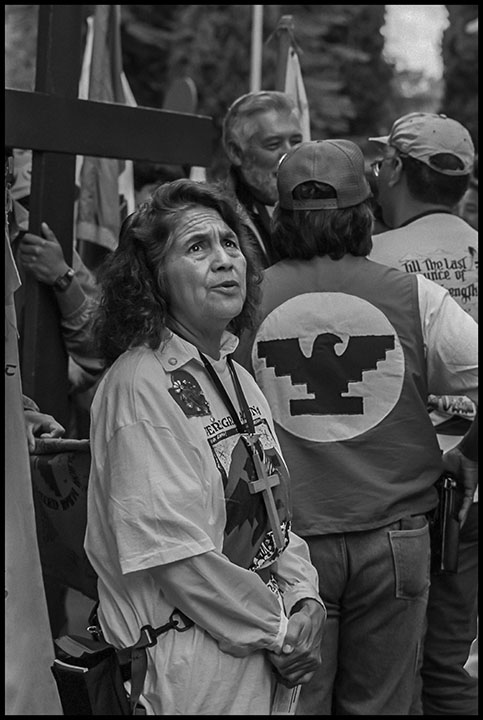
Dolores Huerta and other farmworkers who marched for 20 days to Sacramento wore wooden crosses to show their status as peregrinos.


Gaspar Rivera-Salgado, Chicano & labor studies professor, UCLA:

Long before the Delano Grape Strike began in 1965, Dolores Huerta earned her stripes as an organizer working with the radical Filipinos of the Agricultural Workers Organizing Committee in her native Stockton, even recruiting Larry Itliong, the veteran Filipino organizer of the canneries and fields of the Pacific Northwest. The migration of the indigenous people of Oaxaca, which brought myself, Rufino Dominguez, and other radicals into the California fields, came in the 1980s. By then Dolores was a legend, but to us someone who shared our ideas about organizing and radical social change.

Dolores Huerta's life is part of our collective history of resistance. She is a living link between radical ideas for social change that have defined today's movements for racial justice, worker rights and feminist thought.

We even owe her the chant that all of us know and use almost daily, regardless of what part of the movement we come from. In May 1972, the Arizona legislature passed a growers' bill denying farm workers the right to strike and boycott. When Cesar Chavez started a fast to protest, it fell to Dolores to build people's resistance in the streets. Everyone told her resistance was futile. In a moment of inspiration Dolores responded, ¡Si, se puede! (Yes, it's possible!). Ever since, when we need to show our strength and knowledge that we'll eventually win, we all shout out, ¡Si, se puede!

¡Que viva Dolores Huerta! 


A march and rally to organize strawberry workers in Watsonville begins with Huerta denouncing company terror tactics to the media.  


David Bacon, writer and photographer:

Last fall I walked from Poplar to Delano, Calif., in honor of Larry Itliong, who started the 1965 grape strike and boycott there, with Dolores Huerta, cofounder of the United Farm Workers (UFW). She was 91 then, and I had a hard time keeping up. She sent me a note afterward that ended, "Sí Se Puede con El Rojo Tocino." It was a beautiful joke.

"Sí Se Puede" are three words we all use now, but she invented this confident way of saying "Yes We Can!" "Tocino" was the nickname the union gave me in the years I worked as an organizer-it means "bacon," my last name. And calling me "El Rojo," or "The Red," in this way honored my politics.

When I came back from a solidarity work brigade in Cuba in the 1970s, I landed in New York City with no place to sleep. I called Dolores's daughter, Lori, a friend from California. Not only did I get space on the floor of the NYC boycott's headquarters, but Dolores and her partner, Richard, César Chávez's brother, took us out to eat. Over pizza I enthused about the island. I had stars in my eyes, for both Cuba and Dolores, and still do. I went to work for the UFW as an organizer a few months later.

There was often tension in the union about radical politics, and being called a red was sometimes the route out the door. But for Dolores and Eliseo Medina, being a good organizer was the bottom line-doing what the workers needed.

Over the years, long after I had left the UFW and worked for other unions and then as a photojournalist, I would see Dolores again and again. Going to Watsonville to cover the organizing drives of strawberry workers or to Salinas for the strikes in the vegetable fields, I knew she'd be there. It was a profound experience to watch her in union contract negotiations-this diminutive woman facing off against the beefy growers across the table-and see the sense of power it gave workers.
Returning from Iraq, where I photographed workers after the 2003 US invasion, I took her picture in the front line of marchers against the war. When we were in Sacramento trying to stop the anti-immigrant, anti-affirmative-action, anti-bilingual initiatives, she was the first to speak out.

So when she called me El Rojo Tocino, I thought, "What a compliment!" I hope I live up to it. 


At the beginning of the Iraq War, Huerta marches with actor Danny Glover and an enormous crowd demanding that the troops be brought home. 


Dolores Huerta at a march calling for making Cesar Chavez' birthday a holiday in California.  


Huerta explains to a meeting of rose workers the progress of negotiations of their union contract, at the UFW's historic Forty Acres headquarters.  


Huerta and rose workers talk about the harassment of workers and women in the fields.  


Huerta presents the union's proposals for a fair contract to the managers of the Bear Mountain Rose Nursery in the San Joaquin Valley.  


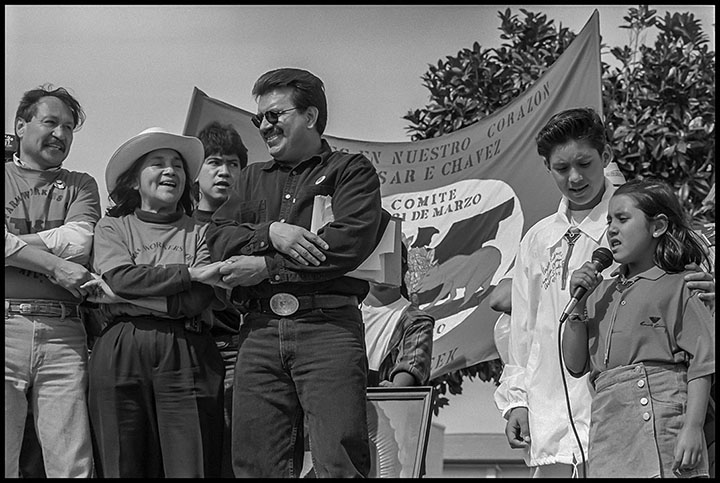
At a Watsonville rally UFW president-emeritus Arturo Rodriguez, Huerta and former organizing director Efren Barajas sing with the daughter of strawberry workers. 


The year after the death of Cesar Chavez Huerta and UFW leaders begin a march to Sacramento by ritually washing the feet of the workers who founded the union in the 1965 grape strike.  


At the Sacramento rally on the state capitol steps at the end of the march.  


Huerta marches with farmworkers in Salinas who've gone on strike against D'Arrigo Brothers Produce. 


Huerta and Rodriguez organized a march and rally in Salinas to support the campaign by John Sweeney to become president of the AFL-CIO.  


At the start of the Immigrant Workers Freedom Ride in San Francisco, Huerta and hotel workers marched to demand immigrant reform. 


Huerta, the Rev. Jesse Jackson, and the head of the National Organization of Women lead the March Against the Right in San Francisco.


Huerta, a former school teacher, talks with children at Jefferson Elementary School in Oakland.


Huerta speaks at a rally of longshoremen in San Francisco who have refused to unload coffee from El Salvador during the Central American civil wars.


Huerta speaks at a Sacramento rally supporting affirmative action, and opposing what would eventually become Proposition 209.


David Bacon is author of Illegal People-How Globalization Creates Migration and Criminalizes Immigrants (2008), and The Right to Stay Home (2013), both from Beacon Press. His latest book, More Than a Wall/Mas que un muro, will be published next month by the Colegio de la Frontera Norte.  For more information about it, write to dbacon@igc.org

Thursday, March 31, 2022

TROUBLE IN THE TULIPS

TROUBLE IN THE TULIPS
Organized Farmworkers Win Basic Demands in a Quick Strike
By David Bacon
Labornotes, March 30, 2022
https://labornotes.org/2022/03/trouble-tulips-organized-farmworkers-win-basic-demands-quick-strike


 Tulip workers take a vote. Photo: Edgar Franks


MT. VERNON, WA - Tulips and daffodils symbolize the arrival of spring, but the fields are bitterly cold when workers' labors begin. Snow still covers the ground when workers go into the tulip rows to plant bulbs in northwest Washington state, near the Canadian border.

Once harvesting starts, so do other problems. When a worker cuts a daffodil, for instance, she or he has to avoid the liquid that oozes from the stem-a source of painful skin rashes.

Yes, the fields of flowers are so beautiful they can take your breath away, but the conditions under which they're cultivated and harvested can be just as bad as they are for any other crop. "Tulips have always been a hard job, but it's a job during a time of the year when work is hard to find," says farmworker Tomas Ramon. "This year we just stopped enduring the problems. We decided things had to change."

On Monday, March 21, their dissatisfaction reached a head. Three crews of pickers at Washington Bulb accused the company of shorting the bonuses paid on top of their hourly wage, Washington's minimum of $14.69. Workers get that extra pay if they exceed a target quota set by the company for picking flowers.

The parent company of RoozenGaarde Flowers and Bulbs is Washington Bulb, the nation's largest tulip grower.

"We've had these problems for a long time," explains Ramon, who has cut tulips for Washington Bulb for seven years. "And the company has always invented reasons not to talk with us."

Workers stopped work that Monday and waited from eight in the morning to see how the owners would respond. The general supervisor was sick, they were told. Someone from the company would talk with them, but only as individuals. "We didn't want that," Ramon says. "We're members of the union, and the union represents us."

Union Wherever They Go

Over two-thirds of the 150 pickers for Washington Bulb work at the state's largest berry grower, Sakuma Farms, later in the season-where they bargain as members of Familias Unidas por la Justicia (FUJ), an independent union. Starting in 2013, farmworkers there struck and boycotted, and finally won a contract after four years. They formed Familias Unidas. At Washington Bulb there is no union contract, yet. But to Ramon and his workmates, they are members of FUJ wherever they go.

When the company wouldn't talk on that Monday, 70 workers voted to strike the following day. Another 20 joined them the next morning, when they again demanded to talk with the company. This time one of the owners told them he wouldn't talk if the president of Familias Unidas, Ramon Torres, was present.

"So we said, 'If you won't talk with our representative, we won't talk without him,'" Tomas Ramon remembers. "'We have a union and you have to make an agreement with him.' So the owner got angry and left."

That Wednesday the flowers were just waving in the breeze, waiting for someone to pick them. The day after, the company lawyer was on the phone to union attorney Kathy Barnard. With a commitment to begin negotiations, workers agreed to go back into the rows after the weekend, and talks got started.

"By the first day of the strike the workers had already met, elected a committee, and put their demands in writing," said FUJ's political director Edgar Franks. "After the four years of fighting for the contract at Sakuma Farms, they knew how to organize themselves quickly. They had community supporters on their picket lines after the first day. They had their list of demands, and finally forced the company to accept it."

Rubber Band Time

When the workers committee and Torres met with Washington Bulb president Leo Roosens on Friday, they went point by point over their 16 demands. Roosens made an oral commitment to resolve all except the demand over wage increases.


Worker leader Tomas Ramon.  Photo: Edgar Franks


 "The most important one for us was that they pay us for the time we spend putting rubber bands on the ring," Ramon says. Workers have to snap a rubber band around each bunch of flowers they cut, from hundreds of bands held on a ring. Each worker harvests thousands of bunches a day, so putting the bands on the ring takes a lot of time.

"There's never enough time, and supervisors don't want people to stop during work time. So on breaks and at lunch we're still filling the ring. They even give us a bag of bands to take home and do it there."

The company doesn't pay this extra time, so demand #7 says, "All work using rubber bands to bunch flowers will be performed during working time, excluding lunch and rest breaks. This work will not be performed off the clock." "Workers knew they had a right to this, because the union won a suit forcing Washington growers to pay for break time, even for workers working on piece rates or bonuses," Franks says.

Parking, Ointment and Bathrooms

Workers often have to walk half a mile from where they park their cars to the rows where they'll work, which the company also won't pay for. So point 3 says, "Workers will be paid the hourly rate from the time they leave their vehicles in the company's parking lots until they return to their vehicles...at the end of their daily shifts."

Gloves are $30 a pair, according to Ramon, and working without them means getting rashes from liquid from cutting daffodils. "The company has cream you can put on to help with that, but it's in the office and they often won't give it to you. Even if they do, they just give you a tiny bit, not enough." So another demand is for company-provided protective gear, and ointment available in the fields.

Of the eight people on the union committee, two are women. There's often just one bathroom for a crew of 50-60 people, and they included a demand for four bathrooms per crew, two for women and two for men, cleaned every day. They also insisted on a demand for better treatment, prohibiting favoritism from supervisors, who "will be trained to treat workers with respect ... and not pressure workers to pick flowers at unreasonable speeds."

The last demand is that the company recognize Familias Unidas por la Justicia as bargaining representative for Washington Bulb workers. If agreement is reached on that point, it will make the company the second in the state with an FUJ contract.

Strategic Timing

The annual Skagit Valley Tulip Festival is set to start on April 1, and runs for a month. The lightning job action less than two weeks before presented the Roosens, the most prominent family in the tulip industry, with the prospect of picket lines in front of fields, as tourists arrive to take photographs and buy flowers.

Almost all Washington Bulb workers have at least three years doing this work, and some as many as 15. They knew the importance of timing and the company's vulnerability. The fact that they were already organized made it easier to reach a quick decision on a job action.

The decision process relied on the collective traditions of the two indigenous groups from Oaxaca and southern Mexico who make up the workforce, Triquis and Mixtecos. Ramon, a Triqui, explains that "each community talked within itself. Each community has its own process, but we have the same kind of problems and the same experience. We all wanted to make things better, so we reached agreement." In that process community members meet, discuss, and arrive at a decision on behalf of everyone.

At Sakuma Farms, women were not elected to the union's leadership, and within the communities, women took a back seat. At Washington Bulb, however, two women were elected to the union committee, and made specific demands. "That's a big step forward for us," Ramon says. It also gives women in the fields suffering sexual harassment the ability to bring complaints to women in the union leadership, instead of men.

The Bosses' Biggest Fea

"Direct action is what makes things move," Franks says. "People put up with a lot because they're scared that they could be unemployed. But when workers go on strike, they lose that fear, they push back, and that's what makes things move. Direct action is the most valuable tool we have, and the bosses' biggest fear. When workers take that leap of faith they can see the world in a whole new say, and recognize their own true value."

Today in western Washington, a growing number of farmworkers have had that experience, and FUJ is following them into new places and farms as a result. It's not a new idea-in the 1940s, Larry Itliong followed Filipino cannery workers from Alaska, where their pitched battles formed Local 37 of the International Longshore and Warehouse Union, back to their work in the fields of the San Joaquin Valley. There, they became the heart of union organizing until the great grape strike of 1965. They eventually joined with Latino workers to form what is now the United Farm Workers.

"We're trying to make sure not to force the issue with workers here," Franks said. "The union is ready to support them once they're ready to take the step. The issues have been present for 20 years, but now, because of Sakuma, there's an ecosystem they can rely on. They can see workers winning and feel better about taking action than they would have years ago. They have a growing leadership, and don't have to put up with this anymore."


NOTE: At press time negotiations with the company had reached agreement on the workers' list of demands. While the union is not the official bargaining agent, the company agreed to treat the union committee as the representative of the workers. Workers were set to vote on the agreement on March 29.


Striking in the tulips.  Photo: Edgar Franks

Sunday, March 13, 2022

PHOTOGRAPHS OF PORTSMOUTH SQUARE - A TRIBUTE TO PAUL STRAND

PHOTOGRAPHS OF PORTSMOUTH SQUARE - A TRIBUTE TO PAUL STRAND
Photographs and text by David Bacon
Stansbury Forum, 3/13/22
https://stansburyforum.com/2022/03/13/photographs-of-portsmouth-square


In presenting these images of Portsmouth Square, in San Francisco's Chinatown, I've tried to keep in mind some of the ideas of Paul Strand, the great modernist and realist photographer.  

Strand was a radical, a founder of the Photo League in New York City in the 1930s, and a teacher who guided its work. After World War Two, as McCarthyite hysteria gripped the country, and especially the world of media and the arts, he was put on a blacklist (along with the Photo League itself) by the U.S. Justice Department.  He went into exile in France, never returning to live in the U.S.  For the next three decades he photographed people in traditional communities, and in newly independent countries during the period of decolonization and national liberation.

Strand was one of the founders of modernism in photography - the idea that photographs had to be connected with the world and depict it cleanly and simply.  He combined those visual ideas with social justice politics, not in a dogmatic or simplistic way, but in an effort to create socially meaningful art with its own philosophy and set of principles.

Strand's books were documents about place, presenting people in the context of their physical world.  The subject of this set of photographs is also a place, one very familiar to me over many years - Portsmouth Square in San Francisco. These photographs were taken over 20 years.  I've sequenced them, as Strand might have done, I think, in an order that emphasizes their social, as well as visual, content.

I was an organizer for the International Ladies Garment Workers Union in the late 1980s and early 1990s.  We set up a Garment Workers Center on Commercial Street, a block from the square.  The workers who came into the center were Chinese women and men who worked in shops all over the city, from outer Third Street to Chinatown itself.  I was just beginning to take photographs in a conscious way in those days, and because I was a union organizer, there was never a possibility that the sweatshop owners would let me inside to document the conditions.  I was a union militant, interested and committed to documenting work, so this was a big regret.  But walking through Portsmouth Square every day gave me a sense of the lives of people in this community, in the hours they spent outside the sewing shops.


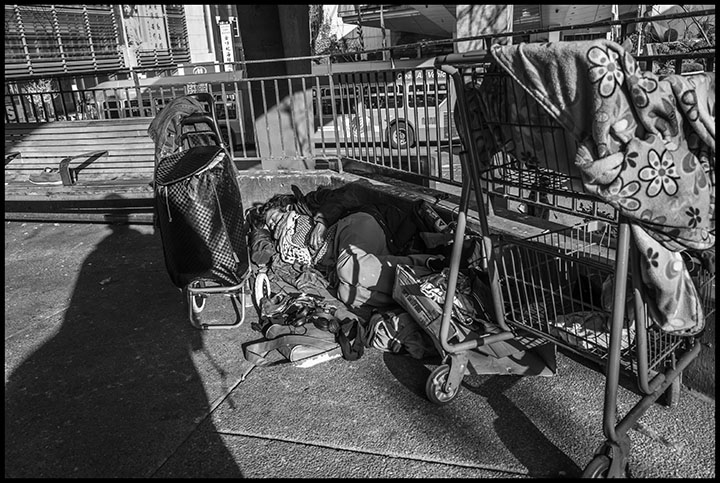
In those years the number of unhoused people on the streets was much smaller than today.  I would see perhaps one or two people sleeping on the sidewalk in the twenty blocks I traveled between our union's central office and the square, and rarely anyone sleeping the square itself.  Today that has changed.  Like any San Francisco park, Portsmouth Square has been made a home, or at least a sleeping place, by several people with nowhere else to go.  The first series of photographs shows a few of these individuals, in their relationship to the facilities of the square, including its benches, castoff cardboard boxes, and the sidewalk itself.


As an organizer I came to realize that Portsmouth Square is home to many activities, and has many levels of meaning to the people of Chinatown.  They relax, play cards and enjoy themselves on the benches whenever the city's notoriously uncertain weather permits.  Over the years I've often returned to take photographs and been struck by how many people play games here.   On one level, it is a place where people get together, in a community where many live with many family members sharing small apartments.  Portsmouth Square means space to breathe, to be noisy and extroverted, to play the games people were taught by mothers and fathers in the generations that came before.  It is a deep expression of the history and culture people share.


Organized cultural events also take place in the Square.  On a recent walk I was pulled towards the performance space by the music of the erhu and other traditional Chinese instruments.  An ensemble of musicians, organized by A Better Chinatown Tomorrow, had assembled to give a concert for the card players and the families wandering through the square.  One woman sang while another danced - stylized voice and motions in humble street clothes.


The culture of Chinatown includes the social movements in which people organized support for revolutions in China itself, and protests over the oppressive conditions and discrimination that people have faced at work.  It is an old history.  A few blocks away, in St. Mary's Square, a statue of Sun Yat Sen by Beniamino Bufano honors the fact that part of the Revolution of 1911, which overthrew the dowager Manchu empress, was planned by Chinese exiles, including those in San Francisco.   

Chinatown is one of the politically most vibrant communities in San Francisco, and Portsmouth Square has always provided space for demonstrations, marches, meetings and leafleting.  When the bombing began in Afghanistan, and the media began its deafening war drumbeat that preceded the invasion of Iraq, Chinatown's internationalists gathered in Portsmouth Square.  There they held signs calling for peace, and for spending on human needs instead of bombs.  After listening to speeches in Chinese, the contingent marched down to Market Street and joined thousands of others from homes across the city, protesting what became a 20-year war.

Perhaps Strand, who took his photographs slowly and deliberately with a large view camera, might have had conflicting feelings in seeing these photographs.  In taking them I took advantage of the mobility of a small camera, moving much more freely than he could with his large apparatus.  He carefully constructed his images, seeing them on the large ground glass at the rear of the camera.  I try to be conscious of the image and its elements as I take my pictures too.  But sometimes I feel that not everything happens on a conscious level.  Working quickly, I depend on a less conscious part of the brain to order the visual pieces of the image..  Perhaps that was also true for him.

But what I take from Strand, and what he might have seen as a commonality in our work, are his aesthetic and political principles.  In his idea of dynamic realism a successful photograph has to encompass three ideas.  It has to be partisan - committed to social change and seeing that change as necessary and possible.  Especially after he left the U.S. during the worst of the Cold War years, he worked in collaboration with radical, often Communist, activists.  They brought him to the communities he photographed, and wrote text accompanying the photographs.

Strand was a committed realist, but he believed that a successful photograph had to do more than just record the reality in front of the lens.  Mike Weaver says in his description of Strand's philosophy, "Certain realities of the world had to be made clear.  To be deeply moved was not enough."  Strand's concept of specificity meant that an image of a particular person had to go beyond her or his individuality, to encompass a more universal truth.  Commenting on a Dorothea Lange photograph he said, "The cotton picker is an unforgettable photograph in which is epitomized not only this one man bending down under the oppressive sky, but the lot of thousands of his fellows."  

Strand did not deny the individuality of the people in his images.  None could have had more dignity, or been photographed with greater care or in more detail.  But without being able to see beyond the individual to greater universality, "photography collapsed into record making, emphasizing the exceptional at the expense of the universal ... One person who has been studied very deeply and penetratingly can become all persons.  Therefore it seems to me that art is very specific and not at all general."

Strand's third principle was dimensionality, referring both to the qualities of the image itself, and how they resonate with its social content.  In an image different elements have a relationship to each other, just as the photograph has a relation to the reality it depicts.  That relationship, within the image, has to have a sensation of movement, he believed.  Even a very still, posed photograph has to have "a sensation of movement through the eye ... simply a reflection of the material fact that everything is in movement ... It is the reflection that in the world things are actually related to each other, even though sometimes we cannot readily see it."

These images of Portsmouth Square been assembled into a sequence, as Strand did in his careful juxtaposition of the images in his books  Some were taken twenty years ago and the most recent just a few weeks back.  Over this period of time I was able to work, and see Portsmouth Square, as an activist myself - an organizer and participant, or sometimes a supporter at a distance, of some of the community's social movements.  The images document the reality of people enduring the pain of marginalization, of the social networks and culture centered on this place, and the efforts to change social reality and fight for justice.

Whether the images succeed in attaining Strand's goal of specificity, or universality, and how well they work as images internally, is up to the viewer to judge.  But taking and sequencing them has forced me to reexamine my own process as a photographer.  I've always considered myself a realist and materialist.  I've paid a lot of attention to the relationships that make my work possible, and I hope socially useful.  But I've given less thought to the aesthetics or the principles behind their conception.  It's seemed enough to say that a photograph either works or it doesn't.

Strand, however, demands a greater commitment.  He voiced a political philosophy that provides a coherent way to analyze photography that is deeply connected to the world.  That forced me to give more attention to the way politics and aesthetic ideas interact in my own work.  Here's his reaction to the unconsidered and unthought realism (photojournalistic and otherwise) of his day (he died in 1976):

"We must reject both this venal realism as well as the mere slice-of-life naturalism which is completely static in its unwillingness to be involved in the struggle ... towards a better and fuller life.

"On the contrary, we should conceive of realism as dynamic, as truth which sees and understands a changing world and in its turn is capable of changing it, in the interests of peace, human progress, and the eradication of human misery and cruelty, and towards the unity of all people.  We must take sides."

Thanks to "Dynamic Realist," by Mike Weaver, in "Paul Strand, Essays on his Life and Work", Aperture, 1990