Sunday, October 29, 2023

CAN PRESIDENT BIDEN'S EXECUTIVE ORDER DELIVER FOR CARE WORKERS?

CAN PRESIDENT BIDEN'S EXECUTIVE ORDER DELIVER FOR CARE WORKERS?
By David Bacon
Equal Times, 27 October 2023
https://www.equaltimes.org/in-a-sector-built-on-historic?var_mode=calcul


Honorata Nono (left) is a Filipina immigrant domestic worker and organiser. She takes care of Michiko Uchida in her home in San Francisco, California.  (Photo (c) David Bacon)


As the age of the US population continues to rise - and millions of people with disabilities, additional needs and children need care - so too does the country's insatiable demand for home healthcare and domestic workers. But years of underinvestment in the sector, and the chronic undervaluing of the important work carried out disproportionately by women of color (particularly those with an immigrant background) has left the sector in a perilous state.

It is a situation that has a deep and shameful history, rooted in the fact that enslaved African-American women were forced to provide unpaid household care for white families during the period of human chattel slavery that operated in the United States from its founding in 1776 until 1865. Following the abolition of slavery, the low wages and poor conditions of domestic work was sustained by a series of violent, racist laws known as 'Jim Crow'.

Against this backdrop, when it passed the US Congress in 1935, the National Labor Relations Act recognised the collective bargaining rights of US private sector workers and established a process to require employers to bargain with their unions. The law carried a political price, however. Racist senators and congressional representatives in the Democratic Party (known as Dixiecrats because they were all from the US South, or from 'Dixie') demanded exclusions. Domestic workers, who were still largely African-American women, would not be covered. Neither would farm workers, mostly Mexican and Filipino immigrants in that era.

The Fair Labor Standards Act, passed three years later, gave private sector workers the right to overtime pay and minimum wages. Again, domestic workers and farm workers were left out, at the insistence of Dixiecrats. It is no accident, therefore, that the labor rights and wages of both groups were held far below those of other workers in the decades that followed. Yet despite the exclusion, farm workers continued to organise. And in the last few decades, domestic workers have sought to end their exclusion as well.

Organising locally, nationally and globally

In California and other states, rising activism accompanied the increase of immigrant workers in the domestic worker labor force. According to labor historian Jennifer Guglielmo: "In the 1970s and 1980s, the domestic workforce began to change dramatically. African-American women moved out of domestic labor in large numbers and into clerical, sales, public sector, and professional jobs. Mexican-American women in the south-west also left domestic work for these jobs [...]. This shift led employers to hire more immigrant women from Latin America, the Caribbean, and Asia in much larger numbers." This wave of migration was in part the product of the displacement of families and communities in countries forced to adopt neoliberal structural adjustment policies and free trade agreements.

One of them, Cristina "Ate Bingbing" recalls, "My life started as a domestic worker when I decided to work abroad because my life was so difficult in the Philippines."  She recounts having to work despite the risk of COVID during the pandemic.  "I am being forced to choose between two very important things: your livelihood or your health. I am a single mom, and I support my daughter, who I haven't seen in years ever since I decided to leave the Philippines to look for work abroad. If something happens to me here, I have no idea what will happen to my family or when I will see my child again."

In the 1990s, immigrant domestic workers in urban centres began to organise community-based workers' centres. San Francisco's Mujeres Unidas y Activas started as a project of the Northern California Coalition for Immigrant Rights, for example, while the Colectiva de Mujeres was originally a women's centre within the city-sponsored Day Labor Program. In the early 2000s they joined, first with Bay Area organisations like Filipinos for Affirmative Action, and then with Southern California organisations like the Coalition for Human Rights in Los Angeles and the Filipino Workers Center, to form a statewide network. This process paralleled others in New York and other states. In 2007, five California organisations joined six from New York and one from Maryland to form the National Domestic Workers Coalition.  

Just a few years later it played a key role in the adoption of a landmark international labor standard for domestic workers in 2011, International Labor Organization Convention 189 on Decent Work for Domestic Workers, which recognised for the first time the right to minimum working standards for domestic workers.  Following a campaign by an alliance of trade unions and domestic worker organisations, C189 has since been ratified by 36 countries.  The United States, however, isn't among them.

When the California Domestic Worker Coalition put a Domestic Workers Bill of Rights on the state legislature's agenda in 2012, then-AFL-CIO president Richard Trumka recognised the historic justice of their demands. "It's not right that domestic workers should be excluded from overtime pay laws," he told a crowd in Washington DC. "It's time for that to end. It's not right that domestic workers are excluded from collective bargaining laws. It's time for that to end. Domestic workers' rights are civil rights. Domestic workers' rights are human rights."

Trumka responded to the stories he was hearing from workers who'd come to push for the bill's promise of racial and labor equity. Teresita Gao-Ay, a domestic worker from San Diego, told him she'd been a caregiver since 1986, working from 7am to 9pm. "I had to do everything from cooking, cleaning the whole house, laundry that had to be pressed and folded, including sheets, gardening and caring for the dog. And I had to do this for the whole family, not just for the client I was taking care of. But how can you say no? I was living in their house. Plus, they said they'd call the police if I didn't do as they asked. Then, when I was injured on the job, no one paid me for the days I had to take off to recover."

"Care workers deserve to make a decent living"

The Covid-19 pandemic brought the plight of care providers into sharp focus everywhere, but in the US, where resources in the care sector were already stretched thin, the situation has worsened as a result of thousands of experienced care workers either leaving the sector or losing their lives after contracting Covid. According to the AFL-CIO: "Care prices have also skyrocketed, straining working families and forcing them to spend a significant portion of their income on services."

When President Joe Biden issued an executive order in April this year, seeking to use the administrative power of the federal government to raise domestic, home care and child care worker wages and make the care they provide to working families more affordable, he implicitly recognised the historic injustice. "Care workers deserve to make a decent living, and that's a fight I'm willing to have," he declared.  "No one should have to choose between caring for the parents who raised them, the children who depend on them, or the paycheque they rely on to take care of both."

The executive order contains a number of directives to different parts of the federal government, covering the programs they administer. The Department of Health and Human Services, for instance, was told to consider actions to reduce or eliminate families' co-payments for childcare. Other agencies were directed to identify which of their grant programs can support childcare and long-term care for individuals working on federal projects. The order calls for increasing the pay of Head Start teachers and childcare providers.  Head Start is the main Federally and state funded program for early childhood education, for pre-school age children.

The order seeks to ensure there are enough home care workers to provide care to seniors and people with disabilities enrolled in Medicaid, which provides free or low-cost health coverage to low-income families and individuals. It proposes to set minimum staffing standards for nursing homes, as well as conditioning a portion of Medicare payments on how well a nursing home retains workers. "This will be the first time that we'll have a care standard," explains Mia Dell, deputy director for advocacy at the AFL-CIO.

This development also aligns with demands from the international labor movement for greater investment in care to ensure equitable access to quality public care and health services. "It advances the social equity goal of the executive order, because the nursing homes with the worst history are those serving low-income communities of color." Better staffing standards and pay would also benefit the workers of color and women making up most of that workforce, another equity component of the order, Dell says.

The President's statement announcing the executive order highlighted the budget proposals intended to advance these goals. The American Rescue Plan, which provided funding to overcome the impact of the pandemic, contained over US$60 billion for care issues. The administration statement credited that funding with saving the country's system of private childcare providers. The Biden Budget, if adopted, would include US$150 billion over ten years to expand Medicaid home services, and proposes US$600 billion over ten years for expanded childcare and preschool programs. However, it faces extreme Republican opposition in Congress.

Historic exclusion

Today, the consequences of the historic exclusion of domestic workers run deep. In 2022 the Economic Policy Institute (EPI) issued a report, the Domestic Workers Chartbook, that outlines the basic living and working conditions for the 2.2 million domestic workers in the United States. That number is expected to grow rapidly - more than three times as fast as employment in other occupations - because the ageing of the US population and workforce is expanding the number of people needing care.

The real size of the workforce is likely larger, the EPI says, because many domestic workers are paid informally, making them less likely to report employment and earnings. In addition, over a third of domestic workers are immigrants, many of whom lack legal immigration status, and many fear the consequences of contact with the authorities, including participation in national surveys.

The lower pay level for domestic work reflects the racist and sexist structure of the US workforce, where people of color, immigrants and women are paid less than average. A majority of domestic workers are Black, Hispanic, or Asian-American and Pacific Islander women. Over 40 per cent are older than 50.  According to the EPI: "The typical domestic worker is paid US$13.79 per hour, including overtime, tips, and commissions - 36.6 per cent less than the typical non-domestic worker, who is paid US$21.76. The typical domestic worker's annual earnings are just two-fifths of a typical worker in another occupation." As a result, "domestic workers are much more likely than other workers to be living in poverty," the report concludes.

The human dimension of these statistics was described by Honor Nono, a Filipina domestic worker in San Francisco. "The work of a caregiver is no joke," she told a 2016 rally supporting the Domestic Workers Bill of Rights. Nono spoke as a member of the Pilipino Association of Workers and Immigrants, originally set up by Filipinos for Affirmative Action. "Clients vary, they may be kind or unkind, happy or grouchy, difficult or easy, even dangerous. You can break your back, your neck, arms, or shoulder assisting your clients, transferring them from bed to wheelchair or vice versa. That is why we say the caregiving job is 3D: difficult, dirty and dangerous. Some caregivers do not get the minimum wage, workers compensation or paid overtime."

Nono has been an organiser of other care givers. "We make all other work possible," she told the rally, "and we work not only with our hands but with our hearts, because the people under our care also deserve love, respect and dignity. We are always in a battle, physically, and emotionally."

Build Back Better

Passing a Domestic Worker Bill of Rights in California has been part of a national strategy to pass similar legislation elsewhere. To date, ten states and three cities have adopted it in some form, and they often include guarantees of paid time off, overtime, a requirement for written agreements and protection against discrimination. In California, the first bills originally proposed guarantees of eight hours of sleep for live-in workers, the right to use kitchen facilities to cook their meals, sick pay and vacations, cost-of-living raises and advance notice of terminations.

The final Bill of Rights was more limited, but the original demands reflect a broad agenda of goals that domestic workers seek to win over time. In Seattle, for example, a more recent bill, passed last year, brings domestic workers under the state's minimum wage law and qualifies them for unemployment insurance. A Domestic Workers Standards Board, with worker, employer and community representatives, will make further recommendations for improving working conditions.

When the Biden administration came into office in January 2021, many of these goals were incorporated into the Build Back Better bill, which included many elements of the Bill of Rights adopted by several states.  Other parts of Build Back Better would have made it possible for undocumented immigrants, including thousands of domestic workers, to gain legal immigration status. In negotiations with conservative Democrats, however, Build Back Better was pulled off the Democrats' agenda, and only a bill funding infrastructure improvements was passed. That was a blow to domestic workers and immigrant rights advocates, among many others.  

The inclusion of the domestic worker agenda in Build Back Better, and then the executive order in April, were the fruits of years fighting against their original exclusion from basic labor legislation.  "The Covid pandemic showed the urgency of the need and created a unique opportunity for making systemic reforms," says Dell. "Making care available to all workers was included in Build Back Better. When it was knocked out and we could no longer pass those reforms, the executive order made sense."

Nevertheless, it is difficult to quantify the concrete impact of the executive order, in terms of the number of people it enables to access care and the changes in the economic situation of care givers. "Basically, the administration was pulling every lever it could. In reality, there are only so many levers," Dell says.

One major achievement of the statewide strategy was legislation in California that gave unions the right to bargain over wages paid to about 500,000 home care workers who provide care to people receiving support from the state's In-Home Supportive Service Program. Two unions - the United Domestic Workers, a local affiliate of the American Federation of State, County and Municipal Workers organized in 1977, and Local 2015 of the Service Workers International Union - were then able to negotiate wages for workers on a county-by-county basis. That led to substantial raises, and a similar system was later achieved for childcare workers. Today UDW represents 98,000 workers, and Local 2015 represents about 450,000. The number of actual union members, however, is not publicly available, however.

The effort continues to pass a national Domestic Workers Bill of Rights, although that path is effectively blocked without a change in the political balance of forces in the Congress. In addition, in 2014 the rightwing-dominated US Supreme Court held that home care workers couldn't be required to pay union dues, and weren't actually workers at all, but 'caregivers' who don't come under labor law and can't be considered state employees. In the meantime, state-by-state efforts are continuing. They make progress in states where domestic workers and care recipients are well-organised, and where progressive Democrats have legislative majorities and governors. "The state-based model has allowed us to organise at scale, but there are not enough states," Dell warns.

The elections of 2024 could change that calculation, but whatever happens, Dell says that unions will keep fighting for decent work for care workers: "We must make sure that workers are paid a living wage, with access to benefits, and the opportunity to join a union."


Each year, 29 October marks the International Day for Care, as part of the call for greater public investment in a resilient and inclusive care economy. For more information, you can visit the International Trade Union Confederation's online care portal.  This article was copublished with Equal Times, with support from the Ford Foundation
 

Wednesday, September 27, 2023

FIGHTING FOR THE PUBLIC SPACE - Mexico City Streets

MEMORY AND REVOLUTION IN MEXICO CITY - Mexico City Streets
Social movements claim public space in one of the largest cities in the Americas.
by David Bacon
The Progressive - October 9, 2023
https://progressive.org/latest/memory-and-revolution-mexico-city-bacon-231009/


Every day Mexico City taxi drivers, trying to navigate the city's intense traffic, tune into the morning's radio announcements of marches and demonstrations.  There are a lot of them - colorful, loud and insistent.  Over the years it has been easy to step out of the Maria Cristina in the morning, walk a block up to the Reforma, and join them with my camera. Much of the political life of the city is found in the street.  Its social movements use the public space often as a reminder of earlier protests and actions that have given form to Mexican politics.  

Those politics reflect an interplay of street protest and a more formal electoral process.  Today, following a new more open procedure for choosing presidential candidates (itself in part a product of movements in the streets), Mexico's governing party Morena (the Movement for National Regeneration), has selected as its standard bearer the city's mayor, Claudia Sheinbaum.  Given the popularity of Morena and its founder, current President Andres Manuel Lopez Obrador, she is virtually certain to be elected.

She is an engineer, a skilled politician, the daughter of a leftist family, and of course a woman.  If elected, she will be Mexico's first female head of state, joining a growing number of women who head or have headed governments throughout the Americas (notably not including the United States).  But it's not just women in office that is changing politics.  The country's Supreme Court recently struck down the prohibition of abortion.  Women have been protesting abuse and gender-based violence for years, especially since the disappearance of scores of young maquiladora workers in Juarez, on the Mexico/U.S. border.

It's no surprise, therefore, to see that women have taken over a traffic island in the middle of the Reforma to highlight these attacks and demand justice.  A metal, violet-colored silhouette of a woman with her fist in the air rises above the corrugated walls of a kiosk.  The surfaces have first been painted back, and then the names of women murdered and subjected to repression have been hand lettered in white.

The number of names is extraordinary.  Each panel of the kiosk emphasizes repression directed towards a particular group.  One displays the names of women journalists.  Another lists indigenous activists.  It includes Bety Cariño, ambushed and killed as she brought support to an autonomous Triqui town in Oaxaca, and Digna Ochoa, defender of the poor, shot in her Mexico City office.  A third panel memorializes the 49 children burned to death in the ABC nursery.

On paper banners hung on strings at the edge of the curb are the words of ordinary women, giving account of abuse:  "Because of fear, because of reprisals, because I was not protected," or "Because he was family, I was afraid of what they'd think of me, and when I told my mother, and she told his mother, they said I'd probably provoked him," or simply, "He scares me."


Further up the Reforma is another permanent memorial.  Not far from the guarded facade of the U.S. Embassy, and the buildings housing rich banks and government offices, is the Ayotzinapa encampment.

Nine years ago, students set out in commandeered busses from their teachers' training school in Guerrero to the annual march commemorating the death of hundreds of students in the city's Tlateloco Plaza in 1968.  Forty three Ayotzinapa students were seized and disappeared.  Through those nine years the investigation into the crime's authors has reached into the highest levels of the government, especially the armed forces.  While previous administrations tried to pretend the students were simply victims of a narcotics cartel, it has become clear that there were deep political reasons for their murder.  

The Ayotzinapa school itself has been the target of the Mexican right for its history of training rural teachers.  The school gave students a radical and Marxist analysis of their country, preparing them to be social organizers, even revolutionaries.  It followed the tradition of one of its best known professors, Lucio Cabañas, who took up arms against the Mexican government in the 1960s.  

Over the years since the 43 murders, new generations of Ayotzinapa student have kept up pressure on the government by coming to the capital every month.  They have built a permanent camp on the Reforma, with cabins and shelters for sleeping and space for meetings.  Surrounding it are silkscreened images of the disappeared students, strung in rows on the shelter's walls, facing the traffic.  This planton, or encampment, even boasts a small library, cared for by Martin, one of a group dedicated to maintaining the space.

On September 28 the families of the 43 disappeared lifted another planton they'd maintained in front of the Military Camp #1 in Mexico City, after a new report from the Commission for Truth and Access to Justice authored by Undersecretary for Human Rights Alejandro Encinas.  Mexican President Andres Manuel Lopez Obrador stated, “We have not abandoned the case, we are going to continue investigating it for the mothers and the fathers, for justice and also for our convictions."  He gave a new order to the army to release files on the case it had withheld, including documentation of the personal involvement of past President Enrique Peña Nieto in covering up the crime.

Public space is contested space for protest movements in any city.  In some, any effort to create a permanent presence is greeted with fire hoses, arrests and worse.  Mexico City has its own history of trying to sweep social movements out of sight.  But a tradition of popular protest is equally strong, including the planton.  It has popular recognition, which the government must take into account.


Perhaps the Ayotzinapa encampment, and the Glorieta de las Mujeres que Luchan (the Roundabout of the Women in Struggle) are products of a certain political moment.  But perhaps they will become as much a part of the recognized life of the city as the Angel of Independence.  The column with its winged statue has towered over the Reforma since 1910, the first year of the Mexican Revolution.

The two occupations of public space mark their own watershed in Mexican politics, and that change, with or without memorials, will perhaps last decades as well.

Thursday, August 31, 2023

LIFE LIVED IN PUBLIC - Mexico City Streets

LIFE LIVED IN PUBLIC - Mexico City Streets
Photographs by David Bacon

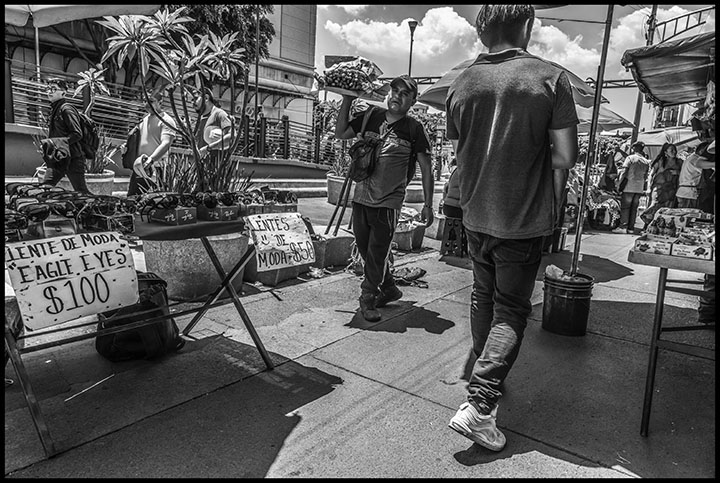
In most of the world people live much of their lives outdoors, in the street.  Mexico City is no different.  A lot happens in the street here.  Public life means not so much events for public consumption, but more life lived in the public space.

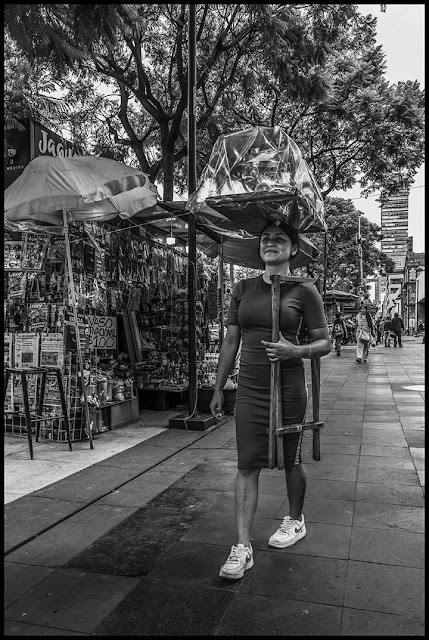
Walking through the old centro historico the first thing you see are people working.  Two men break through the asphalt for a street repair project.  People carry things - an anonymous bundle clutched to the chest, tacos being delivered for someone's lunch.  A woman in a bright red dress balances a tray of pan dulce on her head, striding down the sidewalk past the Alameda, the legs of the folded stand she'll use to set up her stall hanging from her arm. 


In the park a nanny puts a sock on the small foot of the child she cares for. A street sweeper poses with her broom.  A guard stands at attention in front of a jewelry store on the Zocalo.  How long can he keep it up?


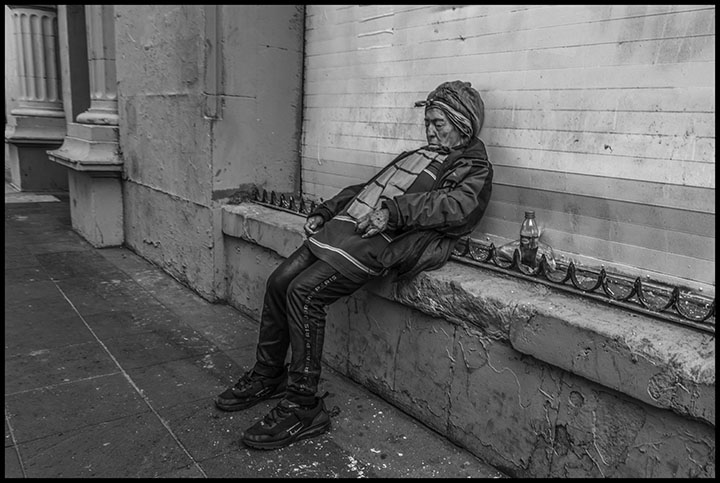
Tired workers sleep in the street too.  An older woman takes a nap at lunchtime, the way I did in the factory years ago, grabbing a few minutes before going back to work.   Two bicycle messengers are asleep, one on a bench and another beneath it.  A line of workers sits back, some nodding out, against the building they're fixing up.  


Of course, not everyone is working.  Two older women are deep in conversation, their walking canes planted beside them, while two younger women seem a little doubtful about the words of their companion, as he guides them past one of the street obstructions around the National Palace.  Not far away, next to the cathedral, a young man puts on greasepaint in a fanciful calacas, getting ready for the next Aztec dance.


As evening starts to soften the light, a bench on the Reforma, a very public space, becomes one of temporary seclusion for two lovers - a moment together they likely can't get with family at home.  


And then a final jazz riff from the sidewalk trumpeter.


FROM SPAIN TO DELANO - THE RADICAL ROOTS OF FARMWORKER UNIONS

FROM SPAIN TO DELANO - THE RADICAL ROOTS OF FARMWORKER UNIONS
By David Bacon
Positively Filipino, 8/30/23
https://www.positivelyfilipino.com/magazine/from-spain-to-delanothe-radical-roots-of-farm-workers-unions


We can't talk about defending the human and labor rights of farm workers without talking about their history of organizing unions-and the efforts by the government to suppress them. Liberal mythology holds that farm worker unions didn't exist until the creation of United Farm Workers in the '60s and that the farm worker unions and advocacy organizations of today appeared out of nowhere, with no history of struggle that went before.

But in fact, during the 1930s Filipinos and other farm workers organized left-wing unions and huge strikes. According to Rick Baldoz, a professor at Oberlin College, "The burgeoning strike activity involving thousands of Filipinos in the mid-1930s occasioned a furious backlash from growers who worked closely with local law enforcement."

The people who fought to organize unions in the '30s, '40s and '50s on the West Coast were the same people who fought for Spain-in the same organizations, like the International Longshore and Warehouse Union, and especially ILWU Local 37. Of all the efforts to organize farm workers, the ones that were closest to the International Brigades were those of the Filipinos during those years. And the forces that later went after the Lincoln vets were the same as those that went after the farm worker unions, using the same tools: blacklisting and deportations.

Baldoz gained access to the FBI files on one of the most radical of the Filipino leaders, Carlos Bulosan. "The fact that these partisans attracted the attention of federal authorities during the Cold War is hardly surprising," he says. "Filipino workers had developed a well-earned reputation for labor militancy in the United States dating back to the early 1930s. That a considerable number of Filipinos (both from the U.S. and the Philippines) had volunteered for the International Brigades during the Spanish Civil War... only added to the perception that they were immersed in international left-wing politics."

In their history of Asian volunteers in the Spanish Civil War, Nancy and Len Tsou write: "At least 11 Filipinos went to Spain to join the International Brigades. Among them, several came from the United States. [Pedro] Penino was able to establish the Rizal Company, a part of the International Brigades named in honor of a Filipino national hero." The Tsous name the following volunteers: Manuel Lizarraga, Artemio Ortega Luna, Enrique Almenar Gabra, Modesto Ausobasa Esteban, Dimitri Gorostiaga, Eduardo Miranda Gonzales, Pedro Penino, Carlos Lopez Maestu, Mark Fajardo, Servando Acevedo Mondragon and Aquilino Belmonte Capinolio.


A group of International volunteers in Spain (L-R): a seaman from Chile; Sterling Rochester (USA); Artemio Luna Ortega (Philippines); Juan Santiago (Cuba); and Jack Shirai (Japan).


Artemio Luna Ortega was born in the Philippines, 1901. He served in the Constabulary from 1922-1925. He immigrated to the US in 1927 where he worked as a draftsman after college. He was a member of the CPUSA and FAECT. He arrived in Spain on January 14, 1937. Artemio served with ALB at Jarama, Brunete and as a guard Villa Paz. He also the joined the GTU. His fate beyond Spain is currently unknown.


Bulosan had worked as a farm laborer since his arrival in the U.S. in 1930, but after his health was destroyed by his work he tried to make a living as a journalist. "Every word is a weapon for freedom," the FBI reported him telling a colleague. In 1946, Bulosan wrote America Is in the Heart, a classic and moving account of life as a Filipino migrant farm worker during the 1930s. The FBI viewed the book as evidence of his Communist associations during the Cold War. Bulosan was hired by leaders of Local 37 of the International Longshore and Warehouse Union, Ernesto Mangaoang and Chris Mensalvas, to edit the union's yearbook in 1952. Among its many appeals for support for radical causes, it urged solidarity with the Huk movement in the Philippines, against continued U.S. imperialist domination of its former colony. 


Carlos Bulosan, a farm worker and later an acclaimed author, caught the attention of the FBI.


In the 1930s, Local 37 was organized by Filipinos who were the workforce in the salmon canneries on the Alaska coast. They were mostly single men, recruited to come to the U.S. from the Philippines. They were shipped to the canneries from Seattle every season, where they faced discrimination and terrible conditions. They organized Local 37 to change those conditions and forced the fish companies to sign contracts.

Until 1949, Local 37 had been part of the Congress of Industrial Organizations' (CIO) farm workers union, the United Cannery, Agricultural and Packing House Workers of America. From 1936 to 1953, the U.S. labor movement was split between the left-wing CIO and the rightwing American Federation of Labor. In 1949, as the Cold War started, the CIO expelled nine unions, including UCAPAWA and the ILWU, because of their left-wing politics and often Communist leaders.

At the height of the McCarthyite hysteria more than 30 members of Local 37 were arrested and threatened with deportation to the Philippines. Raymundo Cabanilla, a former CIO organizer, named names to the FBI, identifying fellow labor activists, including Ernesto Mangaoang, as Communists. Eventually Mangaoang's deportation case was thrown out by the courts. He argued that he couldn't be deported, given that he was a U.S. "national" when he arrived in Seattle in the 20s. "National" was a status given Filipinos because the Philippines was a U.S. colony at the time. Filipinos couldn't be considered immigrants, but they weren't quite citizens either.

Meanwhile, the Federal government tried to bankrupt Local 37 by forcing the accused workers to pay high bails and lawyers' fees. Union leaders were so tied up in legal defense that a conservative faction took control of the local. That group held it until it was thrown out in the 1980s by a new young generation of radical Filipinos, two of whom, Silme Domingo and Gene Viernes (a former farm worker) were assassinated.

UCAPAWA (renamed the Food, Tobacco and Agricultural Workers) was destroyed in the 1949 purge of the CIO, and the Filipino local in Seattle was taken in by Harry Bridges' union, becoming ILWU Local 37. It survived, and today is part of the ILWU's Inland Boatman's Union.

Today, 52 years after the historic 1965 Delano grape strike, it is important to reexamine this history, especially the radical career of Larry Itliong, who headed the Agricultural Workers Organizing Committee (AWOC). Itliong not only shared leadership with Cesar Chavez but actually started the strike. He had a long history as an organizer. 


Labor leaders Larry Itliong (left) and Cesar Chavez (Right) at the Delano Grape Strike (Source: CAAM.org)


Itliong was Ernesto Mangaoang's protégé. In the late 1940s, he was Local 37's dispatcher, sending workers on the boats from Seattle to the Alaska salmon canneries. After the salmon season was over, many Filipinos would return home to California's Salinas and San Joaquin Valleys, where they worked as farm laborers for the rest of the year. In the segregated barrios of towns like Stockton and Salinas they organized hometown associations and social clubs. Itliong used these networks to organize Filipinos when they went to work in the fields. Along with Chris Mensalvas, at the time Local 37 president, Itliong organized a strike in Stockton's asparagus fields in 1949.

Once the left-wingers lost power in the union, however, its conservative leaders stopped its farm worker organizing drives. Still, in the early 1950s Filipino farm workers continued to organize. Ernesto Galarza (author of "Merchants of Labor") started the National Farm Labor Union, which struck the giant DiGiorgio Corporation, then California's largest grower. In 1959 the Agricultural Workers Organizing Committee (AWOC) was set up by the merged AFL-CIO. After hiring Itliong as an organizer because of his history among Filipino workers, AWOC used flying squads of pickets to mount quick strikes. In 1962, it struck the Imperial Valley lettuce harvest, demanding $1.25 per hour.

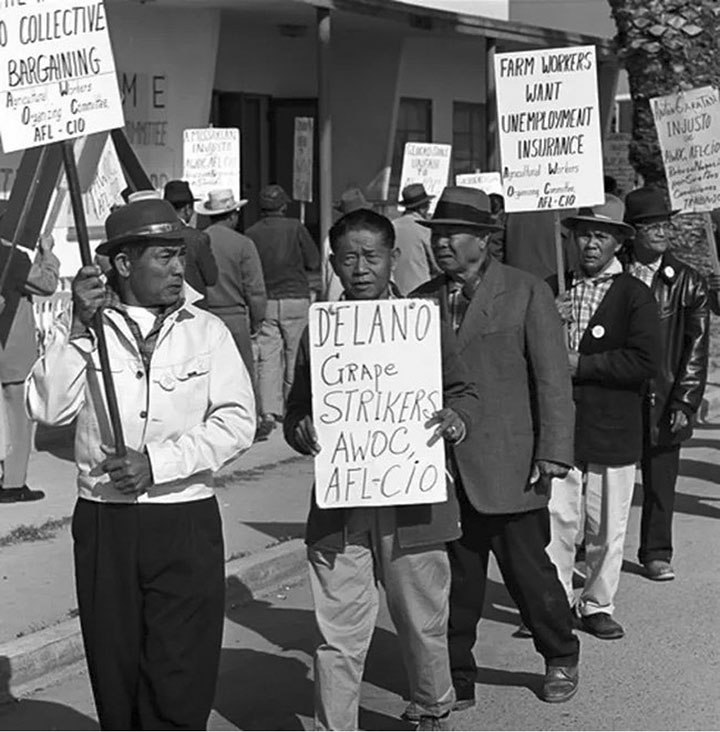
The grape strike started in Delano on September 8, 1965, when Filipino pickers walked off the fields. Mexican workers joined them two weeks later. The strike went on for five years, until all California table grape growers were forced to sign contracts in 1970. The strike was a watershed struggle for civil and labor rights, supported by millions of people across the country, breathing new life into the labor movement and opening doors for immigrants and people of color. 


Filipino workers on strike (Source: Harvey Richards Media Archive)


California's politics have changed profoundly in these 52 years, in large part because of that strike. Delano's mayor today is a Filipino. That would have been unthinkable in 1965, when growers treated the town as a plantation. Children of farm worker families have become members of the state legislature. Last year they spearheaded passage of a law that requires the same overtime pay for farm workers as for all other workers-the first state to pass such a law.

The 1965 Delano grape strike did not, however, start in Delano. It was in the Coachella Valley, near the Mexican border where California's grape harvest begins, that Filipino workers struck the vineyards that summer. They won a 40¢/hour wage increase from grape growers and forced authorities to drop charges against arrested strikers. The Coachella strike was organized by Larry Itliong. After the grape harvest moved north to Delano, he and the Filipino workers of AWOC walked out again.

The timing of the 1965 strike was not accidental. It took place the year after Galarza, Bert Corona, Cesar Chavez, and other civil rights and labor activists forced Congress to repeal Public Law 78 and end the bracero contract labor program, under which growers brought workers from Mexico under tightly controlled, almost slave-like conditions. Farm worker leaders acted after the law's repeal, because once the program was ended growers could no longer bring braceros into the U.S. to break strikes.

The Delano strike was a movement of immigrant workers. To organize farm labor, both Filipinos and Mexicans wanted to keep growers and the government from using immigration policy against them. In ending the bracero program, they sought instead immigration policies favoring families and communities. In the 1965 immigration reform they established family reunification as a basic principle of immigration policy. This enabled thousands of people, especially family members of farm workers, to come from the Philippines, Mexico and other developing countries.

The Delano strike was not spontaneous or unexpected. It was a product of decades of worker organizing and earlier farm worker strikes. Many Filipino workers in Coachella and Delano were members of ILWU Local 37 in 1965, when the grape strike began. Every year they still traveled from the San Joaquin Valley (where Delano is located) to the Alaska fish canneries. Through the end of their lives, they were often active members of both Local 37 and the United Farm Workers.

Cold war fears of communism were strong in the 1960s-one reason why the contributions of Itliong and the Filipinos were obscured. The strike in Delano owes much to Cesar Chavez, Dolores Huerta, Gilbert Padilla, and other Chicano and Mexican leaders who came out of earlier community organizing movements. But the left-wing leadership of Itliong, Philip Veracruz and other rank-and-file Filipino workers was equally important.

Chavez willingly acknowledged that the NFWA hadn't intended to strike in 1965. The decision to act was made by left-wing Filipinos, a product of their history of militant fights against growers. Their political philosophy saw the strike as the fundamental weapon to win better conditions. And it was a decision made by workers on the ground, not by leaders or strategists far away.

Growers had pitted Mexicans and Filipinos against each other for decades. The alliance between Itliong's AWOC and the Cesar Chavez-led National Farm Workers Association (NFWA) was a popular front alliance of workers who had, in many cases, different politics. AWOC's members had their roots in the red UCAPAWA. NFWA's roots were in the Community Service Organization (CSO), which was sometimes hostile to Communists. Yet both organizations were able to find common ground and support each other during the strike, eventually forming the UFW.


Fred Abad and Pete Velasco, Filipino veterans of the United Farm Workers and the Agricultural Workers Organizing Committee. (Photo by David Bacon, Special Collections in Stanford University's Green Library)


Strikers in Delano developed close friendships. Cesar Chavez's son Paul recalls the way the older Filipino men looked at him and other children of Mexican strikers as their own family. Most of the Filipinos were single men, because anti-miscegenation laws prohibited them from marrying non-Filipinas, and the immigration of women from the Philippines was limited until the late 1960s. In the wake of the grape strike, the UFW and scores of young activists from California cities built a retirement home for them in Delano, Paolo Agbayani Retirement Village, to honor their contribution.

Philip Vera Cruz, a Filipino grape picker who became a vice-president of the UFW and later left over disagreements with Chavez, wrote during the strike's fourth year: "The Filipino decision of the great Delano Grape Strike delivered the initial spark to explode the most brilliant incendiary bomb for social and political changes in U.S. rural life." 


Philip Vera cruz, a Filipino grape picker, was one of the initial leaders of the Delano Grape Strike.


Liberal mythology has hidden the true history of the grape strike's connection to some of the most radical movements in the country's labor history. The contribution of that generation of Filipino radicals, including some who went to Spain, should be honored- not just because they helped make history, but because their political and trade union ideas are as relevant to workers today as they were in 1965. Those ideas, which they kept alive through the worst years of the Cold War, led to a renaissance of farm worker organizing that is still going on.

This article was first published in "The Volunteer," February 27, 2018: https://albavolunteer.org/2018/02/human-rights-column-from-spain-to-delano-the-radical-roots-of-farm-workers-unions/

Sunday, August 27, 2023

WAITING FOR REFUGE IN MEXICO CITY - Mexico City Streets

WAITING FOR REFUGE IN MEXICO CITY - Mexico City Streets
by David Bacon
On the Line - The Progressive - August 24, 2023
https://progressive.org/magazine/waiting-for-refuge-in-mexico-city-bacon-20230824/

A Haitian refugee shows her frustration at not being able to reach her destination.


With all the attention on the detention centers on the border, U.S. media rarely if ever acknowledges that camps of migrants and displaced people exist all over Mexico.  In documenting the impact of U.S. border policy on Mexico, I took these photographs in a settlement of Haitian migrants, who had been living for a month in Giordano Bruno Plaza in Colonia Juarez, in downtown Mexico City.  

Over a hundred families were heading for the border after a long journey from Haiti when they realized that they would not be able to cross, or that if they tried and were unsuccessful in getting asylum (since hardly any Haitians do) they would be deported back to Haiti.  In May alone over 4000 Haitians were put on the deportation planes by the U.S. government.

The Mexican government and the government of the city provide some minimal services to the Haitians, who were debating whether they should stay in Mexico.  There is a process, albeit cumbersome, in which they can apply for permission to stay and work.  

Next to the Haitian encampment is a planton, or occupy-style protest camp, set up by Otomi indigenous people and the association "United for Farmer and Indigenous Rights."  Some years before they had occupied an abandoned building and then were expelled.  Refusing to leave they began living on the sidewalk outside, demanding decent housing and protesting gentrification.  Their long-established camp provided the Haitians a place to wash.

The neighborhood authorities who maintain the plaza have painted on a wall behind the migrant tents, "Amor es el vinculo de vinculos" or "Love is the bond of all bonds."  It is an ironic statement, given the world's (and especially the US') hostility to migrants, but it is also a statement that the people of this neighborhood have given them the use of their neighborhood park as a place to rest.  

The statement itself comes from Giordano Bruno, a revolutionary monk of the early Renaissance, burned at the stake in Rome's Piazza de Fiori in 1600 for asserting that the earth was not the center of the universe.  He is considered a hero of scientific and free thought.  Bruno spent most of his life as a migrant and refugee, much like the Haitians, fleeing the Inquisition, before he was finally captured.  Bruno's statement of his mystical vision refers to the chapter in the Bible, Colossians 3:14:  "And above all these things, clothe yourselves with love, which is the bond of unity."

Returning a few weeks later, I found most of the Haitians had left.  According to Josias Termot, they'd gone to the border, and some had been able to cross.  Others were now living in the Casa del Migrante, a refugee shelter managed by the Cuauhtemoc local government a few blocks away.  Many were without work, however, and during the day returned to the plaza to hang out with a new group of migrants from Venezuela, who'd just arrived. 

Gina washes clothes in a bucket.

 
Berlande cooks for her family.

 
Neika is just trying to live as normal a life as she can on the road.

 
Fabienne cooks for her family.

 
Families in the camp's tents cook their food for lunch.

 
"Amor es el vinculo de los vinculos"

 
Josias Termot is a leader of the camp community.

 
Katia cooks for her family.

 
Katia cooks for her family.

 
Peeling garlic.

 
Sleeping on the sidewalk.

 
Next to the camp of the Haitians is a protest planton of Otomi indigenous people, who offer washing and other services to the Haitians.

 
Two Haitian men ask to use the bathroom in the planton of Otomi.

 
Daniel Alejandro Medina says he is from Westminster and wants to go back.

 
Michelle Medina nurses her baby Salome Comenal, and Milagros Tovar holds a Venezuelan flag, while a group of Haitian men look on.

 
The doorway of a church provides refuge.