Sunday, February 5, 2023

WHAT HAPPENED TO THE FLOWER CARRIERS?

WHAT HAPPENED TO THE FLOWER CARRIERS?
From Diego Rivera's Paintings to the Fields of California
Text and Photographs by David Bacon
Dollars and Sense,  January/February 2023
https://dollarsandsense.org/archives/2023/0123bacon.html


Along West Ocean Avenue in the summer of 2022, where Lompoc, California's flower fields meet the edge of town, workers from Oaxaca and Guerrero were harvesting stock flowers. Even far from the rows where they labored, breezes carried the overpowering, almost sickly-sweet fragrance from thousands of blooms.

Stock flowers often anchor elaborate floral arrangements at funerals, their familiar smell calling up memories of churches and death. In Mexico, where Day of the Dead displays always feature brilliant orange marigolds, a family that has lost a child sometimes substitutes white stock blossoms on their altar. For them, the scent and color exercise a singular power to awaken memories of lost innocence.

Workers in the Lompoc field were harvesting stock flowers in several colors-white for funerals, as well as deep purple, pale yellow, violet, and an orangey rose. As each worker moved down a row, he'd pull up a plant, roots and all. Gathering together half a dozen stalks, he'd reach for one of the paper-covered wire ties hanging from his belt. Wrapping the tie around the stems, he'd spin the bunch of flowers like a propeller, twisting it tight and banding them together. 


Lompoc, Calif., 2022-Alberto Vasquez harvests stock flowers in the field, in a crew of Mexican farmworkers. All photographs are by (and ©) David Bacon.


Lompoc, Calif., 2022-Daniel Moreno Hernandez twists a tie around a bunch of flowers he just picked.


Lompoc, Calif., 2022-A worker carries a bunch of stock flowers on his shoulder from the field after harvesting them.


As each worker went down the field, he'd leave a trail of tied bunches behind him. Then, after harvesting enough, he'd move back up the row to collect them. With his foot he'd lever each bunch into his outstretched hand, and then throw it backwards, on top of a growing pile of flowers on his shoulders. At the end of the row his face would be virtually hidden behind hundreds of stems and blooms.

Carrying this load, the worker would arrive at a truck, and carefully lay the pile of fragrant flowers on the grass and dirt. Once one of the two flower knives was free, he'd use its guillotine-like blade to cut off the roots, and bunch by bunch pack the stalks into a plastic bucket. His last act would be to hoist the bucket up to the loader, stacking hundreds in the back of a waiting trailer.

Diego Rivera's 1935 painting "The Flower Carrier," one of his best-known canvasses, shows a man bent down by the weight of a pile of flowers on his shoulders. It is the centerpiece of the Rivera collection at the San Francisco Museum of Modern Art, and was the highlight of its recent show of the revolutionary muralist's smaller works. 


Diego Rivera, "The Flower Carrier," 1935; San Francisco Museum of Modern Art.


Eighty-seven years have elapsed between its creation and last year's flower harvest in Lompoc. But there is more than a coincidental similarity between Rivera's image of the man bent beneath a huge bunch of purple flowers, and a photograph of a man carrying a similar burden in a California field. Is the 1935 flower carrier connected in some way to today's flower harvesters? The images provoke questions. What happened to the flower workers of Rivera's era? Did the social commentary he deftly integrated into the painting in some way predict their fate?  

The man in the painting looks not unlike the workers in the Lompoc field. His pile is made up of beautiful purple blooms in a huge tight bunch, more like dahlias or zinnias than the stalky stock. But the painted sensation of weight feels the same as that felt in a photograph of a half-bent worker at the end of a row.

Like the painted figures of the man and the woman helping him to rise under his load, most workers in the Lompoc rows are short and dark-skinned. That similarity is even more pronounced in Rivera's 1926 painting of the "Flower Seller" (also part of the San Francisco Museum of Modern Art show)-which shows a woman with a basket of flowers in front of her. Rivera paints an explicitly indigenous woman, facing the viewer. Her indigenous identity is clear, as is that of the Lompoc workers, a crew made up of migrants from the Mixtec and Triqui communities of Oaxaca. 


Diego Rivera, "The Flower Seller," 1926; Honolulu Museum of Art.


According to art historian John Lear, Rivera's model for "The Flower Seller" was Luz Jimenez, a Nahuatl woman who posed for him many times. The painting gives her a specific personality, through her forthright gaze. While the painting just shows her selling the flowers, they seem to be ones she might have grown as well. Mexico's new post-revolution culture, through Rivera's depiction, views indigenous people as the true Mexicans, countering the earlier colonialist stereotypes elevating European ancestry, while treating Mexico's original inhabitants as ignorant savages.

By 1935, however, the tone of Rivera's painting has changed. The "Flower Carrier" has no specific identity. He and the woman helping him seem to be the campesinos who have grown the flowers, but the flowers have become a burden, as beautiful as the blooms might be. And if they've grown them, they don't seem to be expecting a transformation of their lives because of this labor.

Yet that was the promise of the Mexican Revolution in the early 1900s. Land reform and a political commitment to a socialist or egalitarian future, and especially support for rural indigenous communities, would provide a life with dignity, free from exploitation, or at least with less of it. Rivera's flower carrier is not celebrating this future, however. Instead, the painting raises doubts about where it's all heading.

Rivera's flower workers are farmers, producers of what they sell. They are not rural wage workers, much less migrants who labor in industrial flower production. Yet even as Rivera painted his campesinos, people from Mexico's countryside were already being displaced. A post-revolutionary wave of migration had already arrived in California and the southwest in the 1910s and 1920s. By the 1930s, when he painted the "Flower Carrier," a wave of anti-immigrant hysteria in the United States had already led to the mass deportation of tens of thousands of migrants, sending them on a return trip to Mexico.

Rivera was not ignorant of this. In one watercolor from 1931, "Repatriated Mexicans in Torreón," which was painted three years before "The Flower Carrier," he shows migrants returning to Mexico after being swept up in those raids.
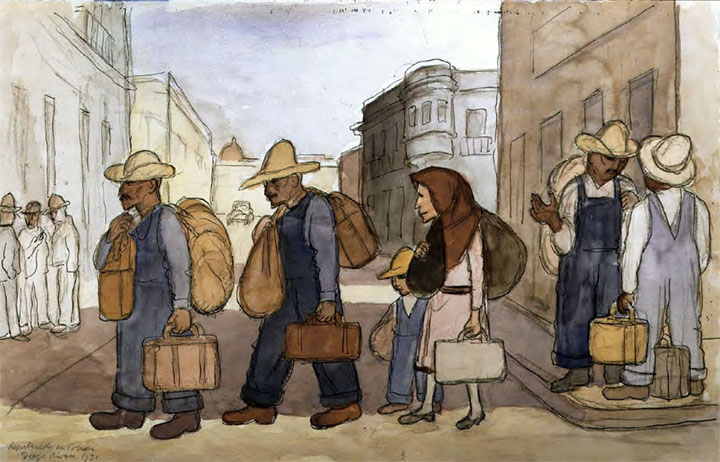


Diego Rivera, "Repatriated Mexicans in Torreón," 1931; private collection.


According to Lear, "While he was in Detroit [painting his famous murals of auto assembly plants], Rivera became the founder, funder, and leader of the 5,000-member Liga de Obreros y Campesinos, whose primary goals, shared with the Mexican consul, were to find local work for, or support the voluntary repatriation of, unemployed Mexicans."  

In those years, however, tens of thousands of Mexicans, and even their U.S.-citizen children, were not repatriated voluntarily at all. They were simply loaded onto boxcars and shipped to the border.

Rivera's engagement with farmworkers, as opposed to industrial workers, was much less direct. During the same visit to the United States he painted a fresco, "Still Life and Blossoming Almond Trees," in the home of Sigmund Stern in the wealthy enclave of Atherton, on the San Francisco Peninsula. In it Mexican-appearing laborers are hoeing in an orchard, while another man drives a tractor behind them. The work seems hard, although not excessively so. But the painting shows no inkling of the rebellion that was about to take place. In 1932, tens of thousands of farmworkers, a majority Mexican, mounted the largest agricultural strike in California's history, the Pixley cotton strike. It was led by the radicals and Communists who were the greatest admirers of Rivera's work. Some, like his assistant of that period, Emmy Lou Packard, went on herself to produce beautiful lithographs of working farm laborers. 


Diego Rivera, "Still Life and Blossoming Almond Trees," 1931; Stern Hall, University of California, Berkeley.


In Mexico, things had not worked out as the revolutionaries of the 1910s and 1920s had hoped. The revolution's changes slowed and eventually stalled, making life as an independent farmer in rural Mexico untenable, while the migrant labor of displaced Mexican campesinos became indispensable to the growth and profits of industrial agriculture in California. Eventually, Mexican farmers' displacement and Californian landowners' hunger for labor created the flower workers of Lompoc. The trajectory between Rivera's paintings and the photographs in California's fields traces visually the social transformation of the people who were once Rivera's subjects, and then became migrants cutting flowers 2,000 miles away, a border and almost a century apart.

In Mexico's countryside, by 1970 over 70% of small farmers could not live on the crops they were able to grow, or what they were able to earn by selling them, as Rivera's flower sellers must do. From 1950 to 1976 Mexico's population doubled, and the number of people living on each square kilometer of farmland did also, from 36 to 67. By then two-thirds of rural families couldn't afford to eat meat most weeks. Mexico City's growth couldn't provide jobs for all those coming in from rural indigenous communities. Migration north to the maquiladora cities of the border, and across the border into U.S. fields, was increasingly the answer for survival.

According to the late Rufino Dominguez, one of the founders of the Frente Indigena de Organizaciones Binacionales, about 500,000 indigenous people from Oaxaca lived in the United States by 2000, 300,000 in California alone. Many came from communities whose economies are totally dependent on migration. The ability to send a son or daughter across the border to the north, to work and send back money, makes the difference between eating chicken or eating salt and tortillas. Migration means not having to cut furrows in dry soil for a corn crop that can't be sold for what it costs to grow it. It means that dollars arrive in the mail when kids need shoes to go to school, or when a grandparent needs a doctor.  

Mexico's National Council of Population reported in the Census of 2000 that in Oaxaca 12.5% of people lived with no electricity, 26.9% lived in homes with no running water, and children got an average of 6.9 years of school. The displacement of people from Oaxacan communities tracks with the growth in poverty. By 2000, 18% of Oaxaca's people had left for other parts of Mexico and the United States. As a result, according to the Indigenous Farmworker Study, one-third of the 700,000 farm workers in California come from Oaxaca and other states in southern Mexico. Of all farm workers in California, indigenous workers receive the lowest pay. According to the study's author, Rick Mines, one-third reported earning the minimum wage, and an additional one-third reported earning less than the minimum-a wage that violates California state law. Most indigenous families live in crowded conditions in apartments or trailers. In some areas the most recent arrivals live outside in tents-even under trees. 


Lompoc, Calif., 2022-Daniel Moreno Hernandez harvests stock flowers in the field. 


Lompoc, Calif., 2022-A worker uses his foot to lever a bunch of flowers into his hand as he gathers the ones he has just picked.


But despite bad housing, low wages, and discrimination in the United States, migration is not just the preferable, but sometimes the only recourse for ensuring survival. "There are no jobs in Oaxaca, and NAFTA [the North American Free Trade Agreement] made the price of corn so low that it's not economically possible to plant a crop anymore," Dominguez asserted in an interview in 2008. "We come to the U.S. to work because we can't get a price for our product at home. There's no alternative."

By 2010, 49.3% of Mexicans lived in poverty, an increase of 6 million people in the previous two years of economic recession, according to estimates from the Economy and Business Investigation Center of the Monterey Technology Institute for Higher Studies. The year of 2008 marked the peak in Mexican migration during the quarter century after NAFTA went into effect, in which the number of Mexican migrants in the United States rose from 4.6 to 12.6 million. 


Lompoc, Calif., 2022-A worker then throws a bunch he has just picked onto the pile of flowers he car-ries on his shoulders. 


Lompoc, Calif., 2022-A worker cuts a bunch of stock flowers using the cutting knife at the truck.


These photographs document the work of Mexican campesinos who are part of that wave of migration, migrants who had to leave Mexico for their families to survive. They've become wage workers in industrial flower production, part of the U.S. working class that Rivera admired. In the Lompoc photographs the flower workers are all men. In many crops in California agriculture, including this one, single men dominate migrant labor in the fields. This is especially true today, when the H-2A contract labor visa program last year alone allowed growers to recruit 317,000 people, almost all rural Mexican farmers, to work here. It is a repeat of what happened in the 1950s, when the exploitative Bracero program brought hundreds of thousands of workers from a previous generation into U.S. fields every year. 


Lompoc, Calif., 2022-A worker lifts the bucket of bunches of stock flowers he has just picked into the arms of the loader in the back of the truck. 


Lompoc, Calif., 2022-A crew of celery harvesters leaving work in a field at the end of their day.


Rivera's images treat flower growing and selling as a family operation. Now it is wage work performed by hired hands on industrial-scale farms far from the workers' original homes. The system of modern migration has put a tremendous burden on many Mexican families, with mostly men leaving, and then sending money home to those left behind. The H-2A program escalates this, even allowing growers to refuse jobs to women, the old, or anyone who can't keep up with the fierce pace of production.

The workers in the fields in Lompoc, working at that rapid pace, use a unique coordination of body movements to keep up. The skill takes weeks of experience to acquire, and those who can't or don't get it quickly find themselves looking for another job. Harvesting flowers is exhausting but takes such skill and strength that it's obvious to workers that what they do is essential, and that not everyone can, or is willing, to do it. In the field next to the flowers, another crew walks to the road after harvesting celery all day. Here the workers who have been packing the vegetables are women. Their rubber aprons flap in the wind as they stride confidently down the rows. Neither the flower nor the celery crew looks ground down by the labor. They may no longer be farmers on their own land, but they work and walk with the assurance of the skilled wage earners they've become.


David Bacon is a California-based writer and photographer. He is the author of several books about migration. His latest book, More Than a Wall/Mas que un Muro, was just published by the Colegio de la Frontera Norte (Tijuana). He was a factory worker and union organizer for two decades, and has been documenting the lives of migrants and farm workers through photographs and journalism since 1986.

Tuesday, January 10, 2023

WHY FARMWORKER LEGALIZATION FAILED

WHY FARMWORKER LEGALIZATION FAILED
The Farm Workforce Modernization Act's failure to become law reveals critical divisions within the immigrant rights movement.
By David Bacon
The Nation, 1/10/23
https://www.thenation.com/article/activism/farmworker-legalization-failed/


Farmworkers brought to the US in the H-2A visa program plant and weed ornamental shrubs early in the morning in a field near Woodburn, Ore. They work for the nursery Advanced Ornamentals. Members of this crew include Manuel Perez. He works with a short-handled hoe, the "cortito," that has been banned in California because repeated use causes damage to the spine. ((c) David Bacon)


For the United Farm Workers and its allies on Capitol Hill, the failure of the Farm Workforce Modernization Act (FWMA) was a defeat for their campaign to win legal immigration status for undocumented field laborers.

Teresa Romero, UFW President, called it "a very bitter disappointment for farm workers across the country who have more than earned the right to legal status through the sweat of their brow." She blamed the American Farm Bureau for withholding its support. "They know that an undocumented workforce is easier to intimidate and exploit," she charged.

"This bill was not perfect and included difficult compromises, but it provided meaningful relief for farmworker families," said a statement from DC advocate Farmworker Justice, which called Congress's failure to pass it "inexcusable."

When the FWMA failed, however, many farmworker organizations outside the Washington, D.C., Beltway felt they'd dodged a bullet. They saw in the bill a boost to the H-2A temporary guestworker program in agriculture, accompanied by immigration enforcement intended to drive undocumented workers from the fields. For Edgar Franks, political director for Familias Unidas por la Justicia, a Washington State farmworker union, "this bill was a gift to growers and gave them things they've always wanted. We've been speaking out against it for three years-time we should have been able to spend organizing workers-because of the threat of E-Verify and the growth of the H-2A program."

The bill passed the House two years ago, but got stuck in the Senate, where Republicans refused to support even a torturous process for granting legal status to some undocumented farmworkers. Facing Congress's adjournment, Colorado Democratic Senator Michael Bennet reintroduced it as the Affordable and Secure Food Act, with more favorable provisions for growers. In a last-minute Hail Mary after failing to obtain a Senate vote on it, the bill's supporters tried to attach it to the omnibus spending bill. That didn't work either, and the bill finally died.

Neither the FWMA's advocates nor its opponents expect that the next Congress, in which right-wing Republicans will dominate the House, will vote for any measure to provide legal status to people without papers, even as a tradeoff for other anti-immigrant or anti-worker provisions. In the wake of its defeat, many activists now call for reassessing the decades old strategy of trading legal status for undocumented immigrants for increased enforcement and guestworkers. Avoiding this tradeoff, they believe, depends on farmworkers having greater political and economic power, and virtually all agricultural unions and workers centers agree that organizing is the key. 


Farmworkers brought to the US in the H-2A visa program harvest melons early in the morning in a field near Firebaugh, in the San Joaquin Valley. The temperature at the time, about 9 in the morning, was over 95 degrees, and would reach over 110 in the afternoon. These workers are Cora indigenous people, recruited from the Mexican state of Nayarit. It was their second day of work in the US, and they were not yet accustomed to the heat. They work for the Rancho Nuevo Harvesting Co. labor contractor, in a field that belongs to the Fisher family, a large California grower. ((c) David Bacon)


The tradeoff compromise

"That reassessment starts with acknowledging that the comprehensive reform compromises, of which the FWMA was only the latest, have all failed over the last quarter-century," according to Rosalinda Guillen, director of Community2Community, a women-led farmworker group in Washington State.

The Farm Workforce Modernization Act had its origin in negotiations between the United Farm Workers and growers during the Trump administration. They developed a bill that inherited the tradeoff of earlier proposals. It would have allowed undocumented farmworkers to obtain a provisional legal status, in which they would have to continue working in agriculture for up to 10 years before applying for permanent residence. In return, growers got an easier process for bringing to the United States H-2A temporary contract workers, whose wages (pegged at close to minimum wage) would be frozen for a year, and then increased by 3 percent yearly.

A statement by San Joaquin Valley Republican Congressman David Valadao made agribusiness' interest clear. "Making sure our farmers have access to a legal and reliable workforce and streamlining the process for the future flow of workers is just common sense," he wrote.

The third element of the tradeoff would have made the use of E-Verify-a system to check the legal status of workers-mandatory in agriculture. Field workers who lack immigration papers would then have been unable to apply for jobs they do every season. Since the Department of Labor estimates that over half of the two million people who labor in the fields are undocumented, the impact on farmworker families would have been enormous. The bill would have given growers an H-2A workforce to continue farming, but would have dealt a bitter blow to the people who worked through the pandemic to put food on the country's tables.

The vulnerability of H-2A workers makes them an attractive workforce for growers. Workers are recruited by large companies, primarily in Mexico. They work for less than a year, and then go back home. Most depend on returning the following year. They are tied to the grower or contractor who recruits them, and can be legally fired for not meeting exhausting production quotas, or for protesting. There is currently no penalty against employers for these reprisals, and the FWMA would not have imposed any. Fired H-2A workers lose their visas and must leave the country. Recruiters in Mexico then refuse to hire them for a new season of employment.

That vulnerability makes it risky to organize to change conditions, and not just for H-2A workers themselves. If farmworkers living in the United States are not content with low wages, growers can and do replace them with temporary workers. While the law requires hiring local workers first, there is virtually no enforcement and a string of legal cases documents a long history of violations.

The last Senate version, which failed to win inclusion in the spending bill, gave agribusiness a change in the H-2A program it has long wanted: allowing employers to keep H-2A workers in year-round jobs. Current regulations limit the contracts for H-2A workers to temporary jobs of less than a year. Extending this was particularly desired by dairies, where work is less seasonal.

One disabled dairy worker, Servando Jimenez, greeted the failure of the bill in a Labornotes article, calling it "legislation that would make us even more vulnerable.... that ties immigration reform to increased labor exploitation."

Jimenez described backbreaking work in New York state dairies: "For six years, I woke up each morning at 3:30 a.m. Between myself and two co-workers, we would milk 1,700 cows in six hours, take a 15-minute lunch break, and then repeat the process for another six hours.... The bill would coerce workers to stay in dangerous jobs, even if their bodies can no longer take it, by preying on their hopes for citizenship and a healthy life.... H-2A workers are often even more vulnerable than undocumented workers." 


Farmworkers brought to the US in the H-2A visa program plant and weed ornamental shrubs early in the morning in a field near Woodburn, Ore. They work for the nursery Advanced Ornamentals. Members of this crew include Feliciano Marcos, Manuel Flores, Manuel Perez, and Alfonso Guevara. ((c) David Bacon)


Ignoring the roots of migration

The FWMA compromise was specific to agriculture, but its general architecture reflects the comprehensive immigration reform proposals of the past two decades. In all these grand compromises, legalization is traded for increased enforcement against the undocumented and immigrant labor programs desired by employers.

This tradeoff strategy was set in place in 1986, with passage of the Immigration Reform and Control Act. That bill provided amnesty for about 3.5 million undocumented people, gave farmworkers a separate legalization program, resurrected a labor visa system from the bracero era, began the process of militarizing the border, and made it a crime for employers to hire undocumented workers.

The 1986 amnesty gave people legal status in a relatively short time, and didn't condition it on their willingness to work in low-wage jobs. Later tradeoff proposals, however, began treating legal status as a privilege that had to be "earned," rather than a way to ensure people's rights and their integration into the communities around them. Supporters of the tradeoff strategy argued that a combination of "earned" legalization and ferocious enforcement against migrants crossing the border, while prohibiting their ability to work, would deter further migration.

Under such policies, however, the number of Mexican migrants in the United States actually increased from about 4.6 to 12.5 million. That flow of people seeking survival continues today. "We need to address the role the US has played in displacing people through free trade agreements and neoliberal economics," says Edgar Franks.


What went wrong with "earned" legalization

Immigration reform based on providing the labor of migrating people to employers to win their political support, while agreeing to anti-immigrant enforcement to win right-wing votes, never addressed the root causes of migration. The idea of "earned" legalization was intended to create an image of deserving immigrants, but it obscured the true reasons for their presence in the United States. At the same time it made migrants more vulnerable.

Myrna Martinez, director of Fresno's Pan Valley Institute, affiliated with the American Friends Service Committee, proposes instead an immediate and inclusive amnesty, that legalizes all undocumented people. "The nearly 2.4 million farmworkers in our community have already 'earned' a pathway to citizenship through decades of work and contributions to their communities and the US," she says. Expanding the H-2A visa program and creating a temporary status for workers applying for legalization, she charges, "ignores the experiences of past and present guest workers that have been characterized by extreme exploitation and abuse akin to human trafficking."

A flawed political strategy has produced these failed tradeoff compromises, and the immigrant rights movement has been deeply divided over them. They are proposals crafted by groups sitting around a table in Washington, D.C., not ones emerging from broad discussions among immigrant and worker groups. In a hostile Congress, the compromises are crafted to get votes from legislators who owe allegiance to employers, who want controlled labor at the lowest possible price. In this process the enforcement lobby, with its stake in detention and border militarization, wields tremendous power.

"From the inception the negotiations over the FWMA weren't transparent and inclusive of other farmworker organizations or unions," Franks says. Instead, immigrants and workers are shut out of negotiations, and then presented with a bill as a fait accompli. The tradeoff is treated as the only way to win legal status, which is the only goal, and an increasingly distant one. 


Farmworkers brought to the US in the H-2A visa program, working for Porterville Citrus, were housed by the labor contractor Fresh Harvest at the Palm Tree Inn in Porterville. Some rooms have notices on the windows saying they've been decontaminated and/or disinfected. Copyright David Bacon ((c) David Bacon)


Proposing an alternative

This is not a new problem. Gabe Camacho, an AFSC staff person in Boston, called for defeating the comprehensive immigration bill of the Obama era. "We must fight to defeat mandatory E-Verify, new Bracero programs, border militarization, and every other anti-immigrant bill at the state and local level," he urged. "In the final analysis, the 'movement' must be led from outside of Washington, D.C."

Camacho and the AFSC proposed an alternative at the time, called A New Path. It outlined a radical proposal for immigration reform that included full legalization, a community-based system for migration and reuniting families, labor and political rights for migrants, and a rejection of US policies abroad that cause displacement. The Frente Indigena de Organizaciones Binacionales, an organization of indigenous Mexican migrants and their hometowns, proposed a set of similar rights. Migrants should have the right to equality wherever they go, the group argued, and at the same time the right to not migrate-to an economic and political future in indigenous communities that would end displacement and forced migration.

The defeat of the Farm Workforce Modernization Act creates a moment in which alternatives like these can be debated. "Now we can envision what a real reform would be, one that's not tied to labor visas, militarizing the border, or detentions and deportations," Franks argues.

The bill's opponents, ranging from the Alianza de Mujeres Activas y Solidarias (ALMAS) in Sonoma County and the Mississippi Immigrants Rights Alliance, to the Farmworkers Association of Florida and the Food Chain Workers Alliance, organized a National Day of Action in August.

The Dignity Campaign proposed an immediate alternative: "Eliminate the H-2A program and allow people who want to work in the United States to apply for resident status, with no employment conditions or recruitment by growers," it urged. "Change the registry date (as HR 8433 does partially), to allow every undocumented person living in the US to apply for permanent residence. Eliminate E-Verify and the prohibition on work for undocumented people, and enforce the labor and human rights of all immigrants."

In fact, other bills were introduced into the last Congress that would have created broader legalization programs without the tradeoffs. During the pandemic lockdown, California Senator Alex Padilla proposed a legalization program for the essential workers who provided the goods and services that enabled life to continue. In the House, California Representative Zoe Lofgren (also an author of the FWMA) introduced HR 8433 to change the "registry" date. Currently, an undocumented person who has been in the country since 1972 can petition to normalize their immigration status. By advancing that date to seven years after its adoption, the bill would have made it possible for millions of people without papers to get legal status quickly. Organizations like ALMAS and the Coalition for Humane Immigrant Rights of Los Angeles brought delegations of migrants to Washington, D.C., to advocate for it.


Organizing is the answer

Last year, growers were certified to bring in 370,000 H-2A workers-over 13 percent of the US farm workforce, and a number that has doubled in just five years, and tripled in eight.

At the same time, deportations of migrants, who are almost all workers, has increased from 21,046 per year under Ronald Reagan and 33,332 under George H.W. Bush to 383,307 under Barack Obama and 275,725 under Donald Trump. In 1992, fewer than 10,000 H-2A visas were issued. That number tripled by 2005, and under Presidents Obama, Trump, and Biden, it mushroomed. H-2A certifications will soon rival the 450,000 workers recruited in 1954 at the height of the notorious bracero program. That year, the United States deported over a million migrants in "Operation Wetback."

The immigration measures which did win inclusion in the omnibus spending bill increased border enforcement and maintained the requirement that at least 34,000 immigrants pending deportation be kept in detention center beds every night, a guarantee of profits to the corporations who run the private centers.

With or without the FWMA, this is where the US immigration system is heading if there's no change on the ground. The movement Gabe Camacho called for must envision a deep change in this system of displacement and exploitation. It must create a democratic process for making concrete proposals. But above all, it must gain the power to force its demands on a capitalist system that resists them.

After the defeat of the FWMA, the Food Chain Workers Alliance warned, "We know there will be continued industry efforts to tie immigration reform to labor exploitation. Grassroots farmworker groups will continue to organize and build power for the farmworker movement and the rights and protections farmworkers deserve."

For farmworkers, real change requires a much larger base of organized workers. Today, less than 1 percent of the farm labor workforce belongs to unions or worker centers. But while pro-immigrant and pro-worker reforms may be blocked in Washington, D.C., in rural valleys throughout the country the political landscape is changing. Farmworker unions and workers centers are active in many states, including Florida, North Carolina, Ohio, Pennsylvania, New Jersey, Hawaii, and others.

New York State has enacted a law that recognizes the right of farmworkers to join unions and negotiate contracts. Dairy worker Jimenez is now a member of the Workers Center of Central New York, and other farmworker groups, like the Alianza Agricola are organizing migrants.

In Washington State, a series of farmworker strikes, including by H-2A workers, have forced the state to include farmworker unions in the political and regulatory process on issues from protecting local workers from displacement to health and safety during the pandemic. During the Covid era, the organizing activity of Familias Unidas por la Justicia moved inland from the coast, sparking the creation of another independent union in Yakima's apple packing sheds. Today a UFW strike among Ostrom mushroom workers is fighting against the replacement of local farmworkers and the grower's use of the H-2A program.

California has implemented a raft of worker protection laws, fought for by the UFW and farmworker advocates. This year, Governor Gavin Newsom was forced to sign a bill he originally vetoed that makes it possible for workers to win union representation rights through a card check process, in which they're much less vulnerable to grower intimidation.

If the UFW uses the new law to organize more workers and force more growers to bargain, it will raise the living standards of some of the poorest communities in the country. The average income for farmworker families is still about $25,000 per year. That poverty had a devastating impact on the spread of the pandemic among them. Once organized, those workers will win, not just higher wages but also the means to engage in direct action, holding responsible those growers who have opposed their social and political rights.

"Yet again we are reminded," the UFW's Teresa Romero pointed out, "why building farm worker power through unionization remains the most urgent strategy in building a truly just food system."


Thursday, December 15, 2022

UNION HEALTH PLAN PROVIDES MUCH-NEEDED SAFETY NET

ILL HARVEST
UNION HEALTH PLAN PROVIDES MUCH-NEEDED SAFETY NET
The Robert F. Kennedy farmworkers plan is limited, but it is the best option for many.
By David Bacon
Capital and Main, 12/15/22
https://capitalandmain.com/union-health-plan-provides-much-needed-safety-net

 
A crew of farmworkers harvest lettuce for D'Arrigo Brothers in a Salinas field in 2018. All photos by David Bacon.


For Maria Zavala's family, there are no easy years. But last year brought the family to the edge of disaster. Zavala, a lettuce worker, is diabetic, and in addition to two other medicines she has to take regularly to control diabetes, she carries an insulin pen. Her 17-year-old son has attention deficit disorder, and she says his doctor told them his depression is one reason why his weight grew dangerously.

Then this year, her 15-year-old daughter also became seriously depressed. Zavala looked for a psychologist or therapist at the local clinic and hospital in Salinas. "There were no appointments," she says, "and especially no one available who can treat adolescents."

The Zavalas are covered by the health care plan from her union, the Robert F. Kennedy Farm Workers Medical Plan. It works fine for her everyday needs, she says. She pays $25 every time she fills a prescription, far below the over-the-counter price of the medicine her family needs. A doctor visit costs $25 for the first five visits and then goes down to $15.


Maria Zavala, a D'Arrigo Brothers lettuce cutter and beneficiary of the UFW's Robert F. Kennedy Farm Workers Medical Plan.


But the closest treatment she could find for her daughter was from the Ohana Center for Child and Adolescent Behavioral Health in Monterey, 20 miles away from their home in Salinas. Ohana is not part of the network of approved providers under the RFK plan, but she talked to the plan administrators and they agreed to provide coverage. Still, the co-pay was a hardship for the Zavalas. For the $4,000 bill, the plan paid $3,000. "A thousand dollars is still a lot for us," she explains, "but it's much better than $4,000."

The RFK plan covers about 3,000 members of the United Farm Workers - about 7,500 people, counting spouses and children. "While that's a small percentage of the state's estimated 700,000 agricultural laborers," according to plan administrator Patrick Pine, "it sets a high standard even for state policymakers and other growers." In 2015, the Affordable Care Act mandated that all employers with more than 50 full-time workers offer medical coverage.

People who work in the fields, however, are usually faced with plans that cover very little, with premiums that are often prohibitively expensive, according to Lauro Barajas, a regional director for the United Farm Workers. The RFK plan may not cover everything with no co-pays, but it gives farmworkers the kind of coverage that's familiar to union workers in urban jobs that often pay much higher wages. According to Farmworker Justice, campesino families still have annual incomes that average $25,000 to $29,999 nationally.

While the RFK plan provided the basic medical care for the Zavalas at a cost they could afford, Maria's situation became more perilous this spring. For reasons she never understood, the clinic she uses in Salinas, the Santa Lucia Medical Group, began saying the plan would not cover her diabetes medication. "I talked to Edgar [her union representative], and he talked with the plan," she says. The plan administrators were able to straighten the pharmacy out, but it took two months, and in the meantime her medicine ran out.

"The pain was bad," she remembers, "but I tried to just live with it because going to the hospital would be expensive. But then I couldn't urinate anymore, and it got so bad that one night I asked my husband to take me to the emergency room." When she got out, that was another bill. The plan paid $1,600, and she paid $700. "The reality is that we depend completely on our plan," she emphasizes. "Without it, I don't know what we'd do."


United Farm Workers Regional Director Lauro Barajas.


That is the prospect that faces them now. Zavala works for the D'Arrigo Brothers Company, one of the largest growers in the Salinas Valley. She has medical coverage because it is negotiated in the contract D'Arrigo has with the United Farm Workers. The company pays the entire premium, but in order to qualify for coverage, she has to work about 80 hours a month. She can do that from May to November, but it leaves four months in the winter when she has to pay the premium herself.

Her husband also works, but at another company with a health plan that's much more expensive and covers much less. He supervises a crew of contract workers on H-2A agricultural visas, and for months he's on the road, only coming back on weekends to see Maria and the children. Still, they are all covered by RFK. So, between his job and her savings, they have been able to make it. They even bought a modest house in Salinas, where a large print of the Last Supper hangs proudly on the wall of her spotless living room. The mortgage is $2,300.

Every year, she saves about $4,000, from a monthly wage that adds up to about $3,000. That's what she uses to keep her insurance in the winter. But she expects the plan's cost to increase in 2023. Her hospital visit and her daughter's care have already wiped out her savings, and the twice-weekly visits to Ohana will continue to cost a lot. Jobs in any farmworker town like Salinas are hard to find until work picks up again in the spring. As she listed the bills she feared she wouldn't be able to pay, she began to cry. "It's going to be very hard. I don't know what we'll do, but we have to keep our insurance. My back is to the wall," she says.
 
The Origin of the RFK Plan

The idea for a farmworker medical plan came out of the grape strike that started in Delano and Coachella in 1965. The vice principal of Garces Memorial High School in Bakersfield, LeRoy Chatfield, went to work for what became the United Farm Workers in the strike's first year, at a salary of $20 a month.

Chatfield then explained to his Catholic superiors that Cesar Chavez had put him in charge of developing a plan for farmworker cooperatives. "Our idea," he told them, "is to build a complex of cooperatives (clinic, pharmacy, credit union, garage, etc.) somewhere in the valley ... owned and controlled by farmworkers themselves." The union's first effort in health care was setting up a clinic at its Forty Acres headquarters in Delano. That was followed in subsequent years by clinics in Salinas and Coachella. "We look upon this as a prerequisite for serious grassroots organizing," he wrote.


D'Arrigo Brothers strikers at the edge of a company field call on other workers to leave work and join the strike in 1998.


Chatfield was put in charge of recruiting doctors, nurses and other health professionals to staff them. "The clinics were important because prior to them, there really wasn't a place farmworkers could go to get good medical care," recalls Arturo Rodriguez, who was UFW president from Chavez's death in 1993 until 2018, when he retired. "They'd end up in emergency rooms, and there were all kinds of horror stories. What little care they got cost an exorbitant amount of money. And because farmworkers had no access, they were susceptible to all kinds of illnesses."

The clinics were not just service providers, however. They were the means to show workers that their collective action could create change. "They demonstrated to workers and their families," Rodriguez says, "that the union was trying to deal not just with low wages and bad treatment in the fields, but with the needs of families outside of work. We were saying, this is what the union can do, providing things they never got before from employers, labor contractors or the government. It gave workers a reason to take the risks we were asking to bring in the union."

The Coachella clinic was inaugurated with a march through the valley at the beginning of union representation elections in 1976. In the 1980s, the union established one final clinic in Salinas, but the clinics had become difficult to sustain. "In the '60s and '70s, a lot of doctors and nurses wanted to volunteer and spend time in programs that required work in rural communities, serving their needs," Rodriguez explains. "That changed, and we could find fewer and fewer every year who wanted to live in places like Salinas and Coachella. Once we accepted that setting up clinics was no longer possible, we began working extremely hard on a medical plan that could provide the services workers and families needed at a low cost."

Chatfield had been charged by Chavez with setting up such a plan, and by 1975 it had begun to be included in the negotiation of union contracts. Chavez would meet with the ranch committees, which were elected to represent workers at union companies. "Last night at the Perelli-Minetti winery meeting," Chatfield wrote in a journal he kept at the time, "the workers were shell-shocked about the benefits. One of the workers said, 'A year ago, I had nothing, and now you ask me if I like these benefits? They're great!'"

Changing the union's emphasis from clinics to the RFK plan, however, also meant that instead of services available to all workers, the plan only covered those who were under union contracts - a much smaller group. For the larger workforce, the union organized political campaigns to improve conditions in general.


Forewoman Blanca and Supervisor Sergio Flores check the quality of the hearts of romaine lettuce.  Maria Zavala works in a crew harvesting this lettuce.


That included union campaigns in support of a suit by California Rural Legal Assistance to ban the short-handled hoe, which the state Supreme Court upheld in 1975. The use of the hoe contributed to spinal damage among workers who had to bend over when thinning vegetables and other crops over a period of years. Later, when cancer clusters were discovered in McFarland and other small towns in the southern San Joaquin Valley, the union launched a campaign against pesticide use on table grapes. And in 2005, after four workers collapsed and died in the summer's extreme heat, the union successfully lobbied for an administrative rule establishing the right to shade and additional breaks in temperatures over 95 degrees, among other protections.

Until 2015, the D'Arrigo Brothers Company, one of the Salinas Valley's oldest vegetable growers and Maria Zavala's employer, had a very contentious relationship with the United Farm Workers. The nascent United Farm Workers Organizing Committee signed a contract with D'Arrigo Brothers during the great Salinas lettuce strike of 1970. It lasted only two years and the company refused to renew it. Workers voted for the union in 1976, but were unable to get an agreement.

Nevertheless, a core of union supporters worked for D'Arrigo Brothers through those decades. In 1998, another strike ended only when one of the company's owners suddenly died. Finally, in 2015 D'Arrigo Brothers Company and the union signed a contract, which is still in effect.  During negotiations in 2014, the D'Arrigo Brothers Company agreed to pay for the RFK plan, and the union signed a contract, which has been renewed. Under that contract, D'Arrigo has agreed to pay the entire premium for the RFK insurance plan, about $700 per employee per month this year. It includes vision and dental coverage and covers all immediate family members. 


D'Arrigo Brothers workers demonstrate at the company offices in 1994, asking the company to sign a contract with the RFK medical plan.


The plan is administered under the Taft-Hartley Act, with a board of three employer representatives and three union representatives. According to Patrick Pine, RFK plan administrator, "The challenge we face is that we cover workers in an industry with low pay, who live in markets like Salinas where the hospital and health care costs are some of the highest."

Some California agricultural employers who have no UFW contract buy medical insurance through the Western Growers Assurance Trust or the United Agricultural Benefit Trust. For coverage similar to that of the RFK plan, however, Pine says growers pay premiums about 25% higher. According to Barajas, they usually pass most of it on to their employees by having them pay a large part for medical insurance with high co-pays and limited coverage.

Pine says the RFK plan keeps administrative costs below those of its competitors and doesn't advertise or pay commissions to insurance brokers. Those savings result in lower premiums. "Our overhead is a lot less," he says. "I get a much lower salary and work in [the UFW headquarters in] La Paz, where the cost of living is a lot less than in Los Angeles." Rodriguez, one of the trustees, says the goal has always been "to maintain the lowest cost possible for employers and workers for a medical plan with the basic services workers use, including maternity, doctor visits and certain surgeries."


Josefina Puga cuts head lettuce in a D'Arrigo Brothers field.


To keep hospital costs low, John D'Arrigo, president of D'Arrigo Brothers, has contributed to Salinas' Natividad Hospital, which launched the D'Arrigo Family Specialty Services clinic. Natividad has hired trilingual interpreters in Spanish, English and the indigenous languages spoken by many valley farmworkers, including Mixtec and Triqui. D'Arrigo promotes the Agricultural Leadership Council, which has 160 members and donated $4.1 million to buy equipment for the hospital.
 

Supporting Long-Term Employment

A big part of D'Arrigo's motivation is maintaining a stable workforce. "It's hard to find workers today," he said in an interview. "We have a shrinking, aging workforce. We have to take care of who we have and make our jobs attractive to the people who live here. We need a long-term workforce, and we want direct hires - people who work directly for the company." At peak harvest season, D'Arrigo directly employs about 1,000 workers, and as a result the RFK plan covers about 2,500 people, including their families.

Maria Zavala may be a high-level user of plan benefits, but she is also a skilled worker, and the plan has kept her in the company's workforce. For five years, she's labored in the "corazones" crew, which cuts the lettuce for the company's leading Andy Boy brand of packaged hearts of romaine. Her crew is mostly women, doing a job that 30 years ago was limited to men. Now just one or two men load the boxes onto trucks, and women do all the other work. Still, even with the union contract and health plan, D'Arrigo finds it hard to fill all the open seats on her crew's lettuce machine.

One answer for the company has been to use labor contractors, who charge the company a price for harvesting a field, and then employ the workers.  Last year, workers with one contractor who brings crews from the Arizona/Sonora border petitioned to join the UFW so they could get covered by the RFK plan. "We worked with people in San Luis Rio Colorado to help put up a new hospital and meet the needs of the workers there also," says Rodriguez, the plan trustee. More than 200 of those workers are now included under RFK. About 250 working for D'Arrigo with another contractor, however, are not. In addition, the company has increased its use of H-2A contract workers, recruited in Mexico on temporary visas. Those workers also are not included in the RFK plan.


Former UFW President Arturo Rodriguez and UFW co-founder Dolores Huerta march with workers in Salinas during the 1998 strike against D'Arrigo Brothers.


"To me," Zavala says, "RFK has functioned well. It would be great if it paid for everything, but compared to others, it's much better." When she had problems with getting her diabetes medication, she was able to use the union's representative to complain and solve problems. Every year, D'Arrigo's employee relations director, Marla Henry, visits each crew with Mercedes Martinez, the RFK plan's assistant administrator. "If anyone expresses a concern, we get their name and contact information and investigate it," Henry says. According to Rodriguez, "Workers have access to the plan's administrators and do call the office to understand why they had to pay what they paid."

"It's not perfect," Barajas concludes, "but RFK is a model for farmworkers. D'Arrigo and Monterey Mushrooms [large companies with UFW contracts], by offering the plan, are forcing their competitors to have better medical plans in order to attract workers. Every time we go into contract negotiations, those other employers are watching. They know that what we get is what they'll have to pay, too."


ILL HARVEST
California Farmworkers and the Struggle for Health Care

 
Guillermina Diaz, a Mixtec immigrant from Oaxaca, picks strawberries.  She and her sister Eliadora support three other family members, all of whom sleep and live in a single room in a house in Oxnard.


More than 500,000 California farmworkers play a critical role in providing Americans with the food that nourishes and sustains their health. Yet, for those workers, their own health is too often in jeopardy.
 
The hazards present in farmwork - from exposure to the elements and harmful chemicals to the physical demands of picking and cutting crops - are aggravated by shortfalls in health coverage, delivery and workplace safety systems. As a result, farmworkers often go without the care they need, enduring injury and illness that might otherwise be prevented.
 
California's agricultural industry has always depended on immigrant labor, whether those migrants were from other U.S. states, Asia or Mexico. Ninety percent of California's farmworkers are immigrants, and more than half are undocumented. Many California farmworkers are indigenous laborers from Mexico for whom Spanish is not their primary language. For these workers, linguistic and cultural differences add another challenge to receiving adequate health care.
 
Journalists David Bacon and Pilar Marrero traveled to the communities where California farmworkers work and live to document the health care conditions they face. From their reporting, we provide a from-the-fields perspective through six stories:
 
In rural California, farmworkers fend for themselves to access health care
Why being a farmworker is a health risk
California's historic Medi-Cal expansion will miss many farmworkers
Treating indigenous farmworkers on their terms
Farmworkers' working and living conditions take a mental health toll
A union health plan provides a much-needed safety net

Tuesday, December 13, 2022

ILL HARVEST: TREATING FARMWORKERS ON THEIR TERMS

 ILL HARVEST
TREATING FARMWORKERS ON THEIR TERMS
For California's indigenous farmworker population, healthcare that respects their traditions is vital.
By David Bacon
Capital and Main,12/12/22
https://capitalandmain.com/treating-farmworkers-on-their-terms

 
Andres Ramirez plants root stock of strawberry plants.  All photos by David Bacon

Gloria Merino came to the Salinas Valley from the Mixteca region of Oaxaca, where she'd learned how to help women deliver babies. "My cousin was a curandero [a practitioner of traditional medicine] and he taught me how to heal," Merino recalls. "The Virgin, God and San Marcos all told me that I would heal people and make a living that way, so I learned to help deliver babies."

In Greenfield, in the Salinas Valley, she became a partera, or midwife, to women who wanted to deliver at home, using methods their communities had depended on for generations. She had to start growing her own herbs, since she couldn't find them in stores. "Triquis [the Oaxacan indigenous group to which she belongs] began to seek my help in healing or for trouble in their marriage," she recalls.

Merino was careful not to attempt dangerous deliveries. "If a woman has a fetus in a breech position or she feels bad during pregnancy," she says, "I rub almond oil on the mother's stomach and give her herbs, but I don't deliver breech babies myself. I just turn them around if they're in that position." For difficult births, she says, women go to the local Clínica de Salud del Valle de Salinas.

Although Merino saw midwifery as a calling, it was not easy to earn enough money from what indigenous immigrant women could pay her, so she also collected cans for recycling. But her biggest problem was that she had to practice in fear. "I heard that if you deliver at home, they can incarcerate the mother and father because it's illegal," she says.


Gloria Merino, a Triqui woman, practices as a partera, or midwife, in her community.  She holds a bundle of the different herbs she uses in making remedies for various illnesses or problems.


Until 2014, California law made it illegal for midwives to work without the supervision of a doctor, and few, if any, doctors were willing to provide it. Today, changes in the law require that midwives be licensed and limit the types of deliveries they can perform.

The Las Islas Clinic Connects With the Mixtecos
    
Indigenous Mexican migrants like Merino now make up a large part of the farm labor force in California. In 2010, the Indigenous Farmworker Study estimated that, including children, about 165,000 people had come from towns in southern Mexico to work in the state's fields.

They have their own system of health care and traditional medical practices, and once they're in the U.S., that system comes up against the existing U.S. health care system. How the relationship between the two develops requires respect for their practices, as well as ensuring that indigenous families get the health care they need, regardless of the system.

These indigenous immigrants speak languages that were thousands of years old when the European colonization started. In California's agricultural counties the two most common languages are Mixtec and Triqui, but people speak over a dozen others. There's no more recent count, but the number of indigenous farmworkers has undoubtedly grown.

In agricultural regions like Oxnard and Greenfield, most Triquis and Mixtecos get their health care in community clinics when they choose to access western, or nontraditional, medicine. It's often there that the divide between two cultures of health care becomes apparent.

Sarait Martinez, executive director of the Centro Binacional para el Desarrollo Indígena Oaxaqueño, says traditional practices, especially for giving birth, are a fundamental part of the rural indigenous culture of Mixteco and Triqui immigrants. "I don't think traditional practices should be left behind," she urges. "They're part of who we are as an indigenous community, and it's our responsibility to support the people who value them. Why can't they be combined with our current medical system here in California?"


The Diaz family, Mixtec immigrants from Oaxaca, sleep and live in a single room in a house in Oxnard, where other migrant families also live.  The Diaz family are strawberry workers.  From the left, Guiillermina Ortiz Diaz, Graciela, Eliadora, their mother Bernardina Diaz Martinez, and little sister Ana Lilia.


The question highlights the importance of the relationship between indigenous communities and health care institutions, especially community clinics. That relationship  - and the ability of clinics to gain the confidence of migrants - plays a key role in determining what care is available to these farmworkers from southern Mexico.

According to researcher Ed Kissam, "Many clinics like Clínica de Las Islas [the Las Islas Family Medical Group] in Oxnard were first organized by groups of progressive doctors, nurses and health care activists, who saw a community need and acted in the absence of support by the established health care system, in the era that followed the civil rights movement."
    
Although indigenous migrants from Oaxaca began coming to work in California during the Bracero Program that ended in 1964, it was only in the 1980s that flows of indigenous migrants began to increase rapidly. So, in their early years, few of the clinics knew much about indigenous migrants. At Las Islas that began to change 23 years ago, when Sandy Young, a family nurse practitioner, realized that most of her farmworker patients were speaking Mixteco.


At the Las Islas Clinic in Oxnard Family Nurse Practitioner Sandy Young examines her patient, Anita Arce, with the help of Nicolasa Revolledo, a Mixtec interpreter.


"The clinic started in the early '80s, and it wasn't until 1998 when the Mixteco community made its presence known," she remembers. "I realized we couldn't think that all we needed to do was hand people pieces of paper. I was the critic who said, 'What was done yesterday can't just be what we do today.'"

In the first step Young convinced clinic director Miguel Cervantes to hire Mixtec interpreters from the community, so that clinic staff could communicate with monolingual patients. But the clinic needed more than translation. Often women would come in with a paper bag full of papers they'd received in the mail or on previous visits. "Since they didn't read English, and sometimes couldn't read at all, everything went into that paper bag," Young recalls. "So we needed case managers who could handle that, and do it in the language people understood. We had to get used to everyone coming into the exam room, kids and all, since no one had childcare."

To help Mixtecos get used to the clinic, Young organized classes for 20 people in a conference room. "We explained how to prepare for a visit to the clinic, to create confidence so they'd come. On Saturday night the clinic became a community center, a safe and accepting place.


At the Las Islas Clinic Mixtec mom Rosalia Solana comforts her baby Joel Galvez.

 
Eventually the classes grew and she moved the meetings to the cafeteria, and then to a school. As Young realized that other needs in the community had to be addressed, she helped Mixteco activists establish a nonprofit organization, the Mixteco/Indígena Community Organizing Project (MICOP). "The community just called her Doctor Sandy, and went to her when they needed medicine, or a woman needed an appointment for a prenatal exam," says Arcenio López, MICOP's executive director.

The Clínica and ICE

"Mexico and Oxnard have very similar circumstances, in terms of access to health care," López explains. "Our indigenous community comes from the rural areas of Oaxaca, Puebla and the south, where people have lived as farmers for generations. Formal health care is a privilege for elites, so they depend on traditional medicine. Prenatal care doesn't really exist, and a pregnant woman has her baby at home. It's the health care system of the colonizer.

"People come to the U.S. and work for years and still can't access health care. But at least there's some possibility of it here. What determines whether they can get it are the priorities of the family. The first priority is to pay the rent, then to buy food and clothes. Health is not a priority because their economy doesn't permit it."

The Mixteco migration from Oaxaca to California began in the mid-1980s, so most Mixtecos were not eligible for the immigration amnesty of 1986, which had an eligibility cutoff date of January 1, 1982. Many, therefore, are undocumented. This also created special problems at the clinic.

"When the rumor mill warned that ICE [Immigration and Customs Enforcement agents] had roadblocks in Oxnard," Young remembers, "no patients would show up. The fear is so huge. We tried to keep people's immigration status out of patient records, and when we had the community meetings here I'd stand at the door, ready to defend people. Actually, I think one of the beauties of community clinics is that we're kind of untouchable."


At the office of the Mixteco Indigenous Community Organizing Project in Oxnard pregnant women and mothers with children, from Oaxaca and Guerrero, attend a Bebe Sano, or Healthy Baby class.


MICOP's López says that while clinics have to create safe spaces, understanding the importance of immigration status has to be deeper. "That fear becomes part of you - fear of big institutions and the government," he explains. "It's what happens when you cross the border, and you begin to think, 'We're breaking the law.' You take the risk because your need is so great, but you try to keep quiet and not cause trouble. That fear has a big impact. You become so anxious, and your children pick up on it."

For over a decade the clinic tried to get people to come despite that fear. "But all our work was thrown into the trash when Trump came out with his public charge rule," López says bitterly. "People heard that if they used any public services they'd never have a chance to get legal."

Migration creates another challenge for providing consistent medical care. Most Mixteco farmworkers in Oxnard work as strawberry pickers during part of the year, and have to migrate north to find more work. Staff at the Las Islas Family Medical Group tried to develop a relationship with the Clínica Salud de la Gente in Watsonville - where pregnant women could go with a copy of their medical records - so they could keep track of any problems.

The Pandemic Hits

When the pandemic hit, the relationships between the Las Islas Family Medical Group and the Mixteco community proved their value. "In the first year of the pandemic," Young says, "people were so frightened that they were unwilling to come to medical appointments. So we did what we could by phone, often while people were working in the fields, with an interpreter. Most farmworkers don't have laptops or internet access. After talking with moms about children or pregnancy, we'd talk about what to do and what not to do, the symptoms and how to get tested. We'd schedule times for vaccinations so that no one had to wait in the waiting room."


Juan Carlos Diaz talks with a farmworker outside the Panaderia Susy early in the morning before work.


CBDIO's relationships with community clinics were sometimes not as positive. "In Monterey County we had a hard time with the Clínica de Salud del Valle," Sarait Martinez recalls. "When the pandemic hit, growers would take busloads of people in, including H-2A workers, and they'd get service right away. But when we'd ask about community people not getting service, they'd never get back to us. It was hard to get appointments for testing and you had to register online. Our staff did thousands of registrations in little towns, signing people up in places that were closest to them." The clinic did not reply to an email asking for comment.

It took some months, in both Ventura and Monterey counties, but broad community-based networks were eventually created to fight the COVID-19 pandemic. In both counties, the networks relied on promotoras (community health workers) to fill crucial roles in fighting the pandemic - helping families get tested for COVID, distributing masks, explaining how to best avoid infection, organizing vaccination events. In Monterey County, CBDIO played a key role in the community coalition, reaching indigenous families and farmworkers, for example, going to the fields to distribute masks and water and talk with workers about safety. In Ventura County, MICOP promotoras trained by Sandy Young play a similar role, while MICOP's popular community radio station Radio Indigena and its on-air host, Jesús Noyola, and others promoted vaccination.

"The state and counties partnered with us because we could speak indigenous languages and we had roots in our communities," says Martinez. "Indigenous migrants are very diverse, but generally invisible within the larger Mexican immigrant population. We had 27 people speaking 15 Mexican indigenous languages. We don't call them promotoras, because they don't promote things. We call them community workers because that's what they do."

Ed Kissam emphasizes that relying heavily on promotoras began long before the pandemic, however. "Rural health clinics have relied on community health workers' cultural capital and communication skills to provide counseling on diabetes, prenatal health, dental care and mental health. But often community health workers wonder how their roles can be expanded to do more than provide prepackaged health information or routine follow-up. What opportunities exist for promotoras to build greater skills? Can they provide unique insights on the social determinants of health in a local community or become more effective advocates?" he asks.


Celestino Najera plants root stock of strawberry plants.


"As the COVID-19 pandemic continues, farmworker health will require adapting the national 'Test to Treat' model to assure easy access to testing as a basis for rapidly prescribing antivirals or monoclonal antibodies," Kissam adds. "Orienting families to routine use of home testing to identify those at high risk for serious COVID illness could mean faster service and greater efficiency. These needs argue for expanding the roles of community health workers in farmworker clinics."

Overcoming the Divide

Kissam believes that rural community clinics can play a broader role addressing socioeconomic and environmental factors in California farmworker and immigrant communities. The initial efforts, he says, to create a distinctive rural health system, responsive to community input and relying on local community workers, came as a result of the War on Poverty in the late '60s. In its earliest years, the White House Office of Economic Opportunity tried to integrate housing, employment, health, education and child development services into broad-based efforts to improve all aspects of community life.

"When the federal Rural Health Clinic Services Act passed in 1977, however, the definition of rural was so limited that it treated many farmworkers in California as urban rather than rural residents and affected funding," Kissam says. "A still more serious problem today is coordinating bureaucratically defined funding into a coherent and flexible system responsive to diverse communities."

Equally important, however, is the relationship between those clinics and the communities they serve. Within these communities are the traditional practitioners, like Gloria Merino. The lack of a role for them in the current medical system highlights the gulf that sometimes separates indigenous communities from community clinics. Fear of the criminalization of these practices makes this gulf wider.

Arcenio López describes a case in which a mother gave manzanilla tea to a sick child, and a nurse reported the family to child services. "It just takes one case for that fear to make people stop using traditional practices. The irony is that it's now becoming a luxury for white people to have midwives and babies at home. A recent training for midwives didn't even include parteras."


Judy and her infant son Ian, purchasing remedies at the Botanica Juquila.


MICOP would like to see more recognition of the value of traditional medicine. "Clínica de las Islas and other community clinics should understand that we have two worlds here," says López. "They could create more confidence in parteras by hiring them to help pregnant women, and train them in western practices. But if we don't have a formal relationship with the clinics, we can't achieve this or decide how we'll work together."

López says MICOP doesn't currently have such a relationship with the Las Islas clinic, now operated by Ventura County, or the other local network of Clínicas del Camino Real. "Our relationship is based on the interpreters, who are key people," he explains, "but a more formal relationship would involve continuous training for their staff about Mixteco culture and history, ways to overcome barriers to services, and mentoring community people. We need more than a meeting where they tell us about the clinic's programs."

In the wake of the pandemic, neighboring Santa Barbara County began reaching out to MICOP, asking for dialogue about what farmworker communities themselves think they need. "Santa Barbara's [now former] Health Department Director Van Do-Reynoso talked directly with our community about the ways structural racism prevents access to health care. We proposed changes inside the structure of the system," López says. "MICOP suggested creating health policy associates and health navigators, who would work on data collection, help people learn of services in their various languages and organize mobile clinic events, especially for new migrants."

"Health can be impacted from the prevention aspect," Do-Reynoso told the Santa Barbara Independent, "through changing policies, the environment, and systems to achieve a healthy community. And I'm proud of partnerships we formed; we linked arms with health care providers and community-based organizations and community leaders."


Eduardo Retano plants root stock of strawberry plants.


CBDIO, however, has had more problems overcoming the divide between clinics and indigenous communities. "Clinics should be culturally and linguistically accessible," says CBDIO's Sarait Martinez. "Our people often don't know how to read and write. They feel discriminated against when they're told they have to fill out a form, and when they have trouble, someone says, 'I can't help you.' They struggle to have access because they live far away, and often come only when their pain is unbearable. We have a base in farmworker communities and people trust us, so the state needs to support and pay attention to us. We were expected to respond to the emergency, because we knew that if we didn't, our community would suffer, but in the past we never got much."    

Sandy Young retired two years ago, and in the end felt frustrated by the slow pace of change. "For me it was never just about treating individual patients. It's about changing how our society is organized. So it is frustrating to realize that my ability to impact that is limited. That's why we have to build organizations and treat root causes, the social determinants of health. It's not enough to treat people when they're sick."


ILL HARVEST

California Farmworkers and the Struggle for Health Care

 
Guillermina Diaz, a Mixtec immigrant from Oaxaca, picks strawberries.  She and her sister Eliadora support three other family members, all of whom sleep and live in a single room in a house in Oxnard.


More than 500,000 California farmworkers play a critical role in providing Americans with the food that nourishes and sustains their health. Yet, for those workers, their own health is too often in jeopardy.
 
The hazards present in farmwork - from exposure to the elements and harmful chemicals to the physical demands of picking and cutting crops - are aggravated by shortfalls in health coverage, delivery and workplace safety systems. As a result, farmworkers often go without the care they need, enduring injury and illness that might otherwise be prevented.
 
California's agricultural industry has always depended on immigrant labor, whether those migrants were from other U.S. states, Asia or Mexico. Ninety percent of California's farmworkers are immigrants, and more than half are undocumented. Many California farmworkers are indigenous laborers from Mexico for whom Spanish is not their primary language. For these workers, linguistic and cultural differences add another challenge to receiving adequate health care.
 
Journalists David Bacon and Pilar Marrero traveled to the communities where California farmworkers work and live to document the health care conditions they face. From their reporting, we provide a from-the-fields perspective through six stories:
 
In rural California, farmworkers fend for themselves to access health care
Why being a farmworker is a health risk
California's historic Medi-Cal expansion will miss many farmworkers
Treating indigenous farmworkers on their terms
The mental health toll of farmwork is heavy while access to therapy is scant
A union health plan provides a much-needed safety net