Tuesday, August 3, 2021

IN 114-DEGREE HEAT FARMWORKERS ARE STILL AT WORK

IN 114-DEGREE HEAT FARMWORKERS ARE STILL AT WORK
By David Bacon
Capital and Main, August 3, 2021
https://capitalandmain.com/california-farmworkers-still-tending-fields-in-114-degree-heat

 
As the sun rises over the Tehachapi Mountains to the east, a farmworker carries his bucket down the row to the place where he'll start picking peppers. All photos by David Bacon.


In a field near Arvin, at the southern end of California's San Joaquin Valley, dozens of workers arrive at 5:30 in the morning. It's already over 80 degrees, and by midafternoon the temperature will top 114 degrees, according to my iPhone.

Is this heat normal? The southern San Joaquin is a desertlike pan between the high Sierras and the Pacific Coast ranges, whose rivers have been diverted into giant irrigation projects. High temperatures are the norm. In 1933 the thermometer reached 116 degrees on July 27. The high this past July was 112.

In the summer, cars line the valley's rural roads and highways, next to field after field. Even before daybreak, people stream from their vehicles into the rows and vines. By starting early, farmworkers can get seven or eight hours in before the heat reaches its peak. Most head home then, but some continue on, despite the temperature.

Farmworkers in the San Joaquin Valley have no choice but to treat the heat in a matter-of-fact way - laboring through the summer means survival in the rest of the year. Summer is the season with the most demand for field labor, so people get in whatever hours they can, hopefully saving enough money to weather the months when work is scarce.

It's easy to pick up a bag of delicate small bell peppers in the supermarket, or lift a heavy watermelon out of the bin, without thinking about what it must have been like to get them from field to city in this summer's heat. But in California, workers used to die from it.

In 2005, after four workers died from heat exposure, California began requiring growers to provide adequate water, shade and rest breaks. But in 2008, 17-year-old Maria Isabel Vasquez Jimenez died from working in the grape harvest in 95-degree heat. That led to stricter standards and more enforcement. Nevertheless, at least 14 California farmworkers died of heat-related illness between 2005 and 2015.

A recent report by Vermont Law School's Center for Agriculture and Food Systems, "Essentially Unprotected," points out that only California, Minnesota, Washington and, most recently, Oregon have any requirements mandating heat protection for farmworkers. There is no federal heat standard, although unions have fought for one.

An article this year in the Journal of Occupational and Environmental Medicine warned, "Immigrant farmworkers will often suffer through [heat-related illness] rather than report it as they do not want to be fired for being perceived as a bad worker, lose income, or let down coworkers, especially if they are being paid by piece rate rather than by time."

Yet, despite the heat, the immigrant workers in these photographs were out in the fields, laboring to provide the food for Los Angeles, San Francisco and the rest of this country's cities, with their sweat earning the money their own families need to live.

 
Agustin Padilla arrives at 5:30 a.m. with a group of friends, and carrying his knee pads he walks from the car to the rows where early arrivals are already at work. This is only his third day, and he hasn't yet learned one of the most basic lessons for people doing this job in the summer heat. He wears a T-shirt instead of the layers of clothing others use to insulate themselves from the brutal temperatures.

 
Veronica Reyes is the forewoman of the crew. She calls out to the arrivals, directing each person to her or his assigned row.

 
Alicia Canseco fills up her bucket with the sweet ornamental bell peppers found in multicolored variety bags in the supermarket. She gets an hourly wage of $14. The company pays a bonus of 50 cents for every bucket, and she estimates that she'll be able to pick 50 buckets that day before it gets so hot she'll have to go home.

 
Agustin Padilla picks as fast as he can, but he's slower than most people in the crew, who've been doing this work much longer. He was able to pick 20 boxes a day and hopes he'll get faster.

 
Francisco Hernandez empties his bucket into the bin. Hernandez is a Oaxacan migrant from Putla, as are many of the workers in this crew. He arrived with his sister Minerva and other family members, who all live together and share a ride to the field.

 
When Agustin Padilla fills his bucket, he takes it to the bin. After emptying it, he hands his ticket to the checker, who punches it to give him credit for the bonus.

 
By 7 a.m. the heat has already gotten to be too much for Padilla. He rests in the shade in the row, wiping the sweat from his forehead.

 
In a nearby field, another group of farmworkers began harvesting watermelons as soon as there was enough light to see. The first people at work in this field are the cutters, who go down the rows looking for ripe melons. When they find one, they cut the vine and lift it above the leaves. Arturo Cardona says he's been doing this job for 22 years.

 
Another cutter, Antonio Torrez, works as part of a three-person team. At 8 in the morning the temperature is now over 95 degrees.

 
Behind the cutters, Jesus Arnoldo and Enrique Morales are part of a crew of loaders. They pick up the melons, often two at a time, and hand or toss them to men on the trailer, who put them into bins.

 
Jonathan Cruz picks up two watermelons.  He'll toss them to Rafael Vasquez, who will toss them to Alexis Cruz.  On the trailer Marcos Mascareno will catch the huge fruit and put it into bins.  In the course of a day the loaders will rotate positions so that each worker eventually does the harder and easier jobs in turn.

Juan Hernandez picks up a watermelon as Jose Chavez gets ready to catch it. Meanwhile Martin Mendoza tosses two melons to Jose Moreno on the trailer. Watermelon crews get paid as a group, $150 for each trailer. They divide the money evenly, which works out to about $20 per person for each trailer. They can load seven to eight trailers before it gets too hot to do this heavy work.

 
On the trailer, Marcos Mascareno catches two watermelons at a time, puts them (without bruising them) into the bins and gets ready for the next toss.

 
The loading crew often works faster than the cutters can cut, and they stop for a break when they catch up to them. Juan Hernandez wipes the sweat from his eyes as he pauses for a minute or two.

 
Each trailer carries an Igloo cooler with water. When the workers stop for a break, they get a drink. Armando Miranda drinks straight from the spigot. California regulations require employers to provide one quart of fresh water per worker per hour of labor.

 
The tractor and crew head down the field. This crew migrates from field to field, following the melon harvest as it moves north through California. Although all the workers are immigrants from Mexico, they live now in California, in the Coachella Valley, an hour north of the border. During the harvest season they're on the road and won't see their families until the picking is over and they return home.

Wednesday, July 21, 2021

GOOD FOR GROWERS, BAD FOR WORKERS

GOOD FOR GROWERS, BAD FOR WORKERS
By David Bacon
The Nation, 7/21/21
https://www.thenation.com/article/politics/farmworkers-h2a-undocumented-immigration/

A woman and man cutting endive lettuce in the Imperial Valley. (David Bacon)
 

If the Senate passes, and President Biden signs, the Farm Workforce Modernization Act, U.S. growers and labor contractors will benefit, but most farmworkers will not.  

There should be no question that undocumented farmworkers need and deserve legal status in this country.  They have fed us, not just during the pandemic, but for as long as we've had wage labor in agriculture.  

But farmworkers, along with all other undocumented families, need and deserve a bill that provides legal status without imposing the notorious H-2A and E-Verify programs as the price.  Growers need labor, but farmworkers need a sustainable future that promises dignified and well-paid work, not just for this generation, but for generations to come.  

The Farm Workforce Modernization Act passed the House once under Trump, and then again this spring.  With no discussion of it's possible negative impact, every Democrat in Congress voted for it, except for Maine's Representative Jared Golden.  Yet this bill, presented as a legalization program for undocumented farmworkers, will likely lead to the replacement of as much as half of the nation's farmworkers by workers brought into the U.S. by growers using the H-2A guest worker program.  That, in turn, will cement in place the existing deep poverty in farmworker communities, and make it much more difficult for farmworkers to change this.
 
Rosalinda Guillen, director of the women-led farmworker organization Community to Community in Washington State, has a long history pushing for equitable opportunities for farm workers and their families to build community.  "The nation's farmworkers," she says, "should be recognized as a valuable skilled workforce, able to use their knowledge to innovate sustainable practices.  Most are indigenous immigrants, and have the right to maintain cultural traditions and languages, and to participate with their multicultural neighbors in building a better America.  This bill instead treats farm workers as a disposable workforce for corporate agriculture."
 
Last year growers were certified to bring in 275,000 H-2A workers.  That is over 10% of the farm workforce in the U.S., and a number that has doubled in just five years, and tripled in eight. In states like Georgia and Washington, this program will fill a majority of farm labor jobs in the next year or two.
 
This program has been studied in many reports over the last decade, from "Close to Slavery" by the Southern Poverty Law Center to "Ripe for Reform" by the Centro de Derechos de los Migrantes to "Exploitation or Dignity" by the Oakland Institute.  All document a record of systematic abuse of workers in the program, and the use of the program to replace farmworkers (themselves immigrants) already living in the U.S.  
 
In 2019 the Department of Labor only punished 25 of the 11,000 growers and labor contractors using the program despite extensive violations, and the punishments were small fines and suspension from it for three years.  The Farm Workforce Modernization Act continues this abuse, and will accelerate sharply the replacement of the existing workforce.  
 
The bill freezes the minimum wage for H-2A workers, already close to minimum wage, for a year, and opens the door to abolishing the wage guarantee entirely.  This will not only hurt H-2A workers themselves.  It will effectively push down the wages of all farmworkers.
 
A long record documents the firing, deportation and blacklisting of H-2A workers who organize or strike.  Familias Unidas por la Justicia, the new union for Washington farmworkers, has helped those workers protest, but seen them forced to leave the county over and over again as a result.  Growers are currently permitted to violate anti-discrimination laws by refusing to hire women or older workers.  The Farm Workforce Modernization Act does not protect them.
 
The bill, however, does have a provision making it mandatory that growers use the notorious E-Verify system to check the immigration status of workers, and refuse to hire anyone undocumented.  This provision will have an enormous impact. Half of the nation's 2.4 million farmworkers are undocumented.  While some will qualify for the bill's tortuous legalization program, many will not.  Denying jobs to hundreds of thousands of farmworkers will cause immense suffering for their families.  This would be a bitter reward for feeding the country through the COVID crisis.
 
Those who qualify for legalization will be required to continue working in agriculture for a period of years.  Losing employment will therefore mean losing their temporary legal status, making it extremely risky for them to organize unions or strike.  Growers, meanwhile, will use the H-2A program to replace domestic workers who can't legalize or who leave the workforce for other reasons, including local workers who organize and strike.  There are no protections in the bill at all for farmworkers' right to organize - either for H-2A workers or workers who are living here.
 
This is a very threatening scenario for farmworker families. Ramon Torres, president of Familias Unidas por la Justicia, says, "In Washington State we have fought with labor contractors and growers for years to protect farmworker rights, of both H-2A and resident workers.  Our lived experience tells us what the impact of this bill will be."

Thursday, July 1, 2021

WHO'S "TAKING" FROM WHOM?

WHO'S "TAKING" FROM WHOM?
The Supreme Court's Real Target - Farmworkers' Organizing Rights
By David Bacon
The Nation, 7/2/21
https://www.thenation.com/article/activism/cedar-point-organizing-labor/

Two farmworkers, who have left their jobs to work as organizers for the United Farm Workers, hold a meeting at lunchtime in a crew of strawberry pickers.  They ask the workers what wage they think is fair for the work they do, and write the answers on a big sheet of butcher paper.  This was part of the process of formulating the demands of the workers for the UFW organizing drive in the strawberry industry.   1997


OAKLAND, CA. Most of the media coverage of the recent Supreme Court decision about the farmworker access rule took for granted the way growers, and the court, defined this regulation.  Jess Bravin in the Wall Street Journal called it "a regulation giving union organizers the right to visit farmworkers."  The first line of the rightwing majority's opinion called it "A California regulation [which] grants labor organizations a 'right to take access' to an agricultural employer's property."

The court, and the growers, deliberately confuse the mechanism of the rule with rights, calling it a right of organizers or organizations.  It is not.  The right the rule implements is simple.  When workers are protesting and organizing a union in the fields, they have a right to talk to union representatives at work.  It's a right of workers, rather than a right of union representatives.  Rolling back this right, and the ability of farmworkers to organize against their endemic poverty, is the main target of the Supreme Court's attack.

At Cedar Point Nursery, the grower that filed the case heard by the court, the stakes were clear.  Cedar Point is a nursery growing rootstock for commercial strawberry growers in Dorris, a remote town in northern California near the Oregon border.  Hundreds of workers migrate here from their homes in central and southern California every year to harvest, trim and pack the plants.  

In 2015 Cedar Point laborers walked out to protest conditions that included, according to worker Jessica Rodriguez, low wages, dirty bathrooms, and harassment from supervisors.  They called the United Farm Workers, which sent organizers and implemented the access rule to talk with them on the property. The strike lasted for just a day, and after the strikers returned to their jobs, the organizing effort fizzled out.  No election was ever held to begin the process of trying to get a contract.

What happened at Cedar Point is not unusual.  The following spring in McFarland, in the densely farmed San Joaquin Valley, hundreds of workers struck the blueberry fields of Gourmet Trading over similar issues.  Support for the organizing was overwhelming.  They called the UFW after they'd struck.  Once they returned to work the union filed for access, and workers held meetings after work at the ranch.  They voted for the union a few days later, and today they work under a union contract.

In 1996, during a huge campaign to organize the strawberry industry in Watsonville, UFW organizers visited picking crews in dozens of fields. They taped butcher paper on the walls of the portapotties during lunchtime meetings.  Strawberry workers wrote down their demands for raising some of the lowest wages in agriculture, and planned marches to the company offices to announce them.

In all these cases the access rule provided a way for workers to understand the organizing process and get help with it.  Farmworkers need this because of the nature of the work.  They are often migrants, working in a harvest in one area of California although they live in another.  Cedar Point's workers lived hundreds of miles from Dorris, and during the work season slept in motel rooms and temporary housing.  At Gourmet Trading some pickers traveled an hour or more to get to the field every day.  Those distances make it hard-and sometimes impossible-for people to meet with union organizers at home.  

According to the Handbook of the Agricultural Labor Relations Board, which administers California's Agricultural Labor Relations Act, "The access regulations ... are meant to insure that farm workers, who often may be contacted only at their work place, have an opportunity to be informed with minimal interruption of working activities."

Organizing a union is a collective process.  Workers need to talk with each other about it.  When the Pacific Legal Foundation argued the Cedar Point case in 2017 before the Ninth District of the U.S. Court of Appeals, and lost, its attorney Wen Fa asserted, "All the workers live in houses or hotels. Many have cellphones."  Even if this were true, forming or joining a union at work is not like buying insurance.  It is something people do together.  

When organizing starts, and workers and the union announce they want an election, California's labor law says voting must take place within a week (within 48 hours if there's a strike) because the work only lasts as long as the season.  The law requires the grower to furnish a list of names and addresses, but according to longtime organizer and former UFW vice-president Eliseo Medina, "those lists are notoriously bad." 


During the UFW campaign to organize grape pickers for the huge VBZ grower in Delano, organizer Yolanda Serna talks to workers eating lunch under the vines.  2007
 

For the tens of thousands of H-2A guest workers brought to California by growers every year, home visits are often forbidden in their company housing.  "H-2A workers are even more impacted by losing the access rule," Medina charges. "They don't have the legal right to organize and they're living in housing under the growers' 24-hour control."

But the most important thing about the access rule is that it demonstrates that the grower doesn't have absolute power at work.  As an organizer for the UFW in the 1970s, and now as a journalist, I've seen what normally happens in the fields when workers start to organize.  The crew foreman usually begins talking all day about how terrible the union is.  He makes threats: if people join the union they're going to be fired or the company is going to move its crop production elsewhere.  

Supervisors buzz around the field in their pickup trucks, watching everyone and making sure the workers know they're being watched.  Very often the company hires union busters.  They talk to workers, while they're working, as long as workers are in that field.  

When union organizers come into the field at lunchtime, it shows that the union has power too, and can actually change things.  That's really why growers hate the rule - because it's a limitation on their power.  According to Medina, "It gives people confidence that change is possible."

Growers hated the rule because it made organizing easier, and called it a "taking."  In an important way it is.  Unspoken in the Supreme Court decision is that the real damage growers suffer is that farmworker wages will go up if organizing is successful.  If the access rule helps them, it will cost the growers money.  

That's not a respectable argument, though, even for rightwing lawyers and justices. Instead Pacific Legal Foundation attorney Wen Fa claimed (and the Supreme Court agreed) that access damages growers' property rights.  Property rights trump the right of workers to organize.  The majority opinion asserts, "No traditional background principle of property law requires the growers to admit union organizers onto their premises."  

However, William Gould III, former chair of both the National Labor Relations Board and the Agricultural Labor Relations Board, says the access rule creates "a kind of public forum where everyone is congregated [that] is vital to union organizing efforts and our public policy which supports them."  

He warns that the impact of the court's decision will not be confined to farmworker organizing.  "One of the Courts casualties," Gould charges, "may well be the constitutionality of legislation [the PRO Act] passed by the House in Washington, pending before the Senate, which would give expanded access to reply to employer captive audience speeches filled with anti-union propaganda on company time and property."  

While the PRO Act's passage is far from certain, the sights of growers and the Pacific Legal Foundation are also trained on a target closer to home.  The Center for Constitutional Jurisprudence, another rightwing legal think tank that filed an amicus brief in the Cedar Point case, has been trying to knock out another key provision of California's farm labor law: mandatory mediation.  Under this procedure, when workers vote for a union and the grower won't agree to a contract, the ALRB can appoint a mediator to craft a settlement.  That can then be adopted by the board and imposed on the grower as a first contract.

The Center for Constitutional Jurisprudence supported a challenge to mandatory mediation by Gerawan Farming, Inc.  In 2017 the California Supreme Court ruled against Gerawan, and held the process constitutional.  It would not be unlikely to see growers take a challenge to the U.S. Supreme Court, seeking a decision upholding property rights.  Ultimately, the Agricultural Labor Relations Act itself could either be taken off the books, or, as it was in the 1980s, rendered so weak as to be virtually useless to farmworkers and farmworker unions.

Aquiles Hernandez, an indigenous Mixtec farmworker, was a teacher and union activist in Mexico.  He became an organizer for the United Farm Workers, and informed Mixtec-speaking workers at Gourmet Trading about their labor rights at lunchtime, during the access period.   2016


In 1975, when California passed the Agricultural Labor Relations Act, the UFW had a big impact on the wages and working conditions of California farmworkers.  At that time the base wage in a union contract was about two and a half times the minimum wage.  At the end of the 70s the union had 40,000 members paying dues at any given time.  During those years, when I was an organizer for the union, we'd won elections to represent about 160,000 workers.  

That's not the case today. In her defense of the access rule, ALRB attorney Victoria Shahid argued that it was not used often enough to impose a real burden on growers.  In 2015, she noted, the UFW only used the access rule on 62 of California's 16,000 farms.  

The decline in the union's strength has had a direct impact on the living standards of farmworkers.  Today their wages hover around the minimum wage.  Each year growers bring a mushrooming number of H-2A guest workers into the state's fields.  "Even undocumented workers have more rights than H-2A workers," Medina charges.  In this context, eroding the right of farmworkers to organize will have immediate consequences.  

For the UFW and other unions trying to rebuild their strength in the fields, access has been a very important tool.  On the ALRB's current agenda is an access request filed by the Teamsters Union to go onto the property of a cannabis grower.  Workers in the  industry today are organizing rapidly, and unions use access to go into the greenhouses to talk with them.

Losing the access rule is not going to stop farmworkers from organizing in California and elsewhere-or stop unions from helping them.  That is the key to raising their wages and fighting this country's epidemic of rural poverty.  Farmworkers were not helped, however, by the relative silence of the labor movement in the face of this attack on their rights.  And because other workers need these same rights desperately-to access and mandatory mediation-the labor movement's silence hurts their efforts as well.

The Supreme Court may have made a predictable decision in the Cedar Point case.  But a much more vocal and militant response can and should push hard to force its rightwing majority to retreat. Start with the question the court so artfully dodged - when growers enforce poverty for the country's 2.5 million farmworkers, who's "taking" from whom?

Thursday, June 10, 2021

FISHING IN THE BOHOL SEA

FISHING IN THE BOHOL SEA
Photoessay by David Bacon
Food First, 6/11/21
https://foodfirst.org/

 
These photos are taken from the David Bacon archive at the Green Library at Stanford University:
https://exhibits.stanford.edu/bacon/browse


Walking up the road in the warm night, with the town sleeping around them, two men turn onto a dirt track between ramshackle houses towards the beach.  Where the coconut palms meet the rocks and gravel, they pass young men who have wrapped themselves in thin colored cloth.  They're sleeping on the ground, their heads invisible.  

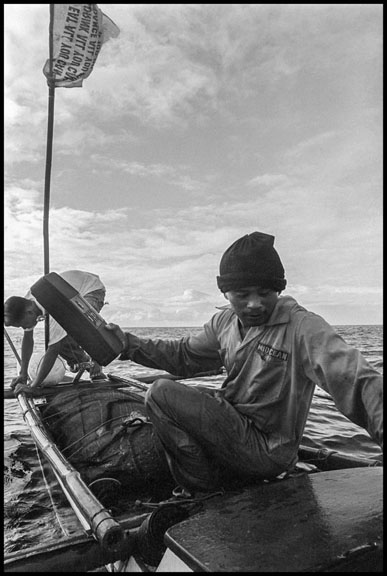
Fishing boats are drawn up on the beach.  The two men, a young teenager and an older man, walk over to the best-looking boat, painted red with indistinct words on the side.  It's a thin, shallow hull, with a small covered section in the middle over a diminutive motor.  Two white outriggers are tied to the end of curving bamboo arms, one on each side.  A big net is wrapped up under a cover in the middle of the boat.
    
The sleeping men wake up.  Together they begin pushing the boat on bamboo rollers down the beach.  Lifting the outrigger arms, they slide the hull into the water, and the boat floats in the small waves.  It's almost totally dark, a crescent moon moving in and out of clouds crossing the sky.

The older man hoists a bag full of beer, and gingerly walks from the needle-nose prow down into the hold between the engine and the net, as the boat rocks gently beneath him.  He is Ayon, the captain.  Beboy, his helper, jumps on. Ayon starts the motor, and the boat pulls away from the beach.  

Ayon loops a wire connected to the accelerator around his big toe.  With one hand he steers the boat with a long pole connected to the rudder, while he guns the small engine with his foot.  They set out into total darkness, the boat rising and falling with the waves.  Bohol's strange peaks are looming dark shapes on the horizon, above the tiny lights of the towns of Garcia Hernandez and Jagna.

They pass a couple of other boats on the way out.  Ayon's brother is a fisherman on one, its yellow light barely visible.  Beboy shines a makeshift flashlight on the outrigger and into the dark water as they go, looking for fish.  Finally, they set out their net, its long line of floats rising and falling with the waves.  Ayon smokes a cigarette while he waits, drinking a beer.  Beboy stands in the stern, watching for clouds and storms.

As dawn breaks and light slowly fills the sky, they pull the net in.  Hand over hand, the web of filaments comes up the side of the boat, and as Beboy pulls Ayon looks for the fish.  They are catching milkfish, or bangus.  The muscles of these small, compact fish promise more meat than most fish their size, making them popular in the market.  Bangsilog, bangus with egg over garlic rice, is a favorite breakfast in the Philippines.

The net in, and the fish in buckets, they turn the prow towards Bohol's hills in the distance.  In no hurry, the motor is barely audible above the sounds of waves and gulls as they head back to land.  A small crowd greets them at the beach, performing the same boat-pulling exercise in reverse, dragging the hull up on bamboo rollers to its original resting place.  

Meanwhile, women from the market stalls of Jagna look into the buckets, and argue with Ayon about the bangus' size and price.  They make their deal, and the morning's catch disappears even before the boat stops moving.  The last beers are passed around and drunk, and Ayon and Beboy walk slowly home.

Over a million people in the Philippines make a living from fishing, and 80% fish in small outrigger boats like Ayon's.  The country is made up of over 7000 islands, giving it the world's largest discontinuous coastline, and making fishing an integral part of what it means to be Filipino.  Fish are the number one source of protein in the diet of the people of the islands.

On the other side of the Bohol Sea is the big island of Camiguin.  Here too, twenty years after Ayon and Beboy's night of fishing, the boats go out every morning, coming back with their catch for the market.  But here, as the women examine the catch, they see no bangus.  They complain that the fish are small, hardly worth selling.

Mario Valladares, father of many of the fishermen on this beach, looks resigned as he mends his nets, as though he's heard this many times before.  His son Virgilio holds up a string of today's catch, and explains that they can't go any longer to the old fishing grounds of years past.  The Philippine government has declared them an ecological preserve to protect the resource from overfishing.  That leaves Camiguin's small fishermen to find their catch in the areas that border it.

"The big fish just run for the preserve and hide.  They know we can't go there to get them," Mario Valladares laments.  After the nets are mended, they carry their strings of fish with them as they head down the beach, planning to cook them for their own breakfast.

In the past, most Filipino fishermen were also farmers.  As fish get scarcer, however, and sections of the sea are walled off, fishermen must travel further to find a good catch.  When they don't, as it happens frequently now with the Valladares family, they no longer have time to farm and the catch doesn't pay for the gas in the boat.

Their predicament is the result of forces over which they have no control.  The Philippine government ratified the Law of the Sea Treaty in 1978, which forced it to commercialize its fish resources in order to retain jurisdiction over its territorial waters.  Commercialization meant attracting foreign investment for large fishing operations.  Huge trawlers pulling purse seine nets scooped up huge quantities of marine life.  Fish stocks plummeted, forcing the creation of no-fishing areas to try to allow the fish to recover.

Small fishermen were left behind - their old fishing grounds and fishing methods walled off by decree, and by the economics of a system in which they cannot compete.  Two decades ago Ayon and Beboy were able to make a living fishing on the coast of Bohol.  The new reality for fishermen is that of the Valladares family on Camiguin, fishing in the same Bohol Sea.

BOHOL


CAMIGUIN


Wednesday, May 19, 2021

PHOTOS WIN PUBLISHERS' AWARDS; MAY DAY MARCH WITH ILWU AND ANGELA DAVIS

 PHOTOS WIN AWARDS FROM THE CALIFORNIA NEWSPAPER PUBLISHERS ASSOCIATION - all published by Capital & Main

First place award for feature story:  A Century of Picking Grapes
** https://cnpa.com/cja2020/digital/gallery/Feature_Story_20_Feature_Story_MC.html#heading13 (https://cnpa.com/cja2020/digital/gallery/Feature_Story_20_Feature_Story_MC.html#heading13)
** https://capitalandmain.com/a-century-picking-grapes-why-the-census-matters-in-poplar (https://capitalandmain.com/a-century-picking-grapes-why-the-census-matters-in-poplar


First, second and third place awards for feature photos:
** https://cnpa.com/cja2020/digital/gallery/Feature_Photo_26_Feature_Photo_MC.html#heading12 (https://cnpa.com/cja2020/digital/gallery/Feature_Photo_26_Feature_Photo_MC.html#heading12)

First place award for feature photo essay:  Tulare County During the Pandemic - The Hard Price of Poverty
** https://cnpa.com/cja2020/digital/gallery/OpenFeature_Photo_31O_OpenFeature_Photo_MAMBMC.html#heading24 (https://cnpa.com/cja2020/digital/gallery/OpenFeature_Photo_31O_OpenFeature_Photo_MAMBMC.html#heading24)
** https://capitalandmain.com/tulare-county-during-pandemic-price-of-poverty-0803 (https://capitalandmain.com/tulare-county-during-pandemic-price-of-poverty-0803)
_____________________________________

ILWU AND NORTHERN CALIFORNIA UNIONS CELEBRATE MAY DAY
By David Bacon
ILWU Dispatcher
** https://www.ilwu.org/ (https://www.ilwu.org/

 
more photos follow the story

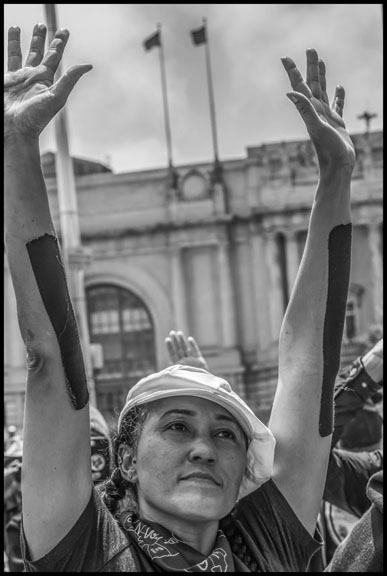
SAN FRANCISCO, CA (5/1/21) -- After Angela Davis spoke to the rally at the end of San Francisco's May Day march, Trent Willis, president of Local 10 of the International Longshore and Warehouse Union, went back to the microphone.  " I'm going to ask the union for a resolution," he announced, "to make our sister Angela Davis an honorary member, as we did with Martin Luther King and Paul Robeson."  The crowd cheered - some older longshore workers in their white caps began shouting out, "Free Angela!" - the chant that swept the world during her 1972 trial.

Willis recalled the union's long history of honoring Black radical leaders, even as a conservative and racist establishment was hounding them.  Robeson was denied his passport and demonized for refusing to knuckle under to McCarthyism's witch-hunts at the height of the Cold War.  Dr. King spoke to the union in 1967 in the last year of his life, calling for radical social change and an end to the Vietnam War.  The New York Times condemned him for it, but King told longshore workers in the Local 10 hall, "We've learned from labor the meaning of power."

As Angela Davis walked up Market Street, flanked by the Local 10 drill team, the union's officers and a thousand other union and worker activists, she honored the ILWU's political independence. She called it one of the most radical unions in the country.  "Local 10 is a majority African-American union, and it's been committed to the support of workers in South Africa, Chile and now Palestine," she explained in an interview with The Dispatcher.  She recalled the years when then-Governor Ronald Reagan had her fired from her teaching job, and tried to send her to prison.  "When I was on trial," she remembered, "the ILWU came to my support too."

Part of Local 10's radicalism has been its celebration of May Day. "Back in 2005," Willis told marchers, "we decided we had to pay attention to May Day and what it means. Back in Chicago, when May Day began, they were working people to death.  People died so that we can have the 8-hour day.  Today if you look at the port, you'll see that no cranes are moving.  "

Willis referred to the origin of the holiday that honors the strike in 1886 over the 8-hour demand, and the execution of the Haymarket martyrs that followed - immigrant labor activists framed by the bosses of the era to try to stop the workers' movement.  One consequence of McCarthyism was the suppression of May Day.  For decades it was celebrated in every country except this one, where it was called the communist holiday.

Redbaiting May Day was never accepted in the ILWU, however.  The union's longshore and warehouse workers often led marches and demonstrations, and found ways to celebrate it.  In 1950, at the height of McCarthyite hysteria, while the government was trying to deport Harry Bridges, Pacific coast maritime workers, including longshore workers from Locals 10, 13 and 2, sent May Day greetings to union brothers and sisters worldwide.  Quoted in The Dispatcher, they said fascism could be defeated "only through militant action, greater maritime unity and world solidarity."

In 1960 the ILWU sent members to the German Democratic Republic (east Germany) to celebrate May Day, and in 1975 Harry Bridges was a guest of the Sea and River Workers Union at May Day in Moscow.  The ILWU in Vancouver has a long tradition of participating in May Day events, and in 1981 the ILWU international convention, taking place on the holiday, stood in silence to honor the Haymarket martyrs.

That tradition of solidarity continued in 2008 when Local 10 members marched in the Port of Oakland and stopped work to oppose the wars in Iraq and Afghanistan.  "May Day, with its special overtones of struggle and militancy, was intentionally selected," according to ILWU historian Harvey Schwartz.  The union had earlier been host to Iraqi unionists asking for support, and sent Local 10's past-President Clarence Thomas to Baghdad to develop relations with them.

What made the 2021 May Day march exceptional, however, was the commitment of other unions and worker organizations.  This year contingents of union workers marched behind banners, and their numbers stretched for blocks down Market Street.  Other contingents came from the Chinese Progressive Association and the California Domestic Workers Alliance.  Chapters of the Democratic Socialists of America showed up in red t-shirts.

Marching in organized union contingents was a nod to the 1934 waterfront and general strike, when thousands of union members paraded silently up Market Street to honor Nick Bordoise and Howard Sperry, murdered by police.  Police murders were on the minds of this year's marchers, as it took place just days after a Minneapolis jury found policeman Derek Chauvin guilty of murdering George Floyd.

"This is more than just another May Day," Willis said.  "This year has been filled with racial tension and police shootings.  Even after that verdict, police shot another young Black man.  Our slogan is An Injury to One is an Injury to All, and we have certainly suffered a lot of injuries."

Willis called on unions and workers to act:  "Racism has been in the way of the labor movement since it started.  Corporate bosses need it to keep me from talking to an Asian man or a Mexican woman, or to you."  Marchers carried banners and Davis and Willis both called for freeing Black prisoner Mumia Abu Jamal.

Many ILWU members came to march from locals throughout Northern California.  One, Blake Dahlstrom, was a leader of the successful organizing drive by ILWU Local 6 at the Anchor Steam Beer brewery. Today she serves as a union steward, and member of the its executive board.  The fight for the 8-hour day isn't just in the past, she warned.  "Many workers have to work a lot more than eight hours at two and more jobs to survive.  In San Francisco one job should be enough, but we know it isn't, and that's a big reason we're marching today," she said.

The marchers without exception called on Congress to pass the PRO Act, a labor law reform bill that would penalize corporations for violating the right of workers to organize unions.  AFL-CIO Vice President Tefere Gebre told marchers at the rally that current labor law does not protect workers from retaliation, or punish employers who retaliate.  "With the PRO Act, there will be consequences," he promised.

Gebre, an Ethiopian immigrant, congratulated marchers for being willing to take action despite the pandemic, while being careful to maintain social distance and wear masks.  "COVID-19 has exposed the structural and systemic racism in this country," he charged. Another speaker at the rally, Eddie Zheng, told of his years in state prison, where the prisoners themselves provide the unpaid labor that keeps the institutions going.  "The labor movement needs to stop this," he urged.

Along with other speakers, Angela Davis also called for passing the PRO Act: "We need to protect the right to organize."  Like Dr. King, she and Zheng connected the fight for prison reform with the demands of unions and workers for a more just society.  "We have to stand up with our sisters and brothers behind prison walls, and abolish the prison industrial complex," she urged.  "I look forward to a world where the police are no longer necessary, and for that world we need housing, schools, jobs and free health care for all."