GUEST WORKERS ON FARMS STAND IN THE EYE OF THE COVID STORM
By David Bacon
Capital & Main, 4/30/20
https://capitalandmain.com/guest-workers-on-farms-are-in-the-eye-of-the-covid-storm-0430
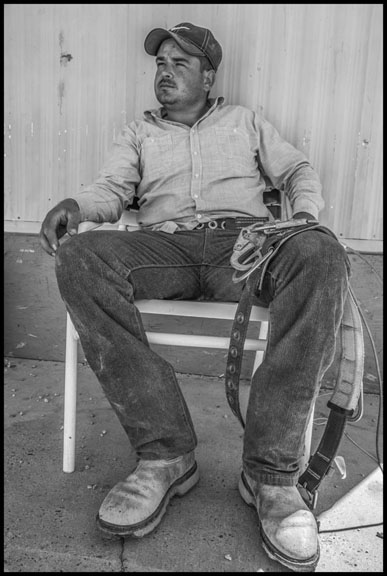
Carlos Gutierrez, an immigrant H-2A guest worker, strings up wire supports for planting apple trees in Washington state. (Photo by David Bacon)
No to family immigration, but yes to guest workers
On April 21 President Trump announced in a tweet that, while stopping almost all kinds of legal immigration for at least two months, he was placing no limits on the continued recruitment of H-2A guest workers by growers. Trump claimed the spreading COVID-19 pandemic made his order necessary, but he cited no evidence to show that a ban covering all forms of family-based migration would stop the virus' spread, while leaving employer-based migration unchanged would not exacerbate the pandemic.
Trump has repeatedly declared his support for the guest worker program. In a 2018 Michigan speech he told a grower audience, "We're going to let your guest workers come in, because we have to have strong borders, but we have to let your workers in ... They're going to work on your farms ... but then they have to go out. But we're gonna let them in because you need them ... We have to have them."
Agriculture Secretary Sonny Perdue explained the apparent contradiction. He wants Trump "to separate immigration, which is people wanting to become citizens, [from] a temporary, legal guest-worker program. That's what agriculture needs, and that's what we want. It doesn't offend people who are anti-immigrant because they don't want more immigrant citizens here. We need people who can help U.S. agriculture meet the production."
This promise is more than election-year politics. It is a big step towards creating a captive workforce in agriculture, based on a program notorious for abuse of the workers in it, and for placing them into low-wage competition with farmworkers already living in the U.S.
It is also a step into the past. Family preference migration, in which immigrants can get residence visas (green cards) based on their family relationships, was won by the civil rights movement. Bert Corona, Cesar Chavez and others convinced Congress to end the bracero program in 1964. They fought for an immigration policy based on family unification, instead of one based on growers' desire for a low-wage labor supply.
Especially for immigrants coming from Asia, Africa and Latin America, this new system made it possible to unite families in the U.S., settle down and become part of communities. Before that watershed step, people could come from Mexico to work as braceros, but not to stay, and not with families. Immigration quotas favoring white migration from Europe made it very hard for families in general to come from non-European countries.
When President Trump said, in a 2018 meeting with Senator Dick Durbin (D-Ill.), "Why do we want these people from all these shithole countries here? We should have more people from places like Norway," he was voicing his nostalgia for that pre-civil rights past.
Trump has now suspended the family preference system. Whether it will be reinstated at some point is anyone's guess. And the H-2A program, which is growing rapidly, is a direct descendant of the old bracero regime. It will continue, given its support in a Congress that is much more conservative than the one in 1964, which abolished the bracero program and established the family migration system. Even Democrats in the current Congress have introduced legislation that would greatly expand H-2A.
Although growers have claimed the coronavirus has created a labor shortage making the H-2A program vital, the program was mushrooming long before the pandemic hit. Last year the U.S. Department of Labor gave agribusiness permission to fill 257,667 jobs with workers brought almost entirely from Mexico, with H-2A visas. That amounted to 10 percent of all the jobs in U.S. agriculture.
The program is five times bigger than the 48,336 jobs certified under George W. Bush in 2005. In some states H-2A certifications now make up more than 10 percent of farmworker jobs. In Georgia growers fill a quarter of all farm labor jobs with H-2A workers.
An agricultural system in which half the workforce would eventually consist of H2-A workers is not unlikely. Florida, Georgia, and Washington are already heading in this direction. Rosalinda Guillen, director of Community to Community, a farmworker advocacy organization in Bellingham, Washington, charges that this expansion "shifts agriculture in the wrong direction, which will lead to the eventual replacement of domestic workers and create even more of a crisis than currently exists for their families and communities."
The problem with H-2A
H-2A workers are given contracts for less than one year, they can only work for the company that contracts them, and they must leave the country at the end of the contract. If they protest abusive conditions they can be fired and deported. And because they must reapply to come back for the following season, they are uniquely vulnerable to blacklisting.
Investigators from the Centro de los Derechos de Migrante (the Migrant Rights Center, CDM) reported in a detailed study released in March, "Ripe for Reform," that "many believed that they would not be allowed to return to work in the U.S. at all if they did not complete a contract, regardless of the reason."
One large recruiter, CSI Visa Processing, with 12 offices in Mexico, brings more than 25,000 workers to the U.S. every year. It has them sign a pledge that authorizes a blacklist: "The boss has the right to fire me and I ... will have to go back to Mexico, and the boss will report me to the authorities. This will obviously affect my ability to return legally to the United States in the future."
"The vast majority of workers start their H-2A jobs deeply in debt," the CDM reported, some paying bribes as much as $4,500, despite legal prohibitions on such "fees." They are often housed in barracks on the grower's property, miles from the nearest town, surrounded by barbed wire fences. "Some workers stated that they needed permission to leave the housing. Others indicated they were prohibited from leaving other than to buy groceries," the CDM study found.
One worker, Mario, said he was charged $1,000 a month for a bunk bed in a barrack with 30 to 40 other workers. When some workers tried to leave, the boss illegally took their passports. "They didn't want us to leave or go anywhere," Mario said.
All interviewees in the CDM report suffered violations of basic labor laws, including receiving wages less than the minimum for H-2A workers and the denial of required breaks. Eighty-six percent reported that companies wouldn't hire women or paid them less when they did. Half complained of bad housing, and a third said they were not provided needed safety equipment. Forty-three percent were not paid the wages promised in their contracts.
"Fraud and misrepresentation about wages were very common," according to the CDM.
One worker reported getting paid $1.25 per hour after illegal kickbacks. Another got $400 for a seven-day week, working 11 hours a day. Underpayment over the lifetime of his contract was $11,000. Multiplied by the dozens of workers in an average crew picking fruit or harvesting vegetables gives an idea of the illegal profits available to employers who seemingly have little fear of consequences.
That lack of fear is understandable given the virtual absence of enforcement. In 2019, out of 11,472 employers using the H-2A program, the Department of Labor filed cases against only 431 (3.73 percent), and of them only 26 (0.25 percent) were barred from recruiting for three years, with an average fine of $109,098.
After one H-2A worker, Honesto Silva, collapsed in a field in Washington State three years ago, and later died, 70 of his co-workers refused to go into the fields. The company, Sarbanand Farms, fired them, and threw them out of the labor camp. Because the H-2A regulations require workers to leave the country if they are terminated, firing effectively meant deporting them.
Washington's new union for farmworkers, Familias Unidas por la Justicia, supported that protest and others by H-2A workers - in 2018 at Crystal View farm and in 2019 at the King Fuji apple ranch. According to Edgar Franks, organizer for Familias Unidas, most of the workers who participated in the Crystal View and King Fuji strikes were not working for the company in the following season.
Favors for growers, COVID for workers
Since his election, Trump has continually tried to make the H-2A program more accessible and profitable for growers. Earlier this year the government dropped a restriction to allow growers to recruit only workers who'd been recruited in the past. Then it suspended a regulation barring growers from keeping workers in the U.S. beyond the end of their old contracts.
Another promised rule change would relax the requirement that companies advertise jobs first to local residents before applying for H-2As. The most important promise was to cut the wage that growers must pay H-2A workers, the Adverse Effect Wage Rate. Set high enough, in theory, not to undermine the prevailing wages of local farmworkers, it actually puts a ceiling on them. If local workers demand wage increases, growers can hire H-2A workers instead.
Low wages put enormous pressure on all farmworkers to go to work, even during the coronavirus crisis. Farmworker families are among the poorest in the U.S., with an average annual income between $17,500 and $20,000-below the official poverty line. Increasing that pressure during the COVID-19 crisis is the fact that half of the country's 2.5 million farmworkers-those without legal status-were written out of all the relief programs passed by Congress. A quarter of a million H-2A workers were written out of the relief bills as well.
The coronavirus crisis adds risk to inequality. Like everyone, H-2A workers must try to maintain the recommended six feet of distance between people in housing, transportation and working conditions. But the CDM report concludes: "That will be impossible under conditions H-2A workers typically experience in the United States." There is no testing for them as they enter the country nor while they're here.
Employers are not required to provide health insurance to H-2A workers. If they stop working because they get sick, the conditions of their visa require them to leave the country. Once in Mexico they then have to find medical care, while their families and communities face the danger of infection.
Uncomfortably close
As Congress began discussing bailout and relief packages in March, however, unions and community organizations began drafting proposals and demands. Thirty-six groups signed a letter drafted by the Washington, D.C. advocates Farmworker Justice, calling for more protections for H-2A workers. Recommendations include safe housing with quarantining facilities, safe transportation, testing of workers before entering the U.S., social distancing at work, and paid treatment for those who get sick. In Washington State Columbia Legal Services filed suit, together with the United Farm Workers, Familias Unidas por la Justicia and Community2Community, a farmworker organizing project, to force the state to set health standards for H-2A workers.
The H-2A program, as changed by the administration, will not likely revert to its pre-pandemic state, however. And H-2A regulations were clearly ineffective in protecting workers before the crisis. Fourteen years ago conditions of H-2A workers were described in a report by the Southern Poverty Law Center, "Close to Slavery." CDM counsel Mary Bauer, who authored that report, charges, "I haven't seen any significant improvement in 30 years. Abuse is baked into a structure in which workers are vulnerable, and where there's always a new supply of workers to replace the old, the sick or those who complain and protest. A program that gives workers virtually no bargaining power creates a perfect storm of vulnerability in the context of this pandemic."
The CDM report makes the same point. "The problem with protecting workers merely by promulgating regulations," it emphasizes, "is that regulations cannot overcome the profound power imbalance between employer and worker."
In the 1960s the Chicano civil rights movement campaigned not to regulate guest worker programs, but to abolish them. Activists fought for an immigration system based on family unification instead. That is the change President Trump now wants to reverse with a tweet.
Thursday, April 30, 2020
Wednesday, April 8, 2020
WAR AND OCCUPATION OPENED THE DOOR TO IRAQ'S VIRUS PANDEMIC
To fight COVID-19, Iraqi workers want political change
By David Bacon
The Nation, 4/8/20
https://www.thenation.com/article/world/iraq-coronavirus-pandemic/
Union leader Falah Alwan, president of the Federation of Workers Councils and Unions of Iraq, and leather goods factory workers argue with the plant manager about their union rights in 2003.
Solidarity, Then the Virus
Many U.S. union activists remember Falah Alwan. As the occupation of Iraq unfolded in the summer of 2005, he and several Iraqi union leaders traveled here to make clear the impact of sanctions and invasion on his country's workers. From one union hall to another, on both coasts and through the Midwest, Alwan and his colleagues appealed for solidarity.
In the end, the war's damage went virtually unhealed, but the ties forged between workers and unions of the two countries have remained undiminished. Last week, as both face the coronavirus pandemic, Alwan wrote to the friends he made in those years. "The news from New York is horrible," he commiserated. "I believe the days to come will be much worse than they are now, not only in Iraq but for you also."
In 2005 the Iraqis effectively dramatized the human cost of U.S. policy. Today, as both countries face the coronavirus, the devastating situation of Iraq's people calls for revisiting that question of responsibility.
On paper, the virus’s toll in Iraq today stands at 1,031 officially confirmed cases, with 64 deaths. While Iraq's per capita count is still much smaller than that in the U.S. - 22 cases per million people to the U.S.' 910 - the numbers don't tell the real story. In Iraq very few people can access medical treatment, and the number of infections and deaths is much higher than that given in official statements.
This past week Reuters reported that confirmed cases numbered instead between 3000 and 9000, quoting doctors and a health official - a report that led the Iraqi government to fine the agency and revoke its reporting license for three months. The higher figure would give Iraq a per capita infection rate higher than South Korea, one of the virus' early concentrations.
Unions and civil society organizations must now try to make up for Iraq's political paralysis and the partial dysfunction of its government. "Because of our ruined healthcare institutions," Alwan explains, "the government hurried to impose a general curfew [a stay-at-home order] to stop the outbreak and a rapid collapse in the whole situation."
That had an enormous impact, especially on workers. Public employees encompass 40% of the workforce, and in theory should still be receiving salaries. But Hashmeya Alsaadawe, head of the country's union for electricity workers and Iraq's highest-ranking woman union leader, points out that eighty thousand of her members have already gone without wages for months because of the country's economic crisis. Yet they are expected, and do, show up for work to provide essential services. In oil refineries and state-owned factories it's the same situation - essential and unpaid - one of the reasons for the huge demonstrations that have challenged the government since last October.
Hashmeya Alsaadawe, President of the Electricity and Energy Union in Basra and the Basra Federation of Trade Unions in 2005, the first woman to be elected as a national trade union leader in Iraq's history.
In the meantime, to stop people from moving within the country, "the main roads were barricaded by concrete blocks," she says. "While this is necessary, the government did not provide anything for those who earn their living on a daily basis. Shops and markets simply closed."
"There's not even a promise of pay for workers losing jobs in the private sector," Alwan adds. "And more than seven million Iraqis only have informal work. To survive, they're obliged to violate the curfew, especially in the slums where three million live in Baghdad alone. Authorities have detained more than 7000 people there, and fined more than 3000 in Najaf." Iraq's population is about 40 million.
How War and Sanctions Destroyed Iraq's Healthcare System
Economic desperation contributes to the impact of the virus, but another factor makes it much more lethal. The spread of COVID-19 is taking place in a country with a devastated healthcare system. The U.S. owns a great part of the responsibility for this. Two invasions, a decade of sanctions and the occupation largely caused the ruin of Iraq's medical and public health systems.
According to an analysis by the Enabling Peace in Iraq Center, "Before the imposition of international sanctions in 1991, Baghdad operated some of the most professional and technologically advanced healthcare and public health institutions in the Arab world." The Ministry of Health operated 172 modern hospitals, 1200 primary care centers and 850 community clinics, providing free healthcare with an annual budget of $450 million. While the Iran-Iraq War of the 1980s produced enormous casualties, the infrastructure itself was not attacked.
Public health depends on well-functioning water and sanitation systems, which served 90 percent of the population in the 1970s. They were destroyed by U.S. bombing in the first Gulf War in 1991. The EPIC report noted, "By March the Tigris River was 'running thickly and slowly with human waste,' according to a Baghdad University law professor. An 87-member international monitoring committee reported that in Iraq’s 30 largest cities, electricity, water, and sewage services were close to total collapse ... Deliberate targeting of civil infrastructure by US airstrikes, and enduring UN sanctions ... dissolved the foundations on which Iraq’s medical infrastructure was built." In the 2003 invasion, 7% of Iraq's remaining hospitals were destroyed and 12% looted in the subsequent chaos.
Over a third of the country's 52,000 licensed physicians fled during the sanctions period of the 1990s. Then another 18,000, over half of those who had remained, left during the extreme violence that followed the U.S. occupation. That violence especially affected healthcare workers. Omar Dewachi, a professor at Brown University, says Baghdad's hospitals were "transformed into ‘killing fields.’” By 2012 Iraq had a third of the doctors, per capita, of Jordan, Syria or even the Israeli-occupied territories.
Apartment buildings built by the government for working class residents of Basra. There is no room here for people with the virus to self-isolate
In the occupation's first six years the U.S. did budget $13.4 billion to rebuild the healthcare system, through the Iraq Relief and Recovery Fund. The fund and U.S. reconstruction projects were marked by fraud and theft, however, leading Senator Robert Byrd (D-W VA) to charge in 2008, “Tens of billions of taxpayer dollars are lost, … gone! ... Individuals think they can get away with bilking—they’re not just milking—bilking the U.S. and Iraqi governments… taking bribes, substituting inferior workmanship, or plain, old-fashioned stealing! Stealing!”
Privatization and Cuts
Instead of rebuilding the healthcare system and basic infrastructure, the occupation introduced private ownership. Now Iraq has a two-track system in which basic services are provided by the Ministry of Health, although they're no longer free. Sami Adnan, an activist in Workers Against Sectarianism, which helped organize the protests that began last October, charges, "Today we have to pay for every single visit and often, in order to get treatment, we are obliged to give a bribe to the few remaining doctors in the country.”
Iraqis - with money - can buy treatment at the Andalus Hospital and Specialized Cancer Treatment Center, a 140,000 square-foot hospital on the eastern side of Baghdad. Owned by mogul Rafee al-Rawi, it boasts a mammography machine, PET and CT scanners, an MRI machine, and even an 8300-ton cyclotron to manufacture a rare anti-cancer medicine. Or they can simply get treatment in another country with a better healthcare system. Both alternatives are subsidized by the government. Or they can pay for drugs smuggled into the country. Forty percent of those limited drugs available are brought in illegally, after merchants pay bribes of $30,000 per container.
Iraq's old State Company for Drugs Industries used to manufacture 300 drugs, and now makes only half that. “We used to export to Eastern European and Arab states. Now look at us,” says Mudhafar Abbas, a manager at the State Company for Marketing Drugs and Medical Appliances.
Driving the decline is a sharp cut in the money the Iraqi government budgets for healthcare, to just 2.5% of $106.5 billion, a much lower rate than the countries around it. The military, by contrast, gets 18% of expenditures, and the oil industry 13%. Even healthcare's small appropriation is now in danger. "A catastrophic economic situation is sweeping the whole country," Alwan warns, "because the budget was calculated when oil's price per barrel was $56, and it is now $24 [recently rising to $34 - ed]. Oil revenue makes up 90% of the budget, so officials plan to cut salaries, and the exchange rate of the Iraqi dinar to the dollar. Millions of workers, especially in the public sector, will pay for this."
The head of the Parliamentary Human Rights Committee, Deputy Arshad al-Salhi warned that even before the virus Iraqis were suffering from a lack of food and miserable wages. He urged the Ministry of Health to provide for families below the poverty line and the unemployed. "This strategy must be worked out by the competent authorities immediately, otherwise we are going towards a famine," al-Salhi said.
Iraq's current prime minister designate, Adnan al-Zorfi, announced a program at the end of March to create a crisis committee, enact measures to detain the virus' spread, provide food to those who need it, and ask for international assistance. The government would provide an "appropriate budget to provide for the requirements." Where the money would come from, no ne knows. He then called on social groups outside the government to help provide aid.
In the aftermath of the 2003 invasion tank treads and turrets were piled in the middle of a residential neighborhood. The wreckage included depleted uranium ammunition, a big health hazard to residents, dissolved in a pond of toxic waste next to apartment buildings.
The Iraqi administration has demanded that private corporations who operate oil concessions keep producing during the crisis. But selling pumping concessions to the world's petroleum behemoths, rather than operating the oil fields on a nationalized basis as it did before the occupation, means the government has only limited control. Some companies continue to keep the oil and dollars flowing, but at least one, the Malaysian giant Petronas, closed down its field and sent its workers home in fear of the pandemic.
The Oil Ministry could ramp up production in its state-operated fields, but must depend on the willingness of oil workers. Their union, the Iraqi Federation of Oil Workers, is the most powerful in the country. It, along with other unions, strongly backed the protests rocking Iraq since last fall. Those huge confrontations in the streets led to the resignation of al-Zorfi's predecessor, Muhammad Tawfiq Allawi, and his predecessor, Adel Abdul Mahdi.
A Wave of Protest Demanding Change
Beginning during the Arab Spring of 2009, waves of demonstrators have occupied Baghdad's Tahrir Square, with smaller protests in Basra and other cities. Hundreds of thousands of Iraqis have risked confrontation with troops and armed militias to condemn the failure of the government to provide jobs, clean water and healthcare. Infuriating especially are the electrical failures, providing no more than a few hours of power each day in the blistering summer.
In 2018 Iraqi Communists joined forces with cleric Moqtada al-Sadr, hoping to harness the power of the protests in their Sairoon electoral coalition. They campaigned against corruption and patronage that divides government posts according to religion. While Iraqi unions don't have a formal endorsement process for candidates, Sairoon clearly had the support of many, if not most union members. It won a plurality of votes in a multi-party system, but not enough seats in Parliament to form a government.
Last year the demonstrations surged again. In September hundreds of doctors filled Baghdad streets, demanding bigger budgets for healthcare, and better pay and security for medical workers. In October thousands of young people came out in every major Iraqi city. And on October 29 the Iraqi military fired on them, killing hundreds in Baghdad, while paramilitaries murdered 18 in Karbala. In Tahrir Square young doctors tried to bandage wounds and provide emergency triage care.
The oil workers were deeply involved. “We stand in solidarity with the demonstrations against corrupt rule in Iraq," their statement said. "The Iraqi people of all classes stand together as one to demand their rights. These rights have been taken away by an unjust government that uses violence, including sniper fire, against defenseless people who have nothing but their faith in God and in the justice of their cause.” In southern Iraq, where the oil and container terminals are located, union members shut down the ports.
In a prescient criticism, unions condemned the Iraqi government for growing completely dependent on oil income, making the country vulnerable to price shifts, while neglecting agriculture and manufacturing, important parts of earlier economic development. From October to March the demonstrations continued. By then, according to the Independent High Commission for Human Rights, the death toll had reached 566, ten times the virus deaths so far, while the number of injured topped 17,000.
In Baghdad people depend for transportation on a network of crowded vans, which make it difficult to maintain social distancing. The curfew now makes travel like this virtually impossible.
Labor and Grassroots Respond to the Virus
Then COVID-19 hit. And while many of those camped out in Tahrir Square left, not all did. Some remained, and began forming teams to go into neighborhoods and talk about the health crisis. The Iraqi Students Union set up a special medical unit to give basic examinations. For these activists, demonstrating against the government and working to overcome the virus are connected.
Sami Adnan says, "the reasons why we took to the streets in recent months were precisely these: the social and health system is totally insufficient to meet people's needs. Inside our tent village in Tahrir Square we are disinfecting everything: clothes, tents, mattresses, blankets, tools and utensils. We are distributing personal protective equipment such as masks and gloves."
Iraqi journalist LuJain Elbaldawi agrees: "The situation in Iraq is heading toward a comprehensive health crisis that the government is unable to cope with; thus, has resorted to drawing from civil society institutions, religious organizations and charities."
At first many clerics, including Moqtada al-Sadr, urged people to continue to come to the mosque and attend religious events. Planes continued to arrive with pilgrims from Iran, where the virus is raging. After pleas from health authorities, however, the imams reversed their earlier edicts. Some went further. In Karbala the al-Abbas shrine built a hall with 52 rooms for infected people. Mullah Hussein al-Awsi in Baghdad told the Al-Monitor news website, “We have formed teams of commission members to disinfect public spaces such as shops, public markets, sports arenas and some of the residential neighborhoods that are difficult for the government to reach.”
Grassroots groups and individuals responded as well. In Baghdad mobile bakeries travel through neighborhoods, distributing bread so that residents don't have to leave home. As people are doing all over the world, activist Nadia Mohammed in Kirkuk began making and handing out facemasks to those with no money to buy them.
Hashmeya Alsaadawe, who is also president of the Basra Trade Union Federation, says the ability of her union to provide aid is limited by the fact that "the government does not recognize our legitimacy nor the legitimacy of other unions." This denial dates back to the Saddam Hussein dictatorship, when the government prohibited unions in the public sector, including oil, electricity and the state enterprises that still dominate the economy.
Workers on an oil drilling rig in the South Rumaila oil field outside of Basra, in southern Iraq in 2005. Workers still go to work to produce the oil since the economy would stop immediately if they didn't.
While that outright prohibition was ended in a 2016 reform, withholding recognition keeps unions from collecting dues and functioning normally. "Our financial capabilities, therefore, are almost zero," she says, "so we're able to provide needed support only to poor workers. We distribute donations and food baskets where we can, and in addition we educate all workers through social media about the dangers of this virus and how to prevent it."
Under union pressure the government has made changes in some workplaces, by only having half of the workforce on the job at one time. In others the shifts have been lengthened in order to increase the number of days off. But, Alsaadawe says, the rules can change in each department and enterprise. "Changes were also too slow, and didn't take into account the seriousness of this virus. Some workplaces only distributed sanitizers in a few departments. Workers who labor crowded together were not released, nor were masks and gloves distributed to them. Individuals had to get them for themselves."
Political Demands
Many unions have gone beyond trying to protect their own members, and call for holding the government responsible for its failures. A National Program of Action to Combat the Coronavirus begins by declaring that "The authorities underestimated the experience of the countries of the world, and did not lift a finger to respond to the crisis until the middle of March."
The declaration, circulated by Hassan Juma'a Awad, president of the Iraqi Federation of Oil Workers, does not stop there. "The cause of the spread of this virus is the capitalist system in the first place," it charges, "and its continuous quest to accumulate capital and profits at the expense of the health and life of people."
The IFOW then lists an extensive set of demands, many echoing those put forward by unions and progressive organizations in the U.S.. The government "must provide drugs and supplies to those who need them," it begins, "with immediate testing, starting with health workers on the front lines," as well as prioritizing people with chronic health problems.
Medicine and food should be rationed and their prices controlled, with meals provided at schools. The government must "pay the wages of all workers, public and private for 4 months and throughout the quarantine period, including payments for those disabled and unemployed and the old and retired." Meanwhile there should be a moratorium on payment of rents, loans, water and electricity bills, and taxes.
To prevent the virus from spreading, people in prisons and detention centers should be released "so that prisons don't turn into epidemics." Public events must be halted, including religious ones, and the border closed to pilgrims from Iran and other pandemic-stricken countries.
Given Iraq's huge protests and wrenching political changes over the last year, unions clearly see that the important long term response is political. By formulating demands for the whole population, not just for workers and union members, the call reaches out beyond labor to "all socialist and human-friendly forces, parties, organizations, labor and women's and professional associations and movements calling for equality." Ultimately, it holds Iraq's economic system responsible for the crisis, and demands basic political change to deal with it.
Hassan Juma'a Awad, President of the Iraqi Federation of Oil Workers, in 2005.
To fight COVID-19, Iraqi workers want political change
By David Bacon
The Nation, 4/8/20
https://www.thenation.com/article/world/iraq-coronavirus-pandemic/
Union leader Falah Alwan, president of the Federation of Workers Councils and Unions of Iraq, and leather goods factory workers argue with the plant manager about their union rights in 2003.
Solidarity, Then the Virus
Many U.S. union activists remember Falah Alwan. As the occupation of Iraq unfolded in the summer of 2005, he and several Iraqi union leaders traveled here to make clear the impact of sanctions and invasion on his country's workers. From one union hall to another, on both coasts and through the Midwest, Alwan and his colleagues appealed for solidarity.
In the end, the war's damage went virtually unhealed, but the ties forged between workers and unions of the two countries have remained undiminished. Last week, as both face the coronavirus pandemic, Alwan wrote to the friends he made in those years. "The news from New York is horrible," he commiserated. "I believe the days to come will be much worse than they are now, not only in Iraq but for you also."
In 2005 the Iraqis effectively dramatized the human cost of U.S. policy. Today, as both countries face the coronavirus, the devastating situation of Iraq's people calls for revisiting that question of responsibility.
On paper, the virus’s toll in Iraq today stands at 1,031 officially confirmed cases, with 64 deaths. While Iraq's per capita count is still much smaller than that in the U.S. - 22 cases per million people to the U.S.' 910 - the numbers don't tell the real story. In Iraq very few people can access medical treatment, and the number of infections and deaths is much higher than that given in official statements.
This past week Reuters reported that confirmed cases numbered instead between 3000 and 9000, quoting doctors and a health official - a report that led the Iraqi government to fine the agency and revoke its reporting license for three months. The higher figure would give Iraq a per capita infection rate higher than South Korea, one of the virus' early concentrations.
Unions and civil society organizations must now try to make up for Iraq's political paralysis and the partial dysfunction of its government. "Because of our ruined healthcare institutions," Alwan explains, "the government hurried to impose a general curfew [a stay-at-home order] to stop the outbreak and a rapid collapse in the whole situation."
That had an enormous impact, especially on workers. Public employees encompass 40% of the workforce, and in theory should still be receiving salaries. But Hashmeya Alsaadawe, head of the country's union for electricity workers and Iraq's highest-ranking woman union leader, points out that eighty thousand of her members have already gone without wages for months because of the country's economic crisis. Yet they are expected, and do, show up for work to provide essential services. In oil refineries and state-owned factories it's the same situation - essential and unpaid - one of the reasons for the huge demonstrations that have challenged the government since last October.
Hashmeya Alsaadawe, President of the Electricity and Energy Union in Basra and the Basra Federation of Trade Unions in 2005, the first woman to be elected as a national trade union leader in Iraq's history.
In the meantime, to stop people from moving within the country, "the main roads were barricaded by concrete blocks," she says. "While this is necessary, the government did not provide anything for those who earn their living on a daily basis. Shops and markets simply closed."
"There's not even a promise of pay for workers losing jobs in the private sector," Alwan adds. "And more than seven million Iraqis only have informal work. To survive, they're obliged to violate the curfew, especially in the slums where three million live in Baghdad alone. Authorities have detained more than 7000 people there, and fined more than 3000 in Najaf." Iraq's population is about 40 million.
How War and Sanctions Destroyed Iraq's Healthcare System
Economic desperation contributes to the impact of the virus, but another factor makes it much more lethal. The spread of COVID-19 is taking place in a country with a devastated healthcare system. The U.S. owns a great part of the responsibility for this. Two invasions, a decade of sanctions and the occupation largely caused the ruin of Iraq's medical and public health systems.
According to an analysis by the Enabling Peace in Iraq Center, "Before the imposition of international sanctions in 1991, Baghdad operated some of the most professional and technologically advanced healthcare and public health institutions in the Arab world." The Ministry of Health operated 172 modern hospitals, 1200 primary care centers and 850 community clinics, providing free healthcare with an annual budget of $450 million. While the Iran-Iraq War of the 1980s produced enormous casualties, the infrastructure itself was not attacked.
Public health depends on well-functioning water and sanitation systems, which served 90 percent of the population in the 1970s. They were destroyed by U.S. bombing in the first Gulf War in 1991. The EPIC report noted, "By March the Tigris River was 'running thickly and slowly with human waste,' according to a Baghdad University law professor. An 87-member international monitoring committee reported that in Iraq’s 30 largest cities, electricity, water, and sewage services were close to total collapse ... Deliberate targeting of civil infrastructure by US airstrikes, and enduring UN sanctions ... dissolved the foundations on which Iraq’s medical infrastructure was built." In the 2003 invasion, 7% of Iraq's remaining hospitals were destroyed and 12% looted in the subsequent chaos.
Over a third of the country's 52,000 licensed physicians fled during the sanctions period of the 1990s. Then another 18,000, over half of those who had remained, left during the extreme violence that followed the U.S. occupation. That violence especially affected healthcare workers. Omar Dewachi, a professor at Brown University, says Baghdad's hospitals were "transformed into ‘killing fields.’” By 2012 Iraq had a third of the doctors, per capita, of Jordan, Syria or even the Israeli-occupied territories.
Apartment buildings built by the government for working class residents of Basra. There is no room here for people with the virus to self-isolate
In the occupation's first six years the U.S. did budget $13.4 billion to rebuild the healthcare system, through the Iraq Relief and Recovery Fund. The fund and U.S. reconstruction projects were marked by fraud and theft, however, leading Senator Robert Byrd (D-W VA) to charge in 2008, “Tens of billions of taxpayer dollars are lost, … gone! ... Individuals think they can get away with bilking—they’re not just milking—bilking the U.S. and Iraqi governments… taking bribes, substituting inferior workmanship, or plain, old-fashioned stealing! Stealing!”
Privatization and Cuts
Instead of rebuilding the healthcare system and basic infrastructure, the occupation introduced private ownership. Now Iraq has a two-track system in which basic services are provided by the Ministry of Health, although they're no longer free. Sami Adnan, an activist in Workers Against Sectarianism, which helped organize the protests that began last October, charges, "Today we have to pay for every single visit and often, in order to get treatment, we are obliged to give a bribe to the few remaining doctors in the country.”
Iraqis - with money - can buy treatment at the Andalus Hospital and Specialized Cancer Treatment Center, a 140,000 square-foot hospital on the eastern side of Baghdad. Owned by mogul Rafee al-Rawi, it boasts a mammography machine, PET and CT scanners, an MRI machine, and even an 8300-ton cyclotron to manufacture a rare anti-cancer medicine. Or they can simply get treatment in another country with a better healthcare system. Both alternatives are subsidized by the government. Or they can pay for drugs smuggled into the country. Forty percent of those limited drugs available are brought in illegally, after merchants pay bribes of $30,000 per container.
Iraq's old State Company for Drugs Industries used to manufacture 300 drugs, and now makes only half that. “We used to export to Eastern European and Arab states. Now look at us,” says Mudhafar Abbas, a manager at the State Company for Marketing Drugs and Medical Appliances.
Driving the decline is a sharp cut in the money the Iraqi government budgets for healthcare, to just 2.5% of $106.5 billion, a much lower rate than the countries around it. The military, by contrast, gets 18% of expenditures, and the oil industry 13%. Even healthcare's small appropriation is now in danger. "A catastrophic economic situation is sweeping the whole country," Alwan warns, "because the budget was calculated when oil's price per barrel was $56, and it is now $24 [recently rising to $34 - ed]. Oil revenue makes up 90% of the budget, so officials plan to cut salaries, and the exchange rate of the Iraqi dinar to the dollar. Millions of workers, especially in the public sector, will pay for this."
The head of the Parliamentary Human Rights Committee, Deputy Arshad al-Salhi warned that even before the virus Iraqis were suffering from a lack of food and miserable wages. He urged the Ministry of Health to provide for families below the poverty line and the unemployed. "This strategy must be worked out by the competent authorities immediately, otherwise we are going towards a famine," al-Salhi said.
Iraq's current prime minister designate, Adnan al-Zorfi, announced a program at the end of March to create a crisis committee, enact measures to detain the virus' spread, provide food to those who need it, and ask for international assistance. The government would provide an "appropriate budget to provide for the requirements." Where the money would come from, no ne knows. He then called on social groups outside the government to help provide aid.
In the aftermath of the 2003 invasion tank treads and turrets were piled in the middle of a residential neighborhood. The wreckage included depleted uranium ammunition, a big health hazard to residents, dissolved in a pond of toxic waste next to apartment buildings.
The Iraqi administration has demanded that private corporations who operate oil concessions keep producing during the crisis. But selling pumping concessions to the world's petroleum behemoths, rather than operating the oil fields on a nationalized basis as it did before the occupation, means the government has only limited control. Some companies continue to keep the oil and dollars flowing, but at least one, the Malaysian giant Petronas, closed down its field and sent its workers home in fear of the pandemic.
The Oil Ministry could ramp up production in its state-operated fields, but must depend on the willingness of oil workers. Their union, the Iraqi Federation of Oil Workers, is the most powerful in the country. It, along with other unions, strongly backed the protests rocking Iraq since last fall. Those huge confrontations in the streets led to the resignation of al-Zorfi's predecessor, Muhammad Tawfiq Allawi, and his predecessor, Adel Abdul Mahdi.
A Wave of Protest Demanding Change
Beginning during the Arab Spring of 2009, waves of demonstrators have occupied Baghdad's Tahrir Square, with smaller protests in Basra and other cities. Hundreds of thousands of Iraqis have risked confrontation with troops and armed militias to condemn the failure of the government to provide jobs, clean water and healthcare. Infuriating especially are the electrical failures, providing no more than a few hours of power each day in the blistering summer.
In 2018 Iraqi Communists joined forces with cleric Moqtada al-Sadr, hoping to harness the power of the protests in their Sairoon electoral coalition. They campaigned against corruption and patronage that divides government posts according to religion. While Iraqi unions don't have a formal endorsement process for candidates, Sairoon clearly had the support of many, if not most union members. It won a plurality of votes in a multi-party system, but not enough seats in Parliament to form a government.
Last year the demonstrations surged again. In September hundreds of doctors filled Baghdad streets, demanding bigger budgets for healthcare, and better pay and security for medical workers. In October thousands of young people came out in every major Iraqi city. And on October 29 the Iraqi military fired on them, killing hundreds in Baghdad, while paramilitaries murdered 18 in Karbala. In Tahrir Square young doctors tried to bandage wounds and provide emergency triage care.
The oil workers were deeply involved. “We stand in solidarity with the demonstrations against corrupt rule in Iraq," their statement said. "The Iraqi people of all classes stand together as one to demand their rights. These rights have been taken away by an unjust government that uses violence, including sniper fire, against defenseless people who have nothing but their faith in God and in the justice of their cause.” In southern Iraq, where the oil and container terminals are located, union members shut down the ports.
In a prescient criticism, unions condemned the Iraqi government for growing completely dependent on oil income, making the country vulnerable to price shifts, while neglecting agriculture and manufacturing, important parts of earlier economic development. From October to March the demonstrations continued. By then, according to the Independent High Commission for Human Rights, the death toll had reached 566, ten times the virus deaths so far, while the number of injured topped 17,000.
In Baghdad people depend for transportation on a network of crowded vans, which make it difficult to maintain social distancing. The curfew now makes travel like this virtually impossible.
Labor and Grassroots Respond to the Virus
Then COVID-19 hit. And while many of those camped out in Tahrir Square left, not all did. Some remained, and began forming teams to go into neighborhoods and talk about the health crisis. The Iraqi Students Union set up a special medical unit to give basic examinations. For these activists, demonstrating against the government and working to overcome the virus are connected.
Sami Adnan says, "the reasons why we took to the streets in recent months were precisely these: the social and health system is totally insufficient to meet people's needs. Inside our tent village in Tahrir Square we are disinfecting everything: clothes, tents, mattresses, blankets, tools and utensils. We are distributing personal protective equipment such as masks and gloves."
Iraqi journalist LuJain Elbaldawi agrees: "The situation in Iraq is heading toward a comprehensive health crisis that the government is unable to cope with; thus, has resorted to drawing from civil society institutions, religious organizations and charities."
At first many clerics, including Moqtada al-Sadr, urged people to continue to come to the mosque and attend religious events. Planes continued to arrive with pilgrims from Iran, where the virus is raging. After pleas from health authorities, however, the imams reversed their earlier edicts. Some went further. In Karbala the al-Abbas shrine built a hall with 52 rooms for infected people. Mullah Hussein al-Awsi in Baghdad told the Al-Monitor news website, “We have formed teams of commission members to disinfect public spaces such as shops, public markets, sports arenas and some of the residential neighborhoods that are difficult for the government to reach.”
Grassroots groups and individuals responded as well. In Baghdad mobile bakeries travel through neighborhoods, distributing bread so that residents don't have to leave home. As people are doing all over the world, activist Nadia Mohammed in Kirkuk began making and handing out facemasks to those with no money to buy them.
Hashmeya Alsaadawe, who is also president of the Basra Trade Union Federation, says the ability of her union to provide aid is limited by the fact that "the government does not recognize our legitimacy nor the legitimacy of other unions." This denial dates back to the Saddam Hussein dictatorship, when the government prohibited unions in the public sector, including oil, electricity and the state enterprises that still dominate the economy.
Workers on an oil drilling rig in the South Rumaila oil field outside of Basra, in southern Iraq in 2005. Workers still go to work to produce the oil since the economy would stop immediately if they didn't.
While that outright prohibition was ended in a 2016 reform, withholding recognition keeps unions from collecting dues and functioning normally. "Our financial capabilities, therefore, are almost zero," she says, "so we're able to provide needed support only to poor workers. We distribute donations and food baskets where we can, and in addition we educate all workers through social media about the dangers of this virus and how to prevent it."
Under union pressure the government has made changes in some workplaces, by only having half of the workforce on the job at one time. In others the shifts have been lengthened in order to increase the number of days off. But, Alsaadawe says, the rules can change in each department and enterprise. "Changes were also too slow, and didn't take into account the seriousness of this virus. Some workplaces only distributed sanitizers in a few departments. Workers who labor crowded together were not released, nor were masks and gloves distributed to them. Individuals had to get them for themselves."
Political Demands
Many unions have gone beyond trying to protect their own members, and call for holding the government responsible for its failures. A National Program of Action to Combat the Coronavirus begins by declaring that "The authorities underestimated the experience of the countries of the world, and did not lift a finger to respond to the crisis until the middle of March."
The declaration, circulated by Hassan Juma'a Awad, president of the Iraqi Federation of Oil Workers, does not stop there. "The cause of the spread of this virus is the capitalist system in the first place," it charges, "and its continuous quest to accumulate capital and profits at the expense of the health and life of people."
The IFOW then lists an extensive set of demands, many echoing those put forward by unions and progressive organizations in the U.S.. The government "must provide drugs and supplies to those who need them," it begins, "with immediate testing, starting with health workers on the front lines," as well as prioritizing people with chronic health problems.
Medicine and food should be rationed and their prices controlled, with meals provided at schools. The government must "pay the wages of all workers, public and private for 4 months and throughout the quarantine period, including payments for those disabled and unemployed and the old and retired." Meanwhile there should be a moratorium on payment of rents, loans, water and electricity bills, and taxes.
To prevent the virus from spreading, people in prisons and detention centers should be released "so that prisons don't turn into epidemics." Public events must be halted, including religious ones, and the border closed to pilgrims from Iran and other pandemic-stricken countries.
Given Iraq's huge protests and wrenching political changes over the last year, unions clearly see that the important long term response is political. By formulating demands for the whole population, not just for workers and union members, the call reaches out beyond labor to "all socialist and human-friendly forces, parties, organizations, labor and women's and professional associations and movements calling for equality." Ultimately, it holds Iraq's economic system responsible for the crisis, and demands basic political change to deal with it.
Hassan Juma'a Awad, President of the Iraqi Federation of Oil Workers, in 2005.
Monday, April 6, 2020
WORK AND POVERTY IN THE DATE PALMS
Photographs by David Bacon
The Progressive, 3/30/20
https://progressive.org/dispatches/poverty-in-the-date-palms-bacon-200330/
These photographs document the date palm workers, or "palmeros". They are a window into their lives, showing their living conditions and the pain of exploitation. They document families, homes, and the culture of indigenous Purepecha people from the Mexican state of Michoacan - the main indigenous group in the farm labor workforce of the Coachella Valley.
In the Coachella Valley, where the date farms are concentrated, the industry brings in $65 million a year. Despite this, many Coachella farm workers live in trailer parks in colonias, or informal settlements, near the fields under the valley's intense sun. There are not many "palmeros" - perhaps only two hundred. Outside of Arabia, Iraq and North Africa, date palms are only grown here.
The work is dangerous - the palms rise from twenty to sixty feet above the sandy desert floor of the Valley. The photographs show the work process in which workers climb into the trees on ladders, or in more recent years on cherry pickers - mechanical lifts - and then walk around the tree's crown on the palm fronds as they work. In the course of a year, a "palmero" has to go up into the palm trees seven times.
The first operation is depicted here - the pollenization. Date palm trees are dioecious - they come in sexes. The flowers of the male palm produce the pollen. It is the female tree that produces flowers that become the seeds, and which therefore bear the fruit.
These photographs are part of a larger body of images and oral histories that I began in Coachella in 1992, and which continues today. The archive of this work is in the Special Collections of the Green Library at Stanford University.
COACHELLA VALLEY, CA - 2017 - Jose Cruz Frias, a "palmero", works in a grove of date palms. He climbs the trees on a ladder, and once up in the tree he walks around on the fronds themselves. This is one of seven operations that must happen to the trees each year to get them to bear fruit. Cruz has been doing this work for 15 years. He originally came to the Coachella Valley from Irapuato, Guanajuato in Mexico.
COACHELLA VALLEY, CA - 2017 - During this phase of the work, Jose Cruz Frias sprays pollen from a small bottle onto the buds that will become the dates, and ties the bunch together with string. This is one of seven operations that must happen to the trees each year to get them to bear fruit.
COACHELLA VALLEY, CA - 2017 - Jose Cruz Frias, a "palmero", points to scars on his hand from the knife and the spines of the tree.
COACHELLA VALLEY, CA - 2010 - Ana Sanchez lives in the St. Anthony's Trailer Park near Thermal, in the desert in Coachella Valley. The water supply of the park is contaminated, and Sanchez and the other residents have to get their drinking water from a tank.
COACHELLA VALLEY, CA - 2010 - Children in the St. Anthony's Trailer Park, in the desert in Coachella Valley.
COACHELLA VALLEY, CA - 2010 - Trailers in the St. Anthony's Trailer Park near Thermal, in the desert.
COACHELLA VALLEY, CA - 2017 - Alberto Castro works as a "palmero", in the date palm groves of Coachella Valley, and has worked over 15 years in the trees. After work he sits in the shade of the trailer where he lives in a trailer park near Thermal. He holds the safety harness he is supposed to use when working, but it restricts his ability to work quickly, and he is paid by the piece rate, so he often doesn't use it.
COACHELLA VALLEY, CA - 2017 - Carlos Chavez works as a "palmero", and has worked over 20 years in the trees. After work he sits in the shade of his trailer with his daughter Michelle. Michelle is in high school, trying to win a scholarship so she can go to college. Carlos took her to work with him one summer, but she didn't like it, and says it motivated her to study harder.
COACHELLA VALLEY, CA - 2010 - Meregildo Ortiz (l) is the president of the Purepecha community in the Coachella Valley. Purepechas are the main indigenous group in the Mexican state of Michoacan, and many live in the trailer camps in the desert near the Salton Sea. They work as farm workers in the fields of the Coachella Valley. Seated with him are Max Ortiz and Julian Benito.
COACHELLA VALLEY, CA - 2017 - Arturo Cordoba, an artist in the Desert View Mobile Home Park, outlines lettering he will carve into a wood plaque.
COACHELLA VALLEY, CA - 2010 - Members of the Purepecha community in the Coachella Valley gather at night to rehearse the Danza de Los Ancianos (the Dance of the Old People), preparing to perform it during a procession celebrating the Virgin de Guadalupe. This is also an opportunity to teach young people the dance and music traditions of the community.
COACHELLA VALLEY, CA - 2017 - The hands of Carlos Chavez, a "palmero", show the lines and creases of 20 years of hard work in the date palms.
Photographs by David Bacon
The Progressive, 3/30/20
https://progressive.org/dispatches/poverty-in-the-date-palms-bacon-200330/
These photographs document the date palm workers, or "palmeros". They are a window into their lives, showing their living conditions and the pain of exploitation. They document families, homes, and the culture of indigenous Purepecha people from the Mexican state of Michoacan - the main indigenous group in the farm labor workforce of the Coachella Valley.
In the Coachella Valley, where the date farms are concentrated, the industry brings in $65 million a year. Despite this, many Coachella farm workers live in trailer parks in colonias, or informal settlements, near the fields under the valley's intense sun. There are not many "palmeros" - perhaps only two hundred. Outside of Arabia, Iraq and North Africa, date palms are only grown here.
The work is dangerous - the palms rise from twenty to sixty feet above the sandy desert floor of the Valley. The photographs show the work process in which workers climb into the trees on ladders, or in more recent years on cherry pickers - mechanical lifts - and then walk around the tree's crown on the palm fronds as they work. In the course of a year, a "palmero" has to go up into the palm trees seven times.
The first operation is depicted here - the pollenization. Date palm trees are dioecious - they come in sexes. The flowers of the male palm produce the pollen. It is the female tree that produces flowers that become the seeds, and which therefore bear the fruit.
These photographs are part of a larger body of images and oral histories that I began in Coachella in 1992, and which continues today. The archive of this work is in the Special Collections of the Green Library at Stanford University.
COACHELLA VALLEY, CA - 2017 - Jose Cruz Frias, a "palmero", works in a grove of date palms. He climbs the trees on a ladder, and once up in the tree he walks around on the fronds themselves. This is one of seven operations that must happen to the trees each year to get them to bear fruit. Cruz has been doing this work for 15 years. He originally came to the Coachella Valley from Irapuato, Guanajuato in Mexico.
COACHELLA VALLEY, CA - 2017 - During this phase of the work, Jose Cruz Frias sprays pollen from a small bottle onto the buds that will become the dates, and ties the bunch together with string. This is one of seven operations that must happen to the trees each year to get them to bear fruit.
COACHELLA VALLEY, CA - 2017 - Jose Cruz Frias, a "palmero", points to scars on his hand from the knife and the spines of the tree.
COACHELLA VALLEY, CA - 2010 - Ana Sanchez lives in the St. Anthony's Trailer Park near Thermal, in the desert in Coachella Valley. The water supply of the park is contaminated, and Sanchez and the other residents have to get their drinking water from a tank.
COACHELLA VALLEY, CA - 2010 - Children in the St. Anthony's Trailer Park, in the desert in Coachella Valley.
COACHELLA VALLEY, CA - 2010 - Trailers in the St. Anthony's Trailer Park near Thermal, in the desert.
COACHELLA VALLEY, CA - 2017 - Alberto Castro works as a "palmero", in the date palm groves of Coachella Valley, and has worked over 15 years in the trees. After work he sits in the shade of the trailer where he lives in a trailer park near Thermal. He holds the safety harness he is supposed to use when working, but it restricts his ability to work quickly, and he is paid by the piece rate, so he often doesn't use it.
COACHELLA VALLEY, CA - 2017 - Carlos Chavez works as a "palmero", and has worked over 20 years in the trees. After work he sits in the shade of his trailer with his daughter Michelle. Michelle is in high school, trying to win a scholarship so she can go to college. Carlos took her to work with him one summer, but she didn't like it, and says it motivated her to study harder.
COACHELLA VALLEY, CA - 2010 - Meregildo Ortiz (l) is the president of the Purepecha community in the Coachella Valley. Purepechas are the main indigenous group in the Mexican state of Michoacan, and many live in the trailer camps in the desert near the Salton Sea. They work as farm workers in the fields of the Coachella Valley. Seated with him are Max Ortiz and Julian Benito.
COACHELLA VALLEY, CA - 2017 - Arturo Cordoba, an artist in the Desert View Mobile Home Park, outlines lettering he will carve into a wood plaque.
COACHELLA VALLEY, CA - 2010 - Members of the Purepecha community in the Coachella Valley gather at night to rehearse the Danza de Los Ancianos (the Dance of the Old People), preparing to perform it during a procession celebrating the Virgin de Guadalupe. This is also an opportunity to teach young people the dance and music traditions of the community.
COACHELLA VALLEY, CA - 2017 - The hands of Carlos Chavez, a "palmero", show the lines and creases of 20 years of hard work in the date palms.
Tuesday, March 31, 2020
FARMWORKERS ARE “ESSENTIAL” BUT EXCLUDED, AWAITING THE VIRUS
FARMWORKERS ARE "ESSENTIAL" BUT EXCLUDED, AWAITING THE VIRUS
By David Bacon
The American Prospect and Capital & Main, 4/1/20
https://prospect.org/ and https://capitalandmain.com/
A worker cuts lettuce in a crew in California's Coachella Valley.
In fields and rural communities across the United States the nation's 2.5 million agricultural laborers are waiting for the shoe to drop - for the first cases of coronavirus among farmworkers. As they wait they are already feeling sharply the effects of the measures taken to contain the virus' spread.
Francisco Lozano, a farmworker in Santa Maria on California's central coast, says poverty makes this crisis much worse. In the winter, when there's no work, families live off meager savings from the previous season, and when those are exhausted, they borrow from family and friends. "This is the time work starts up again, picking strawberries," he says. "But instead of pulling ourselves out of debt our situation is worse now than ever. The fruit is bad, and they're paying by the hour - minimum wage [California's hourly minimum wage is $13]. That's not enough to live on."
Working conditions themselves have deteriorated. "Because of the rains we're working in the mud," he explains. "We work close to each other so social distancing is impossible. They tell us to wash our hands, but there are lots of people for each station and the soap runs out. People normally have colds at this time of year, and many of us have to work anyway because of the economic pressure. With the virus, that's dangerous. But the growers just want production."
Picking strawberries in the mud in Santa Maria
In Washington State one of the few farm jobs in March is cutting tulips, and Skagit County normally hosts a Tulip Festival in April. But three crews, each with 80 to 100 workers, started cutting only to be told that most would be laid off. According to Ramon Torres, president of Familias Unidas por la Justicia, the state's new farmworker union, "growers told them that no one is buying tulips. But the workers also suspect growers couldn't comply with the governor's orders to maintain social distancing of six feet between people. And now the workers who lost their jobs haven't been able to find any others."
Luis Jimenez, head of the Alianza Agricola in New York State, charges that the needs of farmworkers are ignored. With 4000 farms the state produces more yogurt and sour cream than any other area of the country, and most workers live in housing provided by the dairies. "But we can't buy food until we get off work, and by then the store shelves are empty - no rice or eggs or meat or paper," he says. "The growers tell us we have to stay home when we're not working, but then how do we eat?"
Like all workers interviewed for this story, Jimenez fears the arrival of the virus. "We live 8 to 10 people in a house, so how would we isolate? Some have their own room, but I know one farm where everyone sleeps in bunk beds in a big room. At work we have to help each other all the time, like when we have to move a cow. You can't do this alone, and the job requires it. The ranchers say that health is important, but I feel they're really only concerned with getting the work done."
Who Are These Essential Workers?
For the first time in U.S. history farmworkers have been officially declared "essential workers." Without their labor there would be no fruits, vegetables or dairy products in the stores. Yet the economic situation of farmworkers has never reflected that essential status - nor does it now. The last National Agricultural Workers Survey (NAWS) by the U.S. Department of Labor in 2017 found that the average farmworker family had an annual income between $17,500 and $20,000.
More than half relied on at least one public assistance program, with 44 percent using Medicaid (Medi-Cal in California). A third received either food stamps or WIC nutrition assistance. But most telling for families facing the pandemic, less than half of farmworker families have health insurance, and among them, only a third got it from their employer. A third of farmworker families paid cash for doctor visits, and a quarter relied on Medicaid or Medicare.
Guiillermina Ortiz Diaz, Graciela, Eliadora, Ana Lilia and their mother Bernardina Diaz Martinez sleep and live in a single room in a house in Oxnard, where three other migrant families also live.
Exacerbating these problems, according to NAWS, half of all farmworkers are undocumented. Lack of legal status makes workers ineligible for almost all public benefits. Emergency rooms normally must accept people with serious conditions regardless of status, but otherwise, no papers usually means no healthcare.
Sandy Young, a family nurse practitioner at the Las Islas Family Medical Group clinic in Oxnard, California, says that "it's always been true that undocumented people fear that if they go to hospitals or clinics, their names will be give to ICE [Immigration and Customs Enforcement]. In our present situation that lack of free access can be critical."
The Las Islas clinic has a specific program to provide care in Mixteco, the language of the valley's main population of indigenous Mexican immigrants. Young describes them as "a young population, which in the current crisis is a plus factor. But their general health is bad and they usually get healthcare in a hospital emergency room, which is the most dangerous place."
The new interpretation by the Trump administration of the "public charge" policy would disqualify anyone from applying for a visa if they were deemed likely to receive public healthcare, housing or nutrition benefits. Undocumented families, therefore, fear that getting healthcare will stop them from gaining legal status in the future or being able to reunite families. People might stay at home with the coronavirus rather than seeking testing or treatment, she fears.
Further, without sick pay the pressure to keep working is intense. "We won't stop working," Jimenez declares. "We're willing to risk the virus. But I didn't come here to die. I came so that my family in Mexico will live. We don't know what will happen to those who get sick. How will we pay our bills and send money to help our families survive?"
The barracks for H-2A workers behind a razorwire-topped fence in central Washington State.
Undocumented workers are not the only group of farmworkers who are particularly vulnerable. Another group are workers in the H-2A visa program, through which growers and contractors recruit workers in other countries, who then work for the duration of a contract and afterwards must return home. Last year over 250,000 workers were brought to the U.S. under that program.
For these workers, living conditions make maintaining a social distance of six feet virtually impossible. Housing for H-2A workers in central Washington often consists of prefab dormitories, in which four workers sleep on bunk beds in a single small room, and many workers share a common kitchen.
According to attorney Corrie Arellano with California Rural Legal Assistance (CRLA), the legal aid organization for the state's farmworkers, growers and contractors bring about 800 workers to Santa Maria each year. "At first they filled up almost all the inexpensive motel rooms in town," she said. "Now they're renting out houses and apartments, and pushing up rents." In a case filed by CRLA attorneys in Santa Maria, Jose Gonzalez, Efrain Cruz, Ana Teresa Cruz and Rosaura Chavez were held a house in which 18 to 20 workers slept in two bedrooms, and were told they could only leave to go to work. One Santa Maria residence (at 1318 North Broadway) was listed as the residence of 80 of these workers.
According to Mary Bauer, general counsel for the Centro de los Derechos del Migrante, a group that advocates for the rights and welfare of H-2A workers, "it is unclear how workers will access medical care or be able to self-isolate if conditions require them to do so. Employers are not currently required to provide housing which allows workers to be quarantined where necessary."
A room in a dormitory for H-2A workers in central Washington State.
Despite the Trump administration's toxic anti-immigrant rhetoric, it has directed U.S. consulates to process H-2A visa applications by growers and contractors, while most other visa applications have been stopped. It even dropped a previous restriction in which visas would be given only to workers who had been contracted in previous years.
According to Edgar Franks, an organizer with Familias Unidas por la Justicia, "there are already 5000 H-2A workers in central Washington, and growers expect to have 20,000 by the end of August." In Santa Maria Francisco Lozano also reports the arrival of H-2A workers, and as growers bid for available apartments to house them, "rents have gone up very rapidly. Prices are going up too, and the stores are making a lot of money."
A Union Makes a Difference
While only a tiny percentage of farmworkers have unions, those who do usually have a better relationship with their employers and more secure rights and benefits, which translate into better preparation for the advent of the virus.
In Washington State Familias Unidas por la Justicia advocates for farmworkers with the state government. "The Governor says there should be money for workers," Torres says, "but it's distributed through the unemployment benefit system, where undocumented people can't get it because you have to have a Social Security number. We have a committee now that's meeting with him to recommend a better system."
At Sakuma Farms, where the union has its first contract, there are still big questions about the future. The strawberry harvest doesn't start until May, and the company calls workers who live in California in April to come for jobs that their union contract guarantees. "But will people be able to come?" Torres wonders. "And if and when they do come, they'll live in a labor camp with about 250 people close together. Will that be safe? If they can't come what will happen to them, and who will do the work here?"
Women in the labor camp at Sakuma Farms during the 2013 strike when their union, Familias Unidas pro la Justicia, was founded.
At another Washington employer, the big Chateau Ste. Michelle winery, worker Adelaida Mendoza, a member of the United Farm Workers, says the company provides safety training about the virus. "They've put out hand sanitizer and sanitizing wipes in the lunchrooms," she says. In addition to implementing social distancing, "they always have soap, water, and paper towels to clean our hands and disposable cups to drink water." Workers at the company have a union medical plan and sick leave.
Armando Elenes, the UFW's secretary treasurer, says that at Gallo Sonoma workers are assigned to separate rows of grape vines to provide social distancing, and have sick pay available. "In the mushroom sheds workers used to pick in pairs, because it's faster on the piece rate," he says. "Now each worker is given a different [growing] bed so they're not working side by side."
At the big Salinas-based D'Arrigo Brothers vegetable company UFW member Oswaldo Cisneros says that workers are making their own suggestions to the company for safer conditions. One broccoli rabe cutter, for instance, proposed harvesting plants on one side of a row first, and then afterwards the other, instead of cutting on both sides at the same time. Such an arrangement would keep workers more widely separated. "We think we should be at least 80 inches apart," he says.
Even in unionized companies, however, social distancing is not possible for some jobs. On machines for harvesting lettuce or other vegetables, there are often seats a fixed distance apart, corresponding to the distance between rows in the field underneath. "We don't push special equipment like masks and gloves because they can be carriers themselves," Elenes asserts. "People need to be trained not to touch their faces, to wash frequently and avoid physical contact." To do that the union has a network of stewards who themselves get training about how to help workers in the crew protect themselves.
A crew of union workers harvests lettuce in 2018 at D'Arrigo Brothers behind the lettuce machine.
"But some things are more difficult," he acknowledges. "People have to ride to work together. I don't know how you can get around that. If you can be contaminated opening a door, the only way is to wash your hands getting into and out of the car."
Other organizations are also trying to intervene to help keep the fields safe for workers. CRLA has sixteen offices in the agricultural valleys. In the past, lawyers interviewed workers in those offices, documenting complaints of violations of labor and health and safety laws. Community workers went out to the fields, interviewing laborers and making sure they had bathrooms and fresh water.
Now the group's lawyers and community outreach workers are challenged by the need to work remotely. "We do intake by phone," says Esmeralda Zendejas, Legal Director of CRLA's Agricultural Worker Program. "Our community workers can't go out to the fields, so now they call the people they know in the community to find out if there are violations. We're concerned not just about the normal issues like wage theft, but also about the new regulations to protect workers during the pandemic, and the benefits they should know about."
A recent outreach flyer tells workers that even though they are called "essential workers," they still have the right to shelter in place to maintain social distance, to leave home for work or other purposes only when it's necessary, and to stay home if they're sick or need to care for a sick family member. At work they have the right to hand-washing stations with soap and towels, clean bathrooms, accessible water with disposable cups, and protection equipment provided by the employer, like masks and gloves. Community workers leave the flyers in supermarkets and pharmacies, and speak out in social media and on radio programs.
Workers get into a crowded van to go to the fields in Oxnard.
Enforcement and Exclusion
Enforcement, however, is the big question. "California is coming up with good new measures to meet this crisis, but we need to be concerned about enforcement," Zendejas warns. "Some employers are trying to do the right thing but others are not. The price of the lack of enforcement could be very high." In Santa Maria, Lozano charges, "the growers won't even talk about giving sick leave, and they don't recognize sick days."
Pushing in the opposite direction, the UFW sent an open letter to the state's growers on March 17 calling them to take measures to protect workers' health. Those measures include providing 40 hours of sick leave; eliminating waiting periods for sick pay and the requirement for doctors' notes when workers claim it; cleaning and disinfecting frequently touched surfaces multiple times daily; and daycare assistance since schools are closed.
Union president Teresa Romero says she's received no response. The union also advocates legislation to extend federal relief and unemployment benefits to undocumented workers, mandatory plans to ensure social distancing, and accessible medical services including free testing, especially for non-union workers with no health care. Monterey County agricultural groups, she fumed, announced an "advisory" for worker protection, but "their only clear message to farm workers was they should keep working," she said.
Sandy Young with a patient at the Las Islas clinic in Oxnard.
Santa Barbara County has created a rapid response team. Heavily agricultural Ventura County next door, where nurse Sandy Young works, doesn't have one yet. She thinks it should. "We need that and practical measures like making free thermometers available to everyone, along with good information. A team could do assessments of the pressing needs. We have a mobile van we could use to give tests in neighborhoods, but we need a dedicated person to run it, and tests of course. In reality, though, our public health system here is completely overwhelmed."
As Congress began discussing a possible bailout and relief package, unions and community organizations began drafting proposals and demands. Thirty six organizations signed a letter to the administration drafted by the Washington DC advocacy organization Farmworker Justice, calling for more protections for H-2A workers. The recommendations included safe housing with quarantining facilities, safe transportation, testing of workers before entering the U.S., social distancing at work, and paid treatment for those who get sick.
For its part, CRLA provided two pages of bullet-point recommendations. Included were free testing and coverage for all COVID-19 related care regardless of insurance and immigration status, suspension of co-pays and sliding fee payments at clinics, improved food and nutrition services, and expansion of Medi-Cal eligibility to all ages regardless of immigration status.
Some groups went even further. The Food Chain Workers Alliance, a coalition of worker groups in food production and distribution, called for hazard pay at time-and-a-half for food workers, who "must have the right to organize so they can meaningfully exercise their labor rights and protect themselves and their communities." In addition, the Alliance advocated for supplemental income and unemployment benefits, 15 paid sick days per year and free healthcare for all workers.
On a crowded lettuce machine in Winterhaven, California, the distance between workers is much less than six feet.
The Food Chain Alliance was among several immigrant rights groups that have called for eliminating immigration status as a barrier to benefits, eliminating the public charge rule, and ending immigration enforcement against the undocumented and H-2A workers during the pandemic crisis.
The final $2 trillion bailout and relief package adopted by Congress, however, includes a bar forbidding the undocumented from receiving its benefits. The legislation, the CARES Act, provides extended unemployment and one-time cash payments to low and middle-income families. People who lack legal immigration status, and even U.S. citizen children who have at least one undocumented parent, are excluded, however. That exclusion encompasses the majority of the nation's farmworkers, and in California, as many as 70 percent of them.
Reaction was bitter. To Cisneros, "it's just a slap in the face. We're on the front lines. We're taking risks every day, and we never stop. It's not just the money. The fact that we do this work that people depend on should earn us the right to stay here."
"The bosses say we're essential to giving food to the country," Jimenez says, "It is unjust to exclude us because we don't have good Social Security numbers. We all pay taxes. Don't ignore us. Include us like other industries. We're here every day."
FUJ President Ramon Torres charges, "First they want to deport us, then they poison us with pesticides and pay us bad wages, and now they're afraid that there won't be any workers. They say we're essential and we should keep working during the coronavirus, but they don't give us the same benefits and protections that workers get in other industries. We need amnesty, a halt to the detentions and deportations, $25 an hour with overtime, health insurance, childcare, paid vacations and unions. That's the minimum we deserve!"
Nevertheless, Sandy Young tries to stay positive. "At least we're recognizing the importance of farmworkers and indigenous people in the broader community. Now we need to translate that into concern for their health." But the exclusion, and the anti-immigrant hysteria behind it, is still a troubling sign. "If things get worse, with 'us versus them,' it could be really bad," she warns.
Francisco Lozano with his wife at home in Santa Maria.
By David Bacon
The American Prospect and Capital & Main, 4/1/20
https://prospect.org/ and https://capitalandmain.com/
A worker cuts lettuce in a crew in California's Coachella Valley.
In fields and rural communities across the United States the nation's 2.5 million agricultural laborers are waiting for the shoe to drop - for the first cases of coronavirus among farmworkers. As they wait they are already feeling sharply the effects of the measures taken to contain the virus' spread.
Francisco Lozano, a farmworker in Santa Maria on California's central coast, says poverty makes this crisis much worse. In the winter, when there's no work, families live off meager savings from the previous season, and when those are exhausted, they borrow from family and friends. "This is the time work starts up again, picking strawberries," he says. "But instead of pulling ourselves out of debt our situation is worse now than ever. The fruit is bad, and they're paying by the hour - minimum wage [California's hourly minimum wage is $13]. That's not enough to live on."
Working conditions themselves have deteriorated. "Because of the rains we're working in the mud," he explains. "We work close to each other so social distancing is impossible. They tell us to wash our hands, but there are lots of people for each station and the soap runs out. People normally have colds at this time of year, and many of us have to work anyway because of the economic pressure. With the virus, that's dangerous. But the growers just want production."
Picking strawberries in the mud in Santa Maria
In Washington State one of the few farm jobs in March is cutting tulips, and Skagit County normally hosts a Tulip Festival in April. But three crews, each with 80 to 100 workers, started cutting only to be told that most would be laid off. According to Ramon Torres, president of Familias Unidas por la Justicia, the state's new farmworker union, "growers told them that no one is buying tulips. But the workers also suspect growers couldn't comply with the governor's orders to maintain social distancing of six feet between people. And now the workers who lost their jobs haven't been able to find any others."
Luis Jimenez, head of the Alianza Agricola in New York State, charges that the needs of farmworkers are ignored. With 4000 farms the state produces more yogurt and sour cream than any other area of the country, and most workers live in housing provided by the dairies. "But we can't buy food until we get off work, and by then the store shelves are empty - no rice or eggs or meat or paper," he says. "The growers tell us we have to stay home when we're not working, but then how do we eat?"
Like all workers interviewed for this story, Jimenez fears the arrival of the virus. "We live 8 to 10 people in a house, so how would we isolate? Some have their own room, but I know one farm where everyone sleeps in bunk beds in a big room. At work we have to help each other all the time, like when we have to move a cow. You can't do this alone, and the job requires it. The ranchers say that health is important, but I feel they're really only concerned with getting the work done."
Who Are These Essential Workers?
For the first time in U.S. history farmworkers have been officially declared "essential workers." Without their labor there would be no fruits, vegetables or dairy products in the stores. Yet the economic situation of farmworkers has never reflected that essential status - nor does it now. The last National Agricultural Workers Survey (NAWS) by the U.S. Department of Labor in 2017 found that the average farmworker family had an annual income between $17,500 and $20,000.
More than half relied on at least one public assistance program, with 44 percent using Medicaid (Medi-Cal in California). A third received either food stamps or WIC nutrition assistance. But most telling for families facing the pandemic, less than half of farmworker families have health insurance, and among them, only a third got it from their employer. A third of farmworker families paid cash for doctor visits, and a quarter relied on Medicaid or Medicare.
Guiillermina Ortiz Diaz, Graciela, Eliadora, Ana Lilia and their mother Bernardina Diaz Martinez sleep and live in a single room in a house in Oxnard, where three other migrant families also live.
Exacerbating these problems, according to NAWS, half of all farmworkers are undocumented. Lack of legal status makes workers ineligible for almost all public benefits. Emergency rooms normally must accept people with serious conditions regardless of status, but otherwise, no papers usually means no healthcare.
Sandy Young, a family nurse practitioner at the Las Islas Family Medical Group clinic in Oxnard, California, says that "it's always been true that undocumented people fear that if they go to hospitals or clinics, their names will be give to ICE [Immigration and Customs Enforcement]. In our present situation that lack of free access can be critical."
The Las Islas clinic has a specific program to provide care in Mixteco, the language of the valley's main population of indigenous Mexican immigrants. Young describes them as "a young population, which in the current crisis is a plus factor. But their general health is bad and they usually get healthcare in a hospital emergency room, which is the most dangerous place."
The new interpretation by the Trump administration of the "public charge" policy would disqualify anyone from applying for a visa if they were deemed likely to receive public healthcare, housing or nutrition benefits. Undocumented families, therefore, fear that getting healthcare will stop them from gaining legal status in the future or being able to reunite families. People might stay at home with the coronavirus rather than seeking testing or treatment, she fears.
Further, without sick pay the pressure to keep working is intense. "We won't stop working," Jimenez declares. "We're willing to risk the virus. But I didn't come here to die. I came so that my family in Mexico will live. We don't know what will happen to those who get sick. How will we pay our bills and send money to help our families survive?"
The barracks for H-2A workers behind a razorwire-topped fence in central Washington State.
Undocumented workers are not the only group of farmworkers who are particularly vulnerable. Another group are workers in the H-2A visa program, through which growers and contractors recruit workers in other countries, who then work for the duration of a contract and afterwards must return home. Last year over 250,000 workers were brought to the U.S. under that program.
For these workers, living conditions make maintaining a social distance of six feet virtually impossible. Housing for H-2A workers in central Washington often consists of prefab dormitories, in which four workers sleep on bunk beds in a single small room, and many workers share a common kitchen.
According to attorney Corrie Arellano with California Rural Legal Assistance (CRLA), the legal aid organization for the state's farmworkers, growers and contractors bring about 800 workers to Santa Maria each year. "At first they filled up almost all the inexpensive motel rooms in town," she said. "Now they're renting out houses and apartments, and pushing up rents." In a case filed by CRLA attorneys in Santa Maria, Jose Gonzalez, Efrain Cruz, Ana Teresa Cruz and Rosaura Chavez were held a house in which 18 to 20 workers slept in two bedrooms, and were told they could only leave to go to work. One Santa Maria residence (at 1318 North Broadway) was listed as the residence of 80 of these workers.
According to Mary Bauer, general counsel for the Centro de los Derechos del Migrante, a group that advocates for the rights and welfare of H-2A workers, "it is unclear how workers will access medical care or be able to self-isolate if conditions require them to do so. Employers are not currently required to provide housing which allows workers to be quarantined where necessary."
A room in a dormitory for H-2A workers in central Washington State.
Despite the Trump administration's toxic anti-immigrant rhetoric, it has directed U.S. consulates to process H-2A visa applications by growers and contractors, while most other visa applications have been stopped. It even dropped a previous restriction in which visas would be given only to workers who had been contracted in previous years.
According to Edgar Franks, an organizer with Familias Unidas por la Justicia, "there are already 5000 H-2A workers in central Washington, and growers expect to have 20,000 by the end of August." In Santa Maria Francisco Lozano also reports the arrival of H-2A workers, and as growers bid for available apartments to house them, "rents have gone up very rapidly. Prices are going up too, and the stores are making a lot of money."
A Union Makes a Difference
While only a tiny percentage of farmworkers have unions, those who do usually have a better relationship with their employers and more secure rights and benefits, which translate into better preparation for the advent of the virus.
In Washington State Familias Unidas por la Justicia advocates for farmworkers with the state government. "The Governor says there should be money for workers," Torres says, "but it's distributed through the unemployment benefit system, where undocumented people can't get it because you have to have a Social Security number. We have a committee now that's meeting with him to recommend a better system."
At Sakuma Farms, where the union has its first contract, there are still big questions about the future. The strawberry harvest doesn't start until May, and the company calls workers who live in California in April to come for jobs that their union contract guarantees. "But will people be able to come?" Torres wonders. "And if and when they do come, they'll live in a labor camp with about 250 people close together. Will that be safe? If they can't come what will happen to them, and who will do the work here?"
Women in the labor camp at Sakuma Farms during the 2013 strike when their union, Familias Unidas pro la Justicia, was founded.
At another Washington employer, the big Chateau Ste. Michelle winery, worker Adelaida Mendoza, a member of the United Farm Workers, says the company provides safety training about the virus. "They've put out hand sanitizer and sanitizing wipes in the lunchrooms," she says. In addition to implementing social distancing, "they always have soap, water, and paper towels to clean our hands and disposable cups to drink water." Workers at the company have a union medical plan and sick leave.
Armando Elenes, the UFW's secretary treasurer, says that at Gallo Sonoma workers are assigned to separate rows of grape vines to provide social distancing, and have sick pay available. "In the mushroom sheds workers used to pick in pairs, because it's faster on the piece rate," he says. "Now each worker is given a different [growing] bed so they're not working side by side."
At the big Salinas-based D'Arrigo Brothers vegetable company UFW member Oswaldo Cisneros says that workers are making their own suggestions to the company for safer conditions. One broccoli rabe cutter, for instance, proposed harvesting plants on one side of a row first, and then afterwards the other, instead of cutting on both sides at the same time. Such an arrangement would keep workers more widely separated. "We think we should be at least 80 inches apart," he says.
Even in unionized companies, however, social distancing is not possible for some jobs. On machines for harvesting lettuce or other vegetables, there are often seats a fixed distance apart, corresponding to the distance between rows in the field underneath. "We don't push special equipment like masks and gloves because they can be carriers themselves," Elenes asserts. "People need to be trained not to touch their faces, to wash frequently and avoid physical contact." To do that the union has a network of stewards who themselves get training about how to help workers in the crew protect themselves.
A crew of union workers harvests lettuce in 2018 at D'Arrigo Brothers behind the lettuce machine.
"But some things are more difficult," he acknowledges. "People have to ride to work together. I don't know how you can get around that. If you can be contaminated opening a door, the only way is to wash your hands getting into and out of the car."
Other organizations are also trying to intervene to help keep the fields safe for workers. CRLA has sixteen offices in the agricultural valleys. In the past, lawyers interviewed workers in those offices, documenting complaints of violations of labor and health and safety laws. Community workers went out to the fields, interviewing laborers and making sure they had bathrooms and fresh water.
Now the group's lawyers and community outreach workers are challenged by the need to work remotely. "We do intake by phone," says Esmeralda Zendejas, Legal Director of CRLA's Agricultural Worker Program. "Our community workers can't go out to the fields, so now they call the people they know in the community to find out if there are violations. We're concerned not just about the normal issues like wage theft, but also about the new regulations to protect workers during the pandemic, and the benefits they should know about."
A recent outreach flyer tells workers that even though they are called "essential workers," they still have the right to shelter in place to maintain social distance, to leave home for work or other purposes only when it's necessary, and to stay home if they're sick or need to care for a sick family member. At work they have the right to hand-washing stations with soap and towels, clean bathrooms, accessible water with disposable cups, and protection equipment provided by the employer, like masks and gloves. Community workers leave the flyers in supermarkets and pharmacies, and speak out in social media and on radio programs.
Workers get into a crowded van to go to the fields in Oxnard.
Enforcement and Exclusion
Enforcement, however, is the big question. "California is coming up with good new measures to meet this crisis, but we need to be concerned about enforcement," Zendejas warns. "Some employers are trying to do the right thing but others are not. The price of the lack of enforcement could be very high." In Santa Maria, Lozano charges, "the growers won't even talk about giving sick leave, and they don't recognize sick days."
Pushing in the opposite direction, the UFW sent an open letter to the state's growers on March 17 calling them to take measures to protect workers' health. Those measures include providing 40 hours of sick leave; eliminating waiting periods for sick pay and the requirement for doctors' notes when workers claim it; cleaning and disinfecting frequently touched surfaces multiple times daily; and daycare assistance since schools are closed.
Union president Teresa Romero says she's received no response. The union also advocates legislation to extend federal relief and unemployment benefits to undocumented workers, mandatory plans to ensure social distancing, and accessible medical services including free testing, especially for non-union workers with no health care. Monterey County agricultural groups, she fumed, announced an "advisory" for worker protection, but "their only clear message to farm workers was they should keep working," she said.
Sandy Young with a patient at the Las Islas clinic in Oxnard.
Santa Barbara County has created a rapid response team. Heavily agricultural Ventura County next door, where nurse Sandy Young works, doesn't have one yet. She thinks it should. "We need that and practical measures like making free thermometers available to everyone, along with good information. A team could do assessments of the pressing needs. We have a mobile van we could use to give tests in neighborhoods, but we need a dedicated person to run it, and tests of course. In reality, though, our public health system here is completely overwhelmed."
As Congress began discussing a possible bailout and relief package, unions and community organizations began drafting proposals and demands. Thirty six organizations signed a letter to the administration drafted by the Washington DC advocacy organization Farmworker Justice, calling for more protections for H-2A workers. The recommendations included safe housing with quarantining facilities, safe transportation, testing of workers before entering the U.S., social distancing at work, and paid treatment for those who get sick.
For its part, CRLA provided two pages of bullet-point recommendations. Included were free testing and coverage for all COVID-19 related care regardless of insurance and immigration status, suspension of co-pays and sliding fee payments at clinics, improved food and nutrition services, and expansion of Medi-Cal eligibility to all ages regardless of immigration status.
Some groups went even further. The Food Chain Workers Alliance, a coalition of worker groups in food production and distribution, called for hazard pay at time-and-a-half for food workers, who "must have the right to organize so they can meaningfully exercise their labor rights and protect themselves and their communities." In addition, the Alliance advocated for supplemental income and unemployment benefits, 15 paid sick days per year and free healthcare for all workers.
On a crowded lettuce machine in Winterhaven, California, the distance between workers is much less than six feet.
The Food Chain Alliance was among several immigrant rights groups that have called for eliminating immigration status as a barrier to benefits, eliminating the public charge rule, and ending immigration enforcement against the undocumented and H-2A workers during the pandemic crisis.
The final $2 trillion bailout and relief package adopted by Congress, however, includes a bar forbidding the undocumented from receiving its benefits. The legislation, the CARES Act, provides extended unemployment and one-time cash payments to low and middle-income families. People who lack legal immigration status, and even U.S. citizen children who have at least one undocumented parent, are excluded, however. That exclusion encompasses the majority of the nation's farmworkers, and in California, as many as 70 percent of them.
Reaction was bitter. To Cisneros, "it's just a slap in the face. We're on the front lines. We're taking risks every day, and we never stop. It's not just the money. The fact that we do this work that people depend on should earn us the right to stay here."
"The bosses say we're essential to giving food to the country," Jimenez says, "It is unjust to exclude us because we don't have good Social Security numbers. We all pay taxes. Don't ignore us. Include us like other industries. We're here every day."
FUJ President Ramon Torres charges, "First they want to deport us, then they poison us with pesticides and pay us bad wages, and now they're afraid that there won't be any workers. They say we're essential and we should keep working during the coronavirus, but they don't give us the same benefits and protections that workers get in other industries. We need amnesty, a halt to the detentions and deportations, $25 an hour with overtime, health insurance, childcare, paid vacations and unions. That's the minimum we deserve!"
Nevertheless, Sandy Young tries to stay positive. "At least we're recognizing the importance of farmworkers and indigenous people in the broader community. Now we need to translate that into concern for their health." But the exclusion, and the anti-immigrant hysteria behind it, is still a troubling sign. "If things get worse, with 'us versus them,' it could be really bad," she warns.
Francisco Lozano with his wife at home in Santa Maria.
Monday, March 23, 2020
HAWAII: IN A PANDEMIC, NO STATE IS AN ISLAND
By David Bacon
Capital & Main, 3/23/20
https://capitalandmain.com/hawaii-no-state-is-an-island-0323
James "Jiro" Yuda protests continued flights to and from Hawaii as the Covid-19 pandemic worsens.
James "Jiro" Yuda holds a sign at the entrance to the access road to the Hilo, Hawaii, airport. It reads, in part, "Be Responsible. No More Flights to Hawaii." Yuda, 44, is the former deputy public defender on the Big Island, and now works in the Family Law Division of the Hawaii Department of the Attorney General. "I'm doing this," he tells Capital & Main, "because someone has to. Our leaders have to accept the reality of this situation, and what has to be done. We face an existential threat."
Yuda says his protest was motivated by the inactivity of the Big Island's political leaders in the face of the Covid-19 crisis. On March 20 Hawaii Lt. Governor Josh Green, an emergency room physician on the Big Island, urged the state to suspend "all non-essential travel" in and out of the islands. Some airlines have stopped or limited their service, including Hawaiian Airlines, which suspended its nonstop service between Maui and Las Vegas.
In the meantime, the Big Island's County Council urged Governor David Ige and island Mayor Harry Kim to impose a 15-day lockdown with a mandatory "shelter-in-place" order if conditions deteriorate, a move the mayor continues to oppose. In the meantime, another council resolution urged a limited restriction allowing only "essential businesses" to operate. Hawaii has a state government, and each island is a county with a mayor and council.
Kim has argued that it is sufficient for the island to help businesses use preventative practices and for the county to sanitize its public areas. In a broadcast statement last Tuesday Kim announced, "The County of Hawaii will maintain all of its services and operators as normal." He called a state directive on restaurant and church closures "a guide" and declared, "Within this county, restaurants, bars and places of worship may make their own decision as to open or close."
Some Big Island restaurants have begun serving take-out food only, while others still have table service. In the island's numerous farmers' markets, booths selling items other than food are now banned, while others selling fruit and vegetables from local farms continue. Hilo's Farmers' Market, normally thronged with people, has seemed virtually deserted, while other markets have closed entirely.
Yuda feels more urgent measures are necessary, like those imposed in California by Governor Gavin Newsom. "We can't carry on like this," he warns. "Look at what's happened in Italy." Hawaii's economy is more dependent on tourism than any other state's, and stopping travel to and from the islands would have an enormous impact, especially on workers in the tourism industry. While stringent measures will cause sacrifices, he acknowledges, "You can't work if you're dead. We have to put life before the economy."
Yuda is one of 10 candidates who have filed papers to run against Kim in the next mayoral election-a primary on August 8 and general election on November 3. Yuda says his priorities are public safety and climate change.
Photos: Maku'u farmers market in Pahoa, as people begin to be aware of the COVID 19 crisis
Photos: Farmers market in Hilo a week later, after people begin to stay away from crowded places
By David Bacon
Capital & Main, 3/23/20
https://capitalandmain.com/hawaii-no-state-is-an-island-0323
James "Jiro" Yuda protests continued flights to and from Hawaii as the Covid-19 pandemic worsens.
James "Jiro" Yuda holds a sign at the entrance to the access road to the Hilo, Hawaii, airport. It reads, in part, "Be Responsible. No More Flights to Hawaii." Yuda, 44, is the former deputy public defender on the Big Island, and now works in the Family Law Division of the Hawaii Department of the Attorney General. "I'm doing this," he tells Capital & Main, "because someone has to. Our leaders have to accept the reality of this situation, and what has to be done. We face an existential threat."
Yuda says his protest was motivated by the inactivity of the Big Island's political leaders in the face of the Covid-19 crisis. On March 20 Hawaii Lt. Governor Josh Green, an emergency room physician on the Big Island, urged the state to suspend "all non-essential travel" in and out of the islands. Some airlines have stopped or limited their service, including Hawaiian Airlines, which suspended its nonstop service between Maui and Las Vegas.
In the meantime, the Big Island's County Council urged Governor David Ige and island Mayor Harry Kim to impose a 15-day lockdown with a mandatory "shelter-in-place" order if conditions deteriorate, a move the mayor continues to oppose. In the meantime, another council resolution urged a limited restriction allowing only "essential businesses" to operate. Hawaii has a state government, and each island is a county with a mayor and council.
Kim has argued that it is sufficient for the island to help businesses use preventative practices and for the county to sanitize its public areas. In a broadcast statement last Tuesday Kim announced, "The County of Hawaii will maintain all of its services and operators as normal." He called a state directive on restaurant and church closures "a guide" and declared, "Within this county, restaurants, bars and places of worship may make their own decision as to open or close."
Some Big Island restaurants have begun serving take-out food only, while others still have table service. In the island's numerous farmers' markets, booths selling items other than food are now banned, while others selling fruit and vegetables from local farms continue. Hilo's Farmers' Market, normally thronged with people, has seemed virtually deserted, while other markets have closed entirely.
Yuda feels more urgent measures are necessary, like those imposed in California by Governor Gavin Newsom. "We can't carry on like this," he warns. "Look at what's happened in Italy." Hawaii's economy is more dependent on tourism than any other state's, and stopping travel to and from the islands would have an enormous impact, especially on workers in the tourism industry. While stringent measures will cause sacrifices, he acknowledges, "You can't work if you're dead. We have to put life before the economy."
Yuda is one of 10 candidates who have filed papers to run against Kim in the next mayoral election-a primary on August 8 and general election on November 3. Yuda says his priorities are public safety and climate change.
Photos: Maku'u farmers market in Pahoa, as people begin to be aware of the COVID 19 crisis
Photos: Farmers market in Hilo a week later, after people begin to stay away from crowded places
Tuesday, March 17, 2020
TWO DECADES AGO, MEXICO'S HUGE UNIVERSITY STRIKE DEFENDED FREE TUITION AND ACCESS
Historic photographs of Mexico's huge protest over the arrest of students and the invasion of its premier university
By David Bacon
The Stansbury Forum, 3/16/20
https://stansburyforum.com/
The student contingent from the Economics Faculty, one of the main centers of the strike.
Twenty years ago Mexico's Federal government moved to end the huge student strike at the National Autonomous University (UNAM). The strike, which began in 1999, reverberated far beyond Mexico. Like the WTO protest in Seattle, which took place at the same time, it became a global symbol of resistance to pressure by international financial institutions for austerity policies and the privatization of public services.
Social protests erupting throughout that period adopted radical tactics of taking over public spaces and impeding business as usual. The UNAM strike, however, was not just a brief confrontation in the streets. It lasted almost a year, during which students occupied the campus and shut down the operation of one of the world's largest universities.
The strike was organized to defend the historic principle of free tuition at Mexico's premier institution of higher education - with 270,000 students one of the largest and most respected in Latin America. Their key demand was repeal of a newly-instituted tuition in an institution that had always been free. The International Monetary Fund was demanding economic reforms, including ending government subsidies for public services. The government claimed it intended to charge only a symbolic amount - 800 pesos a semester ($85).
But students and university unions feared layoffs and other cost-cutting measures. Even 800 pesos was hardly a symbolic amount for many in Mexico. According to Alejandro Alvarez Bejar, economist and dean of UNAM's economics faculty, the average 5-member family at the time had an income of 5-6000 pesos (then $625-$750) a month, based on three of the five family members working full time. Millions of families earned less.
Students also charged that tuition and other reforms were part of a larger project to begin privatizing education. And in fact, over the next two decades Mexico's national government did try to impose corporate education reforms modeled after those in the U.S., much as the students predicted.
In the twenty years following the strike, a virtual war was fought by teachers against the national government, not just over tuition, but to reverse the neoliberal direction of Mexico's education policies. These battles culminated in the shooting of nine people at Nochixtlan, Oaxaca during a teachers' strike, and the disappearance of 43 students at the teacher training school in Ayotzinapa, Guerrero. Finally, the conflicts helped fuel the election of Andres Manuel Lopez Obrador, eighteen years after the UNAM uprising.
On taking office Lopez Obrador echoed the criticisms and demands of that seminal student strike. "Neoliberal economic policy has been a disaster, a calamity for the public life of the country," he told the Mexican Congress. "We will put aside the neoliberal hypocrisy. Those born poor will not be condemned to die poor." And speaking to tens of thousands of people afterwards in Mexico City's zocalo, he promised that "the so-called educational reform will be canceled, and the right to free education will be established [as mandated by] Article 3 of the Constitution at all levels of schooling."
The UNAM strike of 2000, therefore, was a class battle, but also one played out in the arena of electoral politics. In the year of the strike, Mexico's national government was still controlled by its old ruling party, the Party of the Institutionalized Revolution (PRI). The PRI sought to use the uproar over the conflict to prevent a rising leftwing political tide from winning that year's presidential election.
In two previous national elections the leftwing Party of the Democratic Revolution (PRD) almost succeeded in taking power. In 1988 only massive fraud prevented its candidate, Cuauhtemoc Cardenas, from becoming president. In 1994, the ruling PRI campaigned successfully to elect Ernesto Zedillo by identifying Cardenas, who was again the PRD candidate, with the armed Zapatista rising in Chiapas. A vote for the PRI was portrayed as a vote for social stability, against armed conflict and social unrest.
In 2000 the PRI nominated Francisco Labastida, and Cardenas was the PRD presidential candidate for a third time. Labastida called for arresting the students as a response to what he called growing social chaos, much as Zedillo had used the suppression of the Zapatistas. In 1998, however, the mayor of Mexico City, one of the world's largest urban centers, became an elected position for the first time. The PRD's Cardenas was voted into this crucial office. After a year he resigned, however, in order to run for president once again. Rosario Robles, a PRD leader, then became mayor - the most powerful woman elected to office in Mexico.
By then the strike had started, and the students had broad public support, especially from the union for the university's workers (STUNAM - Sindicato de Trabajadores de UNAM). Nevertheless, Mexico's national PRI government never tried to negotiate with either students or teachers. Instead, it tried to order Robles to use the city police to occupy the campus and arrest students. She refused, saying it would violate the Mexican constitution. Cooperation would also have been viewed by PRD members as a political betrayal.
Instead, after the strike had gone on for nine months, the PRI itself intervened to occupy the campus, using its new anti-drug strike force, as well as army troops in police uniforms. Armed Federal agents arrested and jailed the leaders of the General Strike Committee (CGM - Consejo General de la Huelga), which students had created to organize demonstrations and the occupation of the campus.
After the arrests, Labastida criticized Robles, but in Mexico City the massive repression backfired. People were shocked when the military and police stormed onto the campus, a reminder of the violent and bloody massacre of students in 1968. Mexico, like most Latin American countries, has a tradition of university autonomy, which prohibits presence of government armed forces on the grounds of UNAM. In response over a hundred thousand people marched through the city to protest on February 9, 2000, an event documented in these photographs. During the march, large labor union contingents were interspersed among the students, in an effort to make difficult the arrest of those the government still sought.
The move by the PRI to end the strike killed its chances of winning Mexico City for Labastida. The most popular chant in the huge march was "Not one vote for the PRI!" But the Mexican countryside outside of Mexico City is more conservative, and the government's message wasn't intended for chilangos (Mexico City residents) anyway. In small towns and villages, the message of maintaining social stability was intended to keep the continued loyalty of a small, wealthy elite and the votes they controlled.
In the end, Labastida lost, but not to the PRD. People disgusted with the PRI's long corrupt reign, but manipulated by its social chaos propaganda, voted instead for Vicente Fox, candidate of the rightwing National Action Party. Students and their supporters paid the price. The charges against them were extreme. While the government admitted there was only minor damage to classrooms, 85 student leaders were charged with terrorism and denied bail. Arrest warrants were issued for another 400.
Nevertheless, the PRD's own relations with student leaders were often very difficult, although many strike participants were sons and daughters of the leftwing party's members. But the arrests united a very divided opposition. "While there were many disagreements on strike strategy, the government's action brought everyone together," said Jesus Martin del Campo, vice-chair of the PRD delegation in the Chamber of Deputies, and a founder of the radical caucus in the national teachers' union. "We all agreed that arresting the students and occupying the campus was wrong."
While the arrests and the police invasion of the campus were the immediate issues that brought together city residents, the underlying reason for the outpouring of support was economic. UNAM had been the place where Mexico's elite educated its children - the one place in Mexican society where they mixed with children of the working class. That mixing was a product of the free tuition and open access, guaranteed in the Mexican constitution in the wake of the revolution at the start of the twentieth century. Beginning in the 1980s, however, the wealthy increasingly began sending their children to private universities, which grew rapidly. They often went on to postgraduate work in the U.S., a choice unavailable to those without the money to pay for it.
The situation for most UNAM students was far different, however. Explained Alvarez Bejar, head of the economy faculty at UNAM, "Young people, when they get married, still live with their parents since they can't earn enough to live independently. This was a key argument during the UNAM strike, and the reason why it had so much support." PRD Senator Rosalbina Garabito, an economist, called the tuition proposal part of a larger picture. "The Mexican government has been enforcing an economic policy using high unemployment and falling wages to attract foreign investment," she said at the time. "Mexican workers have lost 70% of their buying power since 1982. For every 10 new jobs created, 6.7 have salaries below the level workers actually need to survive. We need to democratize the country, not just change political parties."
It took another 18 years and three elections for the left to win Mexico's national contest. And when in 2018 Lopez Obrador, himself a former Mexico City mayor, was elected president, it was still far from clear that he could implement his promised change in direction. The student strike of 2000, however, had shown long before that militant direct action could mobilize broad political support for education as a basic human right.
Students and supporters march through the historic center to the Zocalo
The contingent from the Sciences Faculty, another center of the strike.
Students holding the banner of the Economics Faculty.
Students chanting at the start of the march.
Professors from the Economics Faculty Alfonso Vadillo and Héctor Tamayo.
A contingent of supporters from the Mexican Electrical Workers Union (SME) carry a banner saying "Students - Mexico is With You!".
Activists and demonstrators were taken from the campus to the march by commandeered buses.
A handmade sign says "Political Prisoners - Freedom!"
A marcher calls for freedom for political prisoners.
A contingent of supporters came from Oaxaca, from the Triqui Movement for Unification and Struggle (MULT), an indigenous rights organization in Triqui indigenous communities
A Triqui marcher holds her infant son.
Faculty and parents march behind a banner calling for freedom for political prisoners.
Faculty and parents call for an end to the repression.
A marcher holds up her sign calling for freeing the arrested students.
The march passes the Monument to Cuauhtemoc, on its way to the Zocalo.
Students march and chant behind their banner.
Demonstrators stand on top of the bus that has brought them to the march.
Students call for "No More Repression"
Signs held by marchers compare the repression of the student strike in 2000 to the student massacre in 1968, and the President Ernesto Zedillo with former President Gustavo Díaz Ordaz.
Faculty marching in support of students.
An older worker holds the Mexican flag, and wears the insignia of the university workers union STUNAM.
A university worker and STUNAM member.
These photographs are part of a larger body of images documenting social movements in Mexico. The archive of this work is in the Special Collections of the Green Library at Stanford University.
Historic photographs of Mexico's huge protest over the arrest of students and the invasion of its premier university
By David Bacon
The Stansbury Forum, 3/16/20
https://stansburyforum.com/
The student contingent from the Economics Faculty, one of the main centers of the strike.
Twenty years ago Mexico's Federal government moved to end the huge student strike at the National Autonomous University (UNAM). The strike, which began in 1999, reverberated far beyond Mexico. Like the WTO protest in Seattle, which took place at the same time, it became a global symbol of resistance to pressure by international financial institutions for austerity policies and the privatization of public services.
Social protests erupting throughout that period adopted radical tactics of taking over public spaces and impeding business as usual. The UNAM strike, however, was not just a brief confrontation in the streets. It lasted almost a year, during which students occupied the campus and shut down the operation of one of the world's largest universities.
The strike was organized to defend the historic principle of free tuition at Mexico's premier institution of higher education - with 270,000 students one of the largest and most respected in Latin America. Their key demand was repeal of a newly-instituted tuition in an institution that had always been free. The International Monetary Fund was demanding economic reforms, including ending government subsidies for public services. The government claimed it intended to charge only a symbolic amount - 800 pesos a semester ($85).
But students and university unions feared layoffs and other cost-cutting measures. Even 800 pesos was hardly a symbolic amount for many in Mexico. According to Alejandro Alvarez Bejar, economist and dean of UNAM's economics faculty, the average 5-member family at the time had an income of 5-6000 pesos (then $625-$750) a month, based on three of the five family members working full time. Millions of families earned less.
Students also charged that tuition and other reforms were part of a larger project to begin privatizing education. And in fact, over the next two decades Mexico's national government did try to impose corporate education reforms modeled after those in the U.S., much as the students predicted.
In the twenty years following the strike, a virtual war was fought by teachers against the national government, not just over tuition, but to reverse the neoliberal direction of Mexico's education policies. These battles culminated in the shooting of nine people at Nochixtlan, Oaxaca during a teachers' strike, and the disappearance of 43 students at the teacher training school in Ayotzinapa, Guerrero. Finally, the conflicts helped fuel the election of Andres Manuel Lopez Obrador, eighteen years after the UNAM uprising.
On taking office Lopez Obrador echoed the criticisms and demands of that seminal student strike. "Neoliberal economic policy has been a disaster, a calamity for the public life of the country," he told the Mexican Congress. "We will put aside the neoliberal hypocrisy. Those born poor will not be condemned to die poor." And speaking to tens of thousands of people afterwards in Mexico City's zocalo, he promised that "the so-called educational reform will be canceled, and the right to free education will be established [as mandated by] Article 3 of the Constitution at all levels of schooling."
The UNAM strike of 2000, therefore, was a class battle, but also one played out in the arena of electoral politics. In the year of the strike, Mexico's national government was still controlled by its old ruling party, the Party of the Institutionalized Revolution (PRI). The PRI sought to use the uproar over the conflict to prevent a rising leftwing political tide from winning that year's presidential election.
In two previous national elections the leftwing Party of the Democratic Revolution (PRD) almost succeeded in taking power. In 1988 only massive fraud prevented its candidate, Cuauhtemoc Cardenas, from becoming president. In 1994, the ruling PRI campaigned successfully to elect Ernesto Zedillo by identifying Cardenas, who was again the PRD candidate, with the armed Zapatista rising in Chiapas. A vote for the PRI was portrayed as a vote for social stability, against armed conflict and social unrest.
In 2000 the PRI nominated Francisco Labastida, and Cardenas was the PRD presidential candidate for a third time. Labastida called for arresting the students as a response to what he called growing social chaos, much as Zedillo had used the suppression of the Zapatistas. In 1998, however, the mayor of Mexico City, one of the world's largest urban centers, became an elected position for the first time. The PRD's Cardenas was voted into this crucial office. After a year he resigned, however, in order to run for president once again. Rosario Robles, a PRD leader, then became mayor - the most powerful woman elected to office in Mexico.
By then the strike had started, and the students had broad public support, especially from the union for the university's workers (STUNAM - Sindicato de Trabajadores de UNAM). Nevertheless, Mexico's national PRI government never tried to negotiate with either students or teachers. Instead, it tried to order Robles to use the city police to occupy the campus and arrest students. She refused, saying it would violate the Mexican constitution. Cooperation would also have been viewed by PRD members as a political betrayal.
Instead, after the strike had gone on for nine months, the PRI itself intervened to occupy the campus, using its new anti-drug strike force, as well as army troops in police uniforms. Armed Federal agents arrested and jailed the leaders of the General Strike Committee (CGM - Consejo General de la Huelga), which students had created to organize demonstrations and the occupation of the campus.
After the arrests, Labastida criticized Robles, but in Mexico City the massive repression backfired. People were shocked when the military and police stormed onto the campus, a reminder of the violent and bloody massacre of students in 1968. Mexico, like most Latin American countries, has a tradition of university autonomy, which prohibits presence of government armed forces on the grounds of UNAM. In response over a hundred thousand people marched through the city to protest on February 9, 2000, an event documented in these photographs. During the march, large labor union contingents were interspersed among the students, in an effort to make difficult the arrest of those the government still sought.
The move by the PRI to end the strike killed its chances of winning Mexico City for Labastida. The most popular chant in the huge march was "Not one vote for the PRI!" But the Mexican countryside outside of Mexico City is more conservative, and the government's message wasn't intended for chilangos (Mexico City residents) anyway. In small towns and villages, the message of maintaining social stability was intended to keep the continued loyalty of a small, wealthy elite and the votes they controlled.
In the end, Labastida lost, but not to the PRD. People disgusted with the PRI's long corrupt reign, but manipulated by its social chaos propaganda, voted instead for Vicente Fox, candidate of the rightwing National Action Party. Students and their supporters paid the price. The charges against them were extreme. While the government admitted there was only minor damage to classrooms, 85 student leaders were charged with terrorism and denied bail. Arrest warrants were issued for another 400.
Nevertheless, the PRD's own relations with student leaders were often very difficult, although many strike participants were sons and daughters of the leftwing party's members. But the arrests united a very divided opposition. "While there were many disagreements on strike strategy, the government's action brought everyone together," said Jesus Martin del Campo, vice-chair of the PRD delegation in the Chamber of Deputies, and a founder of the radical caucus in the national teachers' union. "We all agreed that arresting the students and occupying the campus was wrong."
While the arrests and the police invasion of the campus were the immediate issues that brought together city residents, the underlying reason for the outpouring of support was economic. UNAM had been the place where Mexico's elite educated its children - the one place in Mexican society where they mixed with children of the working class. That mixing was a product of the free tuition and open access, guaranteed in the Mexican constitution in the wake of the revolution at the start of the twentieth century. Beginning in the 1980s, however, the wealthy increasingly began sending their children to private universities, which grew rapidly. They often went on to postgraduate work in the U.S., a choice unavailable to those without the money to pay for it.
The situation for most UNAM students was far different, however. Explained Alvarez Bejar, head of the economy faculty at UNAM, "Young people, when they get married, still live with their parents since they can't earn enough to live independently. This was a key argument during the UNAM strike, and the reason why it had so much support." PRD Senator Rosalbina Garabito, an economist, called the tuition proposal part of a larger picture. "The Mexican government has been enforcing an economic policy using high unemployment and falling wages to attract foreign investment," she said at the time. "Mexican workers have lost 70% of their buying power since 1982. For every 10 new jobs created, 6.7 have salaries below the level workers actually need to survive. We need to democratize the country, not just change political parties."
It took another 18 years and three elections for the left to win Mexico's national contest. And when in 2018 Lopez Obrador, himself a former Mexico City mayor, was elected president, it was still far from clear that he could implement his promised change in direction. The student strike of 2000, however, had shown long before that militant direct action could mobilize broad political support for education as a basic human right.
Students and supporters march through the historic center to the Zocalo
The contingent from the Sciences Faculty, another center of the strike.
Students holding the banner of the Economics Faculty.
Students chanting at the start of the march.
Professors from the Economics Faculty Alfonso Vadillo and Héctor Tamayo.
A contingent of supporters from the Mexican Electrical Workers Union (SME) carry a banner saying "Students - Mexico is With You!".
Activists and demonstrators were taken from the campus to the march by commandeered buses.
A handmade sign says "Political Prisoners - Freedom!"
A marcher calls for freedom for political prisoners.
A contingent of supporters came from Oaxaca, from the Triqui Movement for Unification and Struggle (MULT), an indigenous rights organization in Triqui indigenous communities
A Triqui marcher holds her infant son.
Faculty and parents march behind a banner calling for freedom for political prisoners.
Faculty and parents call for an end to the repression.
A marcher holds up her sign calling for freeing the arrested students.
The march passes the Monument to Cuauhtemoc, on its way to the Zocalo.
Students march and chant behind their banner.
Demonstrators stand on top of the bus that has brought them to the march.
Students call for "No More Repression"
Signs held by marchers compare the repression of the student strike in 2000 to the student massacre in 1968, and the President Ernesto Zedillo with former President Gustavo Díaz Ordaz.
Faculty marching in support of students.
An older worker holds the Mexican flag, and wears the insignia of the university workers union STUNAM.
A university worker and STUNAM member.
These photographs are part of a larger body of images documenting social movements in Mexico. The archive of this work is in the Special Collections of the Green Library at Stanford University.
Subscribe to:
Comments (Atom)