Sunday, December 8, 2024

photos from the edge 07 - Mushrooms

 photos from the edge 07 - Mushrooms

I love mushrooms because of their mystery.  When you get down on your knees, close to the pine needles where they grow, in the wet spongy earth after the first rains of the fall, the world looks strange and ancient.  Their round bulbous and conical flesh pushes through a carpet of thin needles and rough branches, where they seem to come from another hidden world.

These mushrooms appeared in November, in the pine forest of MacKerricher State Park on the coast.  As I wandered through the trees, the fog filtered through the branches and the surf pounded and hissed on the sand at the forest's edge. Walking through the trees, trying to avoid stepping on the mushrooms themselves, I was still stepping on a lliving being under the forest floor.

The mushroom is the fruit or reproductive organ of a much larger living organism that is truly hidden, the mycelium.  One mycelium network, Armillaria Solidipes, is 2000 years old and is over three miles across.  The first mushrooms appeared on earth 800 million years ago, so as humans, we're just a blip in their history.  And since scientists believe that the organism communicates through mycelium, and that it even has learning capacity and memory, perhaps they have some knowledge of that time, when they were alone on the earth.  


Monday, December 2, 2024

HOW CAN U.S. AND MEXICAN WORKERS BUILD CROSS-BORDER SOLIDARITY?

HOW CAN U.S. AND MEXICAN WORKERS BUILD CROSS-BORDER SOLIDARITY?
By Henry Salazar and David Bacon
Labornotes, December 02, 2024
https://labornotes.org/blogs/2024/12/how-can-us-and-mexican-workers-build-cross-border-solidarity

 
Gig workers and domestic workers demonstrate in solidarity with Edgar Romero and Audi strikers outside the Mexican consulate in Los Angeles. Photo: David Bacon


Since the North American Free Trade Agreement (NAFTA) was passed in 1993, the economies of the U.S., Canada, and Mexico have become increasingly integrated. Workers in all three countries have suffered as corporations have used trade rules to maximize profits, push down wages and benefits, and manage the flow of people displaced by these rules.

Unions in all three countries have faced a basic question: Can they win the battles they face today without joining forces? That question has only become more urgent under the agreement that replaced NAFTA, the U.S.-Mexico-Canada Agreement (USMCA, or T-MEC in Spanish).

In February 2024 the UCLA Labor Center, the AFL-CIO's Solidarity Center, and the Rosa Luxemburg Foundation brought together union and workplace activists from the three countries to talk about labor solidarity in their industries.

The conference took place as a new wave of organizing was unfolding in the Mexican plants of U.S. corporations-including a successful campaign at the General Motors assembly plant in Silao. Participants also heard from Edgar Romero, secretary treasurer of the independent union at an Audi plant in Puebla, Mexico, who described the strike that was then underway at his plant.

United Auto Workers officers and members committed to supporting auto organizing in Mexico. One of them, Henry Salazar, talked with labor journalist David Bacon after the conference.


I've got 25 years seniority at the Stellantis small parts distribution center in Ontario, here in southern California. I belong to United Auto Workers Local 230. I'm the Community Action Program and health and safety rep. Currently I'm working with the region as an organizer.

I started in 1999. Our local used to be the union for the old Chrysler assembly plant in Van Nuys before it closed in the early '80s. When they closed that plant they opened up the parts distribution center. They transferred folks from there to here. We have 135 active members now, and probably about 40 retirees.

Our local is affected by the relationship between the U.S. and Mexico. The company threatens all the time to relocate the parts center to the other side of the border. They try to use the labor market in Mexico against us here, especially during negotiations, but also when deliveries aren't going well, or products aren't coming the way they want them.

During negotiations it's always, "We've got to be competitive with the labor market over there." But we think Mexico needs to be competitive with the U.S. by bringing workers there up to $35 an hour.

Generally speaking, people in the local take those threats with a grain of salt. Over the past five to six years, threats of work loss and moving production have been taken more seriously because the company has actually outsourced our jobs to third parties, supplying direct from Mexico to the dealerships, instead of products coming to our facility first.

But we don't change the way we work because they threaten us. We can only do what we can do with the tools they give us.

The company is real big on saying what they want, which is profits. But they are not investing to make that money. Instead, they're taking that investment out of us, out of our physical bodies, and that definitely needs to change.

'WHAT CAN WE DO HERE?'

When they had that union election at the GM plant in Silao, Mexico, some of our members followed it a little. They're interested in what's going on, but it wasn't televised news. Hearing about it at this conference has been very helpful. We're taking the news back to our members. I started getting phone calls last night, asking, what can we do here for Mexican autoworker unions besides donate?

This was just people responding from word of mouth, and already people wanted to do actions. They want to go out and leaflet the dealerships. We're going to, if that's something that our region says we can do. People are looking for concrete action, not just solidarity in spirit.

The way the UAW has been operating in the past six months has been about concrete action. So if our leadership is saying we're going to do something, to commit to something physical, not just sign on to something, we're going to do it.

I just got the information about the Audi strike [then underway in Puebla, Mexico]. We're waiting to hear the results of their ratification election. A striker from Audi said the strikers were not going to accept what the company was offering. They were really angry about it, actually. They should be.

I think workers in the union here should have much greater collaboration with workers in Mexico, because a lot of our product parts come from Mexico. They come through other labor union hands too. So what if we could work in a coalition? Let's say there's an issue with a supplier to the Stellantis parts plant here in Ontario. We could put some pressure on them here.

We have Audi dealers here, right? Maybe we could go to the Audi dealerships to notify the customers about the strike with a leaflet. Whatever legally we can do to help out. This type of cross-border organizing and communication is really our best tool for direct action. We can talk all we want but something has to be done physically.

If a handful of UAW workers showed up in Mexico, I guarantee you this would get the attention of the Mexican government and the U.S. government. I'd love to go down there. I'd go walk the picket line with them, organize, knock on doors, call on the mayors, to get them to wake up.

TRACKING PARTS

In our warehouse, we know which parts are coming from which plant as they come through, and where the suppliers are. If we were able to organize it, we could start targeting locations to help workers unionize these facilities in the future. That's not hard, if we were aware of what was going on. We could let our our folks on the dock know.

A lot of times our members think that when when we get into leadership that we don't participate in these activities and we're just mouthpieces. But my local knows I'm not like that.

In fact, the CEO of Stellantis got ahold of our UAW vice president and said, "You need to tell your local to stop their activism out there." They were taking our dock away, and we were getting ahold of Congress members and Senators, and they were sending letters to the CEO, and Stellantis was really saying that to me. But my local president and my regional director told him to go pound sand. We're going to continue to do whatever is going to help everybody out. That's our new leadership.

Local 230 has a militant history-it's not a violent one, but we don't take things lightly and sit on our hands. The company is afraid of our plant's activism and what we can and cannot do. We have worker power because of the amount of product that comes through our plant, and that we service. Southern California is the first or second hottest market in the U.S. for OEM [original equipment] parts and truck sales. They don't want us to mess with that and shut down one of those facilities.

They put paramilitary security forces at our plant during the strike. They went at it with us. We had a six-and-a-half-hour standoff. We were holding up the trucks, making a point. Then later that night, they decided to activate their training. Their guards got hands on, and it didn't go over well. After that day, they never came out of the plant again, out into the street. I sent our company director an e-mail and said, "You're more worried about your parts or getting something to your dealership than the value of your employees."

BUSINESS CONNECTIONS

Many of our members are Chicanos or Mexican citizens, and all through Southern California our membership is more Hispanic. We also have a lot of immigrants from other places. We're trying to get them active, get them involved in local politics, to realize how they're affected. There's been a change in how they participate, in their activism. It's not just strictly related to work now.

And there's also knowledge about Mexico or some identification with Mexico among some of the union members. If you ask them right now, most are going to talk about what they see on the news, about migration issues.

But those that truly pay attention know that there is a big business connection between immigration and trade with Mexico. Because of the threat that the company will shift parts over there, they're taking a greater interest in it. But a lot depends on what leadership does, and that's our job, to filter it down to them and get them engaged.

The UAW supports workers in Mexico. It wants to help them get a good contract and hopefully open the eyes of their government officials, to stop choking change. 


Henry Salazar has worked for 25 years at Stellantis and its predecessors as a member of UAW Local 230 in Ontario, California.

Wednesday, November 20, 2024

DOMESTIC WORKERS: A NEW FACE OF INTERNATIONAL SOLIDARITY

DOMESTIC WORKERS:  A NEW FACE OF INTERNATIONAL SOLIDARITY
Interviews by David Bacon
Dollars and Sense | November/December 2024
https://dollarsandsense.org/archives/2024/1124bacon-interviews.html


Domestic workers rallying in Los Angeles on behalf of striking workers at an Audi plant in Mexico, February 10, 2024.

When it passed the U.S. Congress in 1935, the National Relations Act recognized the collective bargaining rights of U.S. private-sector workers and established a process to require employers to bargain with their unions. The law carried a political price, however. Racist senators and congressional representatives in the Democratic Party, mostly from the U.S. South, demanded exclusions. Domestic workers, who were still largely African-American women, would not be covered. Neither would farm workers, who were mostly Mexican and Filipino immigrants in that era.

The Fair Labor Standards Act, passed three years later, gave private-sector workers the right to overtime pay and minimum wages. Again, domestic workers and farm workers were left out. In both Mexico and Canada they faced a similar exclusion. It is no accident that their labor rights and wages were held far below those of other workers in the decades that followed. Domestic labor therefore remained extremely precarious work done by women, and the low pay left their families in poverty.

Yet despite the exclusion, in the last few decades, domestic workers have sought to end their exclusion in all three countries. Yet despite the exclusion, in the last few decades, domestic workers have sought to end their exclusion in all three countries. That has never been an easy struggle. A new Trump administration, undoubtedly hostile to workers' and immigrants' rights, and the organizing efforts of women of color, will make this struggle harder. Solidarity among domestic workers across borders will be more important than ever.

In the United States and Canada, rising activism has accompanied the increase of immigrant workers in the domestic worker labor force. This wave of migration was in part the product of the displacement of families and communities in Mexico under the impact of the North American Free Trade Agreement, as it adopted neoliberal structural adjustment policies.

Global activism among domestic workers led to the adoption of a landmark international labor standard for domestic workers in 2011, the International Labor Organization Convention 189 on Decent Work for Domestic Workers (Convention 189), which recognized for the first time the right to minimum working standards for domestic workers. Following a campaign by an alliance of trade unions and domestic worker organizations, Convention 189 has since been ratified by 36 countries. The United States, however, isn't among them.

The Covid-19 pandemic brought the plight of care providers into sharp focus everywhere. As resources in the care sector were already stretched thin, the situation worsened with thousands of experienced care workers either leaving the sector or losing their lives.

In the United States, Canada, and Mexico domestic workers have similar problems, but have taken different directions in trying to force a change. In the United States, passing a Domestic Worker Bill of Rights has been part of a national strategy. To date, 10 states and three cities have adopted it in some form, often including guarantees of paid time off, overtime, a requirement for written agreements, and protection against discrimination.

One major achievement of the statewide strategy was legislation in California that gave unions the right to bargain over wages paid to about 500,000 home care workers who provide care to people receiving support from the state's In-Home Supportive Service Program. Two unions-the United Domestic Workers, a local affiliate of the American Federation of State, County, and Municipal Workers organized in 1977, and Local 2015 of the Service Workers International Union-were then able to negotiate wages for workers on a county-by-county basis.

Organizing a union for domestic workers has been the central strategy in Mexico, where the National Union of Domestic Workers (Sindicato Nacional de Trabajadores y Trabajadoras del Hogar, or Sinactraho), was formed eight years ago. Pressure by that union has led to an increase in the rights and benefits of caregivers. While it has legal status and recognition, the union has no collective agreement, and focuses on individual contracts and organizing workers to defend their rights.

U.S. and Mexican organizations of domestic workers met in Los Angeles in February, earlier this year, in a conference organized by the UCLA Labor Center. According to Gaspar Rivera Salgado, director of the UCLA Center for Mexican Studies, "Our goal has been to create a space in which workers can exchange experiences and develop strategic planning for workers rights campaigns across borders." A Canadian representative tried to come, but was denied a visa by U.S. immigration authorities. I conducted the following interviews during the meeting. -David Bacon 


Norma Palacios with domestic workers rallying in Los Angeles on behalf of striking workers at an Audi plant in Mexico, February 10, 2024.

Norma Palacios

Norma Palacios is one of the three general secretaries of the National Union of Domestic Workers (Sindicato Nacional de Trabajadores y Trabajadoras del Hogar, or Sinactraho). Her parents were domestic workers, and she started doing the same work at 19 years old. She stopped working after the pandemic, but was a domestic worker until she turned 50 years old.

Last year we celebrated eight years of being established as a union, but we went through a training process for two years before that, which included a reflection on why we had to organize and what we could achieve. About 100 women participated. We organized and established Sinactraho so that we would have a voice, through our representation as a Mexican union at the national level. We complied with all the requirements and we are now functioning as a union.

In Mexico, the vast majority of the women are working for private people. Worldwide the conditions are not very different, whether there is legislation or not. Most do household work or domestic work, and many are indigenous women. Whether paid or unpaid, household work is devalued, and this has an impact on how it is seen, whether it is treated with dignity, and how household work is recognized. We have many strategies to organize ourselves for power, recognizing first that we are domestic workers, strong and powerful women, and then looking at how this work impacts society. Without our work, many of our employers would not be able to go to work.

We suffer from a lack of lack of labor rights, because in legislation in Mexico the value of this work is not recognized. Many of our colleagues suffer discrimination, even violence, and in the end we are left completely unprotected after having worked many years of our lives.

These are the main problems domestic workers have in Mexico, all due to the fact that this work is not recognized as work. By referring to it as "help," it disguises the true relationships. Because we do not have a written contract, we have no right to a fair number of hours in a day, a fair salary, rights such as social security, vacations, housing, and to organize.

In Mexico, the regular domestic workers, that is, our coworkers who live in the workplace, which are the employers' homes, stay with a single employer all week. Other domestic workers have multiple employers. Placement agencies are also an issue, basically outsourcing, because they negotiate wages and assign work, but without any labor protection.

Mexico has ratified Convention 189 of the International Labor Organization, which obligates it to comply with its protection of rights. This led to progress in legislation. The social security law was changed to give access to mandatory social security, but they don't say when, or what will happen to employers who do not comply.

Workplace inspection in this sector is also a problem in Mexico. It's a problem everywhere, and if it's a problem in the automotive sector, you can imagine there's even less for us as domestic workers, and that has an impact. That it makes it more difficult for us to make domestic work a decent job. There are many problems with wage theft. That led many domestic workers to organize ourselves. It is a process that takes time, because we have to go through a process of winning dignity, of recognizing ourselves, of assuming responsibility. If there is no commitment and responsibility to the organization, and to defending our rights, we will always have bad conditions.

We all fear that if we talk back to our employers, they will fire us, but that is what the union is for, to defend our rights. And we have had many success stories. Once we were established we created an advisory program, lawyers who help us defend the workers.

Government enforcement is not enough, and apart from that, there is a lot of ignorance about our labor conditions. The inspectors need to understand that household work is a job. But many people in government bodies are employers themselves, so logically they are not going to want to recognize our complaints. We still do not have a collective contract, but we are trying to promote the signing of an individual contract. There is a great lack of employers who want to sign them, however. And we have to train our colleagues so that they know how to defend themselves and establish that dialogue with employers.

I had the experience of having signed a written contract with an employer, but there is a lot of ignorance. In Mexico, the majority of workers belong to the informal sector, and there is not a lot of information available about why it is important to have a written contract.

We have to start from the right to organize in a union because that gives you power. It completely changes the panorama. Our coworkers have shown a lot of progress, regardless of the legislation that exists and its shortcomings. If you have to look for a change in legislation to be able to form a union, then do it. But in the meantime, we can't stay here doing nothing. In Mexico we don't precisely know how to force employers to comply and many workers are unaware that domestic workers are covered in this labor reform. On an international level, domestic workers need alliances. An alliance with our colleagues in the United States in our own sector would help us, because we are all workers. 

Patricia Santana Bautista speaking at the rally for striking Audi workers, Los Angeles, February 10, 2024.

Patricia Santana Bautista

Patricia Santana Bautista is a representative in the long-term care workers union, SEIU Local 2015, and an executive board member of the union. She represents nursing home and home care coworkers in one of the country's largest union locals. In this interview she refers to the campaign of Claudia Sheinbaum for president of Mexico. Sheinbaum was elected in June by an overwhelming majority, and the line outside the Mexican consulate in Los Angeles of people waiting to vote was so long that the consulate ran out of ballots before half the people had been able to cast one.

This local union represents the people who lived and worked in the shadows and were not recognized for their work as in-home care providers. We take care of family members, of friends, and even many of our own children. Some take care of our husbands, mothers, or grandmothers. This was used as the reason for not recognizing our work as a job.

In reality, all of us care for a person who could be in a nursing home, or who has a medical condition that will last for the rest of their life. This work is very important and it gives people a life with dignity.

The vast majority, 90% of us, are women. We are Hispanic women and African-American women. Asian women are valuable members of our union because they cover so many languages. There is such a great diversity that our union holds all its meetings and does everything in seven languages: English, Spanish, Korean, Mandarin Chinese, and Tagalog. Armenian, too.

In our industry we understand that all people at some point, no matter their language or religion, eventually are going to need to use home care or long-term care.

Our union represents more than 400,000 home care workers at the state level. We are the largest local in our national union. Organizing has not been easy-it has been a struggle of many voluntary hours. It is a lot of work, but it is the only way to change lives.

The union negotiates on behalf of those 400,000 people, but membership is voluntary, not mandatory. That is, one decides to belong or not. But in many parts of our union 80% or 90% of the workers belong, because they understand the need. They understand that only by joining together can we win better contracts and representation. It is the only way we can get better benefits. In this industry the money that pays our checks comes from the federal government. They provide 56% of our income, the state government provides 32%, and another 12% comes from the county government.

That's why we set up a fund, the CAF [Caregivers' Action Fund], used only for political action. As members we sit down with candidates, talk to them, and see which ones support the values of our union. If they say yes to our fight, we are going to support them. Remember that more than 400,000 home care workers all vote. Generally the people we care for are American citizens. They can vote too. So can our family and friends. Every home care provider can impact three or four other people.

Doing the math, this means 1,500,000 or even 2,000,000 voters in California. That's enough to make a candidate win or lose. That's why we have to be organized and inspired, but above all well-informed.

Listening to the women from Mexico, I can see similar processes going on there too, because they have a federal union. It's just that in Mexico it is handled a little differently.

Here we are not afraid to speak or sit down with any politician, to talk face to face. In Mexico gender violence is tremendous. If you want to talk with a politician, that can be an extremely large barrier. But today the candidates are more open to dialogue. It is historic because it has not happened for the last 100 years.

They are really very well-prepared people. They have the fighting spirit and are very inspiring. And best of all they have a real structure, a union. Despite the difficulties that exist at the political level in Mexico, they are super inspired. And we are faced with a simple reality-we all have the same problems, no matter where we live and work. Although we are in different countries, the problems are the same.

This year the presidents of both our countries will be elected. So this is something important we have in common. Now is the time to ask for what we need, and to present our agenda. If we don't speak up now, when they are campaigning during this election period, we are not going to be able to make any changes. So now, when it is election time, it is time to speak, and it's the time for them to listen more than anything. Every time we talk to a politician, we ask, "Once you sit in the seat of power, will you listen to us when we need you?" We don't want you to get power and then forget who we are.

Just a month ago, Claudia Sheinbaum, the candidate for president in Mexico, was here in Los Angeles, and we were thinking about the same kind of process of making demands with her. I think Claudia Sheinbaum is someone who listens and has a strategy to assist our fellow Mexican citizens here in the United States. There are many of us. We are millions, really.

Within our own union there are many Mexicans. And really right now the presidential election in Mexico is very important to us as residents here in the United States, because we are citizens of Mexico too. Plus, we don't forget our parents or our brothers who are in Mexico.

One of my sisters lost her sight, and my mother is 75 years old. So we have to support them because they can't work anymore. So, really, although we are here, our heart is there too. We pay our taxes here, but we have to pay bills there too. Our income has to support two families.

So we are going to be mobilizing all of our people, especially because this is an election that should matter to all of us, both in the United States and in Mexico. 

Vanessa Barba speaking at the Worker Solidarity in Action summit held on February 9-10, 2024, at the UCLA Labor Center in Los Angeles.

Vanessa Barba

Vanessa Barba works for the California Domestic Workers Coalition. The Coalition includes groups that organize domestic workers who work for private employers, often in a family context.

In Mexico there is no state funding or federal or local funding to support home care. There are no home care programs or unemployment insurance. We have programs like that here. But the main difference between our situation in the United States and their situation in Mexico is the issue of immigration status. Here in the United States we are organizing domestic workers who don't have a way to join a union because of citizenship and other barriers, so we're scrambling to create a minimum wage, and to make sure people are getting it.

In the United States coalitions and organizations have concentrated on getting legislation, like the [Domestic Worker] Bill of Rights and civil rights. Through legislation many home care workers are employed through an arrangement that subsidizes the cost of care, and at the same time sets the wages for the workers. In Mexico women think the focus needs to be on organizing a union. They actually got legal recognition for a union for domestic workers in Mexico.

Women here who do home care in a home are advocating for a minimum wage, county by county, of about $30 an hour. Of course we support that, and we think everyone should have it. But it's hard to have collective bargaining if you have individual people working for other individual people rather than an employer who employs a whole bunch of people.

So given those kinds of differences, how do we find the common ground to work with each other here in the United States and in Mexico? I guess the foundation of it all is to see domestic work as real work, a legitimate job, and to see the home as a workplace.

Valuing women's reproductive labor in the home is the big picture. That requires cultural change, because everything stems from that. We need to make an argument politically that people deserve rights, and that those rights at work in a home can be enforced the way they can in another workplace. It all has to stem from seeing it as legitimate work and a legitimate workplace. We also have to recognize the status and the rights of women as women.

I'm excited about exchanging resources and materials, and I feel I've learned a lot. It was good to hear that unions in other industries can and do apply pressure through things like sanctions. I hope we've opened a door to conversations about more collaboration.

We need to get more concrete on what we're advocating around things like health and safety. We need examples that work. We don't have to recreate the wheel, and groups can rely on some of the work and materials that already exist in other countries. In Mexico, for example, they already have trainings and materials we could use here as we train workers to take care of their health.

When we organize women, we make it really clear that we're not there to help anybody. It's each individual's responsibility to help themselves, and to empower each other by using an organizing approach rather than a service approach.

So on an international level, what is the bare minimum we're all advocating? We've started talking about joint campaigns in both the United States and Mexico, with domestic worker groups working together on a common project. I'm not sure what it would look like, but we should try to imagine it.

Wednesday, November 13, 2024

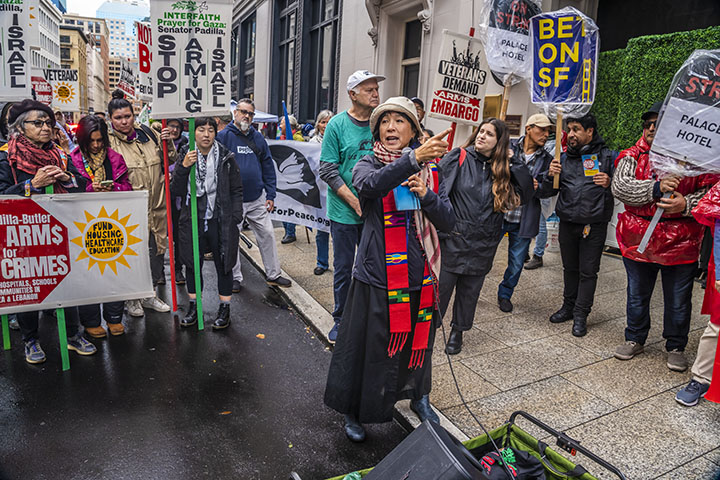
SF MARCH AND CIVIL DISOBEDIENCE DEMAND A CEASEFIRE IN GAZA

photos from the edge 06 - March and Civil Disobedience Demand a Ceasefire in Gaza
Photos by David Bacon

To see a full set of these photos, click here

SAN FRANCISCO, CA  11/11/24 - On Veterans Day hundreds of people, including many war veterans, marched from Harry Bridges Plaza at the foot of Market Street to the office of California Senator Alex Padilla.  Marchers demanded that he and Senator Laphonza Butler support a ceasefire in Israel's assault on Gaza.  More than 43,600 people have been killed in the last year, mostly women and children, and over 102,900 others injured, according to local health authorities.  Israel faces a genocide case at the International Court of Justice for its actions in Gaza.

Senator Bernie Sanders called for a vote in the Senate to block further military aid to Israel.  "The war in Gaza has been conducted almost entirely with American weapons and $18 billion in U.S. taxpayer dollars," he said.  The demonstration was sponsored by Veterans for Peace, the Interfaith Movement for Human Integrity, Jewish Voice for Peace, and others.  Speeches called for meeting the election of Donald Trump without fear, demonstrating in the streets popular opposition to war and repression.

The march stopped to support striking hotel workers outside the Palace Hotel, one of five in San Francisco which have been on strike for weeks.  Marchers and strikers both spoke of seeing the close connection between the working class demands for a decent life and a union, and the demands for an end to military support for Israel.  At the end of the march San Francisco activist artist David Solnit led many in painting a colorful protest on the pavement of Bush Street, while others chained themselves together, blocking the doors of the building housing Senator Padilla's office.


Wednesday, November 6, 2024

WHAT TRUMP CAN AND CAN'T DO TO IMMIGRANTS

WHAT TRUMP CAN AND CAN'T DO TO IMMIGRANTS
By David Bacon
Dollars and Sense | January/February 2017
https://dollarsandsense.org/archives/2017/0117bacon.html

From our January/February 2017 issue, in the wake of Trump's first election to the presidency, David Bacon's perspectives on the economic context of immigration policy and how Trump can-and can't-shape it are still relevant after his recent re-election victory. -Eds.

People make their own history, but they do not make it as they please;
they do not make it under self-selected circumstances, but under
circumstances existing already, given and transmitted from the past.
-Karl Marx, "The Eighteenth Brumaire of Louis Bonaparte," 1852


While the government officials developing and enforcing U.S. immigration policy will change on January 20, the economic system in which they make that policy will not. As fear sweeps through immigrant communities in the United States, understanding that system helps us anticipate what a Trump administration can and can't do in regard to immigrants, and what immigrants themselves can do about it.

Over the terms of the last three presidents, the most visible and threatening aspect of immigration policy has been the drastic increase in enforcement. President Bill Clinton presented anti-immigrant bills as compromises, and presided over the first big increase in border enforcement. George W. Bush used soft rhetoric, but sent immigration agents in military-style uniforms, carrying AK-47s, into workplaces to arrest workers, while threatening to fire millions for not having papers. Under President Barack Obama, a new requirement mandated filling 34,000 beds in detention centers every night. The detention system mushroomed, and over 2 million people were deported.

Enforcement, however, doesn't exist for its own sake. It plays a role in a larger system that serves capitalist economic interests by supplying a labor force employers require. High levels of enforcement also ensure the profits of companies that manage detention and enforcement, who lobby for deportations as hard as Boeing lobbies for the military budget.

Immigrant labor is more vital to many industries than it's ever been before. Immigrants have always made up most of the country's farm workers in the West and Southwest. Today, according to the U.S. Department of Labor, about 57% of the country's entire agricultural workforce is undocumented. But the list of other industries dependent on immigrant labor is long-meatpacking, some construction trades, building services, healthcare, restaurant and retail service, and more. 


Protest in front of Oakland City Hall against the election of Donald Trump as U.S. President.  All photos (c) David Bacon.

During the election campaign, candidate Donald Trump pledged in his "100-day action plan to Make America Great Again" to "begin removing the more than two million criminal illegal immigrants from the country" on his first day in office. In speeches, he further promised to eventually force all undocumented people (estimated at 11 million) to leave.

In a society with one of the world's highest rates of incarceration, crimes are often defined very broadly. In the past, for instance, under President George W. Bush federal prosecutors charged workers with felonies for giving a false Social Security number to an employer when being hired. He further proposed the complete enforcement of employer sanctions-the provision of the 1986 Immigration Reform and Control Act that forbids employers from hiring workers without papers. Bush's order would have had the Immigration and Customs Enforcement agency (ICE) check the immigration status of all workers, and required employers to fire those without legal immigration status, before being blocked by a suit filed by unions and civil rights organizations.

Under President Obama, workplace enforcement was further systematized. In just one year, 2012, ICE audited 1600 employers. Tens of thousands of workers were fired during Obama's eight years in office. Given Trump's choice of Alabama Senator Jeff Sessions as Attorney General, greater workplace enforcement is extremely likely. Sessions has been one of the strongest advocates in Congress for greater immigration enforcement, and has criticized President Obama for not deporting enough people. Last year he proposed a five-year prison sentence for any undocumented immigrant caught in the country after having been previously deported.

Industry Needs Immigrants

Both deportations and workplace firings face a basic obstacle-the immigrant workforce is a source of immense profit to employers. The Pew Hispanic Center estimates that, of the presumed 11 million people in the country without documents, about 8 million are employed (comprising over 5% of all workers). Most earn close to the minimum wage (some far less), and are clustered in low-wage industries. In the Indigenous Farm Worker Survey, for instance, made in 2009, demographer Rick Mines found that a third of California's 165,000 indigenous agricultural laborers (workers from communities in Mexico speaking languages that pre-date European colonization) made less than minimum wage.

The federal minimum wage is still stuck at $7.50/hour, and even California's minimum of $10/hour only gives full-time workers an annual income of $20,000. Meanwhile, Social Security says the national average wage index for 2015 is just over $48,000. In other words, if employers were paying the undocumented workforce the average U.S. wage it would cost them well over $200 billion annually. That wage differential subsidizes whole industries like agriculture and food processing. If that workforce were withdrawn, as Trump threatens, through deportations or mass firings, employers wouldn't be able to replace it without raising wages drastically.

As president, Donald Trump will have to ensure that the labor needs of employers are met, at a price they want to pay. The corporate appointees in his administration reveal that any populist rhetoric about going against big business was just that-rhetoric. But Hillary Clinton would have faced the same necessity. And in fact, the immigration reform proposals in Congress from both Republicans and Democrats over the past decade shared this understanding-that U.S. immigration policy must satisfy corporate labor demands.

During the Congressional debates over immigration reform, the Council on Foreign Relations (CFR) proposed two goals for U.S. immigration policy. In a report from the CFR-sponsored Independent Task Force on U.S. Immigration Policy, Senior Fellow Edward Alden stated, "We should reform the legal immigration system so that it operates more efficiently, responds more accurately to labor market needs, and enhances U.S. competitiveness." He went on to add, "We should restore the integrity of immigration laws, through an enforcement regime that strongly discourages employers and employees from operating outside that legal system." The CFR, therefore, coupled an enforcement regime-with deportations and firings-to a labor-supply scheme. 

Immigrants, workers, union members, people of faith and community activists demonstrated in Silicon Valley, calling for a moratorium on deportations and the firing of undocumented workers because of their immigration status.

This framework assumes the flow of migrating people will continue, and seeks to manage it. This is a safe assumption, because the basic causes of that flow have not changed. Communities in Mexico continue to be displaced by 1) economic reforms that allowed U.S. corporations to flood the country with cheap corn and meat (often selling below the cost of production-known as "dumping"-thanks to U.S. agricultural subsidies and trade agreements like NAFTA), 2) the rapacious development of mining and other extractive concessions in the countryside, and 3) the growing impoverishment of Mexican workers. Violence plays its part, linked to the consequences of displacement, economic desperation, and mass deportations. Continuing U.S. military intervention in Central America and other developing countries will produce further waves of refugees.

While candidate Trump railed against NAFTA in order to get votes (as did Barack Obama), he cannot-and, given his ties to business, has no will to-change the basic relationship between the United States and Mexico and Central America, or other developing countries that are the sources of migration. Changing the relationship (with its impact on displacement and migration) is possible in a government committed to radical reform. Bernie Sanders might have done this. Other voices in Congress have advocated it. But Trump will do what the system wants him to do, and certainly will not implement a program of radical reform.

H-2A Guest Workers

The structures for managing the flow of migrants are already in place, and don't require Congress to pass big immigration reform bills. In Washington State alone, for instance, according to Alex Galarza of the Northwest Justice Project, the Washington Farm Labor Association brought in about 2,000 workers under the H-2A guest worker program in 2006. In 2013, the number rose to 4,000. By 2015, it grew to 11,000. In 2016, it reached 16,000. That kind of growth is taking place in all states with a sizeable agricultural workforce. The H-2A program allows growers to recruit workers outside the country for periods of less than a year, after which they must return to their country of origin. Guest workers who lose their jobs for whatever reason-whether by offending their employer, or not working fast enough, for example-have to leave the country, so joining a union or protesting conditions is extremely risky. Growers can only use the program if they can show they can't find local workers, but the requirement is often unenforced.

The program for foreign contract labor in agriculture is only one of several like it for other industries. One study, "Visas, Inc.," by Global Workers Justice, found that over 900,000 workers were brought to the United States to work every year under similar conditions. The number is growing. In the context of the growth of these programs, immigration enforcement fulfills an important function. It heralds a return to the bracero era, named for the U.S. "guest worker" program that brought millions of Mexican farmworkers to the United States between 1942 and 1964. The program was notorious for its abuse of the braceros, and for pitting them against workers already in the United States in labor competition and labor conflict. In 1954 alone, the United States deported over a million people-while importing 450,000 contract workers. Historically, immigration enforcement has been tied to the growth of contract labor, or "guest worker" programs.

Arresting people at the border, firing them from their jobs for not having papers, and sending people to detention centers for deportation, all push the flow of migrants into labor schemes managed to benefit corporations. The more a Trump administration pushes for deportations and internal enforcement, the more it will rely on expanding guest worker programs.

The areas where programs like H-2A are already growing were heavy Trump supporters. In eastern Washington, a heavily Trump area, immigration agents forced the huge Gebbers apple ranch to fire hundreds of undocumented workers in 2009, and then helped the employer apply for H-2A workers. While the undocumented workers of eastern Washington had good reason to fear Trump's threats, employers knew they didn't have to fear the loss of a low-wage workforce.

Deportations and workplace enforcement will have a big impact on unions and organizing rights. Immigrant workers have been the backbone of some of the most successful labor organizing of the last two decades, from Los Angeles janitors to Las Vegas hotel workers to Republic Windows and Doors in Chicago. At the same time, the use of the E-Verify database under President Obama often targeted workers active in labor campaigns like Fight for $15, as did earlier Bush and Clinton enforcement efforts.

Unions and immigrant communities have developed sophisticated tactics for resisting these attacks, and will have to use them effectively under Trump. Janitors in Minneapolis fought the firing of undocumented fast-food workers in Chipotle restaurants. The International Longshore and Warehouse Union (ILWU) teamed up with faith-based activists, immigrant-rights groups, and environmentalists to stop firings of undocumented workers in Bay Area recycling facilities, winning union representation and higher wages as a result. The same unions and community organizations that have fought enforcement in the workplace have also fought detentions and deportations. 

 
Immigrant Latino workers from the Woodfin Suites hotel in Emeryville, Calif., and their supporters protest after hotel managers fired 20 workers, accusing them of lacking legal immigration status.

These efforts will have to depend on more than a legal defense. The Supreme Court has already held that undocumented workers fired for organizing at work can't be rehired, and their employers don't have to pay them back pay.

Border Enforcement

Trump's threatened enforcement wave extends far beyond the workplace. He promised increased enforcement on the U.S.-Mexico border, expanding the border wall, and increasing the number of Border Patrol agents beyond the current 25,000. Immigration enforcement already costs the government more than all other federal law enforcement programs put together.

Trump proposed an End Illegal Immigration Act, imposing a two-year prison sentence on anyone who re-enters the U.S. after having been deported, and five years for anyone deported more than once. Under President Obama, the United States deported more than two million people. Hundreds of thousands, with children and families in the United States, have tried to return to them. Under this proposed law, they would fill the prisons.

One of Trump's "first day" commitments is to "cancel every unconstitutional executive action, memorandum and order issued by President Obama." This promise includes Obama's executive order giving limited, temporary legal status to undocumented youth brought to the United States by their parents (Deferred Action for Childhood Arrivals, or DACA). DACA has been attacked by the right-wing ideologues advising Trump's transition team since Obama issued his order.

The 750,000 young people who gained status under DACA-the "Dreamers"-have been one of the most active sections of the U.S. immigrant-rights movement. But they had to give the government their address and contact information in order to obtain a deferment, making them vulnerable to deportation sweeps. Defending them will likely be one of the first battles of the Trump era.

Trump further announced that on his first day in office he will "cancel all federal funding to Sanctuary Cities." More than 300 cities in the United States have adopted policies saying that they will not arrest and prosecute people solely for being undocumented.

Many cities, and even some states, have withdrawn from federal schemes, notably the infamous "287(g) program," requiring police to arrest and detain people because of their immigration status. Trump's proposed order would cancel federal funding for housing, medical care, and other social services to cities that won't cooperate. As attorney general, Sessions can be expected to try to enforce this demand. After the election, many city governments and elected officials were quick to announce that they would not be intimidated. The Dreamers especially see direct action in the streets as an important part of defending communities. In the push for DACA, youth demonstrations around the country sought to stop deportations by sitting in front of buses carrying prisoners to detention centers. Dreamers defended young people detained for deportation, and even occupied Obama's Chicago office during his 2012 re-election campaign.

In detention centers themselves, detainees have organized hunger strikes with the support of activists camping in front of the gates. Maru Mora Villapando, one of the organizers of the hunger strikes and protests at the detention center in Tacoma, Wash., says organizers cannot just wait for Trump to begin his attacks, but have to start building up defense efforts immediately. She advocates pressuring the Obama administration to undo as much of the detention and deportation machinery as possible before leaving office. "We don't want him just to hand over the keys to this machine as it is right now," she warns.

The success of efforts to defend immigrants, especially undocumented people, depends not just on their own determination to take direct action, but on support from the broader community. In Philadelphia, less than a week after the election, Javier Flores García was given sanctuary by the congregation of the Arch Street United Methodist Church after being threatened by federal immigration agents. "Solidarity is our protection," urged the Reverend Deborah Lee of the Interfaith Movement for Human Integrity in California. "Our best defense is an organized community committed to each other and bound together with all those at risk. ... We ask faith communities to consider declaring themselves 'sanctuary congregations' or 'immigrant welcoming congregations.'"

But while many workers may have supported Trump because of anger over unemployment and the fallout from trade agreements like NAFTA, they also bought his anti-immigrant political arguments. Those arguments, especially about immigrants in the workplace, even affect people on the left who opposed Trump himself. Some of those arguments have been made by Democrats, and used to justify enforcement measures like E-Verify included in "comprehensive immigration reform" bills. One union activist, Buzz Malone, wrote a piece for In These Times arguing for increased enforcement of employer sanctions, although he envisioned them more as harsher penalties for employers who hire the undocumented. "Imprison the employers ... and all of it would end," he predicted. "The border crossings would fizzle out and many of the people would leave on their own."

What Is to Be Done?

To defeat the Trump enforcement wave, immigrant activists in unions and communities will have to fight for deeper understanding and greater unity between immigrants and U.S.-born people. Workers in general need to see that people in Mexico got hit by NAFTA even harder than people in the U.S. Midwest-and their displacement and migration isn't likely to end soon. In a diverse workforce, the unity needed to defend a union or simply win better conditions depends on fighting for a country and workplace where everyone has equal rights. For immigrant workers, the most basic right is simply the right to stay. Defending that right means not looking the other way when a coworker, a neighbor or a friend is threatened with firing, deportation, or worse.

The rise of a Trump enforcement wave spells the death of the liberal centrism that proposed trading increased enforcement and labor supply programs for a limited legalization of undocumented people. Under Trump, the illusion that there is some kind of "fair" enforcement of employer sanctions and "smart border enforcement" will be stripped away. Sessions will have no interest in "humane detention," with codes of conduct for the private corporations running detention centers. The idea of guest worker programs that don't exploit immigrants or set them against workers already in the United States will face the reality of an administration bent on giving employers what they want.

So in one way the Trump administration presents an opportunity as well-to fight for the goals immigrant rights advocates have historically proposed, to counter inequality, economic exploitation, and the denial of rights. As Sergio Sosa, director of the Heartland Workers Center in Omaha, Nebr., puts it, "we have to go back to the social teachings our movement is based on-to the idea of justice."


DAVID BACON is a journalist and photographer covering labor, immigration, and the impact of the global economy on workers. He is author of several books, including Illegal People: How Globalization Creates Migration and Criminalizes Immigrants (Beacon Press, 2009) and More Than a Wall/Mas que un muro (Colegio de la Frontera Norte, 2022).


SOURCES: "Donald Trump's Contract with the American Voter" (donaldjtrump.com); Chico Harlan, "The private prison industry was crashing-until Donald Trump's victory," Wonkblog, Washington Post, Nov. 10, 2016 (washingtonpost.com); U.S. Immigration and Customs Envorcement, "Delegation of Immigration Authority Section 287(g) Immigration and Nationality Act" (ice.gov); Interfaith Movement for Human Integrity (im4humanintegrity.org); Community Initiatives for Visiting Immigrants in Confinement, "End the Quota" (endisolation.org); Jens Manuel Krogstad, Jeffrey S. Passel, and D'Vera Cohn, "Five facts about illegal immigration in the U.S.," Pew Research Center, Nov. 3, 2016 (pewresearch.org); Bureau of Labor Statistics, "Foreign-Born Workers: Labor Force Characteristics, 2016," May 19, 2016 (bls.gov); Jie Zong and Jeanne Batalova, "Frequently Requested Statistics on Immigrants and Immigration in the United States," Migration Information Service, April 14, 2016 (migrationpolicy.org); "Selected Statistics on Farmworkers," Farmworker Justice, 2014 (farmworkerjustice.org); "Indigenous Mexicans in California Agriculture," Indigenous Farmworker Study (indigenousfarmworkers.org); "U.S. Immigration Policy Task Force Report," Council on Foreign Relations, August 2009 (cfr.org); "Visas, Inc.: Corporate Control and Policy Incoherence in the U.S. Temporary Foreign Labor System," Global Workers Justice Alliance, May 31, 2012 (globalworkers.org); "H-2A Temporary Agricultural Workers," U.S. Citizenship and Immigration Services (uscis.gov); Buzz Malone, "Stop Blaming Immigrants and Start Punishing the Employers Who Exploit Them," Working In These Times (blog), Nov. 15, 2016 (inthesetimes.com); David Bacon, Illegal People (Beacon Press, 2008); David Bacon, The Right to Stay Home (Beacon Press, 2013); David Bacon, author interviews with Alex Galarza, Maru Mora Villapando, Deborah Lee, and Sergio Sosa (2016); Mae M. Ngai, Impossible Subjects: Illegal Aliens and the Making of Modern America (Princeton University Press, 2004); Ronald L. Mize and Alicia C. Swords, Consuming Mexican Labor: From the Bracero Program to NAFTA (University of Toronto Press, 2010).