Monday, July 24, 2023

COMMUNITIES OF RESISTANCE ALONG THE BORDER

COMMUNITIES OF RESISTANCE ALONG THE BORDER
by David Bacon
Latin American Perspectives, March 2023
https://journals.sagepub.com/doi/abs/10.1177/0094582X221149440

 
David Bacon is a photographer and writer who has documented the social movements on the Mexico/U.S. border for 30 years.. The photographs reproduced here are selected from the book  "More Than a Wall/Mas que un muro" published by the Colegio de la Frontera Norte, Tijuana, Mexico, 2022. For more information about the book, write to dbacon@igc.org or click here


Over the past half century the once-small towns of Ciudad Juárez and Tijuana have become cities of millions. A huge part of the industrial workforce in the production and supply chain that delivers products to U.S. consumers lives not on the U.S. but on the Mexican side of the border, where people build homes out of cardboard and shipping pallets cast off by the maquiladoras and the dirt streets of their barrios often end at the border wall.

Many neighborhoods have no sewers and flood when it rains. Electricity is stolen by hooking up to power lines, while drinking water comes in a truck and people must pay to fill the tanks in front of their homes. Often living conditions for poor and homeless people in border cities like Tijuana are no different from those endured by migrants who have crossed the border to live in the United States.

In fact, most people living near the border in Mexico have no hope or expectation of crossing it. More than half of the border residents have no tourist visas or border-crossing cards. Instead they seek a way to earn a living and raise a family where they are. When the wages are low and the housing poor, they try to confront those conditions by changing them, not by crossing over to the other side.

The border has therefore been the scene of some of Mexico's sharpest social struggles, and the photographs in this collection are an effort to document that social history. This upsurge is not new-it's been going on for more than a hundred years. For three decades I've taken photographs of workers' efforts to organize to resist the poverty that the border factory regime imposes, showing both the actions in the streets and the cost visible in the homes of workers, miners, and other people living throughout the border region.

The border is a vast area with a vibrant social history. We need to see behind the superficial media coverage of the wall and people's efforts to get past it. The purpose of my photography in the border region is to provide a broader view historically, to make the invisible visible. The images have a sharp critical edge and are intended to provoke questions about the reality people experience living there.

Maclovio Rojas, on the eastern edge of Tijuana, is home to 1,300 people. It is a community in resistance, first settled in 1988 by people who could find no other place to live in the rapidly expanding city. The land they settled on was unoccupied and belonged to the federal government. Under the old agrarian reform law, people were entitled to settle here and petition the government for formal ownership. Along the dirt roads that fan out like a grid from the highway, peoples' houses are made of old pallets, unfolded corrugated shipping cartons, and other castoffs from the factories. The community sits on a dry, flat, sandy lowland surrounded by treeless hills.

The land here doesn't seem very desirable, but on the other side of a dirt road at the edge of town looms the maquiladora of the Hyundai Corporation, and just over the hill is the Florido Industrial Park. The North American Free Trade Agreement and a devalued peso inspired a building boom in Tijuana, and in a few decades a small, honky-tonk tourist town became home to hundreds of maquiladoras.

The growth of the maquiladora industry transformed life for 2 million people who today live in the city. "Tijuana was created this way," explained Eduardo Badillo, general secretary of the Border Workers' Regional Support Committee, a community organization active in the city's barrios. "The government calls these settlements 'invasions,' and we call them 'possessions.' Whatever you call them, the law recognized our right to build homes on this land, because under the Constitution, it's our country."

Land reform rights were weakened, however, by NAFTA-era changes to Mexico's constitution designed to make it easier for corporations like Hyundai to own land and protect their titles. After building their homes, the Yorbas, Tijuana's original landowners before the Revolution, claimed that the land was theirs. Residents viewed this as a thinly disguised means for Hyundai to gain possession. The family accused the community leader Hortensia Hernandez of illegally taking their land, and in 1995 she was arrested.

Residents refused to abandon their homes, and the conflict grew. After five months in prison, the family couldn't come up with documents proving their title, and Hernandez was finally released. When she walked out of prison, she owed her freedom in large part to the Tijuana-based Border Workers Regional Support Committee and the San Diego-based Support Committee for Maquiladora Workers. Both groups helped organize a march from Tijuana to the state capital in Mexicali to demand her release.

Maclovio Rojas became one of many communities like it along the border. Because they were created by land occupations by poor people, often workers from the maquiladoras, the communities' legal titles were almost always denied by governments anxious to protect investors. Facing efforts to drive them from their homes and off the land, they quickly became communities of resistance. Some were driven away, but others hung on despite the imprisonment of leaders and conflicts with police and golpeadores (thugs who beat people.)

In the 1990s Maclovio Rojas was the scene of conflict like this, but today it is a much more peaceful place, and its residents over the years have forced local government to provide schools and a minimum level of services. The tradition of land occupation is still very much alive, however, and similar communities of resistance exist on the outskirts of almost every large city on the border.

Cañon Buenavista is another community in resistance, created in two separate land invasions by rural workers from the ranches of Maneadero, the agricultural valley just south of Ensenada. The first was led by Benito García, a controversial figure among Oaxacan migrants. He was a charismatic leader of agricultural strikes in the early 1980s, later accused of misusing his authority. In the 1980s Garcia organized farmworkers in the Maneadero Valley who were living in labor camps or even sleeping by the roadside to occupy 50 hectares on a desert hillside south of town. The state government then bought out the people who claimed ownership of the land, and resold it to the occupiers through an agency called the Immobiliaria Estatal.

Julio Sandoval arrived in Cañon Buenavista in 1990 and built a home there for his family. He had already led a similar movement in the San Quintín Valley of Baja California to organize a community of Triqui farmworkers called Nuevo San Juan Copala. The Confederación Independiente de Obreros Agrícolas y Campesinos, a radical rural organization founded by the Mexican Communist Party, led many of these fights, and its leader, Beatriz Chavez, was imprisoned for occupying land for homes.

Sandoval got into trouble with the state authorities when he began telling Cañon Buenavista residents not to make payments on their lots. Immobiliaria Estatal had raised the sale price and payments for each lot, and many families never got out of debt. But Sandoval had discovered that in 1973 the federal government had declared tens of thousands of hectares in northern Baja, including the land Cañon Buenavista sits on, government property. As a result of a new land invasion, Cañon Buenavista's total population grew to 2,700 families -about 10,000 people, most of whom come from  Mixtec and Triqui towns in Oaxaca. Sandoval, however, was accused of taking land by force and jailed in the state prison in Ensenada for two years.

These are communities created by land hunger - people drawn to the border for work but with no provision for housing. To survive, many communities of resistance appealed for support from the Coalition for Justice in the Maquiladoras and other cross-border groups. The Frente Indígena de Organizaciones Binacionales also organized support for indigenous migrants, both in their towns of origin in Oaxaca, in the towns south of the border in Baja California, and in indigenous communities north of the border in California.

At the other end of the border, near the city of Matamoros, maquiladora workers built the settlements of Derechos Humanos and Fuerza y Unidad. Outside of Nuevo Laredo, across the border from Texas, Blanca Navidad, like Cañon Buenavista, also linked itself to the movement for autonomous communities developed by the Zapatistas in Chiapas.

After successfully resisting eviction by the state government of Tamaulipas in 2006, the autonomous indigenous communities of Chiapas sent 1,000 boxes of groceries to the people of Blanca Navidad in support of their north-south alliance. A year later the Zapatista Comandantes Eucaria, Miriam, and Zebedeo held a two-week exchange there and the community built a health center it called El Otro Caracol (The Other Snail). In that meeting Comandante Eucaria explained that women are critical to the survival of communities of resistance:
      
"As women, we are needed the most in the autonomous town. We start up projects like embroidering work, raising chickens, baking bread. Although we make very little money, we use it for the needs of our struggle, and if any is left over we invest it in mills for grinding masa. That way women will have more time to do other work. We make the decisions and no one can give us orders."


Figure 1. Maclovio Rojas, Tijuana, Baja California,  1996. The flag of the CIOAC flying at a gate into the community. On the other side of the road and fence are trailers manufactured in the Hyundai factory. Maclovio Rojas residents believed that the state government was trying to drive them off their land so that the industrial park could expand. 


Figure 2. Maclovio Rojas, Tijuana, Baja California, 1996. A sign at the entrance into Maclovio Rojas declaring it a civil organization and union of small landholders affiliated with the CIOAC. The CIOAC was organized by the Mexican Communist Party and other leftist activists to help small farmers and the rural poor defend their rights to land. By 1996 the original PCM no longer existed, but in Baja California its activists continued to help migrant workers organize, settle, and build homes. 


Figure 3. Maclovio Rojas, Tijuana, Baja California, 1996. Children playing with tires and milk crates in the dirt street. 


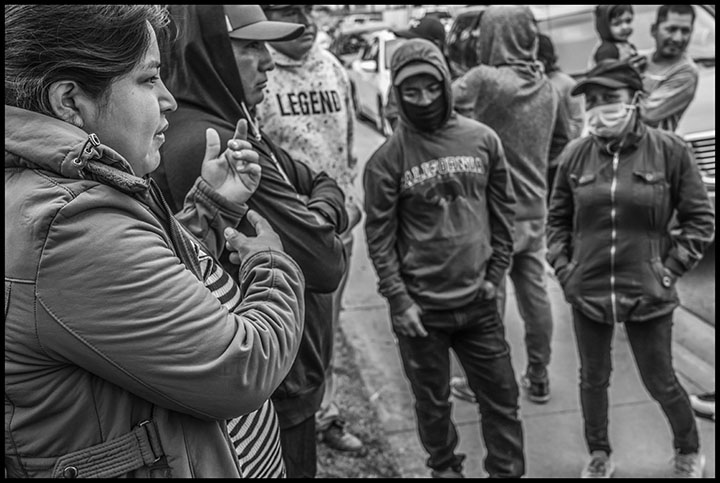
Figure 4. Maclovio Rojas, Tijuana, Baja California, 1996. Residents listening to Hortensia Hernandez speak after she was released from prison, where she had been held for leading the struggle to gain their land rights. "I've lived in Tijuana for 21 years, and 9 years here in Maclovio Rojas," she told them. "We're fighting to keep our 197 hectares. This is an industrial zone. They've told us that they've committed this area to transnational corporations. The freeway is going to come through here, so the land has become very valuable. But we're not going to cede one centimeter.

"The state government wanted to gain possession of the land, but when they saw that we weren't going to give it up they began to fabricate accusations against us, especially despojo de instigación [provoking an illegal occupation]. Here in Baja California, when they accuse you of this, there's no bail, but we were able to prove that we were innocent and that the accusations had been fabricated. We showed that these were federal lands, and I was released. The state government sees that they can't do much to us because of the resistance we've put up.

"I was in jail for five months. In the penitentiary a day felt like a year. This prison is a place of perdition. The people held there, instead of being rehabilitated, leave in a much worse state, in which they've deteriorated morally and physically.

"People here are poor and often don't even have anything to eat. With no support from the government to make this land productive, people have to work in the maquiladoras to survive. Over half the people in Maclovio Rojas are workers in various factories. Many work at Hyundai. When some were unjustly fired from the Laymex factory they decided to organize a strike. We went to support them-one of the reasons I was detained." 


Figure 5. Cañon Buenavista, Baja California, 2002. The town merging into the surrounding desert hills. 


Figure 6. Cañon Buenavista, Baja California, 2002. Esther Murillo, a member of one of the 20 families that first occupied 78 hectares in the hills surrounding Cañon Buenavista. They chose May 1, the international workers' holiday, as the day for their action. "There were only 30 of us at first, and the police surrounded us," she remembered. "They said they were going to burn the houses we built, but 20 of us stayed up and watched all night. We had our children inside, and we were afraid of what might happen to them. But we were all calm and wouldn't move, so there were no physical confrontations. At first there were 40 houses, a week later 50. Now there are about 500. But for a long time the police kept coming every night to scare us."

Murillo had no money to pay rent or buy land. Making 50-70 pesos (US$5-7) a day in the fields and working only during the harvest season, she couldn't survive. "We're poor. So what were we going to do?" she asks. Once they occupied the land, however, she and her fellow residents were in for a surprise. "This was just a hillside covered with weeds, full of snakes and tarantulas, and we cleaned it all up, but then, after we'd done the work, a lot of supposed owners suddenly appeared." 


Figure 7. Cañon Buenavista, Baja California. 2002. Juana Sandoval, the wife of imprisoned community leader Julio Sandoval, heating tortillas on a stove set up on cinder blocks and connected by a rubber hose to a big propane bottle that the family has to fill twice a month. Their one large room is dim even at midday, but their home is better than many in Cañon Buenavista. "Some of us live in cardboard houses and cook on wood fires, a very dangerous combination," Julio said in a phone interview from prison. An exterior plywood wall was charred in one such fire, which burned down the home next door. 


Figure 8. Cañon Buenavista, Baja California, 2002. Residents husking tomatillos for very low pay from the big Herdez canning plant in Ensenada.  


Figure 9. Cañon Buenavista, Baja California, 2002. Residents talking and joking to make the time pass while they work husking tomatillos. 


Figure 10. Blanca Navidad, Tamaulipas, 2006. Community leader Blanca Enriquez working in the community garden. Before building the garden and a community health center, she said, "We had nothing. When the government tried to evict us all we had left were tarps and poles, and a few blankets. The majority of us in this colonia work in the maquiladoras, but regardless of where we work we are from this community, and we all are equal." 


Figure 11. Blanca Navidad, Tamaulipas, 2006. A family inside its home, which has a dirt floor and plywood walls salvaged from construction in the factories. Colonias like Blanca Navidad have been called "lost cities"-places, according to the journalist Javier Hernández Alpízar, "where excluded Mexicans live, stripped of their right to housing." In acute contrast, not far from the colonia is the bridge crossing the border to the United States known as the World Trade International Bridge. 


Figure 12. Blanca Navidad, Tamaulipas, 2006. The extended family of a maquiladora worker. In 2006 the people of the Blanca Navidad community were brutally evicted when Nuevo Laredo's mayor sent in tractors to demolish their houses; many houses were burned, leaving women and children with nothing. When El Mañana exposed the local government and supported the community in its struggle for its land,  the newspaper office was bombed and a reporter was seriously injured. Those responsible for the bombing were never identified. 


Figure 13. Blanca Navidad, Tamaulipas, 2006. A little girl holding her pet cat in front of her house. 


Figure 14. La Alianza, Nuevo León, 2001. Electric wires illegally hooked up to the main line half a mile away snaking into the barrio of La Alianza. The city of Monterrey provides no services to many barrios of maquiladora workers like this one while providing investment and support to developers of the industrial parks where the workers are employed. 


Figure 15. La Alianza, Nuevo León, 2001. A woman leaning on her shovel in front of her home, the walls of which have been assembled out of metal plates, bedsprings, and salvaged wood. 


Figure 16. La Alianza, Nuevo León, 2001. A placard from a recent election reading "The vote is free and secret." One of the strongest defenders of the residents of La Alianza and of poor barrio residents in Monterrey generally was Ignacio Zapata, who challenged fraudulent elections that kept the parties of poor and working-class people out of power.

Zapata helped found organizations like the Alliance of the Users of Public Services, which fought for electricity, water, and municipal services in La Alianza and other barrios, and the Binational Pro-Bracero Alliance, which fought to recover the money taken from the pay of bracero migrants in the United States from the 1940s to the early 1960s.

Originally a believer in liberation theology, he joined the Mexican Communist Party, later helped organize the Mexican Socialist Party (the precursor of the Party of the Democratic Revolution), and supported the 2006 presidential campaign of Andrés Manuel López Obrador, who was elected President of Mexico as the candidate of the Movimiento Regeneracion Nacional in 2018. 


Figure 17. Derechos Humanos, Tamaulipas, 2006. Buses waiting to take residents of Derechos Humanos and Fuerza y Libertad to the factories where many work and to the bridge where they cross the Rio Grande to Brownsville, Texas. 


Figure 18. Derechos Humanos, Tamaulipas, 2006. A small business run from home, selling buns, chocobananas, and tostada snacks. 
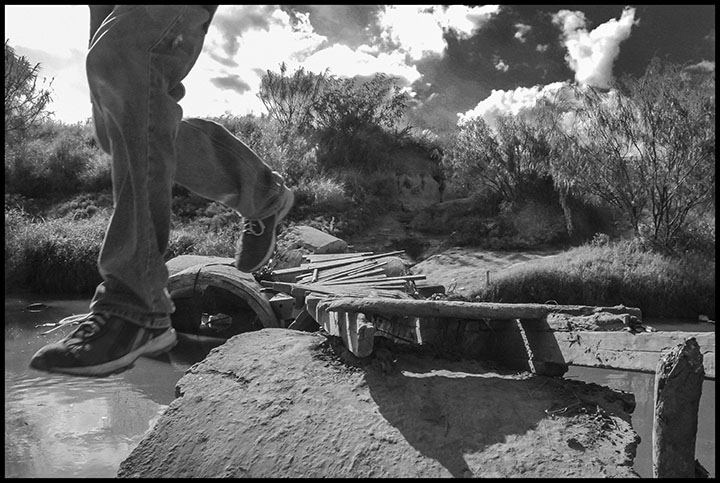


Figure 19. Derechos Humanos, Tamaulipas, 2006. A boy jumping across a rickety bridge over a polluted canal near the U.S. border. The canal, which is contaminated by toxic chemicals dumped by the factories, runs alongside homes. Residents built the bridge to get from one part of the neighborhood to another. 


Figure 20. Derechos Humanos, Tamaulipas, 2006. A boy bringing home wood for the stove. 


Figure 21. San Francisco, California, 2016. Elvia Villescas, the director of Las Hormigas, a community organizing project in a neighborhood of Ciudad Juárez where many maquiladora workers live. She describes her community as follows:

"We're located in Anapra and Lomas de Poleo, very marginalized communities in Ciudad Juárez, Chihuahua, on the U.S. border. We began Las Hormigas to organize educational and human development projects. Anapra and Lomas de Poleo became famous because of the number of women's bodies found there during the feminicides. In both neighborhoods there are many families that had lost a daughter or a sister who disappeared or was murdered.

"Anapra is a community that has been abandoned. On the surface it looks developed. It's on a big highway, and big trucks go by all the time to the border crossing. There are some big businesses along the highway because the government has opened this commercial space for them, but if you walk just one or two blocks into the neighborhood you'll see very deep poverty.

"Anapra has about 20,000 inhabitants. People living there have big health problems because the sanitation is so bad. Many homes still have no sewers or drains, so the wastewater runs into the streets. The government hasn't invested money in the schools. So in that sense, there is a lot of repression against this community.

"The majority of the people living there are migrants, and a great number work in the maquiladoras. In Las Hormigas we've done mini-surveys during our workshops, asking people to raise their hands if they work in a maquila. Out of 30 people, 10 or 12 will raise their hands. So imagine that in Anapra 30 or 40 percent of the people living there work in a maquila. There's a great need in this community for education-not schoolbook education but education in rights and solidarity.

"The media refuse to carry stories about this movement [the Juarez strikes of 2015] in the four maquiladoras or treat it with the importance it deserves. In Commscope 178 workers were fired, and there are four maquilas where this has happened, but people have little information about this. Those who do know about it don't want to talk because they're afraid that if they say anything they'll be identified as troublemakers and the companies will start watching them.

"There is a list of workers whom the companies are watching and following. There are threats all the time that if you do something they don't like, you'll never get a job in a maquiladora. Workers in the maquilas are always very afraid that anything they say may lead to losing their jobs, and a maquila job is still seen as a job with some security-very poorly paid but at least you're working.

"The workers are producing all the wealth but receive very little benefit from it, while the companies make a lot of money. The maquiladoras will not permit workers to organize unions. To allow that would mean that they would have listen to them and respect their labor and health rights. The maquiladoras have no conscience, no sense that workers have rights. They comply with the minimum that the law demands, but there's no sense that because they have thousands of workers they should give them better wages or a clinic or a child care center for the women workers.

"People are tired of the wages. At 170 pesos a day you can't buy anything. You go to the store and buy three or four things and you've spent 500 pesos. But I think that in Mexico generally there is also an exhaustion that has grown and grown. People have grown tired of seeing so many abuses tolerated by those who are on top, whether it's a maquiladora or the authorities. The demand is growing that they begin to respect people's rights. This process has developed over a long time, and we're reaching the limit. That's important, because for so many years we've been living with everything.

"This movement of people in the maquilas is very important. We have to know about it and support it. It is the power of unity against the economic power. It's something incredible. A union with power here would make a very big difference. It would give power to the people, to the workers. Instead of just working to earn their 800 pesos people would feel that they have the ability to make decisions, to demand what they need. Right now, if you are a worker and if you need someone to take care of your child, that means nothing to the maquiladora. You say, 'I need someone to take care of my baby,' but the maquiladora doesn't hear your voice. But if there's a union with the strength that comes from unity the maquiladora will have to listen.

"I love my country, but sometimes it gives me great pain. We need to wake up and recover who we are. We have to change the direction everything is going, all the corruption. It's a very important moment. This movement of maquiladora workers is taking the leap, making us question who we are. It's a very positive signal that things may be difficult but we are going to see a change."

Tuesday, July 18, 2023

WHERE DISCRIMINATION FLOURISHED LIKE MUSHROOMS

WHERE DISCRIMINATION FLOURISHED LIKE MUSHROOMS
By David Bacon
The American Prospect / Capitol & Main - 6/23/23

 
Company housing provided to H-2A mushroom workers. Photo courtesy Elizabeth Strater.


Mushrooms grown for the supermarket thrive on a mixture of straw and manure.  Huge piles of it are heated to prepare the growth media, spreading the pungent stink of ammonia through the barns.  Metal trays, covered with the resulting dark soil, are stacked high into the sheds' moist darkness.  Soon the familiar round white caps appear.  Workers enter and cut their stems, placing them in 10-pound boxes.  Runners ferry them out to a checker, where they're weighed and counted.

An individual mushroom is very light, so picking 68 pounds an hour, as Ostrom Mushroom Farms demanded, meant working like a demon in the dark.  "It's really hard," according to Jose Martinez, a fired Ostrom worker.  "The smell was terrible.  There were chemicals in the growing mix, which made it smell even worse, and they wouldn't tell us what they were.  The foreman would joke, 'Don't worry, you won't die!'  If a picker protested, a supervisor would tell her, 'If you don't like it, there's the door!'"

Last year the company did show the door to dozens of its workers, replacing experienced women pickers with crews of men.  And in May Washington State's Attorney General, Bob Ferguson, found these firings constituted massive violations of worker protection regulations.  He forced Ostrom into a record $3.4 million settlement.  "It's obvious what they did," Ferguson told a May 17 news conference. "They're not paying $3.4 million to the state of Washington unless they did something wrong."  Ostrom's money will pay damages to 170 of its former workers.

The Ostrom case is historic, not just because workers were fired as a result of sex discrimination, protests and failure to meet production quotas.  The company used contract laborers on H-2A temporary visas to replace them.  "This settlement validates what we've been saying for years," charges worker advocate Rosalinda Guillen, a member of the state commission formed to monitor the negative impact of the controversial H-2A visa program.  "It is inherently abusive both to the workers brought to the U.S., and to the local workers the companies replace.  It's not called 'close to slavery' for nothing."

Ostrom has gone out of business, so no representative could be reached for comment for this article.

* * *

Ostrom began operating a mushroom shed in Sunnyside, a small farmworker town in the Yakima Valley, in 2019.  Martinez went to work there soon after, fabricating the metal growing trays.  "I saw women crying because of the way they were mistreated," he recalls.  "Supervisors threatened them to get them to work faster.   They were afraid they'd lose their jobs."

Martinez and organizers for the United Farm Workers began holding meetings to talk about forming a union.  "People started to lose their fear," he says.  "At first there were seven at a meeting, then fourteen, then more.  We talked about the low wages, and about fighting for our rights."  Workers were particularly incensed, he says, when the production quota was raised to 65 pounds an hour.  Their protests briefly got it lowered to 50.

Then Ostrom began bringing in H-2A workers. Under that program, growers and labor contractors can recruit workers in countries like Mexico and bring them to work in the United States for a period of less than a year. Growers must file an application to bring the workers in, called an H-2A Agricultural Clearance Order.

The company's H-2A Agricultural Clearance Order, filed with the U.S. Department of Labor, called for 70 workers who would start on December 15, 2021, and return to Mexico after August 15, 2022.  They'd be paid $16.32 per hour, or a piece rate of 23¢ per pound.  To earn more than the hourly wage at that piece rate, the H-2A laborers would have to pick over 71 pounds per hour.  

In the Clearance Order the company said that meeting the 71 pound quota "is a requirement to hold the position of full time Harvester."  To ensure they had a crew able to do it, Ostrom's labor contractor, H2 Visa Solutions, hired young men almost exclusively.  Under the visa program rules, these workers could only work for Ostrom, and the company could fire them for any reason, including failure to meet the quota.  Terminated workers have to leave the country immediately, and are routinely blacklisted by recruiters, who deny them work in following years.

According to the Attorney General's complaint, from January to May, 2022, the company employed 180 local workers, mostly women, who lived in the Sunnyside area.  Starting in December, 2021, three month before the H-2A workers arrived, "managers began calling domestic [local] pickers into one-on-one meetings in which the domestic pickers were told they were not meeting production minimums, and would be receiving a warning along with a three-day, unpaid suspension if their performance did not improve. The pickers were told they would be fired if they did not meet the production minimum within a week of returning from the three-day suspension."

The quota for the mostly-women local workforce was increased from 62.5 to 68 pounds per hour.  At the same time, the company stopped letting workers know their actual production rate.  Pickers often have to clean the growing rooms and dispose of garbage, but time spent doing this work was counted as though it was time spent picking, and subject to the quota.  "It was very stressful," Martinez says. "The company used the pressure of the H-2A workers, right next to the local workers.  They told the H-2A workers not to talk with us.  Almost all were indigenous people from Guerrero and Chiapas, and many didn't speak Spanish."

The complaint charges the local workers were given written warnings, suspended, and then terminated.  "Female domestic pickers received these warnings and unpaid suspensions more frequently than their male counterparts and were therefore terminated at a higher rate than their male counterparts ... At least some female pickers believed that [Ostrom] instituted these changes in order to have a reason to suspend and terminate workers who they wanted to force out ... From early 2021 to May 2022, [Ostrom] terminated approximately 79% of their domestic pickers and 85% of their female pickers."

* * *

Under the visa program rules, Ostrom had to give hiring preference to local workers.  Before bringing H-2A workers, it was required to advertise the jobs to the local community, and had to pay local workers at the same rate.  But while paying a guaranteed $17.41 per hour to the contracted laborers, it paid a lower wage to local residents.  While Ostrom's public advertisements, and even the Clearance Order, required a minimum of three months experience, few of the H-2A workers met the bar.  Local applicants were rejected if they didn't meet it, however.  

The company's Facebook job advertisement, the only outreach effort it made, said it would hire "solo personal masculino," - only male personnel. According to attorney Edgar Aguilasocho, vice president at Martinez Aguilasocho Law Inc. and general counsel for the UFW Foundation, the hiring process has to be approved by the Washington State Employment Security Department, and then the employer simply self-reports the results.  "It's strange the petition [for H-2A visas] was approved," he says.  "Many domestic workers applied and were denied."  Ostrom reported hiring four local women while hiring 65 male H-2A workers.

According to Colombia Legal Services attorney Joe Morrison, legal aid offices have brought numerous suits in the past over the same violation.  Columbia Legal Services sued a large Washington State winery, Mercer Canyons, in one celebrated case reminiscent of Ostrom's.  Garrett Benton, manager of the company's grape department, testified that many of Mercer Canyons' longtime local workers were told there was no work available, or were referred to jobs paying less than the wages of H-2A workers.  He charged that local workers "felt strongly that they were given harder, less desirable work for less pay.  Mercer Canyons was doing everything it could to discourage local farm workers from gaining employment."  The suit was settled in 2017, and Mercer Canyons agreed to pay a $1.2 million settlement, of which local workers received $545,000.

Growers have little to fear for violations of the H-2A program rules.  In 2019, out of 11,472 employers using the H-2A program, the Department of Labor only filed cases against 431 (3.73 percent), and of them, only 26 (0.25 percent) were barred from recruiting for 3 years, with an average fine of $109,098. "Lack of enforcement is a chronic problem, and characteristic of a program set up to meet grower needs," according to Guillen.

On June 22, 2022, local workers at Ostrom tried to meet with the company to protest the discrimination.  Instead of talking with them, according to the Attorney General, managers retaliated against them.  One woman was assaulted by a supervisor.  Several received unjustified warnings, a step towards being terminated.  

Later in September workers tried to deliver a petition, and were sent home early without pay.  A month afterwards, the local workers were told they would have to bring in their immigration documents to demonstrate their legal status.  Such reverification of documents, which the company had seen and accepted at the time they were hired, is a form of intimidation in a workforce where many may lack legal immigration status.  "[Ostrom] started re-verifying workers after its workers began advocating for fair and nondiscriminatory workplace conditions," the AG's complaint charges.

Many workers were laid off that fall, including Martinez.  He was recalled, but only given a position picking mushrooms, instead of his old job building the metal trays.  He was also given a quota, and then written up when he couldn't meet it. Finally he was fired as a result of his organizing activity, he believes.

Ostrom sold the Sunnyside mushroom farm this February to a Canadian company, Windmill Farms, which also runs two barns in Ontario.  Its subsidiary, Greenwood Mushrooms Sunnyside, then sent a letter to all the local workers, telling them to apply for the jobs they were already doing.  They also had to reverify their immigration status.  

Windmill Farms didn't respond to a request for comment from Capital & Main, but in a statement to The Seattle Times, CEO Clay Taylor said the company is "committed to providing a healthy, safe and supportive workplace."

* * *

The use of H-2A workers to put production pressure on local farmworkers, and eventually replace them, has become a critical issue because of the rapid growth of the program.  Over 317,000 H-2A workers were brought to the U.S. in 2021, an increase of 15 percent over the 275,000 in 2020, and three times the 100,000 of 2013.  In Washington State the number grew by 1000 percent from 2007 to 2019, reaching 34,190 in 2022, or over a third of the total farm workforce (89,943 in 2021).

The U.S. Department of Labor is supposed to enforce worker protections, and keep H-2A workers from displacing local farm workers.  The protections, however, are often non-existent.  While the Washington State Attorney General was able to charge Ostrom with discriminating against women within the state, for instance, it is not illegal for H-2A recruiters to hire only men.  According to Daniel Costa, Director of Immigration Law and Policy Research at the Economic Policy Institute, "an employer may select an entire workforce composed of a single nationality, gender, or age group."

Further, "employers and recruiters can also weed out workers who might dare to speak out against unlawful employment practices, assert their legal rights, or organize for better working conditions by joining or forming a union," Costa says, "by firing them and effectively forcing them to leave the country, or by threatening to blacklist them."

The number of investigations of wage and hour violations for farmworkers in general has actually declined from 2000 per year in the early 2000s to 1000 per year in 2021. There are 30 fewer investigators of labor standards violations for all workers today than there were in 1973.

Meanwhile, enforcement responsibility runs up against an administration policy that has encouraged the growth of the program, under both Democrats and Republicans.  At an April 2017 White House meeting President Donald Trump told growers that, although he was targeting undocumented people for deportation, he would make the H-2A program easier for them to use.  He then tried to relax wage requirements, an initiative the Biden administration rolled back on taking office.  

Yet President Biden continues to favor the growth of the program.  Samantha Power, administrator of the U.S. Agency for International Development, thanked one meeting of growers at the U.S. Department of Agriculture last September for working with the administration on "a critical priority - expanding the pool of H-2 farmworkers from Central America, specifically from El Salvador, Guatemala, and Honduras ... We have got your back," she promised them.  "We are committed to helping maintain a strong pipeline of experienced farmworkers to support you."  

Since this policy will add to the numbers already being brought by growers from Mexico, the overall growth of the program is inevitable, along with the problems it poses for farm workers already living in the U.S., most of whom are immigrants themselves.  Ironically, the UFW itself is associated with an H-2A recruiting program called CIERTO, which operates in Central America in cooperation with the U.S. Department of Agriculture.  At the same time, UFW President Teresa Romero has called abuses of the program "close to modern day slavery," and the union has advocated reforms.

When Romero went to Sunnyside to support the Ostrom workers, she investigated the housing the company was providing its H2-A workers.  Elizabeth Strater, a UFW representative, says that the company had told the Labor Department it was housing them in a public housing complex.  "But we found that the workers weren't there," she says.  "Instead they were living in what looked like an abandoned chicken coop.  The state was supposed to inspect it, but obviously they just took the company's word."

The protests by workers, and the investigation and complaint by the Attorney General, were apparently effective in keeping Windmill Farms from bringing in another crew of H-2A workers this year.  But Martinez says that every day vans carrying dozens of new workers appear at the Sunnyside barns, while the fired workers have not been rehired.  An inquiry to the Attorney General's office, asking why the rehire of the illegally fired workers was not part of the settlement, was not answered.  

Nevertheless, workers continue to rally to demand union recognition.  "We have weekly meetings of our organizing committee," Martinez says, and with the monetary settlement attendance is up. "People were very happy.  In addition some may be able to get help with their immigration status because they're witnesses or victims of violations.  Some want to go back, while others say the mistreatment was too much.  I'm sure the company doesn't want to call me back because I helped start the union, but I'd go.  We all have to work.  And we're going to keep going until we get the union in.  They can't stop us."

Sunday, July 16, 2023

WHAT DOES IT TAKE TO WIN POWER FOR WORKERS?

WHAT DOES IT TAKE TO WIN POWER FOR WORKERS?
A review of Labor Power and Strategy, by John Womack Jr., edited by Peter Olney and Glenn Perusek
PM Press, 2023, 190pp with index and notes

Reviewed by David Bacon

The Nation, 7/17/23
https://www.thenation.com/article/politics/womack-labor-power-strategy-strikes/

 
Silicon Valley electronics worker. Mountain View, California, 2001,  Photo:  David Bacon

Half a century ago I got a job in a huge semiconductor plant, long before the internet.  In Silicon Valley's factories we tried to organize a union, arguing that this industry sat at the heart of the U.S. economy.  If workers in it had a strong union, we believed, we could use our power to change the world.

Perhaps the industry thought so too.  From the start, its titans were committed to keeping workers in their factories unorganized.  When Robert Noyce, cofounder of Intel, famously declared, "Remaining non-union is an essential for survival for most of our companies" we knew he was talking about us.

They'd brought together 250,000 workers in a single valley. What if we began to organize from plant to plant, we asked, much as autoworkers did in Detroit decades ago, and asserted sweeping demands not only for ourselves but other workers as well?  By targeting this strategic industry, might unions have been able to provide a bulwark against the loss of much of labor's power over the following decades?

Of course, this did not happen. Most of us were fired and I was blacklisted.   Mass production of semiconductors left the valley in the 1980s, first to plants dispersed around the U.S. southwest, and then to the Asian Pacific rim.  These are the factories that produce the silicon integrated circuits, or chips, at the heart of the material basis of modern life - computers, cars - you name it.

Today a huge percentage of the western world's chips are fabricated in enormous factories belonging to the Taiwan Semiconductor Manufacturing Corporation, located in three Taiwan cities - Hsinchi, Tainan and Taichung.  The U.S. government, especially the military, worries about this.  What could happen if China goes to war with Taiwan and they're destroyed or captured?  Or might the supply get cut off if a civil uprising brings to power a new government, not as U.S. friendly as its current one?

The unspoken fear, as old as the industry itself, is that the workers in these plants might organize themselves and want to change, not just their wages, but the output and who might be destined to receive it.  Losing control of the fabricating plants for the most sophisticated microcomputers would render the U.S. defense complex extremely vulnerable, and over time, perhaps paralyze its weapons systems.

It is an old fear because it reaches back to the creation of Silicon Valley itself.  At the beginning of the electronics age, from the early 50s to the mid-80s, the first manufacturers of integrated circuits were recipients of cold war Defense Department subsidies.  Starting in Bell Labs, where William Shockley, the theorist of African American inferiority, invented the solid state transistor, the companies produced the chips in a vast complex of factories extending from Santa Clara to Mountain View, at the southern end of San Francisco Bay.  

Those semiconductor factories are long closed, but now the United States is eager to find a way to entice the industry to bring them back.  The recently-passed CHIPS Act, a landmark giveaway to huge electronics corporations, will subsidize the building of semiconductor plants in the U.S.  Arguing that their construction is an issue of national security, the CHIPS Act is trying to reinvent the past.

But if new plants will again be built to produce semiconductors in the U.S., might there be another chance like that missed in Silicon Valley's early days - to organize the workers as they go through the doors, when these factories open and the production lines start?

* * *

The workers in chip factories hold a lot of potential power.  Increasingly sophisticated machines in an intensely automated production system require adept labor to keep them running.  Without it the factories stop.  What might those workers use their power for, if they knew how to win and use it?  The creation of a democratic, progressive and powerful workers movement in the heart of capitalist technology could not only change their own conditions.  It could push forward anti-corporate politics, and even become an engine of social transformation.  

In Labor Power and Strategy John Womack devotes a lot of his thinking about labor strategy to questions of technology and its impact on workers.  It's too bad the book was published just before the CHIPS Act made the question of the strategic position of semiconductor workers so immediate for labor organizers.  If there was ever a convincing demonstration of the strategic importance of certain industries, the CHIPS Act has given it to us.  

Womack would certainly argue against the prevalent idea that the plants are so automated that they won't really need workers, or that organizing them is not vital.  Instead, he would perhaps apply to this situation his general conclusion that a change in the organization of production opens a window for workers:  "The workers who can get into the change - the earlier the better - can imbed themselves in it, lock into the training for it, take part in working out its defects ... so that they soon know better than the company's engineers... how the whole system functions ... how things go together for the system's production - and so how to take them apart."

In Labor Power and Strategy Womack poses goals and strategies that seem almost unrealizable at a time when the percentage of workers belonging to unions declines every year.  His arguments echo our own debates in the plant decades ago, ones going on in U.S. unions almost since their origin.  Over the course of a series of interviews with labor veterans Peter Olney and Glenn Perusek, he holds that some industries are critical to the functioning of modern capitalism, and that workers in those industries therefore have the potential power to force radical change on the system.  Labor, he charges, must direct more of its resources to their organization.

With responses from a series of prominent labor organizers and activists, Labor Power and Strategy also raises many challenges to Womack's provocative thesis.  From Bill Fletcher Jr. to Jane MacAlevey, respondents argue for concentrating on those workers already the most active, even if they're not in strategic industries. But Womack comes right back at them - some workers can shut the system down, while others cannot.

* * *

Womack's journey to his conclusions has been a roundabout one.  A leading scholar of modern Mexican history, he wrote a seminal study of revolutionary Emiliano Zapata, as well as a book and articles examining the role industrial workers played in the Mexican Revolution.  He looked especially at the state of Veracruz, where these workers helped the revolution emerge victorious, and then wrote some of the world's most advanced social and labor rights into the revolutionary constitution.

In Labor Power and Strategy he looks at capitalist production generally, contending that some industries are key to its functioning.  He suggests that by analyzing the specifics of how work is carried out, workers can exercise their power to disrupt it.  It's almost reminiscent of the Wobbly idea of sabotage, or the Communist and Socialist contention in the 20s and 30s that the industrial organization of the working class, able to shut down huge factories, was the route to political power.

Womack's argument looks at winning power in three general contexts - systemic, strategic and tactical.  He begins on the large, systemic scale by asking why workers need power - to what end?  He is a revolutionary - that is, he believes the system of capitalism must be replaced, and even looks, at two points in the book, at the experiences of the two major socialist revolutions of the 20th century - the Soviet and Chinese.  What made those workers and their peasant allies aware of their power, he asks, and willing to use it?

Those revolutions are so different from the situation facing workers in the present-day U.S. that they seem almost irrelevant.  However, by starting there he introduces two key questions.  How have revolutionaries, committed to the centrality of the working class to social transformation, developed flexible strategies that incorporated, and even depended on, the action of other sections of societies already in ferment.  And the related question is that of consciousness - that true social revolution depends on working people gaining a knowledge of themselves as a class, and then the ability to act on it.

But Labor Power and Strategy is not a book of history.  Womack, and the ten veteran organizers and activists who answer him, argue over labor strategy in today's world.  They range from the UAW campaign at Nissan's Canton, Mississippi plant, to the Smithfield meatpacking drive in North Carolina, to Walmart and the Fight for 15, and especially to Amazon.  His interviews with Peter Olney and Glenn Perusek, in which he lays out his strategic framework in the first part of the book, are intended to provoke a rethinking of how the labor movement goes about winning power.

Through detailed examination of the way their place in production gives workers leverage, he develops a broad analysis of the way industrial workers are linked together by the "technical relations" of production.  These are the key functions carried out by different groups of workers that enable, for instance, a chip factory to produce its semiconductors.  Those relations, in turn, are a source of power if workers know how to use them.

In Labor Power and Strategy he speculates about the way a detailed analysis of Amazon's delivery system could identify those points where it's vulnerable to worker action, or how workers in logistics (that is, transport of goods) and communications (from phone to internet) might build a power base.   In Womack's view, not all workers have this power - only those in industries critical to the overall function of capitalist production.  He is not necessarily nostalgic for the organizing drives of the CIO in the 1930s that built powerful unions in auto, steel, textile and other industries - but his arguments react to a common assumption that industrial workers are no longer important, and that in modern production there are so few they don't count anyway.  

Workers critical to the functioning of the capitalist economic system, he holds, have a potential power that other workers do not.  In an era when train derailments and the slow movement of cargo across the docks have impacts that ripple through the whole economy, it's clear that some workers, like those in the logistics industry, can clearly affect the whole system.  


Crane operator, member of the ILWU, moving containers to and from a ship in the Port of Los Angeles. Los Angeles, California 2000  Photo: Robert Gumpert 2000


Womack is not arguing against organizing sectors that are not strategic.  Workers in other areas organize heroic struggles and sometimes challenge capital directly and effectively, as teachers have done in Chicago, Los Angeles and other cities, winning undeniable political power as a result.  But without the leverage to stop the system from functioning, he asserts, the gains are lost over time.  It is a basic Marxist argument.  "Without work producing value, there is no surplus value," he contends, and therefore "power over production, the power to produce or strike production, is the working class's specific, essential, radical, critical power."

* * *

But will organizing strategic industries reverse unions' decline in numbers and political power?  And since much of the organizing that workers have done in recent decades has been in areas like retail (think Starbucks or WalMart) or caregiving (from healthcare to domestic work), is Womack saying that workers' actions here are not strategic?  Rather than ignoring or dismissing these questions, Womack, Olney, and Perusek invite organizers to respond.

Carey Dall, who spent 15 years trying to transform the Brotherhood Maintenance of Way, a major railway union, points out that 85% of logistics workers in the U.S. already belong to unions, yet they are often unable to use their power even to help themselves.  President Biden made their weakness apparent simply by prohibiting a national rail strike.  The west coast longshore union has mounted one-day strikes to protest the Iraq war and refused to unload cargo from apartheid South Africa and prewar militarist Japan.  But in general logistics workers have not been a bulwark defending coworkers in the U.S. or abroad in their hours of need.  

Katy Fox Hodess challenges Womack another way.  Looking around the world, she cites examples of dockworkers who are unorganized and weak, or where their power was defeated by the privatization of the docks and their replacement.  And in fact, the vulnerability of strategic workers is painfully clear in the U.S. labor movement.  In 1981 the air traffic controllers, whose work operating airports is equally central, were replaced by military personnel ordered into the towers by President Reagan, who sent PATCO's leaders to prison.  For most union activists the PATCO strike marked the legitimation of the permanent replacement of strikers.  Yet the lesson here also is that standing alone, their control of critical operations was insufficient to protect them.  

Hodess then gives two examples of longshore unions that successfully used their associational power, that is, the strength of their organization itself and the links created with other workers around them.  Positional power, she argues, also depends on organization, ties with the surrounding community, and the consciousness of the workers involved.  

Lest the reader think of this as idealism divorced from reality, working-class culture shines through the twelve photographs contributed by noted labor photographer Robert Gumpert.  He's been at it a long time.  Among his earliest images are those of a painter high on the cables of the Bay Bridge and a striking Greyhound bus driver and his son, in what was an iconic union battle in 1983.  A 1986 image presents the idled rail cars and dark remains of what was once one of the country's largest industrial facilities - Pennsylvania's Aliquippa Steel Works.  The modern working class is represented on the one hand by shouting Los Angeles janitors and the other by a crane operator high above Long Beach, moving the boxes that are now the lifeblood of global shipping.  The amazing photographs are vivid reminders of that the book is discussing real human beings, not just debating power and strategy in the abstract.

* * *

The argument for the centrality of industrial manufacturing workers is hotly debated throughout the book.  Jane MacAlevey lays out the reasons why the women-led healthcare and education unions are the ones in the U.S. labor movement most active in organizing.  They've created solidly-organized unions, and coalitions beyond their own members, to defend public education, adequate healthcare, and political rights in general.  

Bill Fletcher argues for recognition of the potential of workers located in sites of struggle - where they are already actively organizing and battling the system.  In looking back at the failure of the CIO's Operation Dixie, he asks how history might have been different if the labor movement had concentrated, not on big textile mills, but on public workers in the wake of the Memphis garbage strike where Rev. Dr. Martin Luther King Jr. was assassinated.  

And how should labor respond when workers, not in theoretically strategic positions, ask for help in organizing and strikes?  Jack Metzgar asks, "Are union organizers supposed to warn such workers against this folly or attempt to direct their hope and courage in the most fruitful directions possible in a given situation?"

Some respondents do agree with Womack. Gene Bruskin, who headed the organizing drive at the enormous Smithfield pork packinghouse in Tarheel, North Carolina, gives perhaps the best example, one of the few successful efforts in recent years in very large privately-owned plants. He describes the battle waged by African Americans in the livestock department, where pigs enter the facility for slaughter.  These workers discovered that by sitting down they could stop the plant, force the company to make concessions, and ultimately inspire the rest of the 3000-person workforce to take the union drive to its conclusion.  

It was not just positional strength that won even this battle, however.  Earlier, Mexican workers had learned to slow and control the devastating line speed, and then stopped the plant twice in defense of their rights as immigrants.  After they were driven from the plant by immigration raids, Black workers took up the workplace-based struggle for civil rights.  The link between positional power and political movements, as workers in the plant saw them, won their victory when combined with broad outside support.

Yet unanswered questions in this debate revolve around race and sex - the unity of the working class.  Fletcher says, "Race and gender are not identity questions.  They speak to a specific set of contradictions and forms of oppression that are central to actually existing capitalism."  Struggles against that oppression are "sources of strength and renewal."  


Janitors marching with a coalition of many unions during first day of the labor sponsored 3 day march "Hollywood to the Docks".  Los Angeles, CA.  Photo: Robert Gumpert 2008


Given that people of color and immigrants will make up a majority of the working class by 2032, according to the Economic Policy Institute, are they strategic in their own right?  While the organizing efforts of immigrant farmworkers, janitors, construction workers and others have not occurred in industries held as strategic, they are responsible for most of the actual growth of unions in states like California over the past three decades.

They have also forced radical activists to analyze more deeply the central role of the migration of labor in today's global economic system.  Whether this system could survive without labor migration, and whether migrants themselves therefore have a strategic role in changing it, is not just a theoretical question.  It is one emerging from working-class upsurges in many countries.

A sober and historically accurate assessment of the farmworkers movement would have provided an entry point for examining this question, since it has played such a fundamental role in the position of Latino and Asian immigrants in the history of the U.S. labor movement.  Some forms of oppression and control, like the labor contractor and contingent labor systems, were developed first in relation to the work of immigrants in agriculture.  Workers' responses, going back even to the Wobblies and the depression, contributed some of the country's best labor organizers and radical activists, from Dorothy Healey and Larry Itliong to the young people who learned their first lessons about working class organization in the fields, and then used them to transform many unions.  The Chicano civil rights movement and the immigrant rights movement both have roots in California fields.

The concentration of Black workers in steel and auto was a reason many radicals saw those industries as central to building a movement for fundamental social change.  In the wake of the divestment of capital from those industries domestically, are the areas of the economy where workers of color, women and immigrants are concentrated the key to social progress in the same way?  Many organizers of domestic workers, janitors, and others would certainly say so.  In the book the movements of these workers are sometimes referred to as those of the "most oppressed," in distinction to movements of workers who may earn more, and even have unions, but work in strategically powerful positions.  

Both Fletcher and Womack try to find a bridge across this divide.  Womack describes a culture of comradeship and Bill Fletcher a culture of solidarity - either could be a way to overcome the tendency to pit one against the other.

* * *

One element of labor organizing that needs more attention is the structure of the workers movement itself.  Who is going to implement the various strategic ideas put forward?  In the 1930s, the movement to organize the big mass production industries didn't depend so much on paid organizers as it did on the willingness of ordinary workers to begin organizing themselves, forming unions and starting the era's labor wars.  What workers did have were Communist and Socialist parties, and a long history of popularizing the ideas of a socialist alternative to the existing capitalist system.  Even those organizers drafted onto the staff of emerging unions were often militants who gained their political understanding in the parties of the left.

Many of the respondents talk about the labor left, that is, the inchoate group of people in the labor movement and working class organizations who self-identify as left in their politics.  In the pre-cold war era, however, the left in labor was organized into parties, which gave it political strength and influence far beyond its actual numbers. Today's situation is very different.  Political parties on the left in the U.S. are small, and don't play the same role in the mass education of workers.  

The labor movement itself is fragmented organizationally, so that each union basically pursues its own course independently.  The movement has great difficulty acting as a cohesive class organizer, as it does in other countries.  The current French strikes are seen with admiration by U.S. union officers who can't conceive of the same thing happening here.  A monolith labor is not.  

All of the respondents voice the need to change U.S. unions structurally, in order to implement the strategic ideas they debate.  Since a clear direction is necessary, Olney and Perusek might have invited participation from the United Electrical Workers, the stalwart left pole of U.S. labor.  The UE recently revisited its long held set of principles for democratic unionism, and it is hard to imagine a large progressive labor movement that is not committed to them.  The UE's five principles include aggressive struggle against the boss, rank and file control of the union, political independence, international solidarity and uniting all workers.  

Union organizing today depends on staff organizers, yet the existing labor movement will never have enough of them to bring the hundreds of thousands of workers into its ranks every year needed to stop its shrinkage.  Raising the percentage of organized workers in the U.S. workforce by just one percent would mean organizing over a million people.  Only a social movement can organize people on this scale.  

The labor movement needs a program which can inspire people to organize on their own, one which is unafraid to put forward radical demands, and rejects the constant argument that any proposal that can't get through Congress next year is not worth fighting for. Workers will fight for the future of their children and their communities, even when their own future seems in doubt, but only a radical social vision inspires this kind of commitment.  


UMWA on a 13 month strike at Brookside mines and on the picket line at Highsplint mine.  Harlan County, KY.  Photo:  Robert Gumpert 1974


How are the workers, in the positions where the technical relations of production potentially give them power, going to become politically conscious - able and willing to use that power?  The contributor who speaks to this problem most directly is Melissa Shetler, a protagonist of the popular education movement founded by Paulo Friere:  "To think strategically, union members [and workers without unions too - ed.] must learn to identify and interrogate the assumptions of the status quo."  Shetler rejects education as a process in which those with knowledge "educate" those without it.  "We must engage workers in collective action in which they are valued, heard, and able to leverage their power," she says, describing a participatory and egalitarian process.  Perhaps this is one answer to the "how to" question about building the culture of comradeship and solidarity.

Peter Olney interviewed Womack at a cafe called, appropriately, The Foundry.  The book's intention, in his hopes, is to develop a commitment among labor left organizers to concentrate on organizing Amazon, and to stimulate a debate over strategy that might succeed.  As the book appeared, the mainstream press carried articles about a division in the leadership of the new union that won the first union election, at a distribution center on Staten Island.  Chris Smalls, the drive's leader, has gone on to push organizing and elections at other Amazon distribution centers, trying to create a larger movement able to challenge this giant.  The workers haven't been well organized however, and the elections held have been lost.  Meanwhile, at the Staten Island facility another part of the union wants to concentrate on winning a contract, even by organizing a strike.  They brought in Jane MacAlevey to help, but she was forced to leave by the internal union disagreements.  

The strategic debates in Labor Power and Strategy aren't just discussions far removed from action on the ground.  Is Amazon strategic?  Which workers are the key to defeating the corporation?  What tactics should they use?  Labor Power and Strategy's participants have made a valiant attempt to steer workers and unions in this country into uncharted territory.  Instead of muddling along as it shrinks in numbers and power, they together make a powerful call for labor to change course and concentrate its strength. The radical answers of earlier eras are here combined with new thinking appropriate to changes in what is still the world's most powerful system of capitalist production.  

Whether the ideas of Womack and the organizers will be tested and applied, in the network of Amazon hubs or the building of new semiconductor plants, is not certain.  There is no unanimity, not a surprise in a fractious movement.  But debate is certainly welcome and needed.


Wednesday, June 28, 2023

A PATH TO LIBERATION THAT'S STILL EVOLVING

A PATH TO LIBERATION THAT'S STILL EVOLVING
By David Bacon
Civil Eats, 6/29/23

https://civileats.com/2023/06/29/photo-essay-a-cooperative-farms-long-path-to-liberation-for-farmworkers/


A young chilacoyote seedling in a Tierra y Libertad greenhouse.

On the Sakuma Brothers farm, over two hundred angry Mixtec and Triqui farmworkers stopped work in 2013, over the firing of a coworker.  They needed a spokesperson to present their demands, and Ramon Torres was an unlikely choice.  He wasn't indigenous.  He was originally a city boy, raised in Guadalajara and the son of a construction worker.  And he didn't speak the workers' indigenous languages.  But he did speak Spanish, he was a blueberry picker like they were and lived in the labor camp with everyone else.  Most important, he'd shown a willingness to stand up to the supervisors.

It was a fortuitous choice.  Torres proved to be capable and dedicated.  The workers repeatedly voted him president of their strike committee, and later their union, Familias Unidas por la Justicia, over the next four years.  Finally, in 2017, they convinced Sakuma Brothers Farms to sign a pioneering collective bargaining agreement.  Torres helped bargain the contract, and is still president of their union.

Two years into the bitter struggle Torres was fired.  He tried to eke out a living on other farmworker jobs in the area, at the same time spending countless hours strategizing with the Sakuma workers.  Then he made another unlikely choice.  He became the lead organizer of the first farmworker-based farming co-operative in the Pacific Northwest.  


Ramon Torres, head of the strike committee and president of Familias Unidas por la Justicia, reports to the strikers at Sakuma Farms about the effort to get the company to sign an agreement.


He and his compañeras and compañeros named their co-op Tierra y Libertad (Land and Freedom) - the rallying cry of the Magonistas in Mexico's rural revolution of 1910-20.  They chose the face of Emiliano Zapata, the campesino revolutionary, as their symbol for their banner and the labels of their produce.

Torres was convinced to make the decision by Rosalinda Guillen, founder of Community2Community, a women-led advocacy and organizing center in rural Skagit and Whatcom Counties, two hours north of Seattle.  Guillen had long experience helping farmworkers organize unions, and Community2Community organized the support base for the Sakuma workers.  The new co-op started as a C2C project.

Torres says that the co-op idea grew out of the fight to get the union organized, and to change the conditions for Sakuma workers.  At the beginning, many weren't convinced that a union contract would change their conditions.  "They kept talking about needing another route, and Rosalinda talked with us about a women's co-op she'd formed earlier.  So, workers decided to set one up."

There were many discussions.  C2C organized trainings in co-operative principles, which are still ongoing, eight years later.  "Nevertheless, only a few workers actually decided to participate," Torres remembers.  "It was very hard to convince them.  They'd ask, who's going to give me a paycheck?  Many thought they'd have to put in money they didn't have.  The reality was that we had nothing, no place even to begin planting.  We really didn't know if we could do it or not."


Rosalinda Guillen, director of Community2Community Development, at the start of the May Day march.


Torres and a group from the new union rented their first small piece of land near the Canadian border.  "Twelve of us were committed to it, but the money didn't come in the way we were hoping," he says.  The time commitment was more than most workers could sustain.  In the training sessions someone would always be missing.  To get to the land from Mt. Vernon, where most lived, was a 45 minute drive.  

"People were putting in 10-hour days," Torres recalls.  "They'd arrive at the co-op at 5 in the afternoon, put in an hour and a half, and then have to drive back.  In those years, before the union contract, people would go to work at another farm for a few hours after working at Sakuma, because pay was so low they needed the money to survive.  So, they had to choose between working that extra job or coming to the co-op.  Each day we might get two or three workers, and then the next day two different ones.  The weekends were even harder.  Saturday is a work day, and Sunday is the day for everything for the family - washing clothes, buying food, all the rest."

Finally, only 3 remained of the original 12.  And after fixing the farm up, breathing new life into its rows of red raspberries and putting up a greenhouse, the owner wanted it back.  It was a blow, but they found another piece of land near Sedro Wooley.  That was even further away.  Finally, they found the 75 acres where the co-op farms today.  It's still a long drive from Mt. Vernon, but the co-op hopes to eventually buy it.

The co-op's fortunes began to rise when the union contract was finally signed in 2017.  The income of Sakuma workers rose dramatically.  "Before, people would take home a paycheck for $400," Torres says.  "Even the fastest and most experienced pickers took home $600.  When the contract went into effect, they began making twice as much, even up to $2000 a week at the height of the season."


A member of Familias Unidas por la Justicia prunes blackberry bushes in a Sakuma Brothers Farms field.


With more income, the pressure relaxed to work a second job after a day in Sakuma's fields, making participation more possible.  Sometimes during the picking season workers will come out to help when more hands are needed to meet an order.  They're learning how to develop a solidarity economy, Guillen says.

"It was very important to learn how to organize ourselves, how to fight for our rights," Torres explains.  The union changed the culture of the workers.  Instead of meetings with litanies of complaints, workers now talk about plans for new projects. "We're healthier.  We feel confident that with the union we can pay the rent.  We're not killing ourselves at work and we can look for other things.  Especially those who were there at the beginning can see how both the union and the co-op changed and grew."

The culture changed for women too.  Some began working as promotoras for C2C, spreading knowledge in the community about issues from health care to workers' rights. Men no longer sit separately from women in meetings, and when women speak the men listen.  

Tierra y Libertad still grows and sells blueberries and raspberries, but members have begun to rethink the model of depending on commercial production.  "In that first stage, workers tried to replicate what they could see around them, mimicking what other farmers were growing," Guillen explains.  "Trying to outdo well-established farms was exhausting, however, and eventually they realized that competing in the mainstream marketplace was not going to work."

The co-op began using workers' indigenous culture to find new products to grow, and a market for them.  Co-op members experimented first with nopal, or prickly pear cactus.  Nopal is a staple in Mexico, used in everything from salads to scrambled eggs.  Some of the first year's crop was lost to cold weather, so today the plants begin in a greenhouse long before being replanted outside.


Benito Lopez in a crew cleaning a tulip field.  In 2022 after a short strike, tulip workers like Lopez, belonging to Familias Unidas por la Justicia, convinced the largest grower, Washington Bulb, to recognize their workers' committee.


At the same time, with C2C's help, the co-op began working with the local food bank.  It pays a premium for berries - $4.75 a pint, while the local organic groceries only pay $3.75.  Now the food bank also buys nopal at $4.50 per pound.  It then distributes the co-op products to low-income people, especially to many indigenous Mixtec and Triqui families.  

Last year the co-op also began experimenting with chilacayote, a squash the size of a watermelon.  All parts of the plant are eaten in Oaxacan families, and the flesh can be boiled down to a kind of candy, or piloncillo, that is very popular.  This year the greenhouses are germinating thousands of plants, and four more greenhouses are in the works.

"The food banks are buying it to give to our people," Torres says. "We're not producing for the general population, who don't usually eat these foods.  We're planting for our own people, the food they need and want."  

Today the Tierra y Libertad co-op includes three owners who work on farm full time, and are supported by C2C.  They hope next year the co-op will be completely self-supporting.  C2C will still provide administrative support, digital invoicing, and marketing help.  "We're an incubator for work-owned co-ops," Guillen says.  "But organizing a co-op based on farmworkers is very difficult because of their lack of resources, and the need to develop a culturally appropriate model.  But what we see is that they fall in love with the land.  It speaks to them and they become more free, more themselves."


Monica Atkins, of the Climate Justice Alliance in Jackson, MS, was invited to spend time at the Tierra y Libertad coop, and picked raspberries in a field with Ramon Torres.


Meanwhile, in the union itself workers are discussing a project in which families will buy land and begin small-scale production, while still working at Sakuma Brothers Farms.  According to Torres, "There's more interest because they've seen what we've done here. Now in the union they're talking about forming their own co-ops.  If we can buy the land, then the workers can work it in a collective way, and sell what they grow with the help of Tierra y Libertad."

Building the co-op always depended on building the union, Guillen emphasizes.  "Tierra y Libertad would not exist if not for the union.  It came from the union, which developed a group of liberated farmworkers who were not afraid.  It gave them a path to liberation that's still evolving."


NOTE:  Farmworkers were excluded from both the 1935 National Labor Relations Act and the 1938 Fair Labor Standards Act (although the 1938 Act was eventually amended to partially include ag workers). A surge in union organizing over the last three years has led to passage of laws giving farmworkers overtime pay in Washington and Oregon, an easier path for gaining legal recognitions for unions in California, and legal recognition of farmworker union rights in New York.


Ana Lopez inspects a tree seedling in a Tierra y Libertad orchard.

"No One's Going to do it for Us" - Ana Lopez

Until I was five, I lived on a farm in near Tlaxiaco, in Oaxaca. I grew up speaking Triqui, the language of my town. Then I left with my mother to work in Baja California picking tomatoes, chile, and cucumbers. I was 8 or 9.

When I was 12, we went back to Oaxaca, and lived there another five years. That's why I have experience working the land-from that time. I cut wood for fuel to make tortillas, and I had to carry water from far away because we didn't have a faucet.
 
Then we came here, and I've been living here almost 20 years. I'm very proud that I'm from Oaxaca, and that I'm a farmer and farmworker.

In Oaxaca I worked in the milpa. We planted and grew corn, and then we'd harvest it. We also grew chilacoyote. In Oaxaca we don't use chemicals. We only use bono, which is the waste from chickens, pigs, and goats. It's good for the plants, and it's natural. That's what we're using here in the co-op too. It's good for the strawberries and blueberries, and when the plants are happy, they grow.

When I got to this side of the border, I began working in the strawberries and blueberries. I worked for Sakuma for 18 years. I was in the strike, and participated until the owner agreed to treat our people better.

Then I spent a year as a promotora. I got the training from Rosalinda about the co-operativa. After that I decided to become an owner. I thought it was a beautiful idea to be on a farm here. It's working in the free air, and on the free land, with the chickens and animals.


Ana Lopez with the bullhorn leading the May Day march.  


No one gives orders. If there's something that we don't know, we talk among the three of us, to see if we can find a good solution.

I'm a woman who's worked in many places-with crabs, getting pinched by their claws, or in the packing house during the strike. I admire women a lot; when we have a lot of work, we just do it. Then, no matter how tired I am, I can't go home and rest or lie down. I have to cook, and then there are clothes and dishes to wash. If the house is dirty, I have to clean it.

I have five children. The oldest is in Mexico, and I have four here. Two of them are adults already. They're working, but they can't support me. My daughter is 19 and now she's working as a promotora too. The income from the farm isn't enough to live on, and everything is getting more and more expensive, but we have enough.

I'm very proud of all this. We have to make an effort and work hard, and the co-op will move forward and get bigger, with the help of God. But we have to do the work. No one's going to do it for us.


Jesus Pablo inspects the chilacoyote seedlings in a Tierra y Libertad greenhouse.

"Where we Don't Have a Boss" - Jesus Pablo

In Guatemala my family had a farm near Huehuetenango, where we planted potatoes, corn, and beans. I'm from an Indigenous family, and I grew up speaking Mam. When I was 12, I started working with my father, and I learned everything from him. He's 60 now, and still lives on the farm there. I'm 24 now.

Here the growing season is different. In the winter it's very cold and you can't plant anything, and then the summer is very hot.

In Guatemala we don't have any greenhouses. We don't have the money to build them, but we don't need them the same way we do here; the climate is very moderate and doesn't change much. On the farm there we plant our seeds for corn and potatoes in March, in the field, just using the hoe. Then we harvest in September.

We decided last year that we would grow chilacayote, so I asked my mom to send us seeds, and she sent 5,000. I'm using my experience from Guatemala to grow them here, but of course we have to start the plants in the greenhouse because of the cold.

We make every decision like this, the three of us all together. It's wonderful to do it this way, where we don't have a boss. If I have an appointment, for instance, I don't have to ask permission to leave.

I became involved in the co-operativa because my sister works as a promotora for Community2Community. Rosalinda Guillen invited me to a training, and I went. It lasted five months, and it was about principles and values, about our rights and what we can and can't do. Now I'm both a worker and an owner here.


Ramon Torres is an owner of the Tierra y Libertad farmworker cooperative farm, and president of the union, Familias Unidas por la Justicia.  He fixes a leak in the irrigation system.

"We Had the Idea that Anything was Possible" - Ramon Torres

My father was a construction worker and my mom cleaned houses. We also had a business on the weekends selling tacos. We all had a task, whether it was chopping greens, blending the chile, or making the tacos.

It was my dream to be an architect, but after I finished middle school, my dad told me that I could not keep studying because we did not have enough money. That was when everything changed and I came to Delano, in the San Joaquin Valley.

I had never in my life worked in the fields because I lived in Guadalajara, a city. For the first two months no one wanted to give me work. Then my cousin told me he would teach me. I started in the desojar, or the removal of leaves [on grape vines]. It was very difficult. The whole crew would finish their rows and I barely had 10 vines, and there are 90. But they would come out of their rows and help me.

I had never worked outside, eight hours in the sun and the rain. I had never worked on my knees, cutting rings on the vines, which is very painful. I had these huge blisters around every finger because of the knives that we would use. I could not even grab a knife because I could not feel it.

In California if a crew would not do it for a certain wage, another crew would work for a lower wage, just to work. And this was one of the reasons I left California, because it was a little worse than Washington.


Ramon Torres shakes hands with Danny Weeden, general manager of Sakuma Brothers Farms, after signing the first union contract.


Even here, though, I started to see the abuse. I was working in the berries with Indigenous workers, and often a supervisor would come and scold them. I could hear the supervisor do this right in front of their mom or dad or their children, right there in the row. People would not say anything and would lower their heads. I would ask why, and they would say [if they defended themselves] they would be fired.

Many Indigenous workers would want to leave after eight hours when it was raining, and the supervisors would not let them. I would get up and leave, and to me they would not say anything. That is when I started to see the discrimination, the preference for a lighter skin color.

I began to be a little more conscious, but I never thought that we were going to start organizing. I met Rosalinda, and every day she would tell me that I had to be an organizer. When the strike started, I didn't know if the committees we formed were going to work, or when I went to schools if the students would listen. But we had the idea that anything was possible. When we started the cooperative, I had the same faith that it would work.


Benjamin Salcido clears land at Tierra y Libertad.  


FARM WORKERS ON STRIKE AGAINST WISH FARMS

FARM WORKERS ON STRIKE AGAINST WISH FARMS


GUADALUPE, CA - 13JUNE23 - Strawberry workers went on strike against Wish Farms, a large berry grower in Santa Maria and Lompoc, for two days.  They demanded that the company stop cutting piece rates, and live up to promises of better pay.   

The workers rallied in front of the company office in Guadalupe, a small farmworker town near Santa Maria on the central coast.  After trying unsuccessfully to negotiate with the company manager on the phone, they went to a nearby strawberry field and called on the workers there to leave and join the strike.  Some did, before the company called the sherriff. 

Workers then went back to the company office where they continued meeting.  The company eventually agreed to raise the wages, and workers went back to work the following day.  They decided to keep organizing a union, which they called Freseros por la Justicia, or Strawberry Workers for Justice.

Most pickers are indigenous Mixtec migrants from Oaxaca and southern Mexico, but who now live in the U.S.  The company also brings in contract H-2A contract workers from Mexico.  The strike was supported by the Mixteco Indigenous Community Organizing Project.  People who want to support the workers can contact Fernando Martinez, (805) 940-5528, fernando.martinez@mixteco.org

Photos copyright David Bacon.  Additional photos here:  https://www.flickr.com/photos/56646659@N05/albums/72177720309076488