Wednesday, November 17, 2021

ROOTED IN EXCLUSION, TOWNS FIGHT FOR THE RIGHT TO WATER

ROOTED IN EXCLUSION, TOWNS FIGHT FOR THE RIGHT TO WATER
By David Bacon
Capital & Main, 11/17/21
https://capitalandmain.com/rooted-in-exclusion-california-towns-fight-for-the-right-to-water
The American Prospect, 11/17/21
https://prospect.org/environment/rooted-in-exclusion-california-towns-fight-for-safe-drinking-water/


LANARE, CA - 2010 - Angel Hernandez, a community leader trying to organize residents to win safe water, looks with distaste at a glass of cloudy tap water.


SAN JOAQUIN VALLEY, CALIFORNIA -- Alberto Sanchez came to the United States without papers in the 1950s. After working for two decades, he found a home in Lanare, a tiny unincorporated community in the San Joaquin Valley, where he has lived ever since. "All the people living here then were Black, except for one Mexican family," he remembers.

Lanare is one of the many unincorporated communities in rural California that lack the most basic infrastructure. According to PolicyLink, a foundation promoting economic and social equity, there are thousands of unincorporated communities throughout the U.S., mostly Black and Latino, and frequently poor, excluded from city maps - and services. PolicyLink's 2013 study "California Unincorporated: Mapping Disadvantaged Communities in the San Joaquin Valley" found that 310,000 people live in these communities scattered across the valley.

They are home to some of the valley's poorest residents in one of the richest, most productive agricultural areas in the world. Today, their history of being excluded from incorporated cities affects their survival around the most critical issue facing them: access to water.


LANARE, CA - 2021 - Members of Lanare Community United Alberto Sanchez, Angel Hernandez and Isabel Solorio vaccinated over 1000 people from surrounding communities beneath the awning in their community center.  Lanare residents are all working-class people, mostly Mexican immigrant farm workers.  


Lanare: A History of Racial Exclusion

Lanare has its origin in land theft and racial exclusion, like many similar colonias. The land on which it sits was originally the home of the Tachi band of the Yokut people. It was taken from them and given by Mexican governor Pío Pico of California as a land grant to Manuel Castro, two years before California was seized from Mexico in 1848. Castro's Rancho Laguna de Tache was then fought over by a succession of owners until an English speculator, L.A. Nares, established a town and gave it his own name. From 1912 to 1925 Lanare had a post office and a station on the Laton and Western Railway.
    
Lanare drew its water from the Kings River. The larger town up the road even changed its name to Riverdale to advertise its proximity to the watercourse. But big farmers tapped the Kings in the Sierras to irrigate San Joaquin Valley's vineyards and cotton fields. Instead of flowing past Lanare and Riverdale, in most years it became a dry riverbed. By the 1950s Tulare Lake, the river's terminus, had disappeared.

With no river, people left. The families who stayed in Lanare, or moved there, were those who couldn't live elsewhere. Paul Dictos, Fresno County assessor-recorder, has identified thousands of racially restrictive covenants he calls "the mechanism that enabled the people in authority to maintain residential segregation that effectively deprived people of color from achieving home ownership." One such covenant, written in 1952, said, "This property is sold on condition it is not resold to or occupied by the following races: Armenian, Mexican, Japanese, Korean, Syrian, Negros, Filipinos or Chinese."

Excluded from Fresno, 30 miles away, as well as from Hanford, 23 miles away, and even from Riverdale, a stone's throw down the highway, Black families found homes in Lanare. For farm laborers, truck drivers and poor rural working families, living in Lanare was cheaper. By 2000 Lanare had 540 residents. A decade later, 589. Most people moved into trailers and today are farmworkers in the surrounding fields. A third live under the poverty line, with half the men making less than $22,000 per year, and half the women less than $16,000.

With no river, Lanare had to get its water from a well. And in the late 1990s residents discovered that chemicals, especially arsenic, were concentrated in the aquifer below this low-lying area of the San Joaquin Valley. They organized Community United in Lanare and got a $1.3 million federal grant for a plant to remove the arsenic. When the plant failed, the water district they'd formed went into receivership, leaving families paying over $50 a month for water they couldn't use.

Community United in Lanare banded together with many of those unincorporated settlements suffering the same problem, and began to push the state to take responsibility for supplying water. California Rural Legal Assistance (CRLA) filed suit on their behalf, saying California's Safe Drinking Water Act required the state to formulate a Safe Drinking Water Plan. Then former CRLA attorneys set up a new organization, the Leadership Counsel for Justice and Accountability, which filed more suits.

"We organized to make the state respond," says community activist Isabel Solorio. "We got stories in the media and took delegations to Sacramento many times." State Sen. Bill Monning, who gained firsthand knowledge of California's rural poverty as a lawyer for the United Farm Workers, wrote a bill to provide funding for towns like Lanare. SB 200, the Safe and Affordable Funding for Equity and Resilience (SAFER) Act, finally passed in 2019, providing $1.4 billion over a decade to fund drinking water projects, consolidate unsustainable systems and subsidize water delivery in low-income communities.

 
LANARE, CA - 2021 - Lanare residents have been fighting for drinkable water for over a decade.  They installed the tanks for cleaning arsenic from the water, but the treatment plant failed.

 
LANARE, CA - 2010 - Juventino Gonzalez, a community leader who helped start the struggle for safe water, walks next to the abandoned gas station next to the highway.  Today it is still there, although the old Hancock gas sign has disappeared.
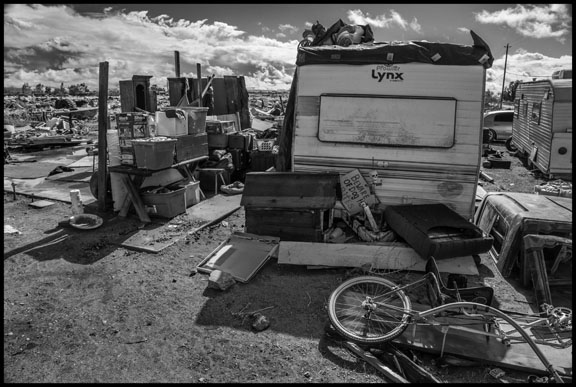
 
LANARE, CA - 2021 - In the middle of the Lanare colonia is a huge junkyard with old house trailers that provide living space for people with no money to live elsewhere.  

 
LANARE, CA - 2021 - Ricardo Camarena Tafolla collects cans to survive. Lanare residents are all working-class people, mostly Mexican immigrant farm workers.


Matheny Tract: Fighting for Water and Basic Services

For many unincorporated towns, however, funding for water service alone is not a complete solution. A history of exclusion has left them without other services, near the towns and cities that excluded them. One is the Matheny Tract, just outside Tulare city limits. Vance McKinney, a truck driver who grew up there, recalls that his parents, whom he called "black Okies," couldn't get a loan for a home when they came up from the South in 1955. They bought a lot from developer Edwin Matheny, who'd subdivided land just outside the city limits and sold lots to Black families.

Four decades ago Tulare County's General Plan even proposed tearing down the community. Matheny Tract, the plan said, had "little or no authentic future." After the Matheny Tract Committee organized to pressure the state, in 2011 the city and county of Tulare agreed to connect city water lines with Matheny's Pratt Mutual Water Company. The city then backpedaled, claiming it had no water during the drought. At the same time, however, it was providing water to its own, higher-income subdivisions and industrial developments.

Finally the state Water Resources Control Board issued an order for the voluntary consolidation of Tulare and Matheny's water systems. When the city still dragged its feet, the state issued a mandatory order and the systems were connected in 2016.

But Matheny Tract also has no sewage system, and discharges from septic tanks sometimes even bubble up in the yards of families like McKinney's. Tulare's wastewater plant is a stone's throw away, but Matheny residents can't hook up to it. According to activist Javier Medina, "On some days it smells really bad here. I went to a city council meeting once, and one of their experts said it was probably because they were using the waste to irrigate the pistachio grove next to it."

Medina says he invited Tulare Supervisor Pete Vander Poel to come to Matheny to experience it. "He said he'd only meet with us in the cafeteria in the Target store in Tulare, because Matheny was very dangerous," he recalls. For Reinalda Palma, another committee member, the reason for Tulare's reluctance is simple. "There's a lot of discrimination against Mexicans," she charges. "We have to mobilize if we want anything to change." Finally a threat to sue from the Leadership Counsel got the city to agree to begin planning a sewer consolidation as well.

 
MATHENY TRACT, CA - 2010 - Residents of Matheny Tract live just outside the city limts of Tulare. Vance McKinney, a truck driver, was a leader of the first community efforts to force Tulare to extend water and sewer services to homes there.  Without a sewer, waste water from his home would up through the grass in his yard because the clay soil can't absorb the water.

 
MATHENY TRACT, CA - 2010 - Community leaders Caty Topete, Irene Paredes and Vance McKinney stand outside Tulare's huge water and sewage treatment just beyond their homes, forcing them to endure foul odors while they are denied the services the plant could provide.

 
MATHENY TRACT, CA - 2021 - Javier Medina, a leader of the community committee in Matheny Tract, points to a dry canal that bisects the town.  Residents pay $50/year, he says, for the canal although it has no water they can use.

 
MATHENY TRACT, CA - 2021 - Jose Gomez, a Matheny resident, collects the sweet sap from agave plants in his yard.  Matheny's residents are mostly Mexican immigrant farm workers, and many, like Gomez, come from the countryside with farming knowledge and skills.

 
MATHENY TRACT, CA - 2021 - Sunset in Matheny Tract.  In front of this home are big tanks this family uses to store water.


Tooleville: "They Think We're Nothing"

Even less cooperation has been forthcoming in Tooleville, less than a mile from the Tulare County city of Exeter. In 2001 residents of this unincorporated community began asking Exeter to extend its water lines to provide service. The city refused, thus beginning one of the longest fights for drinking water in the valley's history.

Ironically, Tooleville's two dirt streets end at the base of the Sierra foothills, where the Friant-Kern Canal carries millions of gallons of water from the Friant Dam on the San Joaquin River to fields at the valley's south end. The canal was built with taxpayer funding by the U.S. Bureau of Reclamation in the 1940s, as part of the Central Valley Project. It diverts so much water that the San Joaquin River disappears in areas below the Friant Dam during dry seasons. With no river water, farmers in the river basin pump water from the aquifer below, leading to land subsidence in many areas of the San Joaquin Valley. Even the canal itself has lost up to 60% of its delivery capacity because the land is sinking under it.

While Tooleville residents can watch the water flow by on the other side of a chain-link fence, they can't touch it, much less drink it. The community gets its water from two wells. One has already gone dry. "We only have water in the morning," says Maria Paz Olivera, secretary of the Tooleville Mutual Nonprofit Water Association. "When workers come home from the fields in the afternoon there's no water, and they have to wait until late before they can shower."

The state has discovered hexavalent chromium in the water as well, and people fear drinking and cooking with it. It currently supplies bottled water to residents.

Tooleville is surrounded by grape vineyards and citrus groves. "The growers beside us have sunk 400-foot wells, while our wells only go down 200 feet," Paz Olivera says. "Growers run Exeter, and they're all Trump people. When they look at us, all they see are poor Mexicans. They think we're nothing."

Blanca Escobedo, a Leadership Counsel organizer working with the Tooleville community, agrees. "The Exeter City Council members are all white, while half of Exeter is Latino," she says. "You see this in their comments. One councilmember said they wouldn't connect with Tooleville because people there wouldn't pay their bills. When the community invited the Exeter mayor and council to tour, they wouldn't talk with residents. In one meeting the mayor said consolidation was a waste of money and he wished Santa Claus was real." When Tooleville residents attended a meeting in 2019, Escobedo says councilmembers asked to be escorted to their cars by security.

After negotiating for a year and a half with Michael Claiborne, the Leadership Counsel attorney representing Tooleville, the Exeter City Council adopted a water master plan in 2019 with no consolidation. Mayor Mary Waterman-Philpot said, "We have to take care of Exeter first," and was "not interested" in Tooleville.

Under previous laws the state water board could only request a voluntary consolidation in a case like Tooleville's. But this year the legislature passed SB 403, authorizing mandated consolidation where a water system is at risk of failure. The water board has told Exeter that it is prepared to issue an order, and according to Leadership Counsel co-director Veronica Garibay, the city has agreed to begin planning a consolidation.

 
TOOLEVILLE, CA - 2021 - Maria Paz Olivera is the secrtary of the Tooleville Mutual Water Company, and says Exeter won't supply water to Tooleville because most of its residents are Mexican and Exeter's government is make up of "Trump people."  On her phone she has a photo of the water faucet in her house, with no water coming from it.

 
TOOLVILLE, CA - 2010 - Eunice Martinez was a leader of the Tooleville's effort to gain safe drinking water.  Residents of Toolville discovered dangerous concentrations of nitrates in their water supply, because of the fertilizers in runoff from irrigating surrounding farms.  She holds a glass of water from the tap that she was afraid to drink.

 
TOOLEVILLE, CA - 2021 - In Toolville the water runs out in the afternoon, and residents want their water system connected to the nearby city of Exeter.  Ruben Garcia has lived in the colonia for 14 years, and says growers just want to keep the water to themselves.

 
TOOLVILLE, CA - 2010 - Valeria Alvarado is a Mixtex immigrant from Oaxaca, and lived in a trailer in Toolville with her husband, son and three daughters, who were all farmworkers.  She was active in the community's effort to gain safe drinking water.

 
TOOLVILLE, CA - 2010 - Just behind Toolville is the Friant-Kern Canal, carrying water diverted from the San Joaquin River to irrigating the valley's huge industrial farms.  None of the canal's water is available to Toolville residents for drinking.


Canaries in the Coal Mines?

Perhaps these small communities, vulnerable due to their history of exclusion, are like canaries in the coal mines. Even the large cities of the San Joaquin Valley now have burgeoning problems finding water. Roughly 80% of the water used by all California businesses and homes is taken by growers to irrigate 9 million acres of farmland.

While state legislation has given unincorporated communities more power to negotiate for their tiny portion, the system is structured to serve the needs of agriculture. And as the land sinks in many areas, and wells go even deeper, the aquifer itself is in danger.

For African Americans who began many of the valley's unincorporated settlements, state legislation comes late. Ten years ago, Vance McKinney showed me the place where sewage welled up in front of his house. Now he has moved his family into Tulare and just comes for visits to the place where he grew up.

In another colonia, Monterey Park Tract, the community finally won a water connection to the nearby city of Ceres (itself facing rising water contamination), but the Black families who settled here are mostly gone. Betty Yelder, still on the local water board, remembers that her father came from Biloxi, Miss., in the 1930s, "when we couldn't live in most parts of Modesto. But I'm retired now, and the rest of our family doesn't live here anymore."

Mary Broad, one of the last Black residents of Lanare, died a few years ago.  

In the middle of the Matheny Tract, a dry canal bisects the community. It's empty except for a few windblown papers and dead tumbleweeds. Javier Medina says residents still pay $50 a year for the privilege of having it run through town. "We have better water now," he admits, "but I wonder if the canal is also a warning of what's in store."

 
MONTEREY PARK TRACT, CA - 2021 - Willie Davis is the former board secretary of the Monterey Park Tract Water District.  Her grandfather started the settlement because Black people were barred from living in Modesto in the 1930s, she says.  Her sister is one of the few African Americans who still live there.  Davis and other members of her family have moved away.

 
LANARE, CA - 18MAY10 - Mary Broad moved to Lanare in 1955, when only African American families lived there.  She died a few years ago, and now most Lanare residents are Mexican immigrants.

Wednesday, October 27, 2021

LARRY ITLIONG BIRTHDAY CELEBRATION IN POPLAR AND DELANO

LARRY ITLIONG BIRTHDAY CELEBRATION IN POPLAR AND DELANO
For a full selection of photographs, click here:
https://www.flickr.com/photos/56646659@N05/albums/72157720130510660

POPLAR, CA - 24OCTOBER21 - Farmworker movement activists celebrated the birthday of Larry Itiong at the Larry Itliong Resource Center in Poplar, and walked and caravanned to Delano.  Itliong was a Filipino labor leader, starting in the 1940s, when he helped organize farmworkers and Alaska cannery workers, and was dispatcher of UCAPAWA Local 7 (now the Inlandboatmen's Union of the ILWU).  He organized farmworkers through the 1950s with the Agricultural Workers Organizing Committee, and in 1965 he and other Filipino workers started the 1965 grape strike, which led to the organization of the United Farm Workers.  A day in honor of his birth was declared by the California state legislature.

Among the people celebrating his birthday were California Attorney General Rob Bonta, UFW co-founder Dolores Huerta, Assemblywoman Mia Bonta, Sacramento LCLAA chapter president Desiree Rojas, Filipina academic Robyn Rodriguez, Central Valley Empowerment Alliance organizers Mari Perez and Arturo Rodriguez, longtime Filipino community activists Cyntia Bonta, Lillian Galedo and Edwin Batonbacal, members of the Itliong family, including Johnny Itliong, and many others.

Copyright David Bacon


Thursday, October 7, 2021

A CANDIDATE FOR MIXTECOS IN THE REPUBLICAN HEARTLAND

A CANDIDATE FOR MIXTECOS IN THE REPUBLICAN HEARTLAND
By David Bacon
The Nation, 10/7/21
https://www.thenation.com/article/politics/california-elsa-mejia-election/

 
MADERA, CA - Alejandro Santiago picks wine grapes and packs them into boxes.  He is a Mixteco indigenous migrant from Coatecas Altas, Oaxaca, and lives in Madera.  He wears a mask because of the coronavirus pandemic.--Copyright David Bacon


Madera County has been a stronghold for decades for the Republican Party in California's San Joaquin Valley.  Billboards this fall lined rural highways, urging the recall of Governor Newsom, pasted over peeling Trump/Pence posters.  If Newsom's fate had rested on Madera County he would no longer be governor - sixty percent of county voters went against him.  Fifty six percent went for Trump in 2020, slightly more than 2016.  In fact, the last Democratic Presidential candidate to win the county (barely) was Jimmy Carter in 1976.

But in the city of Madera, the county seat, changing demographics are producing political challenges to a conservative order.  That seemingly solid majority does not reflect the demographic reality of the county's 156,000 residents.  Almost 60% of county residents list their origin as Hispanic. African Americans, Native Americans and Asian Americans make up another 10%.  


LOS BANOS, CA - Equipment yard with U.S. flags and rightwing signs put up by the Madera County Republican Party, calling for recalling Governor Gavin Newsom.  Older signs urge votes for Trump and Pence.--Copyright David Bacon


MADERA, CA - Elsa Mejia is a candidate for Madera City Council District 5.--Copyright David Bacon


That challenge is colorful and young in the city's District 5, which combines a delapidated downtown with a large eastside barrio.  Here California's growing community of indigenous Mexican migrants has put forward its first candidate - Elsa Mejia, who is running for an open seat on the city council.

Mejia was born in nearby Fresno, to parents who'd come to the Valley from the Oaxacan town of Santa Maria Tindu.  A decade ago the Leadership Council of Santa Maria Tindu, an organization of town residents now living in the U.S, carried out its own community census.  They wanted answers because the government does no count indigenous migrants, even in the Census.  The Council found that migrants from just this one Mixtec hometown, living in Madera, already numbered 2,500.  Together with migrants from other Oaxacan communities, Mixtec-speaking people now are an sizeable part of Madera's people.

California communities of indigenous migrants maintain their ties with their Mexican towns of origin.  Growing up, Mejia would return with those family members who could cross the border to visit her grandfather in Tindu.  He would try to teach her Mixteco.  "But we didn't stay long enough, so I just learned a few words," she laughs.  Later she lived in Oaxaca for a year, working for Rufino Dominguez, a revered migrant leader in California who went back to Oaxaca to head its state Institute for Attention to Migrants.  Mejia later worked for a decade as a reporter for the Madera Tribune, and then edited Fresno's progressive monthly, the Community Alliance.  Today she works in the communications staff of Service Employees Local 521, the Valley's union for many public workers.

Mejia's laugh belies the many things her parents, and Mixteco parents like them, did over the years to make sure their children know and enjoy Mixtec culture.  They formed organizations to carry that torch, from dance groups to language classes.  

Every year the Binational Fronte of Indigenous Organizations (Frente Indigena de Organizationes Binacionales - FIOB) mounts a dazzling festival showcasing the dances of Oaxacan towns, called the Guelaguetza.  Its Fresno festival is just one of several.  California's indigenous Oaxacan population is so large there are more Guelaguetzas organized here than in Oaxaca.  In Madera itself FIOB has organized a yearly basketball tournament, the Copa de Juarez, on the birthday of Benito Juarez, Mexico's first indigenous president.  It organized protests against the celebration of Christopher Columbus' arrival in the Americas, accusing colonizers of trying to destroy indigenous culture and people.


MADERA, CA - A home near downtown Madera in a neighborhood of many indigenous immigrant farmworkers.--Copyright David Bacon


MADERA, CA - Inside the Del Valle market in downtown Madera people can order and eat food or buy piñatas for their children's birthday parties.--Copyright David Bacon


MADERA, CA - A paletero, or ice cream seller, sells frozen fruit juice bars from his cart to mechanics in an auto shop near downtown's Yosemite Avenue.--Copyright David Bacon


Culture is a principal basis of organization in Mixteco communities, a key understanding for winning an election in Madera District 5.  Even if she has problems with the language, as many second generation immigrants often do, Mejia understands its importance in mobilizing her community.  "It's very important for people to have access to public services in their own language," she explains.  "We still don't have equal access, even in Spanish.  You can't take a driving test in Mixteco.  Everybody should have access in the languages they speak."    

FIOB fought over many years for language rights in the Valley.  It won interpretation in Mixteco and other indigenous languages in California courts before that right was recognized in Mexico.  But Fidelina Espinoza, FIOB's state coordinator who staffs its Madera office, says she supports Mejia because language is still a huge problem tied to the lack of city services in general.  "When our parents go to school for a conference with teachers, there are no interpreters, and sometimes even no conference," she charges.  "We have no translation to help us access what we need, and the city doesn't support cultural programs or even community gardens for our young people."

Downtown Madera could use a lot of community gardens.  The main street, Yosemite Avenue, is lined with small businesses, mostly with Spanish-language signs, that are clearly having a hard time.  One star attraction is Sabores de Oaxaca (Oaxacan Flavors) where a stream of Mixteco-speaking customers find a small cool restaurant.  Many come inside still in sweat-stained clothes from a day in the fields, in 115-degree heat.  

Nevertheless, other businesses on Yosemite Avenue could clearly use city support.  Across the freeway chain stores and malls get a lot more attention.  Downtown homes are mostly modest rentals, many in need of help as well.  

"The city has abandoned downtown," Mejia charges.  "Those little stores and restaurants were hit hard by COVID, but where was the help?  People in District 5 have the lowest incomes in Madera.  A lot of people have no homes and there's no city program to build housing.  The subsidies in the Federal bills for renters never got here."


MADERA, CA - Alejandro Santiago picks wine grapes near Madera, where the temperature can reach over 110 in the afternoon.--Copyright David Bacon


MADERA, CA - Juana Ruiz picks grapes for raisins early in the morning, in a vinyard near Madera.  She stands on a milk crate so that she can reach the grapes on the vines above her.--Copyright David Bacon


MADERA, CA - Cesilia Perez Lopez, an indigenous farmworker from Oaxaca, comes home from work.  She shows the card punched at work that gives her credit for every bucket of tomatoes she picks.  She is a steward for the United Farm Workers there.--Copyright David Bacon


"Things are going to change if Elsa is elected," promises Antonio Cortes, Central Valley Director for the United Farm Workers.  Cortes also comes from Tindu, and today works in the union's Madera office.  "Oaxacans are very numerous and important here," he says.  "We're always struggling with the city for resources, and we deserve representation.  She comes from a farmworker family, and has that commitment."

Out of an economically active population of 85,000, about 23,000 Madera County residents work in the fields, according to demographer Rick Mines.  His studies show that the median income for a farmworker is between $10,000 and $12,499 while for a family, the median is between $12,500 and $15,000.

In the pandemic, poverty translates into illness and death.  Madera County has had over 22,000 COVID-19 cases (14% of the population) and 266 deaths.   Only half of its residents are vaccinated.  Reporting Area C, which includes downtown and the eastside barrio, has the most cases, almost a third.  By comparison, in Silicon Valley's Santa Clara County, while it has more cases, only 7% of residents got the virus, and over three quarters are vaccinated.  Every day activists in FIOB go out to the fields to sign people up for shots.  UFW organizers visit members in the almond orchards, bringing masks, sanitizer and other protective equipment.

Mejia's chances of winning come from her connection to these campaigns and organizations, working on concrete community problems.  She's running for an open seat, and her opponent is another Latina, Matilda Villafan.  But in challenging the economic priorities of the San Joaquin Valley, Mejia doesn't have an easy path to election.  For instance, she believes that "farmworkers who work during the pandemic should be paid better since they're risking their lives.  And not just them, but their families as well.  This should be part of treating them with dignity as workers."  The growers who put up those Trump signs can't be happy about that.  


FRESNO, CA - Rolando Hernandez, a community activist with FIOB and the Centro Binacional, talks with Angelica Corona as she picks peaches about the importance of getting vaccinated against COVID-19.  Hernandez speaks Mixteco, and can talk with the many workers who only speak that language.--Copyright David Bacon


MADERA, CA - Vianney Torres, an organizer for the United Farm Workers, hands out personal protective equipment to workers in a pistachio grove at lunchtime to members of the United Farm Workers at the Wonderful Co., a large grower.--Copyright David Bacon


MADERA, CA - Carlos Cruz Victoriano lives in a rundown home in Madera with other Mixteco farmworkers.  In the summer of 2020 everyone in the house had serious cases of COVID-19 and were hospitalized.--Copyright David Bacon


She thinks there are about 2000 eligible voters in her district, but there's no precise number for those who come from indigenous families.  It is a complicated question for several reasons.  In the huge migration of people out of Oaxaca, the first wave of migrants to reach California arrived in the mid-1980s, and the arrival of people has continued ever since.  Because the last immigration amnesty in 1986 had a cutoff date of January 1, 1982, most of these migrants have been undocumented.  For them, citizenship, the ability to register to vote, and the political rights that come with that, are out of reach.

If all the immigrant farmworkers in San Joaquin Valley agriculture could vote, Kevin McCarthy would probably not be the Congressman from Bakersfield, and head of the Republican Congressional caucus.  Using citizenship to restrict the franchise has successfully prevented the formation of a voting base for more worker-friendly politicians, and more progressive legislation.  

Elsa Mejia represents the new generation of the children of these families, born here, and therefore citizens.  Her campaign is part of their entrance onto the political stage in communities where immigrant workers contribute the bulk of the labor, but cannot vote.  Over time, that could affect California politics as profoundly as the immigrant upsurge did in Los Angeles in the 1990s.  

But it does make it difficult to determine who the Oaxacan or Oaxacan-descended voters are in District 5, and how to mobilize them.  In an era of scientific election campaigns, like those already unfolding for 2020's Congressional election, lack of such concrete information is a cardinal sin.  

But sometimes what scientific campaigns lack is an organic connection to local communities and their struggles.  Mejia is not running against Trump, at least not directly.  She's running on her ability to speak to the concrete needs of her district, which in the end conflict with those of the ranchers, with all their flags and recall signs.  On November 2 this year, Elsa Mejia will have the chance to show that kind of strength.


FRESNO, CA - The Danza de los Diablos, performed by the community of Mixtec immigrants from San Miguel Cuevas, Oaxaca, at the annual festival of Oaxacan indigenous culture, the Guelaguetza.


Monday, October 4, 2021

GOV. NEWSOM VETOES UNION VOTE-BY-MAIL BILL FOR FARMWORKERS

GOV. NEWSOM VETOES UNION VOTE-BY-MAIL BILL FOR FARMWORKERS
By David Bacon
Capital & Main, 10/4/21
https://capitalandmain.com/gov-newsom-vetoes-union-vote-by-mail-bill-for-farmworkers


United Farm Workers members and supporters begin the "March for the Governor's Signature" in Farmersville, CA on Sept. 22 in support of Assembly Bill 616. Newsom vetoed the bill the same day. All photos by David Bacon


Almost before athe farmworker voting rights march set out for Sacramento last week, their 217-mile pilgrimage was cut short by the Governor's veto of the bill they supported.

The march sought to press Gov. Gavin Newsom to sign a bill that would have brought farmworker union elections into line with the voting process used in California general elections.   Instead, the governor refused to allow changes in a 50-year old election process that workers say favors growers - changes that he has 's advocated for in general elections, like the recall vote he just overcame.

"Why was the absentee ballot process good for the Governor when he depended on it to defeat the recall, but not good for farmworkers?" asked Teresa Romero, president of the United Farm Workers.

AB 616 would have made it easier for farmworkers to vote to unionize by allowing them to fill out and mail ballots as absentees, just as voters do in a general election. Under AB 616 a union could distribute ballots to workers at home, which they could mail back to California's Agricultural Labor Relations Board in envelopes that keep the vote confidential, just like voters can do in any political election.

Newsom, in a veto statement, said he "has worked tirelessly to protect and support workers across California." However, he added, "this bill contains various inconsistencies and procedural issues related to the collection and review of ballot cards." No specifics were given in the message, or beforehand to the union and the bill's sponsors.

Presently, workers are forced to vote in polling places on the growers' or company's property. Voting by absentee would make it possible for farmworkers to cast their ballot away from foremen and anti-union consultants.

Currently, when workers want to organize a union, they have to sign cards that authorize the union to represent them. The union then presents them to the Agricultural Labor Relations Board. If the Board decides a majority of the grower's workers have signed, and other requirements have been met, it sets up a polling place on the company property. Workers have to cast their votes there, in favor or against the union.  

 
Xico Garza and Paulina Rodriguez lead UFW members and supporters in a prayer to the four directions at the start of the march.


It is a very high-stress process. Before the vote growers often hire union busters to dissuade workers all day from joining up. Foremen can legally pull workers aside during work hours, giving each a one-on-one talk to pressure her or him to vote as the grower wants. Since the Supreme Court ruled in June (Cedar Point Nursey v. Hassid) union organizers can no longer go on a grower's property during non-work time to counter false statements or threats.

Organizing a union in the face of these obstacles is hard and risky for workers.  Over the years the Agricultural Labor Relations Board, which administers California's farmworker unionization law, has held hundreds of hearings.  An endless parade of workers has testified to threats, firings and other illegal actions by growers and crew bosses.- all intended to increase fear.

Just as voting by absentee ballot is easier and less stressful in a general election, voting at home would make it possible for farmworkers to cast their ballot away from the pressure. Under AB 616 a union could distribute ballots to workers at home, which they could then fill out and mail back to the Board in envelopes that keep the vote confidential, just as anyone in California can do in a general election.

The Governor's objections makes little sense to the workers and their advocates. The existing process outlined in the Agricultural Labor Relations Act allows a union to request a list of employees by giving the Board authorizations signed by 10% of the workforce. Then the union can either request an election on the grower's property, as it can now, or it can distribute ballot cards to workers, allowing them to cast their vote at home. This is the same procedure that gave Biden his victory over Trump in many states, one that rightwing Republicans are now trying to outlaw in Texas and elsewhere.

The Agricultural Labor Relations Board must monitor the validity of the signatures on the ballot cards it receives, and must hold a hearing if there are accusations of chicanery. Voter coercion or falsifying signatures is already illegal.

As farmworker advocates see it, Newsom's veto is a self-serving bow to California's $50 billion agricultural industry as he faces relection next year and beyond that, he may run for the Oval Office - both of which need big-money donors. Among his anti-recall donors, along with unions, are tech moguls Eric Schmidt, Reed Hastings, Priscilla Chan and Jerry Yang, to whom unions are anathema.

As San Francisco mayor,  Gavin Newsom did play an important role in helping hotel workers win their lockout and strike in 2004, but his labor record is more mixed than his veto message claims. Workers have no union in Newsom's Plumpjack restaurant and Napa Valley winery. Business lobbyists were well represented at the lobbyist's birthday party Newsom attended, maskless and indoors, at the swanky French Laundry  restaurant at the height of the pandemic last November.  

 
UFW President Teresa Romero and farmworker activist Lourdes Cardenas march in support of AB 616.


His misstep angered millions of locked-down Californians and helped put the recall petition on the ballot. Farmworkers were not invited, a fact the United Farm Workers dramatized last week in a protest of his veto outside the French Laundry.  

In the weeks before Newsom fended off a recall on Sept. 15, UFW's Romero had asked to meet with him to talk about the bill. He refused. "We didn't want it to become an issue in the recall campaign, which farmworkers were committed to winning," she said, "so we didn't say anything publicly, even though we thought he should have been willing to hear our reasons for it."

This summer and fall AB 616 easily passed the state Assembly and Senate, despite fierce opposition from growers. The California Chamber of Commerce called it a "job killer."  Presumably if workers organize more easily, a larger and stronger union might push wages up - not a prospect agricultural businesses favor.

Agribusiness has fought laws giving farmworkers a legal process for organizing unions since agricultural and domestic labor  was excluded from the National Labor Relations Act in 1935.  Currently only California and Hawaii have state laws with a unionization process for farmworkers.  One result is that less than one percent of farmworkers belong to unions today.  In strengthening California's law, therefore, AB 616 could help increase that percentage and inspire the spread of similar laws to other states.

After the recall election was over, however, Newsom continued to sit on AB 616. Finally the union and its supporters decided to start walking to Sacramento to demonstrate their commitment and ask him to sign it. The march was due to take 19 days, following in the footsteps of the original farmworker march to Sacramento in 1967, during the famous Delano grape strike that marked the beginnings of the UFW.

Senator Alex Padilla, appointed by Newsom to fill Vice-President Kamala Harris's seat, supported the bill. "As Secretary of State," he said in a written statement, "I was proud to support and implement changes in state law to make it easier for people to exercise their right to vote. Farm workers should have similar opportunities as they exercise their longstanding right to vote in a union representation [election]."

Voting rights for farmworkers can't be taken for granted. They came with the passage of the Agricultural Labor Relations Act in 1975, after decades of conflict in California fields.  Last week's farmworker march sought to remind the governor of that history by starting in Farmersville, site of one of the key conflicts that led to the creation of the United Farm Workers union.

 
Xico Garza walks at the head of the march burning sage. UFW President Teresa Romero and activist Lourdes Cardenas walk behind him.


Pointing proudly to a silent man in a soft-brimmed hat walking beside her, Mari Perez said, "My father was part of that history.  He stood up for us."  Marchers like Jose Perez started their perigrinacion, or pilgrimage, less than a mile from one of the most famous battles, the rent strike at the Linnell labor camp.  "Voting rights and unions for farmworkers only came after a long struggle against poverty and powerlessness," explained another marcher, Roberto DeLa Rosa, board chair of California Rural Legal Assistance.

In 1965 anger over racism and exploitation grew hot in Tulare County, and boiled over when farmworkers living at the Linnell labor camp in Farmersville decided to stop paying rent. Residents lived in shacks built for dust bowl migrants.  They were so hot during the summer that families would salvage rugs from the dump, douse them with water, and spread them on the roof to cool off the rooms below. There were no separate showers for women. Gilbert Padilla, one of the strike organizers, called it "a very disgusting site."  

Camp residents won their strike. and Padilla (now a revered veteran organizer) went on to help lead the Delano grape strike later that year. Voting rights came a decade after that-- - in 1965 farmworkers had no right to vote for a union in the fields.  Even in general elections voting procedures were restricted, and most farmworkers didn't or couldn't vote. The idea that you could register easily at the DMV, or that every voter would be mailed a ballot to send back at their convenience, would have seemed utopian.

Today those changes in general election procedures are the norm in California, intended to make voting as easy as possible, and to encourage the maximum turnout. Governor Gavin Newsom owes his victory in the recent recall election at least in part to the increased turnout those changes made possible. Indeed, on Sept. 27, Newsom signed a bill to make mail-in ballots - a pandemic-era safety measure - permanent.

On Wednesday, September 22, 25 workers and their supporters who'd agreed to walk the whole way gathered in a Farmersville church parking lot. After a prayer to the four directions, led by dancers Xico Garza and Paulina Rodriguez, and accompanied by dozens of supporters, the marchers set off. A few hours later the word came down - Newsom had vetoed the bill.

Assemblywoman Lorena Gonzalez, the San Diego Assemblymember who authored AB 5 to end misclassification of gig workers, tweeted her disappointment at the veto of AB 616, which she cosponsored. "I'm truly devastated that @GavinNewsom vetoed the most important union organizing bill of the year. Denying Farmworkers the right to organize and join a union in the same manner we allow all public sector workers in CA to do so is abhorrent."

"To me, the reasons he gave for the veto have no value," Romero said.told Capital & Main. "He benefitted from the voting choice Californians have to beat the recall. But he thinks farmworkers are not equal to him."


More photos from the march:


Thursday, September 9, 2021

THE FIERCE ENDURING LEGACY OF ANTI-AFGHANISTAN WAR PROTESTS

THE FIERCE ENDURING LEGACY OF ANTI-AFGHANISTAN WAR PROTESTS
Photoessay by David Bacon, Rick Reinhard, Jim West, Meg Handler and Najib Joe Hakim
The Nation, 9/9/21
https://www.thenation.com/article/world/photos-afghanistan-war-protests/

 
These photos from 20 years ago remind us that resistance to the war began even before the war itself.


The U.S. is finally bringing its troops home, after 20 years of imperial intervention. But they leave Afghanistan a deeply war-wounded country, its cities in ruins and hundreds of thousands of its people in graves.  

Almost no one calls for the troops to stay, but media coverage often overlooks that the war was always unpopular.  From the beginning thousands of people in U.S. cities went into the streets to call for it to stop.  

Nevertheless, despite grassroots opposition, Congress was eager to go to war in 2001.  East Bay Representative Barbara Lee was the only vote against authorizing it - Joint Resolution 64 - passed three days after the planes flew into the World Trade Center.  Congress provided the justification and administrations, both Republican and Democratic, used it for two decades of invasions from Somalia to Syria and Iraq.  

By October government attacks on U.S. Muslims had already begun, with illegal roundups and imprisonment in hastily organized "detention centers."  Around the country demonstrations condemned the racist raids, while government repression legitimized a broad wave of anti-Muslim attacks.  

The first marches followed Congress' vote by just two weeks, at the end of September.  More followed after the U.S. started bombing Kabul at the beginning of its Afghan invasion.

People protesting the war in Afghanistan quickly linked it to U.S. mideast policy in general.  Marchers opposed both the Afghan war and Israel's military offensive in the occupied territories during the second intifada, "Operation Shield Wall."

Protestors linked the Afghan war to social cost of the enormous military budget, while banners announced that "another world is possible" - an enduring theme during the following years of protests.

These photographs are evidence that opposing the Afghan war started as soon as the war did.  Those protests may not have been as widespread as those opposing the war in Vietnam, but they played their part.  

Yet wars and militarization are still with us.  Some of the children brought to those first marches in their strollers are now young activists in their 20s.  A whole generation grew up protesting this war.

To see the full selection at The Nation website, click here