Thursday, June 10, 2021

FISHING IN THE BOHOL SEA

FISHING IN THE BOHOL SEA
Photoessay by David Bacon
Food First, 6/11/21
https://foodfirst.org/

 
These photos are taken from the David Bacon archive at the Green Library at Stanford University:
https://exhibits.stanford.edu/bacon/browse


Walking up the road in the warm night, with the town sleeping around them, two men turn onto a dirt track between ramshackle houses towards the beach.  Where the coconut palms meet the rocks and gravel, they pass young men who have wrapped themselves in thin colored cloth.  They're sleeping on the ground, their heads invisible.  

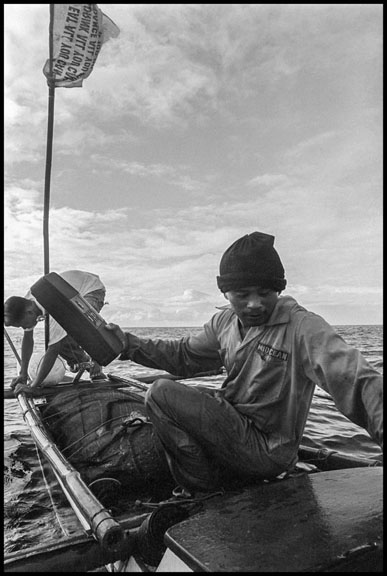
Fishing boats are drawn up on the beach.  The two men, a young teenager and an older man, walk over to the best-looking boat, painted red with indistinct words on the side.  It's a thin, shallow hull, with a small covered section in the middle over a diminutive motor.  Two white outriggers are tied to the end of curving bamboo arms, one on each side.  A big net is wrapped up under a cover in the middle of the boat.
    
The sleeping men wake up.  Together they begin pushing the boat on bamboo rollers down the beach.  Lifting the outrigger arms, they slide the hull into the water, and the boat floats in the small waves.  It's almost totally dark, a crescent moon moving in and out of clouds crossing the sky.

The older man hoists a bag full of beer, and gingerly walks from the needle-nose prow down into the hold between the engine and the net, as the boat rocks gently beneath him.  He is Ayon, the captain.  Beboy, his helper, jumps on. Ayon starts the motor, and the boat pulls away from the beach.  

Ayon loops a wire connected to the accelerator around his big toe.  With one hand he steers the boat with a long pole connected to the rudder, while he guns the small engine with his foot.  They set out into total darkness, the boat rising and falling with the waves.  Bohol's strange peaks are looming dark shapes on the horizon, above the tiny lights of the towns of Garcia Hernandez and Jagna.

They pass a couple of other boats on the way out.  Ayon's brother is a fisherman on one, its yellow light barely visible.  Beboy shines a makeshift flashlight on the outrigger and into the dark water as they go, looking for fish.  Finally, they set out their net, its long line of floats rising and falling with the waves.  Ayon smokes a cigarette while he waits, drinking a beer.  Beboy stands in the stern, watching for clouds and storms.

As dawn breaks and light slowly fills the sky, they pull the net in.  Hand over hand, the web of filaments comes up the side of the boat, and as Beboy pulls Ayon looks for the fish.  They are catching milkfish, or bangus.  The muscles of these small, compact fish promise more meat than most fish their size, making them popular in the market.  Bangsilog, bangus with egg over garlic rice, is a favorite breakfast in the Philippines.

The net in, and the fish in buckets, they turn the prow towards Bohol's hills in the distance.  In no hurry, the motor is barely audible above the sounds of waves and gulls as they head back to land.  A small crowd greets them at the beach, performing the same boat-pulling exercise in reverse, dragging the hull up on bamboo rollers to its original resting place.  

Meanwhile, women from the market stalls of Jagna look into the buckets, and argue with Ayon about the bangus' size and price.  They make their deal, and the morning's catch disappears even before the boat stops moving.  The last beers are passed around and drunk, and Ayon and Beboy walk slowly home.

Over a million people in the Philippines make a living from fishing, and 80% fish in small outrigger boats like Ayon's.  The country is made up of over 7000 islands, giving it the world's largest discontinuous coastline, and making fishing an integral part of what it means to be Filipino.  Fish are the number one source of protein in the diet of the people of the islands.

On the other side of the Bohol Sea is the big island of Camiguin.  Here too, twenty years after Ayon and Beboy's night of fishing, the boats go out every morning, coming back with their catch for the market.  But here, as the women examine the catch, they see no bangus.  They complain that the fish are small, hardly worth selling.

Mario Valladares, father of many of the fishermen on this beach, looks resigned as he mends his nets, as though he's heard this many times before.  His son Virgilio holds up a string of today's catch, and explains that they can't go any longer to the old fishing grounds of years past.  The Philippine government has declared them an ecological preserve to protect the resource from overfishing.  That leaves Camiguin's small fishermen to find their catch in the areas that border it.

"The big fish just run for the preserve and hide.  They know we can't go there to get them," Mario Valladares laments.  After the nets are mended, they carry their strings of fish with them as they head down the beach, planning to cook them for their own breakfast.

In the past, most Filipino fishermen were also farmers.  As fish get scarcer, however, and sections of the sea are walled off, fishermen must travel further to find a good catch.  When they don't, as it happens frequently now with the Valladares family, they no longer have time to farm and the catch doesn't pay for the gas in the boat.

Their predicament is the result of forces over which they have no control.  The Philippine government ratified the Law of the Sea Treaty in 1978, which forced it to commercialize its fish resources in order to retain jurisdiction over its territorial waters.  Commercialization meant attracting foreign investment for large fishing operations.  Huge trawlers pulling purse seine nets scooped up huge quantities of marine life.  Fish stocks plummeted, forcing the creation of no-fishing areas to try to allow the fish to recover.

Small fishermen were left behind - their old fishing grounds and fishing methods walled off by decree, and by the economics of a system in which they cannot compete.  Two decades ago Ayon and Beboy were able to make a living fishing on the coast of Bohol.  The new reality for fishermen is that of the Valladares family on Camiguin, fishing in the same Bohol Sea.

BOHOL


CAMIGUIN


Wednesday, May 19, 2021

PHOTOS WIN PUBLISHERS' AWARDS; MAY DAY MARCH WITH ILWU AND ANGELA DAVIS

 PHOTOS WIN AWARDS FROM THE CALIFORNIA NEWSPAPER PUBLISHERS ASSOCIATION - all published by Capital & Main

First place award for feature story:  A Century of Picking Grapes
** https://cnpa.com/cja2020/digital/gallery/Feature_Story_20_Feature_Story_MC.html#heading13 (https://cnpa.com/cja2020/digital/gallery/Feature_Story_20_Feature_Story_MC.html#heading13)
** https://capitalandmain.com/a-century-picking-grapes-why-the-census-matters-in-poplar (https://capitalandmain.com/a-century-picking-grapes-why-the-census-matters-in-poplar


First, second and third place awards for feature photos:
** https://cnpa.com/cja2020/digital/gallery/Feature_Photo_26_Feature_Photo_MC.html#heading12 (https://cnpa.com/cja2020/digital/gallery/Feature_Photo_26_Feature_Photo_MC.html#heading12)

First place award for feature photo essay:  Tulare County During the Pandemic - The Hard Price of Poverty
** https://cnpa.com/cja2020/digital/gallery/OpenFeature_Photo_31O_OpenFeature_Photo_MAMBMC.html#heading24 (https://cnpa.com/cja2020/digital/gallery/OpenFeature_Photo_31O_OpenFeature_Photo_MAMBMC.html#heading24)
** https://capitalandmain.com/tulare-county-during-pandemic-price-of-poverty-0803 (https://capitalandmain.com/tulare-county-during-pandemic-price-of-poverty-0803)
_____________________________________

ILWU AND NORTHERN CALIFORNIA UNIONS CELEBRATE MAY DAY
By David Bacon
ILWU Dispatcher
** https://www.ilwu.org/ (https://www.ilwu.org/

 
more photos follow the story

SAN FRANCISCO, CA (5/1/21) -- After Angela Davis spoke to the rally at the end of San Francisco's May Day march, Trent Willis, president of Local 10 of the International Longshore and Warehouse Union, went back to the microphone.  " I'm going to ask the union for a resolution," he announced, "to make our sister Angela Davis an honorary member, as we did with Martin Luther King and Paul Robeson."  The crowd cheered - some older longshore workers in their white caps began shouting out, "Free Angela!" - the chant that swept the world during her 1972 trial.

Willis recalled the union's long history of honoring Black radical leaders, even as a conservative and racist establishment was hounding them.  Robeson was denied his passport and demonized for refusing to knuckle under to McCarthyism's witch-hunts at the height of the Cold War.  Dr. King spoke to the union in 1967 in the last year of his life, calling for radical social change and an end to the Vietnam War.  The New York Times condemned him for it, but King told longshore workers in the Local 10 hall, "We've learned from labor the meaning of power."

As Angela Davis walked up Market Street, flanked by the Local 10 drill team, the union's officers and a thousand other union and worker activists, she honored the ILWU's political independence. She called it one of the most radical unions in the country.  "Local 10 is a majority African-American union, and it's been committed to the support of workers in South Africa, Chile and now Palestine," she explained in an interview with The Dispatcher.  She recalled the years when then-Governor Ronald Reagan had her fired from her teaching job, and tried to send her to prison.  "When I was on trial," she remembered, "the ILWU came to my support too."

Part of Local 10's radicalism has been its celebration of May Day. "Back in 2005," Willis told marchers, "we decided we had to pay attention to May Day and what it means. Back in Chicago, when May Day began, they were working people to death.  People died so that we can have the 8-hour day.  Today if you look at the port, you'll see that no cranes are moving.  "

Willis referred to the origin of the holiday that honors the strike in 1886 over the 8-hour demand, and the execution of the Haymarket martyrs that followed - immigrant labor activists framed by the bosses of the era to try to stop the workers' movement.  One consequence of McCarthyism was the suppression of May Day.  For decades it was celebrated in every country except this one, where it was called the communist holiday.

Redbaiting May Day was never accepted in the ILWU, however.  The union's longshore and warehouse workers often led marches and demonstrations, and found ways to celebrate it.  In 1950, at the height of McCarthyite hysteria, while the government was trying to deport Harry Bridges, Pacific coast maritime workers, including longshore workers from Locals 10, 13 and 2, sent May Day greetings to union brothers and sisters worldwide.  Quoted in The Dispatcher, they said fascism could be defeated "only through militant action, greater maritime unity and world solidarity."

In 1960 the ILWU sent members to the German Democratic Republic (east Germany) to celebrate May Day, and in 1975 Harry Bridges was a guest of the Sea and River Workers Union at May Day in Moscow.  The ILWU in Vancouver has a long tradition of participating in May Day events, and in 1981 the ILWU international convention, taking place on the holiday, stood in silence to honor the Haymarket martyrs.

That tradition of solidarity continued in 2008 when Local 10 members marched in the Port of Oakland and stopped work to oppose the wars in Iraq and Afghanistan.  "May Day, with its special overtones of struggle and militancy, was intentionally selected," according to ILWU historian Harvey Schwartz.  The union had earlier been host to Iraqi unionists asking for support, and sent Local 10's past-President Clarence Thomas to Baghdad to develop relations with them.

What made the 2021 May Day march exceptional, however, was the commitment of other unions and worker organizations.  This year contingents of union workers marched behind banners, and their numbers stretched for blocks down Market Street.  Other contingents came from the Chinese Progressive Association and the California Domestic Workers Alliance.  Chapters of the Democratic Socialists of America showed up in red t-shirts.

Marching in organized union contingents was a nod to the 1934 waterfront and general strike, when thousands of union members paraded silently up Market Street to honor Nick Bordoise and Howard Sperry, murdered by police.  Police murders were on the minds of this year's marchers, as it took place just days after a Minneapolis jury found policeman Derek Chauvin guilty of murdering George Floyd.

"This is more than just another May Day," Willis said.  "This year has been filled with racial tension and police shootings.  Even after that verdict, police shot another young Black man.  Our slogan is An Injury to One is an Injury to All, and we have certainly suffered a lot of injuries."

Willis called on unions and workers to act:  "Racism has been in the way of the labor movement since it started.  Corporate bosses need it to keep me from talking to an Asian man or a Mexican woman, or to you."  Marchers carried banners and Davis and Willis both called for freeing Black prisoner Mumia Abu Jamal.

Many ILWU members came to march from locals throughout Northern California.  One, Blake Dahlstrom, was a leader of the successful organizing drive by ILWU Local 6 at the Anchor Steam Beer brewery. Today she serves as a union steward, and member of the its executive board.  The fight for the 8-hour day isn't just in the past, she warned.  "Many workers have to work a lot more than eight hours at two and more jobs to survive.  In San Francisco one job should be enough, but we know it isn't, and that's a big reason we're marching today," she said.

The marchers without exception called on Congress to pass the PRO Act, a labor law reform bill that would penalize corporations for violating the right of workers to organize unions.  AFL-CIO Vice President Tefere Gebre told marchers at the rally that current labor law does not protect workers from retaliation, or punish employers who retaliate.  "With the PRO Act, there will be consequences," he promised.

Gebre, an Ethiopian immigrant, congratulated marchers for being willing to take action despite the pandemic, while being careful to maintain social distance and wear masks.  "COVID-19 has exposed the structural and systemic racism in this country," he charged. Another speaker at the rally, Eddie Zheng, told of his years in state prison, where the prisoners themselves provide the unpaid labor that keeps the institutions going.  "The labor movement needs to stop this," he urged.

Along with other speakers, Angela Davis also called for passing the PRO Act: "We need to protect the right to organize."  Like Dr. King, she and Zheng connected the fight for prison reform with the demands of unions and workers for a more just society.  "We have to stand up with our sisters and brothers behind prison walls, and abolish the prison industrial complex," she urged.  "I look forward to a world where the police are no longer necessary, and for that world we need housing, schools, jobs and free health care for all." 


Thursday, April 29, 2021

GUEST WORKER COVID PROTECTIONS ABANDONED - A TASTE OF THINGS TO COME

GUEST WORKER COVID PROTECTIONS ABANDONED - A TASTE OF THINGS TO COME
By David Bacon
Capital & Main, 4/30/21
https://capitalandmain.com/is-the-abandonment-of-guest-worker-covid-protections-a-taste-of-things-to-come-0430


BELLINGHAM, WA - Farm workers and their supporters march to protest the H2-A guest worker program and the death of Honesto Silva, a guest worker, on the anniversary of his death two years earlier. The march was organized by Community2Community and the new union for Washington farm workers, Familias Unidas por la Justicia.


Growers are just beginning to bring this year's wave of contracted laborers into Washington State for the coming season to pick apples, cherries and other fruit. The laborers are arriving to just-relaxed COVID-19 health and safety requirements for farmworkers, courtesy of a Superior Court judge in Yakima County, the heart of the state's apple country.

Meanwhile a vote nears in the U.S. Senate that would lead to the massive expansion of the H2-A guest worker program, used by growers across the country to recruit these laborers.

In 2020, despite the pandemic, growers and labor contractors brought 28,959 workers, almost all from Mexico, to work in Washington's fields and orchards, a 10 percent increase over the previous year.  Nationally the number of H2-A workers brought to the U.S. annually has mushroomed from 79,011 to 275,430 in a decade.  

COVID-19 outbreaks struck Washington's guest worker barracks in April, starting with 36 laborers in a Stemilt Growers housing unit in East Wenatchee. Within months eight other clusters were found, and by mid-May rural Yakima County had 2,186 cases - 122 were reported on May 15 alone - and 73 people were dead.

With 455 infections per 100,000 residents, the county had the highest COVID-19 rate on the West Coast. Then Juan Carlos Santiago Rincon, a Mexican H2-A worker, died in a Gebbers Farms barracks in July. A second death followed a week later - a 63-year old Jamaican farmer, Earl Edwards, who had been coming to Washington State as an H2-A worker for several years.


MATTAWA, WA - A King Fuji striker demands no reprisals and no blacklisting because of their job action.  Photo by Edgar Franks.


State health authorities only found out about Santiago's death from anonymous phone calls from workers. Ernesto Dimas, another Gebbers worker, told the Spokane Spokesman-Review that the company sent workers into the orchards even when they showed symptoms of illness. "You could hear people coughing everywhere," he said.  Sick workers were sent to an isolation camp, but one infected worker, Juan Celin Guerrero Camacho, said, "I got scared seeing what happened - that workers were not getting medical attention."

The barracks for H-2A workers leave them vulnerable to infections. They are divided into rooms around a common living and kitchen area. Four workers live in each room, sleeping in two bunk beds, making it impossible for them to maintain the required six feet of distance to help avoid contagion. Stemilt Growers says that it has 90 such dormitory units in central Washington, with 1,677 beds, half of which are bunks. It adds up to a "unique risk," according to a court declaration given last May by University of Washington epidemiologists Drs. Anjum Hajat and Catherine Karr.  

Familias Unidas por la Justicia, the state's new farmworker union, Columbia Legal Services and other advocates sued the state a year ago in March, demanding better safety measures. Although they didn't win a ban on the bunk beds, they did win other protections, including twice-daily medical checks for workers with COVID-19 symptoms, quick access to emergency services, and allowing community advocates to contact workers on the farms.  

But those victories were invalidated by Yakima County Superior Court Judge Blaine Gibson's April 21 decision.

In a news release, John Stuhlmiller, chief executive officer of the Washington Farm Bureau, called it a "common sense ruling" and "science-based adjustments." He called for "repeal or modification" of other requirements, including any limits on bunk beds or other distancing measures, which he had previously labeled "crippling business restrictions."


WAPATO, WA - Dorian Lopez, an H2A guest worker from Mexico, lives in barracks in central Washington built to house contract workers brought to the U.S. by growers under the H2A visa program. These barracks belong to the Green Acres company.


Washington State was hardly a fierce enforcer of the regulations. Even before the ruling, the state Department of Health said the monitoring requirements weren't feasible, and the Department of Labor and Industries said it would not enforce them. State communicable disease epidemiologist Scott Lindquist said in an April 13 court declaration that a daily phone call to a sick worker, from an unspecified source, could take the place of medical visits.

But Edgar Franks, political director for Families Unidas por la Justicia, said such a measure "wouldn't have helped the workers who died at Gebbers, since there was no phone service because they couldn't get a good signal in that rural area."

Meanwhile, Congressman Dan Newhouse, a grower from the Yakima Valley, has pushed the Farm Workforce Modernization Act through the U.S. House of Representatives, and it now awaits a vote in the Senate.

"The Farm Workforce Modernization Act is the dream of the industry," said Franks, "because it lets them do what they want with workers, including paying them low wages, and blacklisting and deporting them if they protest. The judge's recent ruling just gives us a taste of what's coming down the line. Even the minimal gains we've fought for can be taken away, just like that."

The bill contains a complex and restrictive legalization program for some of the country's 1.2 million undocumented farmworkers, along with enforcement provisions that would prevent undocumented people from working in agriculture at all in the future. 


BELLINGHAM, WA - Farm workers and their supporters march to protest the H2-A guestworker program.


The bill's main impact, however, is the relaxation of restrictions on the use of the H2-A visa program, which would likely lead to enormous increases in the number of workers brought to the U.S. by growers and labor contractors.  

Dan Fazio, director of the country's second-largest labor contractor for H2-A workers, the Washington Farm Labor Association, told Capital Press, "The program works, and we don't have an alternative."

Even though unemployment skyrocketed during the pandemic, growers claim they couldn't find local workers willing to pick Washington's fruit. "We don't see any effect from the unemployment rate for U.S. workers," Fazio claimed.

According to Washington State Tree Fruit Association President Jon DeVaney, unemployed people don't want to work because "they are collecting state and federal unemployment benefits."

Rep. Newhouse was successful in winning grower support for the bill, but only 30 Republicans voted for it. The bill's cosponsor is Silicon Valley Democratic Congresswoman Zoe Lofgren, and every Democrat in the House - except Maine's Jared Golden - voted for it, even the party's leftist representatives. 


ROYAL CITY, WA - H2A contract workrs in the kitchen of the barracks where they live in central Washington.  


"There's a real disconnect among policy makers from the reality on the ground," Franks charged. "They're preserving a system that is putting workers at risk. With this judge's decision community organizations and unions are now denied access to these workers, while growers have them in a stranglehold."

Nevertheless, Stuhlmiller asserted, "We all share the same goal: protecting farm worker health while keeping our farmers in business."

Within days of the judge's decision, Gov. Jay Inslee warned, "we now are seeing the beginnings of a fourth [coronavirus] surge in the state of Washington."  

Affected guest workers will no doubt receive a phone number they can call when they get sick.


SUMAS, WA - Edgar Franks (l), political director of Familias Unidas por la Justicia, supports a worker who complains about bad treatment to the grower and his son.

Saturday, April 17, 2021

A DEMOCRATIC FOOD SYSTEM MEANS UNIONS FOR FARMWORKERS

A DEMOCRATIC FOOD SYSTEM MEANS UNIONS FOR FARMWORKERS
By David Bacon
Food First, 4/14/21
https://foodfirst.org/publication/a-democratic-food-system-means-unions-for-farmworkers/


BURLINGTON, WA - Migrant indigenous farm workers on strike against Sakuma Farms, a large berry grower in northern Washington State, blocked the entrance into the labor camp where they live during the picking season.  The strikers wanted to stop the grower from bringing in contract guest workers from Mexico to do the work they usually do every year.


The people who labor in U.S. fields produce immense wealth, yet poverty among farmworkers is widespread and endemic.  It is the most undemocratic feature of the U.S. food system. Cesar Chavez called it an irony, that despite their labor at the system's base, farmworkers "don't have any money or any food left for themselves."  

Enforced poverty and the racist structure of the field labor workforce go hand in hand.  U.S. industrial agriculture has its roots in slavery and the brutal kidnapping of Africans, whose labor developed the plantation economy, and the subsequent semi-slave sharecropping system in the South.  For over a century, especially in the West and Southwest, industrial agriculture has depended on a migrant workforce, formed from waves of Chinese, Japanese, Filipino, Mexican, South Asian, Yemeni, Puerto Rican and more recently, Central American migrants.  

The dislocation of communities produces this migrant workforce, as people are forced by poverty, war and political repression to leave home to seek work and survive.  Any vision for a more democratic and sustainable system must acknowledge this historic reality of poverty, forced migration and inequality, and the efforts of workers themselves to change it.

California's Tulare County, for instance, produced $7.2 billion in fruit, nuts and vegetables in 2019, making it one of the most productive agricultural areas in the world. Yet 123,000 of Tulare's 453,000 residents live below the poverty line.  Over 32,000 county residents are farmworkers; according to the US Department of Labor the average annual income of a farmworker is between $20,000 and $24,999, less than half the median U.S. household income.  

Poverty has its price.  It has forced farmworkers to continue working during the COVID-19 pandemic, although they are well aware of the danger of illness and death.   As the gruesome year of 2020 came to an end, Tulare County, where the United Farm Workers was born in the 1965 grape strike, had 34,479 COVID-19 cases, and 406 people had died.  That gave it infection and death rates more than twice that of urban San Francisco, or Silicon Valley's Santa Clara County.  COVID rates follow income.  Median family annual income in San Francisco is $112,249 and in Santa Clara it's $124,055.  Half of Tulare County families, almost all farmworkers, earn less than its median $49,687.  

Democratizing the food system starts with acknowledging this disparity and seeking the means to end it.  And in fact, the broader working class of California has concrete reasons for supporting farmworkers.  COVID and future epidemics, for instance, do not stay neatly confined to poor rural barrios, but spread.  Pesticides that poison farmworkers remain on fruit and vegetables that show up in supermarkets and dinner tables.  Labor contractors and temporary jobs were features of farmworker life long before precarious employment spread to high tech and became the bane of UBER drivers.  


CHUALAR, CA - Members of the United Farm Workers on strike against D'Arrigo Brothers, demanding a contract. Early in the morning striking farmworkers stop a bus bringing strikebreakers into a field.


The rural legacy of economic exploitation and racial inequality was challenged most successfully in 1965, when the grape strike began first in Coachella, and then spread to Delano.  It was a product of decades of worker organizing and earlier farm worker strikes, and took place the year after civil rights and labor activists forced Congress to repeal Public Law 78 and end the bracero contract labor program.  

The grape strike was a fundamental democratic movement, started by rank-and-file Filipino and Mexican workers.  Although some couldn't read or write, they were politically sophisticated, had a good understanding of their situation, and chose their action carefully.  Growers had pitted Mexicans and Filipinos against each other for decades.  When Filipinos acted first by going on strike, and then asked the Mexican workers, a much larger part of the workforce, to join them, they believed that workers' common interest could overcome those divisions.  Their multi-racial unity was a precondition for winning democracy in the fields.

Philip Veracruz, a Filipino grape picker who became a vice-president of the UFW, wrote during the strike's fourth year:  "The Filipino decision of the great Delano grape strike delivered the initial spark to explode the most brilliant incendiary bomb for social and political changes in U.S. rural life."

The strike's impact was enormous.  Fifteen years after it started, farmworkers achieved the highest standard of living they've had in the years before or since.  In the union contracts negotiated in the late 1970s the base wage was 2.5 to 3 times the minimum wage of the time, the equivalent in California of what would be $37-45 per hour today.  The worst pesticides were banned, and for a decade union hiring halls kept labor contractors out of the fields.

By striking, farmworkers in 1965 were demanding the democratization of the food system.  Winning the first and most basic step - a union contract - required overcoming the division between rural and urban people.  Workers left the fields, traveled across the country, recruited allies, and stood in front of stores in the cities, appealing to consumers not to buy the struck grapes.  Of all the achievements of the farmworkers' movement, its most powerful and longest enduring was the boycott.  It leveled the playing field in the fight with agricultural corporations over the right to form a union, and led to the most powerful and important alliance between unions and communities in modern labor history.
    
Farm worker strikes have traditionally been broken by strikebreakers, and all too often, drowned in blood and violence.  No country has done more than the U.S. to enshrine the right of employers to break strikes.  From their first picket lines in Delano, members of the new union, the United Farm Workers, watched in anger as growers brought in crews of strikebreakers to take their jobs.  The boycott couldn't end the violence, but after farm workers crossed the enormous gulf between the fields and the big cities, they didn't have to fight by themselves.

The boycott was a participatory, democratizing strategy, and since then it has become a powerful tool for community-based union organizing.  Today alliances between unions and communities are a bedrock of progressive activism.  Farmworker strikes and boycotts helped develop this strategy, and gave the UFW its character as a social movement.  

In 2013 farmworkers used that experience when they went on strike against the Sakuma Brothers blueberry farm in Burlington, Washington.  For four years they combined strikes in the fields with a boycott of Sakuma's main client, Driscoll's, the world's largest berry distributor.  Their campaign succeeded in winning a union contract, and developed new ways to fight for rural democracy.


OXNARD, CA - The family of Lino Reyes are Mixtec migrants from San Martin Peras in Oaxaca.  He and his wife work in the strawberry fields, and live in the garage of a house on the outskirts of town.


Since the mid-1980s a growing part of the migrant flow into U.S. fields has come from the states of southern Mexico, especially the indigenous Mixtec, Triqui and other communities of Oaxaca and the most remote parts of Mexico's countryside.  Migrants speaking the languages of these towns formed a new union in the heat of the Sakuma strike, Familias Unidas por la Justicia.  Their fight for higher wages was closely bound to the right to speak Mixteco and Triqui, and to develop indigenous culture in rural Washington state towns two thousand miles from their home villages.  Their struggle for cultural rights expanded the meaning of rural democracy.

The strike at Sakuma Farms started when the company made obvious its intention to replace its existing workers with a new set of migrants, recruited in Mexico and brought to the U.S. in the H2-A visa program.  The union fought successfully for the rights and jobs of Sakuma's existing employees, the Mixteco and Triqui farmworkers already living and working in the U.S.  But in the years that followed their union also became the primary source of support for H2-A workers themselves, when they protested about abusive conditions.  

Familias Unidas organizers came to the defense of workers at one company, who were fired and forced to leave the U.S. after protesting the death of an H2-A worker, Honesto Silva.  They helped guestworkers on other farms protest exhausting production quotas.  And when H2-A workers began to get sick and die after contracting the coronavirus in their crowded living quarters, Familias Unidas por la Justicia sued the state over grower-friendly regulations that allowed the virus to spread.

Sakuma Farms workers discovered in the course of their strike that the U.S. food system is a transborder system.  In 2015 a similar strike movement began in Baja California, among the strawberry pickers at Driscoll's and other growers in the San Quintin Valley.  Workers there come from the same towns in Oaxaca, even the same families, as the strikers in Washington State.   Both groups found that challenging the big growers, and winning the right to a voice over working and living conditions, ultimately means cooperation and solidarity across the U.S./Mexico border.

The largest agricultural employers have responded to demands by workers for economic and racial democracy by proposals to expand the H2-A contract labor system, criticized for being "close to slavery."  The largest recruiters of H-2A workers have enormous influence over immigration policy. With no limits on the number of visas issued annually, their recruitment of workers has mushroomed from 10,000 in 1992 to over 250,000 in 2020 - a tenth of the U.S. agricultural workforce.

Their principal proposal in Congress today is the Farm Workforce Modernization Act.  It sets up the conditions for enormous growth in the H2-A program, and would likely lead to half the farm labor workforce in the U.S. laboring under H2-A visas within a few years. The bill will prohibit undocumented workers from working in agriculture, while implementing a restrictive and complex process in which some undocumented farmworkers could apply for legal status.

Instead of competing for domestic workers by raising wages, growers seek a supply of H2-A workers whose wages stay only slightly above the legal minimum.  This system then places workers with H-2A visas into competition with a domestic labor force, depressing the wages of all farmworkers.  As the program grows, domestic workers have to compete with growers for housing, and rents rise.  When guest workers are pressured to speed up their work, an exhausting work pace spreads to the other farmworkers around them. 


MATTAWA, WA - An H2-A worker on strike at the King Fuji apple ranch.  Photo by Edgar Franks.


For farmworkers trying to organize and change conditions, the H2-A program creates enormous obstacles.  When H-2A workers themselves try to change exploitative conditions, employers can terminate their employment and end their legal visa status, in effect deporting them. Workers are then legally blacklisted, preventing their recruitment to work in future seasons.  Farmworkers living in the U.S., thinking about organizing or going on strike, have to consider the risk of being replaced.

Growers threaten that if wages rise, consumers will have to pay much higher prices for food.  Yet a woman picking strawberries in a California field gets less than 20¢ for each plastic clamshell box, which sells in the supermarket for $3-4.  Doubling her wage would hardly change the price in the store.   Yet the food system is built on her poverty, and growers' efforts to build a labor force of temporary workers cements that poverty into place.

Democracy in the fields is based on the idea that farmworkers belong to organic communities - that they are not just individuals without family or community, whose labor must be made available at a price growers want to pay.  When Familias Unidas por la Justicia set up a coop to grow blueberries, Tierra y Libertad, it sought to create instead a new basis for community,  a system in which workers could make the basic decisions as a community - about what to grow, how land should be used, and how to share the work without exploitation.

Rosalinda Guillen, the daughter of a farmworker family and founder of Communty2Community, the main support base for the strikers at Sakuma Farms, believes that a democratic system for food production can't be achieved if farmworkers continue to be landless.  "The value of what we bring to a community is blatantly waved aside," she charges.  "We're invisible.  Our contributions are invisible.  That's part of the capitalist culture in this country.  We are like the dregs of slavery in this country.  They're holding onto that slave mentality to try to get value from the cheapest labor they can get.  If they keep us landless, if we do not have the opportunity to root ourselves into the communities in the way we want, then it's easy to get more value out of us with less investment in us. It's as blunt as that."
        
Organizing a union doesn't give farmworkers land, and Guillen cautions that its goals are more immediate and limited.  " It's not enough to say we've got X number of union contracts," she say. "Those workers are still in a fight. They're fighting everyday for their existence."  

But getting land and reorganizing production requires political power, just as raising wages does.  And the food monopolies controlling land and production won't give up their power without a fight.  Unions for farmworkers, therefore, are the first, most basic step to power.  Democratizing the food system without the organized power of the workers within it will remain just a dream. 


BELLINGHAM, WA - Marchers commemorate the death of H2-A guestworker Honesto Silva, and support the creation of the new farmworkers cooperative, Tierra y Libertad.

Saturday, April 10, 2021

FARMWORKERS NEED FAMILIES, NOT DEPORTATION AND EXPLOITATION

FARMWORKERS NEED FAMILIES, NOT DEPORTATION AND EXPLOITATION
By David Bacon and Anuradha Mittal
Americas Program, 4/9/21
https://www.americas.org/52253/

POPLAR, CA - 2020 - Farmworkers pick persimmons in a field near Poplar, in the San Joaquin Valley, in a crew of Mexican immigrants. Many workers wear facemasks or bandannas as a protection against spreading the coronavirus. Maria Madrigal is a picker in the crew.


During the Trump administration, the U.S. deported an average of 275,725 people per year, almost the same number of workers - 257,667 - brought by growers last year to labor in U.S. fields. Contract laborers on H2-A visas now make up is a tenth of the U.S.'s total agricultural workforce - an increase of more than 100,000 in just six years.

Deporting people while bringing in contract farm labor is not new.  In 1954, during the bracero program the U.S. deported 1,074,277 people in the infamous "Operation Wetback, and brought in 309,033 contract workers. " Two years later 445,197 braceros were brought to work on U.S. farms.

Farmworkers already living in the U.S. were replaced by contract labor when they demanded higher wages.  Farmworker advocates accused the government of using deportations to create a labor shortage, and force workers and growers into the bracero program. Braceros were abused and cheated, they argued, and deported if they went on strike.

In response, civil rights and labor leaders of that era, including Cesar Chavez and Ernesto Galarza, pushed Congress to end the bracero program.

After ending the bracero program in 1964, Congress passed the Immigration and Nationality Act of 1965.  A preference system for family immigration replaced the growers' cheap labor supply scheme. By no accident, the grape strike which began the farmworkers' union movement in Delano started the same year.

Today the Biden administration is seeking ways to undo the damage to immigrants and workers wrought by Trump's executive orders.  For farmworkers the worst of those orders came last April, when an infamous tweet suspended all the processing of family preference visas, effective ending the program won by the civil rights movement. At the same time Trump tried to cut the wages of today's braceros, the H2-A workers, and expand the program by making it even more grower-friendly.

In one positive move, Biden rescinded Trump's wage cut.  But a deeper choice remains.  

The H2-A program is even more abusive than the old bracero program.  An opaque system of private recruiters and contractors brings in workers, extorting bribes for visas.  Once in the U.S. these workers suffer wage theft and systematic labor violations.  During the pandemic their barracks and bunk beds have become centers for spreading infection, and several have died. When workers protest conditions and go on strike they are fired and sent back to Mexico, and blacklisted for future employment.

At the same time, farmworkers living in the U.S. have seen their wages stagnate.  It is not unusual to see workers living in cars and under trees at harvest time.  Legal cases document the replacement of resident farmworkers by H2-A workers. This is not legal, but only 26 out of over eleven thousand growers were temporarily suspended from the program last year for violations.  Already in states like Georgia and Washington more than a quarter of all farm jobs are now filled by growers bringing in contract labor, and the number is rising quickly.

Over 90 percent of all farmworkers living in the U.S. are immigrants, and half are undocumented. Yet there is no way for those without papers to gain legal status.  The largest agricultural employers have responded to demands for legalization with the Farm Workforce Modernization Act.  It sets up the conditions for enormous growth in the H2-A program, and would likely lead to half the farm labor workforce in the U.S. laboring under H2-A visas within a few years. The bill will prohibit undocumented workers from working in agriculture, while implementing a restrictive and complex process in which some undocumented farmworkers could apply for legal status.

Instead of competing for domestic workers by raising wages, growers want H2-A workers whose wages stay only slightly above the legal minimum.  This system then places workers with H-2A visas into competition with a domestic labor force, depressing the wages of all farmworkers.

For farmworkers trying to organize and change conditions, the H2-A program creates enormous obstacles.  When H-2A workers themselves try to change exploitative conditions, employers can terminate their employment and end their legal visa status, in effect deporting them. Workers are then legally blacklisted, preventing their recruitment to work in future seasons.  Farmworkers living in the U.S., thinking about organizing or going on strike, have to consider the risk of being replaced.

Meanwhile, farmworkers who have visas or are citizens can't reunite their families here in the U.S.  A mother who wants to bring her married daughter or son from Mexico City or Manila must wait over two decades because the family preference system has been starved for visas.  Meanwhile the H2-A program grows exponentially.

The time has come to do what Chavez and Galarza advocated, and won, half a century ago.  The H2-A program must be ended.  Family reunification visas should be made available to the families that need them.  People brought by their families to the U.S. will need work, and growers can hire them and others by raising wages and bargaining with farmworker unions.  

Many people in Mexico need work in the U.S. as well.  Making permanent visas available that are not tied to work status, while prohibiting recruitment by employers and contractors, allows people to cross the border and settle here with families.  Growers needing their labor can pay higher wages to make farm labor jobs attractive.

High-wages and secure jobs for farmworkers can only come by discarding the old deportation/guestworker model, and instead supporting families with legalization, family-based visas, and unions and labor rights. 


OXNARD, CA  2009 - The family of Lino Reyes are Mixtec migrants from San Martin Peras in Oaxaca.  He and his wife work in the strawberry fields, and live in the garage of a house on the outskirts of town.


David Bacon is a California journalist covering farm labor and immigration.  His latest book is In the Fields of the North (University of California, 2017).

Anuradha Mittal is the executive director of the Oakland Institute.

This oped is based on a report on the H2-A program from the Oakland Institute, "DIGNITY OR EXPLOITATION - WHAT FUTURE FOR FARMWORKER FAMILIES IN THE UNITED STATES?"

Tuesday, March 9, 2021

JOE BIDEN SHOULD ROLL BACK EXPLOITATIVE GUEST WORKER PROGRAMS

JOE BIDEN SHOULD ROLL BACK EXPLOITATIVE GUEST WORKER PROGRAMS
By David Bacon
Jacobin, 3/9/20
https://jacobinmag.com/2021/03/biden-guest-worker-program-immigration-farmworker

Members of the Yakama Nation of Native Americans join farmworkers and other immigrants to celebrate May Day in 2017 and protest continued deportations and detentions. (Photo (c) David Bacon)  

The current guest worker system prioritizes agricultural growers' profits over immigrants' and workers' rights. Joe Biden should seek a different way: building an immigration system based on family reunification, community stability, and immigrant workers' rights to decent wages, health, and housing.


The intention of the US guest worker program for agriculture, called the H-2A program, couldn't have been stated more clearly than it was by agriculture secretary Sonny Perdue in a January 2020 speech to growers. He wanted, he said,

to separate immigration, which is people wanting to become citizens, [from] a temporary, legal guest-worker program . . . That's what agriculture needs, and that's what we want. It doesn't offend people who are anti-immigrant because they don't want more immigrant citizens here. We need people who can help US agriculture meet the production.

By separating the immigration of families, in which migrants become community members and eventually citizens, from the recruitment of migrants solely for their labor power, in which they work and then leave, Perdue was restating a goal of US immigration policy that has existed from its inception. In opposition to that goal, the civil rights movement among Mexican and Asian Americans proposed an alternative vision to guide our immigration policy, one that favored unifying families and strengthening immigrant communities, and forced Congress to enact a law in 1965 that enshrines that vision.

The Immigration and Nationality Act of 1965 was a high point, however. In the subsequent years, US agriculture's use of migration as a labor supply program has grown enormously, under both Democratic and Republican administrations. The Trump administration, however, made the H-2A program's growth a priority. While ending family-based migration through an emergency executive measure, it issued order after order making the H-2A guest worker program more attractive to agribusiness.

The Biden administration must decide not only which of those administrative orders it intends to revoke, but if it will pursue a different direction for US immigration policy in general.

Regulating Migrant Flows for Capital

The movement of people from country to country, displaced by war, insecurity, and neoliberal economic policies, is enormous and growing. The US government, like all others, develops its policy within that context. The US Congress and presidential administrations do not debate the means for ending this flow of people, despite the often-poisonous anti-migrant rhetoric. Nothing can stop this global movement, short of a radical reordering of the world's economy and politics. Instead, US political debate centers on how directly this flow should be used for its ability to create wealth for those who employ it, and over the legal status and rights of migrants themselves.

US industrial agriculture has its roots in slavery and the brutal kidnapping of Africans, whose labor developed the plantation economy, and the subsequent semi-slave sharecropping system in the South. For over a century, especially in the West and the Southwest, industrial agriculture has depended on a migrant workforce, formed from waves of Chinese, Japanese, Filipino, Mexican, and, more recently, Central American migrants. Today, a growing percentage of farmworkers are indigenous people speaking languages other than Spanish, an indication that economic dislocation has reached far into the Mexican countryside's most remote parts.

Repeated waves of immigration raids and deportations are not intended to halt migration. Immigrant labor plays such a critical part in the economy that the price of stopping migration would be economic chaos. The intention of immigration policy since the Chinese Exclusion and Alien Land acts of the late 1800s is managing the flow of people and determining their status in the United States in the interest of employers.

The political fault lines that divide the US immigrant rights movement are determined by decisions to either support this general trend in policy and its political advocates in Washington, DC, or to oppose it and create a social movement for equality and rights based in migrants' own communities. Those fault lines were set in place thirty-five years ago, when the 1986 Immigration Reform and Control Act criminalized work for undocumented migrants and resurrected the contract labor programs that were ended in 1964 with the abolition of the Bracero Program. Current debates over immigration policy must choose between these alternatives, and this choice will govern the approach to immigration under a new Biden administration.

The largest US guest worker program, the recruitment of migrants by agribusiness through the H-2A work visa, has its historical roots in the earlier Bracero Program of the Cold War period, from 1942 to 1964. The exploitative conditions and vulnerability of migrants who came under that program are very close to those of the H-2A program today.

During the Bracero period, immigration enforcement by a growing US Border Patrol and government bureaucracy was used to create labor shortages, which then provided the rationale for vastly expanding the recruitment of contract labor: the braceros. Today, the impact of immigration enforcement is very similar. Raids and the use of employer sanctions (prohibiting the employment of people without legal immigration status) are directly used to require the substitution of an H-2A workforce for undocumented workers.

The H-2A program does not just provide a replacement for undocumented labor. It also impacts farmworkers already in the United States, both documented and undocumented. The program has been used repeatedly to replace workers with residence visas or who are US citizens. Legal protections against such replacement are ineffective, and enforcement of those protections by the Department of Labor is virtually absent.

Intensifying a Race to the Bottom

Some of the largest H-2A worker recruiters have enormous influence over immigration policy and its enforcement. With no limits on the number of visas issued annually, their recruitment has mushroomed from 10,000 workers in 1992 to more than 250,000 in 2020 - one-tenth of the US agricultural workforce.

A system in which workers with H-2A visas are put in competition with a domestic labor force depresses all farmworkers' wages. Even mild protections that should provide a wage floor are easily swept aside, as the Trump administration did by issuing executive orders effectively cutting H2-A wages in 2020. (Those orders were challenged in court, and later rescinded by Joe Biden upon taking office.) The growth of the H-2A program has exacerbated the existing housing crisis for rural workers and impacted their living conditions. While some states seek to limit grower access to government housing subsidies, other states encourage growers to use them to build more barracks for contract workers.

Guest workers are pressured to speed up their work, which then increases pressure on other farmworkers around them. When H-2A workers try to organize against exploitative conditions, the H-2A visa allows employers to terminate their employment and end their legal visa status - in effect deporting them. Workers can then be legally blacklisted, preventing their recruitment to work in future seasons.

Although farmworkers were officially declared "essential workers" during the COVID-19 pandemic, the declaration did not increase workers' rights, provide protection from the virus, nor result in a living wage. Instead, H-2A workers were particularly vulnerable to contracting the virus because of the structure of the program, in which they live in congregate housing and travel to and from work in close proximity. The power of the growers and contractors using this program was clearly demonstrated by their successful effort to maintain dangerous housing conditions in Washington State and the lack of regulation of housing conditions in California. The coronavirus crisis only added extreme health risks to a bedrock of the inequality and exclusion suffered by H-2A workers generally.

The gross imbalance of power between H-2A workers and growers makes it impossible to implement meaningful worker protections. Yet efforts to expand the H-2A program have garnered political support among both Democrats and Republicans. The Farm Workforce Modernization Act, the most important of these bipartisan efforts, would likely lead to half the farm labor workforce in the United States laboring under the H-2A program within a few years - five times the already large number of H-2A workers currently.

Intensifying a race to the bottom for all farmworkers in the United States, the consequences would be disastrous, as it would likely limit any growth in wages, increase workers' vulnerability to employer pressure, undermine their bargaining power, and increase the already heavy obstacles to independent worker organization and unions.

Real change for H-2A and resident farmworkers requires upsetting the balance of power between workers and growers, and the government that protects them. The choice confronting the Biden administration is whether to expand an immigration program prioritizing grower profits over workers' and immigrants' rights, or to reinforce an immigration system based on family reunification and community stability, while protecting the wages, rights, health, and housing of farmworkers - the alternative advanced by the civil rights movement over half a century ago.

This article summarizes the conclusions of a report by the Oakland Institute, Dignity or Exploitation - What Future for Farmworker Families in the United States?, issued on February 18, 2021.