Saturday, October 6, 2018

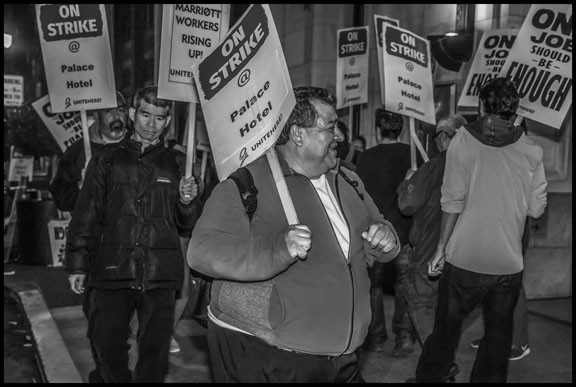
THE FACES OF THE HOTEL STRIKERS - PHOTOGRAPHS FROM THE PICKETLINES

THE FACES OF THE HOTEL STRIKERS - PHOTOGRAPHS FROM THE PICKETLINES
By David Bacon

Workers in seven San Francisco Marriott hotels, and the San Jose Marriott, went on strike on Thursday, October 4.  Workers at the Oakland Marriott walked out the next day.  These are the faces of the workers on the lines.  If you're in the Bay Area, you'd be welcome to walk with them as they tell the hotels "One Job Should Be Enough!"

You can see the full selection of images on these webpages:
San Francisco Marriott Strike - Day 1
https://www.flickr.com/photos/56646659@N05/albums/72157674201553958
Evening on the SF Marriott Picketline
https://www.flickr.com/photos/56646659@N05/albums/72157696275039800
Oakland Marriott Workers Walk Out
https://www.flickr.com/photos/56646659@N05/albums/72157698901870202
San Jose Hotel Workers Strike Marriott
https://www.flickr.com/photos/56646659@N05/albums/72157701912219114

San Francisco


Oakland 


San Jose


Tuesday, October 2, 2018

TLATELOLCO AND ITS MEANING: REFLECTIONS BY RAUL ALVAREZ GARIN

TLATELOLCO AND ITS MEANING:  REFLECTIONS BY RAUL ALVAREZ GARIN
By David Bacon
NACLA Reports, October 2, 2018
https://nacla.org/news/2018/10/02/tlatelolco-and-its-meaning-reflections-ra%C3%BAl-%C3%A1lvarez-gar%C3%ADn


Raul Alvarez' photograph, taken on another October 2 march a few years earlier, was carried as the banner at the head of the marchers in 2014. If he'd been alive, he would undoubtedly have been there in front himself.  (David Bacon)


A 2002 discussion with Raúl Álvarez Garín, a survivor of the 1968 student massacre, on the ongoing legacy of state impunity in Mexico.

Every year on October 2 thousands of Mexican students pour into the streets of Mexico City, marching from Tlatelolco plaza through the historic downtown to the Zócalo. They're remembering the hundreds of students who were gunned down by their own government in 1968, an event that shaped the lives of almost every young person in Mexico during that time.

Raúl Álvarez Garín was one of those students whose world changed at Tlatelolco. He was a leader of the national student strike committee, organizing campus walkouts and street mobilizations through the spring of 1968. This rebellious upsurge occurred simultaneously with student protests in France, the United States, and across the globe. When the Left resurfaced after a period of extreme repression in the late 1960s and early 1970s, Álvarez became a leader of the Mexican Left, publishing the leftist magazine Punto Critico, Corre la Voz and numerous articles. For more biographical information, see the 2014 article "A Hero of Tlatelolco," reprinted below.

In 2014, the commemoration march took on even greater significance. It occurred just days after the disappearance of the 43 Ayotzinapa students, who had commandeered buses to travel to the march but were kidnapped and murdered before they left Guerrero. Álvarez Garín himself had passed away after a battle with cancer on the same day-September 26, 2014. His photograph graced a banner at the head of the march. If he had been alive, he would undoubtedly have been in front of the march himself, pointing out that the impunity of the Mexican state in 2014 has legacies in the impunity of five decades before.

The following interview, conducted on December 1, 2002, contains Álvarez Garín's reflections on the massacre. At the time, he and others were seeking to bring the perpetrators of the massacre to trial on the heels of the PRI's historic presidential loss after 71 years in power. On the 50th anniversary of this tragedy, his words bear remembering. His oral history is reprinted in abridged and edited form, below:


In 1968 I was at the school of Mathematics and participated in the Consejo Nacional de Huelga (National Strike Council, CNH) as the school representative. The 1968 movement was against government repression. It grew very large, but ended tragically with the events of October 2. That culminated in the arrest of many students and professors.

In order to explain the events of Tlatelolco, you can discuss at length every event leading up to them, for example, the actions taken by both the student movement and the government. There were student marches and dialogues between the two sides. There was also an effort by the government to blame the president of the university for the actions of the students.

Today there are discussions of whether or not these actions were indeed genocide.You can also discuss the resources used by both sides. There was the military occupation of the university. The movement was gaining strength when the government then decided to use excessive force. It was a planned attack using the element of surprise, which is against the law. It meant the death of political opponents. Today there are discussions of whether or not these actions were indeed genocide.

You can also look at Tlatelolco in theoretical terms. The PRI, the ruling political party at the time, had a way of repressing social movements using a firm hand. But it also wanted to be seen as a democratic government. There were many discussions between both sides until the tragic end.

After the massacre of October 2, the government opened the door to this new response method. In essence, it allowed the government to respond in the same way in the future. On June 10 it happened again. Ultimately it led to the formation of the White Brigades, an illegal entity with permission to kill political opponents. In legal terms, we are saying that from October 2, 1968 to 1982, which was the last documented existence of the White Brigades, there existed in Mexico a sort of political genocide. A decision was made to combat a sector of the population, the political opposition. The conflict between society and the government resulted in the extermination of the opposition.

The explanation given by the government is what we call the official version of the events of October 2. They first alleged that there had been a confrontation in Tlatelolco between guerrilla groups comprised of students and the Mexican military. They said that when the military arrived to break up a student march, they were met by gunfire.

It is the same explanation they give for the events of June 10, 1971. They also try to present that situation as a confrontation between two different student groups with different ideologies. They say that the police decided to not intervene. The truth is very different.

When you talk about repression by the Mexican government, it follows a constant line, that the student groups always attacked the military. This is presented as a rebellion or an act of violence that the military had to crush. This is how they explained the events of Tlatelolco.

They explained the events of September 15, 1961 in San Luis Potosí in the same way. At the time San Luis Potosí was a very important railroad town. It was relatively small, with about 300,00 to 400,00 people, but had a large number of 8,000 railroad workers. San Luis Potosí was the hub of the railroad industry of Mexico at the time. In 1959 there had been a nationwide railroad workers' movement centered in the area. This movement was crushed as well. One of the reasons for Dr. Salvador Nava's movement was to release all of the political prisoners from the railroad movement of 1959. In 1961, Dr. Nava decided to run in the elections. He won in the city, but the state was still controlled by the PRI.

The government declared to the rest of the country that [Nava's movement] was an extreme right-wing movement. That legitimized its actions. In order to crush Dr. Nava's political opposition campaign, the government utilized the same script. The military came in during the night, while the Independence Day festivities were underway. Police, armed and dressed as civilians, started shooting and the military stepped in. Many people died and were injured. This allowed the government to prosecute and jail the leaders.

The same government officials who led this campaign then led Tlatelolco. The government characterized the movement there as the opposite, that they were crushing opposition of the extreme left wing. We say there is a Mexican school of oppression, because they have a certain way in which they always respond to situations like this. In ideological terms, the government states that these groups were not made up of students, but instead were guerrilla groups or subversive agents, communists, or terrorists. When the labels escalated as they did, they felt their actions were justified.

It is the same tactic used during the Spanish Inquisition. It is like saying the government's opponents are not Christians. They are Jews, they practice a twisted belief and are the devil. Therefore, it is justifiable to burn them alive. It is a sequence of actions that they follow to oppress people.

In Atenco, it was the same. They are not agricultural workers, the government said. They are guerrillas. Everything was in place to respond in the same way. They don't explain the situation as frustrated agricultural workers who are victims of the social, political, and economic situation in Mexico. They define their opponents as a threat to authority. Therefore, they have to respond.

There are two kinds of incidents. One is used to crush movements in the universities and the other to crush agricultural worker movements. There were conflicts in the Universities of Michoacán, Nuevo León, Sonora, Puebla, Tabasco, and Guerrero. They all were suffocated by military action. There were massacres in Chilpancingo in 1960 and 1967. The government's actions grew increasingly violent. By the time of the movement of 1968 the government had already taken military action against all of these groups.

The government jailed 50-60 students they labeled as communists, even though the students had done nothing illegal. In July that year, the government detained part of the communist group and student opponents of the government. They did not want protests and marches during the Olympics. The student groups continued to call for marches. The government jailed 50-60 students they labeled as communists, even though the students had done nothing illegal. Before the visits of foreign dignitaries like President Kennedy, or other big events, the government wanted to be sure there would be no student uprisings. They conducted preventive detentions of many students who had done nothing wrong. There were deaths, but nothing is documented. The National University was invaded on September 18 and confrontations took place at the Polytechnic University on September 23 and October 2.

The invasion of the Polytechnic University didn't crush the movement. Instead, the movement grew, incorporating other sectors in the protests. After the confrontations at the university on September 18, the movement began to receive support from workers. There were work stoppages at hospitals and schools in Mexico City. There were railroad worker stoppages. On October 2, a large number of railroad workers arrived in the city to join the marches. Petroleum and electrical workers also supported the student movement. Newspapers declared their disagreement with the government actions. Huge banners hung on buildings throughout the city expressed anger at the police.

The events that took place in the Plaza of Tlatelolco were very complex and all of us there have our personal view of them. Students who had the most privileged view of the day were the ones in the meeting on the third floor of the Chihuahua building. They saw what was happening in the Plaza only for a few seconds. It was a peaceful meeting and when they saw the massacre begin to unfold, they were immediately apprehended. They saw the police on the third floor begin to randomly shoot down towards the plaza, at the military and students alike. Everyone dropped to the floor.

I was in the Plaza and I observed police shooting down on us as the military approached from behind. The first reaction of some students was to try to advance to the third floor and assist our friends there, because we couldn't see them anymore. We were denied access by government agents. They were shooting, and we retreated again to the plaza. Students ran toward Manuel Gonzalez Street, which was then the only exit from the Plaza. Some of us ran inside the church, where we were later surrounded and apprehended. Each person had only a very partial view, because none of us could see the entire event.

A very important document was published three or four weeks afterward, which began circulating on October 27 and 28. It was a reconstruction of the events by the National Strike Council. It corresponded with our defense version in 1970, and we have been saying the same thing all of these years. From the first moment, we noticed there were three barricades. The first barricade was around the Chihuahua building which was put in place on orders of Ernesto Gutiérrez Gómez Tagle. He was responsible for blocking access to the building and for the strategically-placed officers in civilian wear. That was a crime.

The second barricade was around the entire plaza and led by Commander José Gómez Toledo. They had three battalions of military officers, which totaled 4,000 to 4,500 soldiers. The third barricade was around the entire property of Tlatelolco, which was led by Cristóforo Mazón Pineda, the leader of the First Brigade in the Mexican military. In that post, there were approximately 4,000 soldiers. This gives us an idea of the magnitude of the operation.

The first shooting started at 6:10 [PM] and ended at 8:30. There were two and a half hours of continuous shooting by hundreds of firearms. The operation lasted a long time. It wasn't something that happened only once and very quickly, like an explosion or a single gunshot. It was two and a half hours of an extensive military operation. They had sufficient time to make decisions one way or another. The actions they took were planned. It was not out of their control. It was very well planned out.

The time from the moment the shooting started until the Plaza was empty, except for the bodies of the dead and wounded, was not more than two minutes. From there on, action proceeded at the Chihuahua building, where there were snipers on the third floor. We are waiting for the explanation of the government about these individuals who shot at targets for two and a half hours. What was their purpose? For those of us in the Plaza, it was very evident that it was an oppressive measure by the government. The soldiers shot at the building and at anything that moved. I was very angered by what I saw.

When the shooting started, David Vega was talking. We were in the corner by the mural and the convent. The soldiers were a few meters away. I left immediately and when I turned I saw a group of people where I had been standing, who were injured or dead, including a child. At that moment I couldn't stop and reflect. It was different at the military detention center where we were all taken. For the first few days, I was under the impression that all of our fellow students on the third floor of the building had been killed. Fortunately, that was not the case.

I was detained in Tlatelolco. All of my fellow students in the Chihuahua building were immediately taken to the military detention center as a group. I was taken with another group to Santa Martha. They then realized that I was to have taken part in a meeting with them. They transferred me to the military detention center, but isolated from the group. The other students didn't know I was detained there and vice versa. We knew we were political prisoners and we would not be liberated immediately. I was detained for two years and seven months.

People became more aware of the many illegal atrocities taking place, and as a consequence, many decided to form a new political movement against the ruling party.The movement of 1968 triggered a change in the mind of many Mexicans. People became more aware of the many illegal atrocities taking place, and as a consequence, many decided to form a new political movement against the ruling party. Many committees started popping up. All of this activity spurred political participation and popular opposition to the administration. In 1971 President Díaz Ordaz left office, and Luis Echeverría became president, beginning a series of changes. Prisoners were freed, from both the railroad movement and our movement.

Some students were released in January and February. We were released in April, but we had to agree to leave the country. Our only condition was that we could decide which of us would leave the country first. We left to Peru and Chile, another chapter of our political struggle. Students with longer prison terms were the ones who left the country. That way students with shorter prison terms would have to be released and allowed to stay. After we were released in April, the students who were already free and in Mexico began a campaign, charging that we had been exiled. We used a quote from Porfirio Díaz, which referred to the treatment of political opponents, which called for imprisonment, banishment or death. The government said we hadn't been banished from the country and that they had not forced us to leave. They said we had a choice, so we then changed our minds and returned to Mexico on June 3, 1971.

Seven days later was the massacre of June 10. The movement of June 10 began at the University of Nuevo León. It called for a change in the political structure, with many issues. A march was scheduled in Mexico City to support the students in Nuevo León. The government used the march as an opportunity to attack with a paramilitary group called the Falcons. They were dressed as fellow protesters, and then suddenly attacked. A total of 37 people died, possibly more.

The government stated that the students who returned from Chile had provoked it and caused another confrontation.  That excuse didn't hold up very well. The press immediately told another story, and showed the planned coordination between the Mexico City police, the National military and the Falcons. Their government made an investigation but the findings were never reported.

In those days, the government would arrest you for two reasons. One was because you belonged to the Communist Party, and the other was because you were a leader in the student movement. Either was enough to be detained. The formal accusations depended on the moment. The students who were detained in July 1968, were charged with minor offenses, like robbery and illicit activities. As time went on, more serious charges were made. After September, the government began charging them with rebellion. After October 2, the charges included homicide. We were accused of 12 charges, which included robbery, illicit activities, rebellion, and homicide. The trials of 1968 were ridiculous. The prosecutor at the time has admitted that these charges were bogus, with no foundation. He became a witness for us, in order to dismiss those charges.

Yet Echeverría's image is associated with left-wing movements in Latin America. At that time, Mexico welcomed political exiles from Chile, like the family of Salvador Allende, and received a large number of Argentine and Brazilian exiles. Mexico was seen as a leader in Latin America. This is not in contradiction with extreme nationalism, a nationalism very close to fascism. But it put opposition groups in Mexico in a very difficult situation. For many years Mexico was seen by other countries as a very positive and democratic government, since it was receiving political exiles. That made opposition groups in Mexico seem extremely radical. If you were not completely aware of Mexico's situation is was easy to be fooled.

Another event like October 2 is not completely out of the question. Every time there is an uprising, the possibility of this happening is still present. We have been saying for the last 30 years that this action to stop. In 1988, with the victory of Cuauhtémoc Cárdenas, the same thing could have happened when they voided his win. In his speech he stated, "they want a blood bath." But the same oppression could not happen again, he said, because we were going to build a party so big and united that they would have to retreat.

In 1993, a year before the elections of 1994, some said the two giant trains would collide-the PRI and the PRD, with its leader Cuauhtémoc Cardenas. Many feared that the PRI would use deadly force again. That year a commission was formed to find final answers about the events of Tlatelolco. They didn't have access to government documents, however. The government stated that for national security reasons they could not release military documents for 30 years. So we waited until 1998, when again a commission was formed to investigate the events, and once again they were denied information. Nevertheless, we made our own study and conclusions about what happened, with the purpose of prosecuting those responsible for the massacre.

Some people still say that excessive force is justified to pacify opposition groups. The only way to have people punished for their actions is to try them in the justice system. We had to say that we weren't interested in the reasons the government had for taking actions. What we wanted was an investigation to determine whether certain actions on October 2 warranted criminal charges.

We presented the charges, and at first we were not taken seriously. But the international community began looking at human rights issues seriously, like the Pinochet case. The situation changed. Now it is not as easy to dismiss our charges. They must respond to them.

Naturally, the judicial system tried to change or modify the cases, so that our side would get frustrated. The press responded favorably to us because they had also been affecting by censorship. At the center of everything was the military, and many have concluded that there must be a code of ethics in the Mexican military. The way the system works is that the military obeys all government orders blindly. We want them to have loyalty first and foremost to the nation and the law, not to their supervisors. This is a national cultural battle. An article in the newspaper La Jornada said this new idea should be taught and implemented in military schools.

During those years Mexico maintained a distance from the U.S. government. Until 1968 the Mexican military was trained to stop aggression from the United States. This had always been their frame of mind and didn't start to change until then. After 1968 new elements were incorporated, like taking a stance against national subversive groups like the Communists. Until 1976, Mexico did not participate in military conferences in Latin America. Nevertheless, there was some collaboration between the U.S. and Mexico.

After the attacks of September 11, the United States has asked for much broader cooperation from other countries. They have asked for intelligence information from their borders and the activities of possible terrorist movements and groups. They have a very broad definition of what they define as terrorism. All of this has to have some effect on intelligence and military factions of Mexico. This is alarming, because the people who hold offices in the intelligence community in Mexico is a relatively small group. That will be reflected in the outcome of the trials. These trials will have to investigate the intelligence community. They are the ones that gave information to the government, which in turn made decisions based on that information.

In 2002, a special prosecutor was appointed in the case filed by Alvarez Garin, Jesus Martin del Campo, and Felix Hernández Gamundi, but in 2007 a court hearing the case dismissed it.  Following the election of Andrés Manuel López Obrador as president of Mexico, however, hope increased that the case could be revived. On September 24 of this year the government issued a statement that confirmed that the Tlatelolco shootings constituted a massacre. As Jaime Rochin, chief of the Executive Commission for Victims' Assistance in Mexico (CEAV), a subsidiary of the Department of the Interior, wrote: "The Tlatelolco massacre, which took place on the afternoon of Oct. 2, 1968...represents a historical chapter in which the Mexican state showed its most authoritarian face by silencing the voices of the citizen's movement."


A HERO OF TLATELOLCO
By David Bacon
NACLA Reports, October 20, 2014
https://nacla.org/news/2014/10/20/hero-tlatelolco


Raúl Álvarez Garín, 1990 (David Bacon)


Every year on October 2 thousands of Mexican students pour into the streets of Mexico City, marching from Tlatelolco (the Plaza of Three Cultures) through the historic city center downtown, to the main plaza, the Zócalo. They're remembering the hundreds of students who were gunned down by their own government in 1968, an event that shaped the lives of almost every politically aware young person in Mexico during that time.

This year, just days before the march, the municipal police in Iguala, Guerrero, shot students from the local teachers' training college at Ayotzinapa. More demonstrations and marches are taking place all over Mexico, demanding that the government find 43 students still missing. Students marching on October 2 were in the streets for them as well, aware that the bloody events of 1968 were not so far away in some distant past.

Raúl Álvarez Garín was one of those whose world changed at Tlatelolco. He was a leader of the national student strike committee, organizing campus walkouts and street mobilizations through the spring of 1968. This rebellious upsurge was simultaneous with student protests in France, the United States and, it seemed then, the whole world. In Mexico it culminated in a huge rally at Three Cultures Plaza.

The Mexican government was preparing for the Mexico City Olympics that year. It had never tolerated political dissent beyond very narrow limits, but then it was even more defensive than usual, fearing any social movement that appeared to challenge its hold on the country's politics. The authorities decided to bring out the army and shoot the students down.

Somehow Álvarez survived the bullets in the plaza, and was then shut into a cell in the notorious Lecumberri prison for two years and eight months. He died two weeks ago on September 27, having spent a lifetime trying to assign responsibility for the decision to fire on the crowd. There was actually no mystery about it. The orders for the massacre were given by then-Secretary of the Interior (Gobernación) Luis Echevarria. But Echevarria was acting for Mexico's political establishment, organized in the Institutional Revolutionary Party (PRI). Álvarez wanted the crime acknowledged publicly and the guilty punished. By spending the next half-century pursuing that goal, he became not just a hero to the Mexican left, but its conscience.

Álvarez was already a man of the left when he got to Tlatelolco. He'd joined the Young Communists, but then left before 1968. He married María Fernanda Campa, daughter of Valentín Campa, one of Mexico's most famous radicals who lived underground and went to prison after leading a railroad workers strike in 1958. After his release, Campa became the 1976 presidential candidate of the Mexican Communist Party, before it merged with other parties and eventually disappeared.

Later in life it was hard to imagine Álvarez as he was described by friends in '68-a skinny intense youth of 27. When I met him in 1989 he was already a man of substantial girth. We'd go to lunch with his brother, economist Alejandro Álvarez, and spend hours talking politics. Raúl would get animated, talking beneath his huge mustache faster than my broken Spanish could keep up. He'd ask a hundred questions about Mexicans and unions in the U.S., and we'd plan articles for the newspaper he edited, Corre la Voz (Spread the Word).

Álvarez believed that words have power. Long before Corre la Voz, he started another famous Mexican leftwing journal, Punto Crítico, with other 1968 veterans. His goal was to make his politics accessible to ordinary people, not to inspire debate among dogmatists. "He put our debates into context and showed their limits," remembered Luis Navarro, now an editor at Mexico's leftwing daily La Jornada. "His language was always understandable."

Through the years after 1968 he supported every worker's fight that seemed capable of improving conditions, but that also challenged the political order. As Mexico's political structure began to change in the 1980s Cuauhtémoc Cárdenas ran for President in 1988, against the PRI his father had founded 40 years earlier. Álvarez and others saw the Cardenas campaign as an opening to wrest power from the PRI, 20 years after Tlatelolco. As the votes for Cárdenas were being counted, and it was clear he was winning, the election computers suddenly went down. When they came back up the next morning the PRI candidate, Carlos Salinas de Gortari, one of the country's most corrupt politicians, was declared the winner.

During and after that campaign, many currents of the Mexican left came together and organized the Democratic Revolutionary Party. Álvarez was a founder. He began to look for a way to break workers and unions free of the PRI, to give the new party a working-class base. I met him that year after the election, when I came to Mexico with other U.S. trade unionists. The North American Free Trade Agreement was already on the horizon. Raúl and Alejandro Álvarez were some of the first people who saw the advantage of cooperation in trying to fight it on both sides of the border.

I was beginning to work as journalist north of the border. Raúl and Alejandro helped me understand that for all of NAFTA's disastrous impact on the workers of my country, the trade agreement would have much worse consequences in Mexico. I spent last week as a judge in the Permanent People's Tribunal investigating the causes of migration from Mexico to the United States and the terrible violations of the rights of migrants in both countries. It's clear that if anything, they underestimated the damage. And repression in Mexico is not just a thing of the past. As we met as judges in the Permanent People's Tribunal, just days after Raúl Álvarez died, we heard testimony about yet other mass killings-of 73 migrants killed and buried in the desert in northern Mexico, and the discovery of 193 more in 47 graves less than a year later.

The PRI finally lost the Presidency in 2000, although not to the left but to the rightwing National Action Party. Nevertheless, Álvarez believed it might be possible to get a new government, even a conservative one, to call the murderers of 1968 to account. A new office was created, the Special Prosecutor for Social and Political Movements of the Past. Álvarez, Felix Hernández Gamundi and Jesus Martin del Campo filed a legal case against Echevarria over the Tlatelolco massacre, the killings of other students in a street protest in 1971, and the "dirty war" in which the Mexican government targeted leftists for assassination through the rest of the 1970s.

Formal charges were finally made against Luis Echevarria Alvarez and Luis Gutierrez Oropeza for the Tlatelolco murders, and Mario Moya Palencia and Alfonso Martinez Dominguez, among others, for the 1971 attacks. In the end, however, these former functionaries were able to avoid trial after invoking legal technicalities challenging the ability of prosecutors to indict them. In reality, the political system itself was reluctant to unearth a network of responsibility that would have spread to include many others. Nevertheless, Raúl Álvarez and his two co-complainants felt their work made plain to the Mexican people the terrible acts of repression that had cost many lives, and who had given the orders for them.

Bringing up the rear of the October 2 march were members of the only union visibly present-the Mexican Electrical Workers (SME). Both Álvarez and this union have been anchors of left wing politics in Mexico City. For twenty years the SME campaigned to stop the Mexican government from turning over the nationalized oil and electrical power industries to private corporations. To neutralize its opposition, the SME's 44,000 members were fired five years ago. The PAN administration of Felipe Calderón ordered the army to occupy the generating stations and declared the union "non-existent." When the PRI came back into power last July, it pushed through a constitutional amendment permitting the privatization.

Raul would have pointed out that there is really no difference between the pro-corporate policies of PRI and PAN. He fought to keep parts of the PRD from supporting the same privatization reforms. Just days before his death, a delegation of SME leaders went to his home in Mexico City, and gave him a union card, making him member #16,600. He told them he was proud to be a member of this "union in resistance."


David Bacon is a California writer and photographer, with numerous published articles about Mexican politics and labor. His latest book is In the Fields of the North / En los campos del norte (University of California Press / Colegio de la Frontera Norte, 2017). He was a friend of Raúl Álvarez Garín.

Tuesday, September 25, 2018

HOTEL WORKERS REGISTER ANGER WITH MARRIOTT IN DECISIVE STRIKE VOTE

HOTEL WORKERS REGISTER ANGER WITH MARRIOTT IN DECISIVE STRIKE VOTE
By David Bacon
Truthout, September 25, 2018
https://truthout.org/articles/hotel-workers-register-anger-with-marriott-in-decisive-strike-vote/


 Workers celebrate the 98.6 percent vote to strike

There are times when a vote is more than an expression of opinion about a political candidate. There are even times when it's more important than deciding whether joining a union is a good idea. For hotel workers, last week was one of those times - a vote to go on strike or not.

Striking may cost a housekeeper her rent money for several weeks at least, and maybe longer. It may have a bellman walking sidewalks instead of the carpeted hotel lobby. Voting to strike is a choice with certain risk and sacrifice on one side. On the other, however, workers have to envision and weigh the future of their jobs. Would a bartender eventually lose her job to a new cocktail-mixing machine? Would the rising premium for a cook's health care cut into his paychecks further and further every year?

Deciding to strike or not is a question with real and immediate consequences. It is a very democratic process. Everyone affected gets to choose. And everyone has to live by the result, regardless of how each individual votes. Once workers strike, those with families at risk will have no patience or tolerance for anyone who breaks ranks to go to work.

These photographs show what happened last week when the hotel workers in San Francisco and Oakland cast their votes. They reflect the great diversity of the hotel workforce - multiracial, young and old, men and women, immigrants and native born. And they show people's determination. It's no accident that more than nine out of 10 in every ballot chose to strike. In the photos you can see the anger they harbor against Marriott Corporation. You can see the relief when the votes were counted - relief that pretty much everyone agreed on what to do about it.

In San Francisco and Oakland the vote in favor was 98.6 percent. Hotel workers in these two cities are joining other Marriott workers in Hawaii, Boston, San Jose, Seattle, San Diego and Detroit, who all voted to strike by over 90 percent. Chicago hotel workers are already on strike at Marriott and other hotels.

More than 2,300 San Francisco hotel workers have been working without a contract since August 15 at the Marriott Union Square, the Palace Hotel, the W, Westin St. Francis Union Square, Marriott Marquis, Courtyard San Francisco Downtown and the luxurious St. Regis. They voted in a ballroom at the Parc 55, the scene of a Local 2 organizing drive that took four years to win. Oakland hotel workers voted at the Local 2850 office on Broadway, just across the street from the Downtown Marriott, where walking the picket line will be a first-time experience.

A Hawaii strike will hit some of the most famous tourist resorts on Oahu and Maui, where 3,500 people work at the Waikiki Beach Marriott, Sheraton Waikiki, the Royal Hawaiian, Westin Moana Surfrider, Sheraton Princess Kaiulani and Sheraton Maui. A Boston strike will include 1,800 workers at the W, Westin Copley, Westin Boston Waterfront, Renaissance, Ritz Carlton, Sheraton Boston, Aloft and Element.

Marriott has become a behemoth in the hotel industry, with 1.2 million rooms, far bigger than its closest competitor. It has more employees than Facebook, American Airlines, Microsoft or Boeing. Gobbling up other chains has made it the biggest hotel employer in San Francisco and the world's richest hotel corporation. Company profits have increased 279 percent since the recession. The 1 percent per year increase workers have received in the same period has long been eaten up by inflation. No wonder they're angry.

In San Francisco, the union collected some comments by workers as they cast their ballots. Larrilou Carumba, a housekeeper, said, "I voted 'yes' because my job at Marriott Hotels isn't enough for me to take care of my kids. Many days, after working full-time at the Marquis, I have to work the night shift at a laundromat."

The union's demand in negotiations, which will be its rallying cry in the strike, is "One job should be enough!"

Kirk Paganelli, a server and bartender, told the union, "I voted to strike because I live in fear of losing my job. Marriott Hotels laid me off after 18 years at my last hotel, so I know I'm never safe. Now I see Marriott installing bartending machines that threaten my job." Nix Guirre, a butler, said simply, "We're fed up. One job should be enough."

Anand Singh, Local 2 president, warned, "There will be disruptions if a strike happens." He says the industry is booming for investors, but not for workers. "Our members have been left behind, so we're fighting for a decent standard of living for ourselves and our families."

Eric Gill, secretary treasurer of Hawaii's Local 5, told his members that Marriott has grown so big that this is the last chance to force it to take their needs into account: "Our proposal is to make one job enough to live in Hawaii. Marriott's proposal is to get another job."


Unite Here Local 2 members line up to register to vote 


Hotel workers wait to get their strike vote ballots


Local 2 members showing identification to get ballots 


A Local 2 member votes to strike 


A hotel worker puts his ballot in the box 


The crush to put strike votes in the ballot box 


Counting the ballots 


Anand Singh, Local 2 president, announces the strike vote result 


Workers celebrate the 98.6 percent vote to strike 


A member of Unite Here Local 2850 registers to get her strike vote ballot 


Local 2850 President Wei-Ling Huber and organizer Yulisa Elenes talk with hotel workers about the strike vote 


A Local 2850 member votes to strike 


Putting the strike vote ballot in the ballot box


Two hotel workers show their support for striking

Wednesday, September 19, 2018

AN IMMIGRANT WOMAN TAKES CHARGE OF THE UNITED FARM WORKERS

AN IMMIGRANT WOMAN TAKES CHARGE OF THE UNITED FARM WORKERS
By David Bacon
The American Prospect, September 19, 2018
http://prospect.org/article/immigrant-woman-takes-charge-united-farm-workers-0


A crew of farm workers harvests head lettuce for D'Arrigo Brothers Company in a Salinas field.  Crew 125A has some of the longest-term workers at the company, and many of the workers cutting lettuce are women.

Women make up almost one-third of all agricultural laborers, but the presidents and most top leaders of the United Farm Workers have invariably been men. Dolores Huerta, the union's fiery co-founder, faced down growers and negotiated many of the union's contracts. She became secretary-treasurer, but not president.

Does it make a difference? The UFW has chosen a new president, Teresa Romero, who says it does. Although she's never worked in the fields, she believes her gender gives her a close connection to the lives of the women who do. 

After her election by the union's executive board on August 28 (the next convention in 2020 will make a permanent choice), Romero's first field visit was to lettuce and broccoli harvesters working in Salinas for the D'Arrigo Brothers Company. "In some crews a majority of the workers are women," she says. "There was a time when they didn't hire women for some jobs. I don't know what the reason was, but whatever it was, it was wrong. 

"Women can do everything, and we want the opportunity to do it. I've seen some older women in their 50s doing work that some younger people can't. If growers are worried about a labor shortage, there are women out there who can do the work.  But they want to be paid equally, and treated respectfully."

After 25 years as president of the United Farm Workers, Arturo Rodriguez is retiring in December, and the union has selected an immigrant woman to replace him. The UFW has had only two presidents in 50 years: Before Rodriguez, it was Cesar Chavez.


Teresa Romero, the new president of the United Farm Workers

This is more than a changing of the guard. Internally the union is trying to reflect more accurately its members. And while acknowledging the epic battles of its early years, it is coming to terms with a new group of California growers, some of whom see an advantage in cooperation, even though others still want a fight to the death.

The UFW is also looking for ways to address more directly the problems of its women members. Women in the fields are especially vulnerable in today's anti-immigrant political climate, Romero charges. "Harassment is very difficult for women to talk about, especially when they feel they might be deported and separated from their children. And for women, being fired is not their problem alone. Most are working with their husband or brother or sister, and abusers hold those jobs over their heads. It's important to have women in charge of crews as supervisors, to make it easier for a woman to come and say, 'This is what happened to me.'"

More than 90 percent of California farm workers were born in Mexico, yet UFW presidents until now have come from families with roots on the U.S. side. Chavez was born north of the border, in Yuma, Arizona, in 1927. Rodriguez, who followed Chavez in 1993, hails from San Antonio, Texas. Larry Itliong, the Filipino labor leader who shared leadership with Chavez during the union's initial five-year grape strike, was an immigrant, born in Pangasinan, in the Philippines. But he was never president.

Born in Mexico City, Romero grew up in Guadalajara, and came to the U.S. in her 20s.  She worked, successively, in a shoe store, in a lawyer's office, as assistant to Rodriguez, and finally as UFW secretary-treasurer. While she doesn't speak Zapoteco, the language of her grandmother, her roots as an immigrant with indigenous ancestry match the changing demographics of California's field laborers. People from southern Mexico, speaking Mixteco, Purepecha, and Triqui as well as Zapoteco, are the fastest-growing group among farm workers.  They've often been the backbone of UFW organizing campaigns and strikes during the last several years.

"I did what my grandmother did when she left Oaxaca to come to Mexico City," Romero says. "Like her, I moved to a different place where I didn't know the language or the culture. I never thought it would be forever, yet now I've been here over 30 years. That's what happens in the fields too. The workers and I share that same immigrant experience."

The UFW was slow to adjust to the rise in indigenous migration. In the early 1990s it signed an experimental agreement with an organization of Oaxacan migrants, the Binational Front of Indigenous Organizations. Rodriguez credits its former coordinator and Mixteco leader, UCLA professor Gaspar Rivera, with helping the union understand their culture. Indigenous organizers were slowly hired. In the early 2000s the UFW became a vocal defender of Triqui-speaking workers in the Salinas Valley community of Greenfield, organizing marches when immigration raids targeted them. 

Union meetings are still mostly in Spanish, as are contracts (which are also in English), but translation into indigenous languages is becoming more common. "It has been a challenge," Romero says. "But if we don't understand people's culture, they will see us as outsiders. When we learn and understand what's important to them, it opens doors."


Cesar Chavez, the first president of the United Farm Workers.

The United Farm Workers is not the same union Cesar Chavez left in 1993 when he died in San Luis, Arizona. He'd gone to Yuma, just a few miles from his birthplace, to testify in an all-consuming legal case against one of the union's most bitter enemies, the Bruce Church lettuce company. Bruce Church, like many other growers whose workers had voted for the union in the late 1970s, refused to negotiate with the union. 
By the time Chavez died, the UFW had shrunk to a few thousand members from a peak of about 40,000 in the late 1970s. Over 160,000 workers had voted for the union under California's Agricultural Labor Relations Act, the law the union had fought for in 1975. Like Bruce Church, however, most growers wouldn't sign contracts. Many others who did either went out of business, changed their names and dumped their workers, or simply refused to renew their agreements. 

Wages fell. "Things got so bad that the year before Cesar died we wanted to do something to give people hope," Rodriguez remembers, "and thousands of workers went on strike in Coachella to raise wages." Two years later the union repeated its seminal march of 1968, from Delano to Sacramento. "Cesar was gone. But that didn't mean we wouldn't continue to fight." 

In 1996 Bruce Church finally did sign a contract to settle its decades-long legal war with the union, and over the next 25 years, the UFW stabilized and began to grow. According to Rodriguez, 10,000 people now work under union agreements, mostly in California.

A successful boycott at the Chateau Saint Michelle winery in Washington state gave organizers the idea for an arrangement to force growers to negotiate. "The workers there won a contract using the idea of mandatory mediation," he says. The threat to return to the boycott was so powerful that the company agreed that a contract would be imposed if negotiations hadn't concluded by a set date.


Odilia Aldana works in a crew of farm workers harvesting head lettuce for D'Arrigo Brothers Company in Salinas. Aldana was a member of the UFW committee that negotiated the recent union contract.

In California the union convinced the legislature to pass a law with the same mechanism, to deal with the many companies where workers had voted for the union, but which never signed contracts. Now, if a grower won't negotiate after its workers organize and vote for the union, a state mediator can write up an agreement and the Agricultural Labor Relations Board can impose it. 

Growers predictably challenged the law, but the California Supreme Court upheld it in 2008. Several large growers, employing thousands of workers, then signed contracts, either because the state imposed them, or knowing that the state would if they didn't agree. That inspired further challenges. The world's largest peach grower, the Gerawan family in Fresno, tried again to have the law declared unconstitutional, but again the state courts upheld it. That case is now on appeal to the U.S. Supreme Court. 

"Mandatory mediation is important to us," Romero says. "If workers vote for a union, we have something we can use to get an agreement. But a law on the books doesn't by itself create change in the fields." 

The union also persuaded the legislature to act on issues affecting workers far beyond its own members. Until recently, at least one worker died in the fields every year, in the fierce summer heat in the San Joaquin Valley where temperatures routinely exceed 100 degrees. When a pregnant young woman, Maria Isabel Vasquez Jimenez, collapsed in 2008, the uproar over her death inspired protective legislation. "I went to so many funerals of people who died of the heat," Rodriguez recalls. "Her death stuck with me, though, in part because her father Doroteo lost his job when he spoke out. We won today's heat protections because of what they and others lost."

Another legislative victory gained overtime pay for farm workers on the same basis as other workers. "We convinced legislators when we reminded them that farm workers had been excluded from overtime by racism long ago," Romero says. 

Overtime pay and heat protection have now been extended to all farm workers in California. Yet, taking inflation into account, farm workers are paid much less today than they were in the period of the union's greatest strength in the late 1970s. The master vegetable contract of that era pegged starting hourly pay at about 2.5 times the minimum wage. If the same ratio held today, California farm workers would be earning over $27 an hour. Instead wages are close to the minimum of $11 an hour for large employers this year, and $12 next year. It's not uncommon to find groups of migrant workers living under trees, or sleeping in their cars at harvest time.


Retiring United Farm Workers of America President Arturo Rodriguez and farm workers from the Gallo wine ranch in Sonoma County protest the unwillingness of the company to sign a union contract. 

"While union contract wages are generally much higher than the minimum wage, the UFW faces a daunting challenge in trying to raise the income of farm workers across the board. Meanwhile, the contested terrain between growers and the union is changing rapidly. For several decades corporate growers have been globalizing their operations, growing fruit and vegetables in many countries. At the same time, as trade agreements like NAFTA have displaced poor rural communities in Oaxaca and elsewhere, farmers have come to the U.S. looking for work and survival. "We have a mostly undocumented workforce, and no immigration reform in sight," Rodriguez says. "Growers are running away to Mexico and elsewhere. It's a huge problem."

Even as immigration enforcement is creating a climate of fear in California farm-worker towns, the government is encouraging growers to hire that flow of displaced people, but only as temporary contract labor through the H-2A visa program. President Donald Trump, despite his otherwise sour anti-immigrant rhetoric, told a rural Michigan rally in February, "We have to have strong borders, but we have to let your workers in. We have to have them."

In the last few years, the number of workers brought to California on temporary H-2A work visas has climbed steeply.  The state's growers imported 3,089 H-2A workers in 2012. In 2017 the number had mushroomed to 15,232-a 500 percent increase in just five years.Some growers see the possibility of replacing at least part of their workforce of resident farm workers with this contracted labor. Some major agricultural corporations, among them Tanimura and Antle, are building barracks for hundreds of H2-A workers in Salinas.

Some immigrant rights activists have called for abolishing guest worker programs, citing the abuse of the workers, and the potential for undermining the existing farm labor workforce. Romero and Rodriguez believe growers face a labor shortage, however, and need at least some H-2A workers at peak harvest times. 

Romero argues that if there are going to be H-2A workers, the union has to protect them like other workers. "In Mexico they are charged thousands of dollars by recruiters, which is illegal. The [recruiters] bring them here and take away their documents. Some families in Mexico haven't heard from their loved ones for months, or don't even know if they're alive. And the contractors say 'no women.'" The union helped set up an organization, CIERTO, which advertises "clean recruitment." It also partners with organizations in Mexico that monitor the recruiters.


Migrant farm workers and their supporters march in Salinas to protest immigration raids. The march was organized by the United Farm Workers union, and celebrated the birthday of union founder Cesar Chavez. Retiring UFW President Arturo Rodriguez heads the march.

But the H-2A program, with its threat to replace the established work force, scares the workers living here, Romero admits. As well, defending the rights of H-2A workers is extremely difficult, as growers can fire them for protesting abuse or not working fast enough, which then triggers the workers' deportation. But Romero remains optimistic that growers will never be able to use the program to replace their workforce.

As she sees it, the future of the UFW lies in its ability to work with growers like D'Arrigo Brothers. The union just renegotiated a contract with the company covering 1500 resident farm workers, along with about 200 H-2A visa holders. Some D'Arrigo employees have worked at the company for several decades. John D'Arrigo says that the key to dealing with the current shortage of farm labor is to encourage workers to stay by making them direct employees, rather than hiring them through contractors.

"With direct hires, there's less product left in the field," Romero says, outlining a potential increase in productivity. "D'Arrigo wants the workers to come back year after year-a workforce that is part of the community. If he gives them benefits, they'll want to keep coming back. We can have a training program, with older workers spending time with newer ones. The company can listen more to the workers, to see what works and what doesn't, making workers part of the solution-not just pushing them to work faster." Items like the training program remain options for future contracts, but the new agreement does provide family health care, with the company paying the premiums, along with increased job security.

Cooperation, Romero believes, helps both management and labor. "When we work together workers bring solutions to the table. Production is better. Quality is better."

Part of her argument is that farm labor is undervalued, not just economically, but socially. "Growers need a competent and stable workforce," she emphasizes. "Nobody knows what's happening at the farm level better than the workers. The people are skilled and experienced. They have endurance. Farm work is a profession that deserves the same respect and consideration as a reporter or an engineer." 

Cooperation, however, hasn't often been the norm in agricultural labor relations. According to Rodriguez, "We have to change what attracts workers to agriculture. There have to be better wages, but that's not everything. The work can't require that someone be disabled by their job by the time they're 50 years old." 

The UFW, however, was born in massive strikes and national boycotts, which forced giant grape growers like John Giumarra and Richard Bagdasarian to sign contracts in 1970. Those companies are still a big presence in California agriculture, and not at all friendly to the union. 

If the union has to fight, the boycott is still an effective weapon, Rodriguez says. "You don't need to cut 50 percent of their business. A small group of committed people can influence consumers and have an impact. If there's no other way, then that's necessary."

Romero agrees, although she'd clearly prefer talking to fighting. "People like Giumarra-I don't know if we'll ever change them," she says. "Those who want to do things the old way have to be forced to change conditions. If workers say a company isn't doing right, and they want to strike and boycott, then we're going to do it."


Josefina Puga harvests head lettuce for D'Arrigo Brothers Company in a Salinas field.

Wednesday, September 12, 2018

ENDING THE USE OF COUNTY JAILS AS DETENTION CENTERS

ENDING THE USE OF COUNTY JAILS AS DETENTION CENTERS
Photoessay By David Bacon
Capital and Main, 9/12/18
https://capitalandmain.com/how-immigration-activists-got-ice-out-of-a-county-jail-0912


Family members of detainees, including Maria Lopez, Adrianna, and Hulissa Aguilar, called on ICE to release their loved ones after it was announced the center would close.

More photos below.


Bay Area immigrant communities and immigrant rights activists felt they'd won an important victory July 10. At a news conference, Sheriff David Livingston, flanked by the Contra Costa County Board of Supervisors, announced that his department was ending its contract with Immigration and Customs Enforcement (ICE) to hold immigration detainees in Richmond at the West County Detention Facility, one of the county's four jails.

Immediately, the organizations that had put pressure for years on the county over its cooperation with ICE demanded the release of the detainees, urging authorities not to transfer them to another location. For the next two months, until the immigrant facility inside the jail was closed, detainees' families and their supporters mobilized to get legal help, and raise the bond money needed to bail people out of detention. In the end, they raised tens of thousands of dollars, and freed 21 of about 175 detainees held inside the center. The rest were transferred.

A final vigil held September 1, after the ICE facility closed, was a bittersweet moment. For seven years, monthly vigils had been held under the portico next to the center's doors. After the sheriff was forced to abandon the ICE contract, however, activists and families were forced to gather next to a new chain-link fence, in the traffic lane of the highway outside the detention center's parking lot.

Several former detainees, some freed just days before, came with their families to celebrate. Other families, however, faced the reality that their detained loved ones were now far away, in centers ranging from Adelanto in San Bernardino County to Arizona. Alexa Lopez's father, Raul, was taken to a facility in Colorado.

"We can't see him anymore," said his wife Dianeth.

At the end of an hour of songs, prayers and speeches, the participants wrote messages on white ribbons to those still detained, and tied them onto the chain-link fence.

ICE spokesman Richard Rocha accused those who had pressured the county of being responsible for separating families. In a statement when the contract was canceled he said, "Instead of being housed close to family members or local attorneys, ICE may have to depend on its national system of detention bed space to place those detainees in locations farther away, reducing the opportunities for in-person family visitation and attorney coordination." Immigrant rights activists called that a threat and tried to free as many detainees as they could.

Rev. Deborah Lee, director of the Interfaith Movement for Human Integrity, and the central organizer of the vigils, said the faith groups involved had to examine their conscience. "The transfer of many detainees instead of their release was hard to swallow at first, and many families felt helpless," she said. "We asked ourselves if we were responsible for their transfer, as ICE accused us. But the families reminded us that ICE moves detainees all the time, and often they don't know where their own family members are."

The ICE argument, that forcing the county to divest from cooperation in detention would harm the detainees, is similar to arguments heard during the fight for divestment from apartheid in South Africa. Corporations investing in South Africa at the time said divestment would harm those people who divestment proponents were trying to support.

Opposing divestment, however, was then and is now also a matter of economic self-interest. ICE was paying Contra Costa County $3 million per year to house immigrant detainees. Yet the sheriff didn't hire any new employees with the money, according to Lee. Instead his department relied on overtime by the existing workforce. In a petition a year ago detainees complained they were being held in cells 23 hours a day, that there were no toilets in the cells, and that free time for calling relatives or taking showers was often canceled. One detainee asked to be deported in preference to continued detention.

"County jails are the worst place to be an immigrant detainee, even worse than many of the huge privately operated detention centers," Lee charges. "They have far fewer services for people, and aren't built for long-term detention. Of course, what does that say about the conditions for the non-immigrant people imprisoned there?"

ICE has facilities located in hundreds of county jails around the country, building a dependency among counties on the money paid for housing detainees. The city councils of Hoboken and Jersey City protested when Hudson County, New Jersey, supervisors (all Democrats) voted last July to renew its ICE detention contract. "The county and cities shouldn't be in the business of profiting off human misery," Jersey City Mayor Steve Fulop told the New York Times. Sacramento was receiving $6.6 million annually from ICE before it canceled its contract in June. Other contracts have also been canceled in Santa Ana, Virginia and Texas.

The vigils at the West County Detention Facility went on longer than protests at any other county jail. "They created a monthly platform," Lee explains, "where detainee families could come and ask for support. A consistent, regular event provided a place where people who weren't necessarily activists could participate. People brought their children, made their own signs, and came to play music. Often one person from a congregation would come at first, and then go back and recruit others. From the beginning, we were committed to the long haul."

Lee relied on faith congregations as a base, and each month appealed to one of them to take responsibility for the vigil. As the vigils gained momentum and before they were successful, Lee explained why congregations were morally obligated to be involved: "Since the detention center is in our community, we can't look away. We have to own it, to scrutinize and examine what goes on inside, and be involved with the detainees and their families. Ultimately, we have to force our local authorities to divest and get out of the business of detention, and stop collaborating and making money from it. It's not impossible. It's something that people can do to end the detention system."


Supporters of Lourdes Barraza and her husband Fernando were able to raise the bond to get him released. He came to the next vigil to show support for other families, holding his youngest daughter.


Alexa Lopez hoped her father, Raul, would be released in time to celebrate her quinceñera (15th birthday).  After the Contra Costa County Sherriff announced he was closing the center some detainees were released on bond, but to the dismay of Alexa and her mother, Raul was not one of them, and he was transferred to Colorado.


Liliana comforted her niece after she saw her mother for the first time in 8 months.  Her mom was not released, however.


Family members of detainees called on ICE to release their loved ones after it was announced the center would close. 


Rev. Deborah Lee, the vigil organizer and director of the Interfaith Movement for Human Integrity.


Other faith activists outside the detention center the day it closed.


Kara Hernandez and her son Victor Jr. came to the last vigil with her husband, Victor, who had just been released before the immigration detention center was closed.  


Victor Hernandez embraced Hugo Aguilar during the last vigil, showing the friendship that had developed between them during months inside.


Hulissa Aguilar came to a vigil to ask for help to get her father Hugo released.  After raising the bond and getting him out, the family was reunited at the last vigil, together with Hugo's sister Isela and brother Gonzalo.


The Sherriff put up a fence to keep vigil participants out of the parking lot and away from the detention center, after he was forced by county supervisors to end the contract with ICE to run it.


Hulissa Aguilar and Victor Hernandez, along with many vigil participants, tied ribbons to the fence after writing messages on them expressing support for the families of other detainees.