Tuesday, March 15, 2016

NO COUNTRY FOR OLD PEOPLE

NO COUNTRY FOR OLD PEOPLE
U.S. market ideology is undermining human rights for elders.
By David Bacon
Dollars and Sense, March 2015, New America Media
http://dollarsandsense.org/archives/2016/0316bacon.html
http://newamericamedia.org/


Dallas lives in the camp outside the old Berkeley City Hall, called by the residents an occupation.  It is a protest against the Berkeley City Council passing an anti-homeless ordinance.


Is there a human right to age in dignity? Some countries think so.

Unfortunately, ours isn't one of them.

The Organization of American States recently adopted the first international convention on the human rights of older people (though the United States did not endorse it). The Organization of African Unity is debating its own convention, and is expected to adopt it next year.

It is ironic that the world's poorer countries, presumably those with the fewest resources to deal with aging, are in the vanguard of establishing this set of rights. Meanwhile, the richest countries with the most resources, including the United States and the European Union, are arguing against applying a human rights framework to aging. In part, their contrarian stance reflects the dominance of market ideology. In a corporate economy, people lose their social importance and position when they are not working and producing value. In the United States, the resulting set of priorities has a devastating impact on older people.

While some countries are creating a new definition of human rights to include aging, and passing conventions that incorporate it, millions of seniors in the United States live in very vulnerable and precarious conditions, which are violations of their human rights as viewed in this context.

In another 15 years, 18% of the people in the United States will be over 65 years old. Though their numbers may be increasing, however, their security is not. In fact, the future of the nation's elders is growing ever more precarious.

According to a recent study, Senior Poverty in America, by Rebecca Vallas, director of policy in the Poverty to Prosperity Program at the Center for American Progress, 10% of seniors (4.6 million people) fall below this country's official poverty line.

In 1966 it was 29%. That sounds like progress. Vallas attributes the decline mostly to Medicare, Medicaid, and other programs established during this period. But this appearance of progress, she says, doesn't account for the desperate situation of millions of seniors today. The programs helped people, but their success at lowering poverty among some seniors masks the desperate situation of millions of others. The official poverty line is too low, has grown increasingly out of whack over the years from the real cost of living, and uses a faulty method (3x the basic food budget) that does not correspond to current spending patterns for low-income people.


James Kelly lives in a camp outside the old Berkeley City Hall, called by the residents an occupation - "Liberty City".

The official poverty line defines poverty for a single person as an income less than $11,770, and for a couple, $15,930 (for Alaska and Hawaii it's slightly higher). Rent alone absorbs a huge portion of this. Even seniors at 125% of the poverty line spend more than three quarters of their income on rent, Vallas found-$11,034 for singles, and $14,934 for a couple. It's hard to imagine finding an apartment in many urban areas with rent that low.

According to Vallas, seniors across the board spend 14% of their income on medical costs. Adding that to rent, poor seniors are left with about 10% of their income for food, bus fares, and everything else. It's no wonder that so many people in line at county food banks are old.

Even an income of twice the official poverty line is hardly enough to make ends meet, and the number of seniors under this line is much greater-32% of those over 65 and 40% of those over 75.

A better criterion for poverty is the Supplemental Poverty Measure. The U.S. Census Bureau created this yardstick in response to criticism that the official poverty line grossly underestimates poverty (see Jeannette Wicks-Lim, "Undercounting the Poor," Dollars & Sense, May/June 2013). The SPM is based on real-life expenditures for basic necessities like food, housing, clothing and utilities. It varies from place to place and isn't meant to qualify or disqualify people for government programs. Vallas found that about 15% of seniors fall below this line, and 45% are "economically vulnerable"-below twice the SPM.

Poverty is no more evenly distributed among seniors than it is among people in general in the United States. Nearly 12% of older women (3.1 million) live below the official poverty line (vs. 7% of men), and 17% live below the SPM (vs. 12% of men), according to a 2015 Kaiser Family Foundation report. "The typical woman suffers an earnings loss of $431,000 over the course of a 40-year career due to the gender wage gap," Vallas says. "The gap is even larger for women of color." Black and Hispanic seniors are poorer in general-19% and 18% respectively are under the official poverty line, and 22% and 28% are under the SPM.

The income of seniors is overwhelmingly dependent on Social Security. The number of seniors who receive pensions from employers is declining rapidly, as corporations divest themselves of the "defined benefit" plans that pegged payments to pre-retirement earnings for an earlier generation. Today, the average Social Security benefit is just over $16,000 per year-not far above even the official poverty line. "For nearly two-thirds of seniors, it is their main source of income, and for one-third it is their only income," Vallas notes. Without it, half of all seniors would fall below the SPM.


Hermilo Lopez, a Mixtec immigrant from San Juan Mixtepec, Oaxaca, works in a crew picking bell peppers near Fresno. He's 69 years old.

The official poverty statistics do not even account for people who have been left out of the Social Security system entirely. Many workers do not make contributions, including workers in the informal economy, like day laborers.

Two million seniors get Supplemental Security Income (SSI) benefits, which are based on low income rather than contributions made while they were working. But the maximum is $8,796 per year, well below the official poverty line. According to the Center for Budget and Policy Priorities, "for nearly three-fifths of recipients, SSI is their only source of income."

Getting left out of the safety net has devastating consequences. As of 2010, roughly 45,000 adults over age 65 were homeless, according to Vallas, who projects that that will increase by 33% by 2020 and more than double by 2050. The homeless population is getting older as well. The median age of single homeless adults was 35 in 1990, and 50 in 2010.

Immigration status is an even greater barrier to benefits. According to the Migration Policy Institute, about five million immigrants 65 and over make up 12% of the total U.S. immigrant population. For those who haven't become citizens, the safety net has huge holes.

Most lawful permanent residents (LPRs) can't receive SSI or food stamps (SNAP) for their first five years in the United States, although they can collect Social Security if they've managed to accumulate any qualifying earnings. People with no legal immigration status (an estimated eleven million people) can't even apply for a Social Security card. In order to work they have to give an employer a Social Security number they've invented or that belongs to someone else. Payments are deducted from their paychecks, but these workers never become eligible for the benefits the contributions are supposed to provide.

The Social Security Administration estimated in 2010 that 3.1 million undocumented people were paying about $13 billion per year in contributions into the benefit fund. Undocumented recipients, mostly people who received Social Security numbers before the system was tightened, received only $1 billion per year in payments. Stephen Goss, the chief actuary of the Social Security Administration, told VICE News in 2014 that that surplus of payments versus benefits had totaled more than $100 billion over the previous decade.

Excluded undocumented immigrants, however, get old like everyone else. Without Social Security, they have to find some other way to survive-primarily by continuing to work or relying on family.


Consuelo Mendez worked forty years at Brokaw Nursery near Oxnard, then retired, but came back to work because Social Security benefits didn't cover her bills.

According to Lia Daichman, president of the Argentina chapter of the International Longevity Alliance, and the ILA's representative at the United Nations, "governments should guarantee that all people have a non-contributory pension, to be able to live without the support of younger people." Her own country, Argentina, began paying nearly every old person a pension in 2003, with medical and social benefits, even to those who made no contributions. "This is good for women," she emphasizes, "because we often work in the home and weren't able to contribute, or because we worked in the informal economy." Even Nepal, one of the world's poorest countries, has instituted a non-contributory pension of 700 rupees a month.

Daichman doesn't view elders as needy people asking for charity. "People have a right to income and a dignified life," she asserts. "They worked all their lives for it." This perspective underlies her work trying to convince the international community to codify this right. The convention adopted by the Organization of American States is a step towards the goal, she believes, in part because it will cover such a large area. In Latin America and the Caribbean, nearly 71 million people were older than 60 in 2015; by 2030 that figure will increase by over 70%, to 121 million people, according to a 2015 United Nations study of the aging of the world population.

Adopting new definitions and conventions on human rights (especially economic ones), even if they are not immediately implemented, helps to set a goal-a vision of how we want the world to work. Passing human rights treaties is also an important step in establishing rights in international law.

The OAS convention enumerates 27 specific rights, with many sub-categories, from the right to independence, political participation, and freedom from violence to the right to a healthy environment. Some of the key rights it asserts are economic. Older people, it says, "have the right to social security to protect them so that they can live in dignity," and governments should provide income "to ensure a dignified life for older persons." Seniors also have the right to "dignified and decent work" with benefits, labor and union rights, and pay equal to all other workers. Older people have the right to healthcare, housing, education and to "participate in the cultural and artistic life of the community, and to enjoy the benefits of scientific and technological progress."

The U.S. government does not recognize many of these rights, however-to housing, income, education, and healthcare, for instance. In this country these are all commodities, bought and sold on the market. Yet Social Security itself is a product of an earlier era in U.S. political life, in which President Franklin Roosevelt postulated that all people had the right to "freedom from want." Today a "cost/benefit analysis" is the more likely framework-weighing the need to ensure a dignified life for seniors against the cost of providing it.

Social welfare programs in the United States are the product of popular struggle against the inherent dynamic of a market economy to demand as high a rate of profit as possible. Old people, children, the disabled, and others who don't immediately produce profit are a social cost, and vulnerable in a system like this. Popular struggle is necessary to demand their needs be met. When popular movements weaken, the safety net then starts getting pulled apart. U.S. opposition to a human rights treaty for the aged is based not on a lack of morality, uncaring politics, or bad intentions, but on the way the system functions.


Lucas Carina, the oldest and most experienced worker in a crew of farm workers grafting pistachio trees in an orchard near Caruthers, a small town in the San Joaquin Valley.

In declining to endorse the OAS convention on aging, the U.S. inserted a note declaring: "The United States has consistently objected to the negotiation of new legally binding instruments on the rights of older persons. ... We do not believe a convention is necessary to ensure that the human rights of older persons are protected. ... The resources of the OAS and of its member states should be used to identify practical steps that governments in the Americas might adopt to combat discrimination against older persons." In other words, instead of having to abide by a binding agreement, each country should be free to do as it chooses.

As radical as they might sound to U.S. ears, these economic rights don't even test the limits of the ways a globalized economy now affects the aged. Enormous movements of people, for instance, fleeing war and poverty, have led to the separation of families. UN conventions, and almost all countries, recognize the right to migrate because of war and persecution. Should this be expanded to recognize a right of old people to reunite with their families, if they're separated by war or previous migration? Should the U.S. recognize the right of a migrant in California's Central Valley, for instance, after a lifetime working in the fields, to travel home to Mexico, and then return to their family putting down roots in Fresno?

"Of course it should," says Susan Somers, president of the International Network for the Prevention of Elder Abuse. "All we need is a little political will. But get it into a convention? That's a hard road, because of every nation's immigration laws. We're not trying to force countries to change their culture or ways of life. But when they come into conflict with harm, culture and tradition are no excuse."

A proposed U.N. convention has been stalled over these disagreements, and Daichman and Somers say opposition is coming from the United States, Australia, Israel and the European Union. "They are really trying to push us back," Somers fumes. "They think it's going to cost them something, and that older people aren't deserving. Yet the budget item for treaties is so small compared to peace keeping and the Security Council-almost nothing."

A growing and vocal constituency is not simply waiting for wealthy nations to come around, however. Among Asian countries, Malaysia, Indonesia, Thailand, Bangladesh, and even Myanmar have made statements about the human rights of older people. "Human rights are at the core of everything," Daichman says. "The rights of people getting old should be considered human rights because they're human beings."


David Bacon is a journalist and photographer covering labor, immigration, and the impact of the global economy on workers. For this article, he received a Journalists in Aging Fellowship, a program of New America Media and the Gerontological Society of America, sponsored by The Scan Foundation.


Sources: Draft Resolution-Inter-American Convention on Protecting the Human Rights of Older Persons; Organization of American States, "The Americas Becomes First Region in the World to Have an Instrument for the Promotion and Protection of the Rights of Older Persons,"press release, June 15, 2015 (oas.org); Rebecca Vallas, "Senior Poverty in America: The Looming Crisis No One's Talking About," Center for American Progress (americanprogress.org); Interview with Rebecca Vallas, November 2015; Juliette Cubanski, Giselle Casillas, and Anthony Damico, "Poverty Among Seniors: An Updated Analysis of National and State Level Poverty Rates Under the Official and Supplemental Poverty Measures," Kaisar Family Foundation, June 10, 2015 (kff.org); Social Security Administration, "Effects of Unauthorized Immigration on the Actuarial Status of the Social Security Trust Funds" (ssa.gov); Roy Germano, "Unauthorized Immigrants Paid $100 Billion Into Social Security Over Last Decade," VICE News, August 4, 2014 (news.vice.com);  National Immigration Law Center, "Overview of Immigrant Eligibility for Federal Programs,"  (nilc.org); National Immigration Law Center, "A Quick Guide to Immigrant Eligibility for ACA and Key Federal Means-tested Programs," (nilc.org); Interview with Susan Somers, November 2015; Interview with Lia Daichman, November 2015; Center on Budget and Policy Priorities, "Policy Basics: Introduction to Supplemental Security Income"(cbpp.org); United Nations Department of Social and Economic Affairs, "World Population Ageing 2015" (un.org/en/development/desa).



Thursday, March 3, 2016

LEAD IN FLINT WATER, MOLD IN DETROIT SCHOOLS

LEAD IN FLINT WATER, MOLD IN DETROIT SCHOOLS:
An anatomy of a free market disaster
By David Bacon, Equal Times, 1 March 2016
http://www.equaltimes.org/lead-in-flint-water-mold-in#.Vtkb9SlhpBs


In spite of the growing sense of disbelief and horror surrounding the lead contamination of drinking water in the Michigan city of Flint, at least one thing is clear: that the catastrophic levels of pollution and destruction are a direct result of the extreme policies pursued by the Michigan's right-wing leadership.

A very conservative group has controlled Michigan since the election of Governor Rick Snyder and a Republican majority in its legislature in 2011. At the heart of their policies has been a concerted effort to remove control over cities and communities by the people who live in them, and to impose austerity and free market measures on populations who are mostly African American and people of colour.

Some of the key opponents to that threat to democracy, however, have been Detroit's teachers. This January, the Detroit Federation of Teachers filed lawsuit, and some educators even staged a walkout of the city's schools, to protest against the "deplorable, dangerous, unhealthy and unacceptable" conditions for children that have emerged from the wreck of Michigan's autocratic rule.

The key to the conservative's strategy has been the emergency manager law. While a version of it was passed in 1988 under a Democratic administration, new Republican office holders passed Public Law 4 in 2011, which was much more radical. It gave virtually unlimited powers to unelected managers appointed by the governor in times of financial distress, while elected city councils and school boards lost all decision-making power.

With none of the constraints of public accountability, emergency managers in several cities then proceeded to nullify union bargaining agreements and sell off public assets. Detroit itself was forced into bankruptcy in July 2013.

In nearby Flint, Governor Snyder appointed Darnell Earley as emergency manager in October 2013. Over the next 16 months, Earley laid the groundwork for switching Flint's water supply from the municipal utility that serves Detroit to pumping water from the Flint River - a waterway that is highly-polluted as a result of decades of toxic waste dumping by auto plants and other heavy industry.

Earley, a Democrat, justified the move as a measure to reduce costs. It has since become clear, however, that his action was connected to a plan to drive Detroit even further into bankruptcy.

The Detroit Water and Sewerage Department has operated with budget deficits that averaged US$57 million a year; debt servicing took up half of its budget. Bondholders, facing the loss of Flint as a customer, pressured for cutting off delinquent customers and raising rates to avoid writing down their investments in bankruptcy proceedings. The French waste and water management multinational, Veolia, was waiting in the wings.


Flint is the biggest customer for Detroit's water

When Detroit's water agency offered to halve its rates to keep supplying the city, Earley and his successor refused. Instead they signed an agreement to put Flint into the hands of a new water supplier connected to Veolia.

Without Flint as a customer, Detroit residents now have to pay higher rates. Detroit itself may have to sell its public water system - one of its main assets - to private investors.

One year ago, under the decree of Detroit's emergency manager Kevyn Orr, the water district began to shut off water services to poor residents behind on their bills. Only a global outcry stalled the move. At the same time Orr began negotiations with Veolia.

In February 2015 Veolia was then hired by Flint to study its water, after the switch in sources had been made. Public health doctors were already warning state and federal authorities that the level of lead in the drinking water pumped from the Flint River was alarmingly high. Lead is a recognised cause of learning disabilities in children, and the damage to their cognitive development is permanent.

Veolia announced that Flint's water was safe. It echoed similar false safety claims by the Michigan Department of Environmental Quality, an agency under the control of Governor Snyder. However, last year even General Motors stopped using Flint water in its car manufacturing plant because it was causing corrosion.

Eventually Snyder was forced to admit that corrosive river water was dissolving the lining of Flint's ancient lead pipes, causing a spike in the metal's concentration.

Embarrassing emails revealed knowledge by state authorities of the lead contamination, at the same time they were ridiculing parents and public health officials who warned of the danger.

Eventually a state of emergency was declared, and President Barack Obama offered US$80 million in relief, although replacing the city's pipes is likely to cost over US$1 billion.


Emergency in Detroit's schools

After leaving Flint, in January 2015 Earley was appointed by Governor Snyder as emergency manager of Detroit Public Schools (DPS) - the system's fourth emergency manager in seven years.

The main program of all four has been the privatisation of Detroit schools. By the end of the 2009-2010 school year, 36 per cent of students (50,139 students) were already attending private charter schools, and another 41 schools (30 per cent of the district serving 16,000 students) were converted into charters.

The Deficit Elimination Plan - agreed between managers and the state of Michigan in a bid to erase DPS' US$20.4 million deficit by the end of 2021 - required the district to close a further 70 schools over two years, and raise class sizes to 60 students at high school level.

Voters rebelled and repealed Public Law 4 in the 2012 election. The legislature moved even further to the right, however, passing a law forbidding contracts that require union membership as a condition of employment (a so-called "Right to Work" law), and then passed Public Law 4 again in a slightly modified form, as Public Act 436.

In a recent opinion piece, Pamela Pugh, treasurer of the (elected) State of Michigan Board of Education, wrote: "After more than six years of a failed state takeover, Detroit Public Schools have deteriorated into a destabilised education system, marred by decreased academic outcomes and increased deficit, upward of US$3.5 billion. Just as Flint's water crisis occurred under emergency management, so did the demise of the Detroit school district."

Last month, the Detroit Federation of Teachers finally filed a lawsuit to force Earley to resign, and to return the schools to control by an elected school board. "Asking a child to learn or a teacher to instruct in classrooms with steam coming from their mouth due to the cold in the classroom, in vermin-infested rooms, with ceiling tiles falling from above and buckets to catch the rainwater, or in buildings that are literally making them sick, is more than what is legally or constitutionally tolerable", the suit says.

Other conditions named in the action include black mold, bacteria, freezing cold or boiling hot classrooms, rats and insects, exposed wiring and falling debris.

At the beginning of this February Earley finally resigned, telling Governor Snyder he'd completed his work of "comprehensive restructuring" months ahead of schedule. And as hundreds of teachers staging a'sickout'rallied in front of the school district offices, Snyder announced he'd appoint a 'transition leader' to move the schools back toward local control.

"Educators and parents have been raising the red flag for years about dangerous school conditions, only to be snubbed, ignored and disrespected by DPS and the emergency managers, including Earley", said Ivy Bailey, interim president of the Detroit Federation of Teachers, in a statement. "The state has brought the school district to its knees, and now it's time to give up the reins."

Michigan cities like Detroit and Flint have been used as a laboratory for market-based policies and the most extreme forms of austerity. The results have been deadly.

Detroit remains in bankruptcy and emergency managers still wreak havoc in several other cities. Detroit schools, even without an emergency manager, will take many years to recover from the devastation caused by disinvestment and privatisation. The water in Flint still has lead, and the children damaged by its pollution will never fully heal.

As Americans go to the polls to vote this year, they must remember that conservative candidates all over the country are proposing to extend policies like those enacted in Michigan. The actions of politicians shouldn't just be debated in the abstract; when people are forced to suffer the very real consequences of political negligence such as that wrought on Flint and Detroit, individuals must be held to account.

Wednesday, March 2, 2016

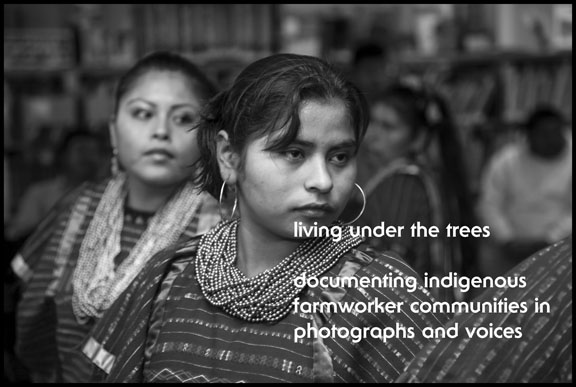
THIS FARM WORKER DOCUMENTARY PROJECT NEEDS YOUR SUPPORT

Dear friends,

This coming year is going to be a watershed for farm workers. 

https://www.beaconreader.com/projects/living-under-the-trees-poverty-in-the-fields


Wages have been going down, people are living in crowded conditions - sometimes even outside under the trees, in tents and in cars. The communities of indigenous migrants who harvest our food up and down the Pacific Coast have been rising in protest, and last year organized strikes from Baja California to Washington State.

In this crucial year I'm going to travel through the Pacific Coast's indigenous farm worker communities, working with and guided by community activists as we document peoples' lives.  We will produce a reality check - the hard work, the bad housing, but also the vibrant culture and the way people organize in response. 

I'm writing to ask you to help me.  I need to raise at least $20,000 to make this happen.  Beacon Reader has generously offered to help raise the money, and even to match every contribution made on its website, dollar for dollar.  But I only have a month, starting today.  Here's the address for the site where you can make your donation:

https://www.beaconreader.com/projects/living-under-the-trees-poverty-in-the-fields

The money will be used in the following ways:
---   It will produce large photographic prints that will travel through urban and rural communities
---   It will produce written narratives by indigenous migrants that will accompany the photographs
---   It will produce an interactive website combining the photographs and voices
---   It will publish the photographs and narratives in mainstream media, and eventually collected as a book.

You can make this photojournalism and deep reporting possible, by making a donation to this crowdfunding campaign.  I've been doing this work for over a decade, and your pledge will be carefully used.

This is work that will have an impact on people's lives.  It will be used to help reduce anti-immigrant hysteria, and support indigenous migrant communities as they seek understanding and justice.  It will educate people living in cities, concerned about the food they eat, about the lives of the people who put it on the table.

All donations are appreciated and will be acknowledged.  But if you donate at least $100, you can get an 8.5x11" print from the series we'll take this year.  If you donate more, we'll send you a larger print and books.  I'll even come and talk about the project with you.  The website explains it all.

On the site there's a short, 90-second video that also shows you the power of combining the voices of community leaders with photographs that document their reality.

https://www.beaconreader.com/projects/living-under-the-trees-poverty-in-the-fields

Please be as generous as you can, and put me on the road this coming year.  You won't regret it.

Saludos,

David Bacon

Friday, February 19, 2016

TAXI DRIVERS OF THE BACK 40


TAXI DRIVERS OF THE BACK 40
Photoessay by David Bacon
New America Media, 2/15/16
http://newamericamedia.org/2016/02/taxi-drivers-of-the-back-40.php


Mohamed Hussain

At the St. Louis airport, the Back 40 isn't part of a ranch.  It's the nickname taxi drivers give to a big parking lot just up the road.  There they wait for the call to go pick up a fare at the terminal.  Spotless white vans sit bumper to bumper in long rows, while the cabbies mill around and talk, or play chess in a small shelter.  Waiting can get a little boring.  It wasn't hard to get four of them to talk about the ups and downs of making a living in a cab.

"Most of us are immigrants from Africa - Ethiopia, Nigeria and Somalia," says Joshua Osho.  "Some Russians too." 

"A lot of Ethiopians drive taxis, because that's our first chance to work when we get here," adds Malaku Tamir.  "You can't go to school when you're as old as many of us are when we come.  And you must earn something right away for your kids and family.  The easy way is to drive a taxi."


Joshua Osho

When Tamir began at the airport 19 years ago, everyone worked for six companies.  "Then the county opened the business and we organized the service and got permits.  The old owners couldn't get any drivers and they left," he recalls.  "Now more than 80% of the cabs are owned by drivers like me." 

It was hard at the beginning, and the drivers had to get bank loans to buy their vans, or tap the resources of their families.  Almost all say they're driving for their kids.  Tamir has four, one in college and three more getting ready, so he has to come up with the money soon. 

Mohammed Hussein has eight children, the largest family on the lot, and his hopes for them are high.  "I want them to go to school.  I don't want them to drive a taxi," he declares.  "I want them to be in perfect shape, with a better life and a better education."  He laughs. "But kids are very expensive to have in this country." 

To support them, he drives 15-16 hours a day sometimes, more than most.  Tamir drives 10 hours, five and a half days a week.  He says that's about average.


Rufus Jewel

All the drivers have a story about why they came to the U.S.  Rufus Jewel left Nigeria at 37.  "I dropped out of college because there we have no student loans," he remembers.  "If you don't have any family to come up with your college fees there's no way you can keep going."  He hopes his children will do what he couldn't, and go to college - even if the family has to get loans to help them.

Tamir came because of the civil war in Ethiopia.  "Most educated Ethiopians are now living outside the country," he says.  "There are a lot everywhere.  If you go to DC, you see highly educated people driving taxis."

Hussein's experience leaving Mogadishu, Somalia, was the worst.  "When the civil war started some of my family were massacred," he recounts in a somber voice.  "I survived and left. This turned out to be my American Dream - driving a taxi."

Having worked so hard to get to St. Louis, most don't plan to go back.  Hussein is different, though.  His ambition is to be president of the country he left behind.  It's not actually such a far-fetched notion.  Several of Somalia's highest government officials in recent years, including a prime minister, spent many years living in the U.S. before returning.

 
Malaku Tamir

"I want to take my kids back and show them the beautiful country I came from," he says wistfully.  "I hope my kids will be engineers or ministers back home.  I will take them educated kids and they will fix my country.  They are Americans, and they aren't going to live there forever.  They will come back here.  I hope they'll have a double home - here and there.  But the connection to Somalia will always exist for my family.  Forever.  We aren't going to abandon Africa."

Joshua Osho has fewer dreams about Africa.  He's more concerned with finding a way to get a better life for drivers here.  He already put his kids through college working in a cab, and now he and others have organized the Taxi Council at the airport.  In the council cabbies advocate for each other, and make sure everyone does their job well.  "The council makes sure we are operating within the requirements of the MTC and the airport," he explains.  "We have an excellent relationship with the regulatory authorities."

He calls Americans "very loving and accommodating.  They accept us for who we are."  This is perhaps a surprising attitude in the era of Michael Brown and Trayvon Martin, but perceptions of racism and discrimination by Black immigrants from Africa can be different from those of African Americans.  

Hussein also talks about his customers warmly, and recalls an incident in which he stopped a passenger from overpaying him, and then got a $250 check in the mail from him a few days later.  "We are humble servants of the public," he emphasizes.  "We are loyal to our customers. We will deliver them safely to their homes."


Joshua Osho and Mohamed Hussain

Jewel, however, worries that this job is becoming less sustainable for families.  "It has been decent way to make a living for those of us who come from a Third World country," he observes.  "When I started sixteen years ago the number of on-call cabs was limited at the airport. But now, with all this competition from limos and shuttles, it's very challenging.  Now we've started feeling the effect of Uber.  We're beginning to notice that we're getting fewer fares every day."  Like taxi drivers in many airports, he says it's not a level playing field - that he and his friends have to pay fees to the airport, and obey regulations, that his competition doesn't.

Jewel wonders whether the public really understands his situation. "As a foreigner, I am now a good American," he argues.  "We're doing the little we can do to help the economy. We go to the market and buy food with the income we make from fares.  So they shouldn't make our American dream more difficult to achieve." 

Hussein feels the same insecurity.  "We are all struggling, but sometimes it feels threatening, like it's not going to be a permanent job," he worries.  But looking beyond the situation of the drivers themselves, he also thinks about the images he sees in the newspaper, of people fleeing Africa, and now Syria.

Hussein hopes that cities like St. Louis will continue to welcome strangers, as it welcomed him and his family.  "I hope people realize that refugees, when they come to this country, start at zero, scratch, from the bottom.  I hope our voice will reach whoever can help us." 


A chess game two drivers play while waiting is interrupted by a dispatch to go pick up a passenger.

Wednesday, February 10, 2016

AN INTENTIONAL HOMELESS COMMUNITY

AN INTENTIONAL HOMELESS COMMUNITY
By David Bacon
East Bay Express, 2/10/16


The camp outside the Berkeley Post Office, originally established to protest the sale of the Main Post Office building.


Michael Lee started living on the streets of San Francisco last May. He had traveled to the city from Las Vegas to seek medical treatment. When he arrived, he searched for cheap, temporary housing in some of San Francisco's most affordable neighborhoods, but he had seriously underestimated the cost of living in the nation's most expensive city.

"I was under the impression the rent was $300 a month, and I brought the resources for sixty days," he said in an interview. "I was going to go back to Las Vegas afterwards and go back to work. But the first place I walked into, they told me it was $300 a week. The next was $400 a week, and then $500. People were laughing at me - $300 a week is actually cheap on Skid Row. So I wound up living on the streets."

Lee soon heard of a large encampment in Berkeley that homeless activists had set up to protest the US Postal Service's plan to sell Berkeley's historic downtown post office building. So he moved across the bay and quickly became a leader of the Berkeley camp. He advocated for a plan to transform the old post office building into a community resource: "A homeless contact center run by homeless people," he said.

"Why [were] homeless people the main defenders?" Lee asked rhetorically, referring to the post office.  "Without community resources we can't get a hand up. There's just no place to go. This is where we live, unfortunately - on the sidewalks. We don't want to live in a community where private developers, the One Percenters, have everything.


Michael Lee is an activist among homeless people in Berkeley, and a leader of the camp outside the Berkeley Post Office. 


"We're not going to be homeless forever," Lee continued. "Eventually, we will recover from homelessness because we're pretty determined individuals. That's something that people with houses truly need to understand. We are going to be rejoining the community."

After a federal judge granted the City of Berkeley a temporary restraining order against the US Postal Service's planned sale of the downtown post office, the USPS announced that it was shelving its plans to sell the building. Several months later, some of the people in the post office camp set up a larger homeless encampment, which became known as "Liberty City" or "Liberty Village." They set this camp up a block away, on the lawn in front of Old City Hall, to protest a new city council plan to establish stricter rules targeting homeless people. During the holidays, Berkeley cleared out Liberty City, and the homeless people who had been part of it scattered to other spots in the city and to locations throughout the Bay Area.  The post office camp, now more than four hundred days old, still remains.

Over the years, Berkeley, like most liberal communities, has been comfortable with the idea of the homeless being victims. But many Berkeley residents and business owners grow uneasy when homeless people organize and use the creative tactics of the labor and civil rights movements.

Last year, Berkeley's homeless people did just that. They created what they called, "intentional communities," or "occupations," like Liberty City and the post office camp, not just as a protest tactic, but also as places where they could gain more control over their lives and implement their own ideas for dealing with homelessness.


Dmitri is a homeless man, living in the Berkeley Post Office Camp. 


Many drew on previous experience in other movements.  " A lot of us are older activists," Lee explained.  "Our ideas come out of the 1960s and even before, from the 1930s.  Homeless people have always formed communities, whether we were considered hoboes or homeless people or just bums. Hobo jungles were intentional communities too, based on an unconscious understanding of the need for mutual aid and voluntary cooperation.

"People police themselves," he added, in an interview while Liberty City was still operating. "I see people out there in the middle of the night with flashlights picking up trash. I see them chase off anti-social elements. If you want to talk about the solution to homelessness, all you have to do is walk down to Berkeley City Hall, and the post office. Is it a perfect solution? No. Housing is the permanent solution to homelessness. But this is a helluva good start."

City Councilmember Jesse Arreguin, who is running for mayor this year, said that he thinks the residents of Liberty City did a good job of keeping it safe and well-run. "Liberty City shows that homeless people can create a community," he said. But he cautioned that such communities can't "be completely removed from the city. There should be an ongoing city presence, that might include homeless outreach staff, mental health workers, or others."

Nearly everyone agrees that the answer to homelessness is permanent housing. But the state and federal governments do not provide the funding needed to build permanent housing for homeless people. In fact, over the decades, national policies have eliminated housing for poor people and cost hundreds of thousands of jobs (see sidebar, "Where Is Homelessness Coming From?," page XX).


Michelle Lot is a homeless woman, living in the Berkeley Post Office Camp.


Local governments provide homeless shelters and services, but they are unable to meet the needs of the huge number of people living on the streets because of a lack of money. Berkeley alone has 1,200 homeless residents, according to city officials. Further, many homeless people don't like shelters because they can't bring their pets, or because most shelters require you to be inside by a certain hour in the evening and to leave during the day.

As a result, some cities, including Portland and Seattle, have approved the creation of tent cities as an alternative form of temporary housing for homeless people. And Berkeley's experience with Liberty City revealed that a tent city has the potential to work in the East Bay as well.

But while Berkeley views itself as progressive community, it remains to be seen whether the city would ever approve a tent city plan. After all, the council voted on December 1 to greenlight the city's crackdown on the homeless.   

****


Liberty City, the camp outside the old Berkeley City Hall, called by the residents an occupation.  It was a protest against the Berkeley City Council passing an anti-homeless ordinance.


Mike Zint has been homeless since 2000. For many years, he lived out of his car, moving from town to town. He said that during the Occupy movement several years ago, he was in San Francisco when "police sent me to Occupy, thinking that I must be a drug addict. But they made a big mistake, because I began organizing."

Zint said that after San Francisco police "crushed" the Occupy encampment, he and other homeless activists staged a series of protests, including one during the America's Cup yacht race. Then they set up an "Occupy Staples" protest in San Francisco to demonstrate against Staples' decision to open postal kiosks, which activists viewed as a further "privatization of the post office," he said.

Zint said that, over the years, San Francisco has hardened its stance against marginalized people, like the homeless. Politicians "pass laws to get the homeless out of sight of the businesses, so shoppers don't see them," he said. "San Francisco has an image as a world class city, but there are no bathrooms. There are no shower facilities. They say there are only a few thousand homeless when there are twice as many. With the shuffle going on they just move them. One day this street looks good because they've cleared people out, and then they get rid of them somewhere else."


Mike Zint is a leader of the homeless protestors in the Berkeley Post Office Camp and at Liberty City, and a veteran of Occupy San Francisco.


Eventually, Zint and other demonstrators moved the San Francisco demonstration in front of Staples to the store in Berkeley.  Then, "last year, we learned the post office was going to sell the main building downtown. So we removed everything from Staples, and took the corner of the post office instead," he said. "We put the occupation right there.

"Over the last year, we've been organizing the homeless into an actual movement," he continued. Our intention has always been to occupy a much larger piece of property, and get one of the Bay Area cities to allow homeless people to take care of themselves. Berkeley, because of its reputation, is a good place to do this. People here are genuine and care. The university and high school students are incredible. The teachers are very good. It's night and day, compared to San Francisco."

At first, fighting the Postal Service brought homeless people together with city authorities in a loose-knit coalition in Berkeley that included Mayor Tom Bates, Councilmember Linda Maio, and local legal and political activists. While rallies and court actions sought to block the sale of the post office building, the encampment on the post office steps became a constant presence and visible evidence of resistance. 


A young woman in the Liberty City Camp outside the old Berkeley City Hall.


Within the encampment, homeless people developed their own community. They organized themselves and worked together. They made decisions collectively. And they developed their own ideas about what causes homelessness, and devised short-term and long-term solutions to it.

Last fall, while Liberty City was still operating, Michael Lee said, "People in the community came out and looked at us, and maybe at first they thought, 'Look at the poor homeless people.' But now we're creating the new world in the shell of the old. What we're doing in terms of mutual aid and cooperation can be applied anywhere. They're going to have to finally see that organizing is the solution to homelessness."

Paul Kealoha Blake, who is director of the East Bay Media Center on Addison Street and a business owner sympathetic to the homeless, said residents of Liberty City maintained order in their camp. "I think that Liberty Village and its organizers did an excellent job of setting standards of no drugs and alcohol," he said.


Muzik and Kevin set up a new tent in the Liberty City Camp.


But the coalition of homeless activists and city politicians didn't last beyond the post office battle. Several months after the Postal Service announced that it no longer planned to sell the building, Bates and Maio brought the homeless-crackdown ordinance, sought by the Downtown Business Association, before the council. The new ordinance prohibits people from lying in planter beds, tying possessions to poles or trees or keeping them within two feet of a tree well or planter, taking up more than two square feet of space with belongings, and keeping a shopping cart in one place for more than an hour during the day. It also further penalizes urinating and defecating in public, which are already against the law.

Both Blake and Arreguin, who voted against the new ordinance, believe that homelessness has become an overly polarized issue in Berkeley, rather than one in which different parts of the community find common ground. "The business community would like to see people not camping out in doorways," Arreguin noted. "Business people want a long-term solution. Homeless people did a good job on changing perceptions of homelessness at Liberty City. They set ground rules and enforced them. They had a process for that, where everybody participated in the meetings."

Before Berkeley cleared out Liberty City, Zint said that that he and other homeless activists were attempting to develop "an actual city through a bunch of homeless people coming together. We have a community here. And if we can pull it off properly here, we can use this as a model to be done all over. They'll begin listening to our message, and that is that we should be able to take care of ourselves."

****


Dallas lived in the Liberty City Camp.


Berkeley is not the only community where homeless people have proposed running their own encampments. A homeless protest and occupation in Portland last year evolved into Dignity Village, which now exists with the city's approval. Portland, in fact, is debating the creation of new, similar encampments.

The Seattle City Council has already approved three new tent cities, each housing one hundred residents, although they will be run by service providers, rather than the homeless themselves.  They're estimated to cost $200,000 per year in trash collection and portable toilets, but that cost is less than a traditional shelter. In Honolulu, which has also passed multiple ordinances cracking down on sitting and sleeping in public, Mayor Kirk Caldwell has set up a new homeless camp that is made up of shipping containers.

Berkeley also had an earlier experience with a homeless camp, called Rainbow Village, in what is now Cesar Chavez Park at the marina. Mostly, it consisted of an area where people could park and live in their cars. After an incident in which someone was killed, however, the city closed it down.


"Reptile" lived in the Liberty City Camp and fixed bicycles and scooters.


"But I do not believe that the Rainbow Village should be evaluated solely on that tragedy," Blake cautioned. "A close and collaborative relationship between homeless leadership and the City of Berkeley can work and was in fact working at Liberty City."

One big question is where such a camp could be located in Berkeley. Rainbow Village was far from transit and services needed by homeless people. Arreguin said, however, that when Liberty City was operating in downtown, his office got complaints from neighbors living near the old City Hall. "The camp had a spillover of people who were attracted to it and who engaged in inappropriate behavior," he said. "Not everyone respects our laws, and the perception of homeless people is often based on those examples. But we need to be sensitive to the concerns of neighbors."

For their part, however, most homeless people in Berkeley complain that they are demonized, and they established Liberty City partly in response. Many homeless people are also veterans, and have to reconcile the irony of having fought in the country's military, only to later find themselves social outcasts in a nation they had defended.


James Kelly lived with his wife in the Liberty City Camp.


"I spent ten years in the Navy upholding the Constitution, from 1979 to 1989," said James Kelly, a former resident of Liberty City. "I believe a person should not have to worry day-to-day where they're going to lay their head or get their next meal. That should just be a given."

Andre Cameron, another Liberty City resident, said his experience in Berkeley at the encampment was dramatically different from the time he spent in Los Angeles, the last city he lived in. "In LA, they don't have anything like this. They have Skid Row," he said. "A huge amount of people live on the street in downtown LA. There's no help for them. Here, there's a community. I feel the love here. I feel that here in Berkeley there's at least some hope. There are people here that care. If I had to choose to be homeless anyplace in the world, it would be here in Berkeley.

"It's embarrassing, if you've never been homeless," he continued. "People in LA look at homeless people like a plague. Here, there's more of an acceptance of this subculture of homeless people. I think it's a tribute in some small cultural way to the community as a whole.  I've never gotten that sense anywhere else."


Andre Cameron lived in the Liberty City Camp, and slept in front of the doors.  The Old Berkeley City Hall is named after the late Maudelle Shirek, the most progressive council member in the city's history, who would have taken the side of the homeless people.


Ultimately, Arreguin said, the city needs to hear from the homeless themselves and treat them as normal members of the body politic. "When the city passed a law last year that criminalizes homelessness, there was no conversation about what the homeless need, and the city didn't have any input from them. But it can be done," he said. "We do have a crisis, and all options should be on the table. Berkeley should consider a temporary encampment until we have more permanent housing. People need a place to go."

Cameron added, "They should have a place, a park, some sort of a space where people can set up tents, and live peacefully, with porta potties and showers and trash pickup, and that's organized.  We need a place for people to be human - eat, sleep, utilize restrooms. That need doesn't stop because of a law."

And, warns Lee, "Homeless people can vote."


After Liberty City was dismantled, Dallas lived in a camp set up under tarps at the other end of the steps in front of the Post Office.  On Sunday the police came and took down those tarps and told the people there they'd have to move once again.

Tuesday, February 9, 2016

U.S. UNIONS CONDEMN DEPORTATIONS OF CENTRAL AMERICAN FAMILIES

U.S. UNIONS CONDEMN DEPORTATIONS OF CENTRAL AMERICAN FAMILIES
By David Bacon
Equal Times, 2/8/16


In December the Obama administration announced it was going to begin deporting Central American families who'd arrived in the U.S. in the U.S. as refugees over the past two years.  Immigrant rights and labor groups, prominent among them the AFL-CIO, immediately condemned the announcement.
      
Federation president Richard Trumka noted that unions had, from the beginning, urged that these families be given refugee status and allowed to remain in the country.  "Instead, the shameful response of our government has been to erode due process protections by expediting legal proceedings and to lock families in remote detention facilities with little access to counsel," he said.  "Now, in an inexcusable escalation and without any transparency, the Department of Homeland Security has begun conducting armed home raids in order to deport vulnerable women and children back to some of the most dangerous countries in the world."
      
By the detention program's first weekend in December, 121 people had been held for deportation.  Defending the action, Homeland Security Secretary Jeh Johnson claimed, "This should come as no surprise.  I have said publicly for months that individuals who constitute enforcement priorities, including families and unaccompanied children, will be removed."
     
Trumka's criticism of an administration that unions helped to elect in 2008, and again in 2012, doesn't just voice disappointment in this particular action.  It reflects a broader disagreement with the administration's policy on both immigration and trade, and a growing acknowledgement in labor that migration to the U.S. is linked to the displacement of people in their countries of origin.  That displacement, in turn, is in large part a product of U.S. economic, political and military policies.
      
The deportation decision came at a moment when the administration is mounting its final push to get the U.S. Congress to ratify the Trans Pacific Partnership (TPP).  This treaty is the latest in a long string of free trade agreements pushed through by both political parties, starting with the North American Free Trade Agreement, ratified in 1993 under Democratic President Bill Clinton, and the U.S./Canada Free Trade Agreement, ratified under Republican President George Bush a few years earlier.
      
President Obama, in his 2016 State of the Union address, claimed the TPP, which includes 12 countries around the Pacific Rim, would "open markets, protect workers and the environment, and advance American leadership in Asia," and that it "cuts 18,000 taxes on products made in America, and supports more good jobs ... You want to show our strength in this century? Approve this agreement."
      
U.S. unions, however, are opposing the TPP more strongly than any trade agreement negotiated over the last two decades.  In part, this is because they argue that the agreements displace communities abroad, and once people arrive in the U.S. as migrants, they are then treated like criminals or exploited as a source of low-wage labor with reduced rights.
      
That argument was made at length in a report by a delegation of union leaders, headed by AFL-CIO Vice President Tefere Gebre, which went to Honduras seeking the sources of the wave of migrants that began crossing the U.S. border with Mexico two years ago.  The report, "Trade, Violence and Migration: The Broken Promises to Honduran Workers," was unusually critical of U.S. foreign and immigration policies.  It noted the many military interventions in Honduras and Central America to prop up wealthy elites and their U.S. corporate partners.  After the most recent coup against elected President Manual Zelaya, "numerous trade unionists and community activists who participated in resistance were killed, beaten, threatened and jailed," it declared. 
      
The report made the case that poverty in Honduras was deepened by the impact of the Central American Free Trade Agreement: "Today, Honduras is the most unequal country in Latin America," it noted.  Poverty rose from 60 to 64.5% from 2006 to 2013. 
      
More than 18,000 unaccompanied Honduran children arrived in the United States in 2014 alone, while the number of Hondurans outside the country reached 523,000. "Today, migration is seen by many families as a means to escape violence or seek employment opportunity or reunite with family, while the government has embraced the remittances from migrants as a major economic resource."
      
Ultimately, it concluded, the U.S. government must move away from policies that "criminalize migrant children and their families, while pursuing trade deals that simultaneously displace subsistence farmers and lower wages and standards across other sectors, and eliminate good jobs, intensifying the economic conditions that drive migration."
      
Instead of moving in this direction, however, the administration went forward with building of two detention centers in Texas, designed to hold 1500 women and children from Central America, at the same time it was negotiating the TPP.
      
In July Judge Dollie Gee, U.S. District Court Judge for the Central District of California, condemned the treatment of the detainees as "deplorable."  She ruled that detention violated a previous decision, the 1997 Flores Settlement, which held that authorities should avoid detaining migrant children and release them whenever possible.  She ordered the women and children held in the centers freed. 
      
Defending their decision to continue detaining them, however, administration lawyers claimed imprisonment prevented "another surge in illegal migration across our Southwest border by Central American families," and accused mothers of bringing children with them "as a means to avoid detention and gain access to the interior of the United States."  Judge Gee rejected the argument as "fear-mongering." 
      
Her sympathy with the migrants has roots in her own family - her mother worked as an immigrant seamstress in the sweatshops of Los Angeles.  Later Gee was a lawyer and coordinator for the Teamsters Union during labor organizing drives.  She is the first Chinese-American to serve as a Federal Court judge.
      
Administration that detention and deportation would stop migration proved hollow this fall, as the number of families from Central America arriving at the U.S./Mexico border began rising again.  The Border Patrol announced it had captured 12,500 "family units" in October and November, a big rise from the 4,600 families caught during the same months of the previous year.  The number of minors traveling without their parents also rose, from 5,100 in October and November of 2014 to 10,600 in the same months of 2015.

Deporting them, however, was too much even for the Democratic Presidential candidates fighting for nomination, all three of whom (Bernie Sanders, Hillary Clinton and Martin O'Malley) condemned them.  "What the hell have we come to as a country that you talk about rounding up women and children fleeing death gangs at Christmas time?" fumed Maryland Governor O'Malley.