FROM SPAIN TO DELANO - THE RADICAL ROOTS OF FARMWORKER UNIONS
By David Bacon
Positively Filipino, 8/30/23
https://www.positivelyfilipino.com/magazine/from-spain-to-delanothe-radical-roots-of-farm-workers-unions
We can't talk about defending the human and labor rights of farm workers without talking about their history of organizing unions-and the efforts by the government to suppress them. Liberal mythology holds that farm worker unions didn't exist until the creation of United Farm Workers in the '60s and that the farm worker unions and advocacy organizations of today appeared out of nowhere, with no history of struggle that went before.
But in fact, during the 1930s Filipinos and other farm workers organized left-wing unions and huge strikes. According to Rick Baldoz, a professor at Oberlin College, "The burgeoning strike activity involving thousands of Filipinos in the mid-1930s occasioned a furious backlash from growers who worked closely with local law enforcement."
The people who fought to organize unions in the '30s, '40s and '50s on the West Coast were the same people who fought for Spain-in the same organizations, like the International Longshore and Warehouse Union, and especially ILWU Local 37. Of all the efforts to organize farm workers, the ones that were closest to the International Brigades were those of the Filipinos during those years. And the forces that later went after the Lincoln vets were the same as those that went after the farm worker unions, using the same tools: blacklisting and deportations.
Baldoz gained access to the FBI files on one of the most radical of the Filipino leaders, Carlos Bulosan. "The fact that these partisans attracted the attention of federal authorities during the Cold War is hardly surprising," he says. "Filipino workers had developed a well-earned reputation for labor militancy in the United States dating back to the early 1930s. That a considerable number of Filipinos (both from the U.S. and the Philippines) had volunteered for the International Brigades during the Spanish Civil War... only added to the perception that they were immersed in international left-wing politics."
In their history of Asian volunteers in the Spanish Civil War, Nancy and Len Tsou write: "At least 11 Filipinos went to Spain to join the International Brigades. Among them, several came from the United States. [Pedro] Penino was able to establish the Rizal Company, a part of the International Brigades named in honor of a Filipino national hero." The Tsous name the following volunteers: Manuel Lizarraga, Artemio Ortega Luna, Enrique Almenar Gabra, Modesto Ausobasa Esteban, Dimitri Gorostiaga, Eduardo Miranda Gonzales, Pedro Penino, Carlos Lopez Maestu, Mark Fajardo, Servando Acevedo Mondragon and Aquilino Belmonte Capinolio.

Artemio Luna Ortega was born in the Philippines, 1901. He served in the Constabulary from 1922-1925. He immigrated to the US in 1927 where he worked as a draftsman after college. He was a member of the CPUSA and FAECT. He arrived in Spain on January 14, 1937. Artemio served with ALB at Jarama, Brunete and as a guard Villa Paz. He also the joined the GTU. His fate beyond Spain is currently unknown.Bulosan had worked as a farm laborer since his arrival in the U.S. in 1930, but after his health was destroyed by his work he tried to make a living as a journalist. "Every word is a weapon for freedom," the FBI reported him telling a colleague. In 1946, Bulosan wrote America Is in the Heart, a classic and moving account of life as a Filipino migrant farm worker during the 1930s. The FBI viewed the book as evidence of his Communist associations during the Cold War. Bulosan was hired by leaders of Local 37 of the International Longshore and Warehouse Union, Ernesto Mangaoang and Chris Mensalvas, to edit the union's yearbook in 1952. Among its many appeals for support for radical causes, it urged solidarity with the Huk movement in the Philippines, against continued U.S. imperialist domination of its former colony.
Carlos Bulosan, a farm worker and later an acclaimed author, caught the attention of the FBI.In the 1930s, Local 37 was organized by Filipinos who were the workforce in the salmon canneries on the Alaska coast. They were mostly single men, recruited to come to the U.S. from the Philippines. They were shipped to the canneries from Seattle every season, where they faced discrimination and terrible conditions. They organized Local 37 to change those conditions and forced the fish companies to sign contracts.
Until 1949, Local 37 had been part of the Congress of Industrial Organizations' (CIO) farm workers union, the United Cannery, Agricultural and Packing House Workers of America. From 1936 to 1953, the U.S. labor movement was split between the left-wing CIO and the rightwing American Federation of Labor. In 1949, as the Cold War started, the CIO expelled nine unions, including UCAPAWA and the ILWU, because of their left-wing politics and often Communist leaders.
At the height of the McCarthyite hysteria more than 30 members of Local 37 were arrested and threatened with deportation to the Philippines. Raymundo Cabanilla, a former CIO organizer, named names to the FBI, identifying fellow labor activists, including Ernesto Mangaoang, as Communists. Eventually Mangaoang's deportation case was thrown out by the courts. He argued that he couldn't be deported, given that he was a U.S. "national" when he arrived in Seattle in the 20s. "National" was a status given Filipinos because the Philippines was a U.S. colony at the time. Filipinos couldn't be considered immigrants, but they weren't quite citizens either.
Meanwhile, the Federal government tried to bankrupt Local 37 by forcing the accused workers to pay high bails and lawyers' fees. Union leaders were so tied up in legal defense that a conservative faction took control of the local. That group held it until it was thrown out in the 1980s by a new young generation of radical Filipinos, two of whom, Silme Domingo and Gene Viernes (a former farm worker) were assassinated.
UCAPAWA (renamed the Food, Tobacco and Agricultural Workers) was destroyed in the 1949 purge of the CIO, and the Filipino local in Seattle was taken in by Harry Bridges' union, becoming ILWU Local 37. It survived, and today is part of the ILWU's Inland Boatman's Union.
Today, 52 years after the historic 1965 Delano grape strike, it is important to reexamine this history, especially the radical career of Larry Itliong, who headed the Agricultural Workers Organizing Committee (AWOC). Itliong not only shared leadership with Cesar Chavez but actually started the strike. He had a long history as an organizer.
Labor leaders Larry Itliong (left) and Cesar Chavez (Right) at the Delano Grape Strike (Source: CAAM.org)Itliong was Ernesto Mangaoang's protégé. In the late 1940s, he was Local 37's dispatcher, sending workers on the boats from Seattle to the Alaska salmon canneries. After the salmon season was over, many Filipinos would return home to California's Salinas and San Joaquin Valleys, where they worked as farm laborers for the rest of the year. In the segregated barrios of towns like Stockton and Salinas they organized hometown associations and social clubs. Itliong used these networks to organize Filipinos when they went to work in the fields. Along with Chris Mensalvas, at the time Local 37 president, Itliong organized a strike in Stockton's asparagus fields in 1949.
Once the left-wingers lost power in the union, however, its conservative leaders stopped its farm worker organizing drives. Still, in the early 1950s Filipino farm workers continued to organize. Ernesto Galarza (author of "Merchants of Labor") started the National Farm Labor Union, which struck the giant DiGiorgio Corporation, then California's largest grower. In 1959 the Agricultural Workers Organizing Committee (AWOC) was set up by the merged AFL-CIO. After hiring Itliong as an organizer because of his history among Filipino workers, AWOC used flying squads of pickets to mount quick strikes. In 1962, it struck the Imperial Valley lettuce harvest, demanding $1.25 per hour.
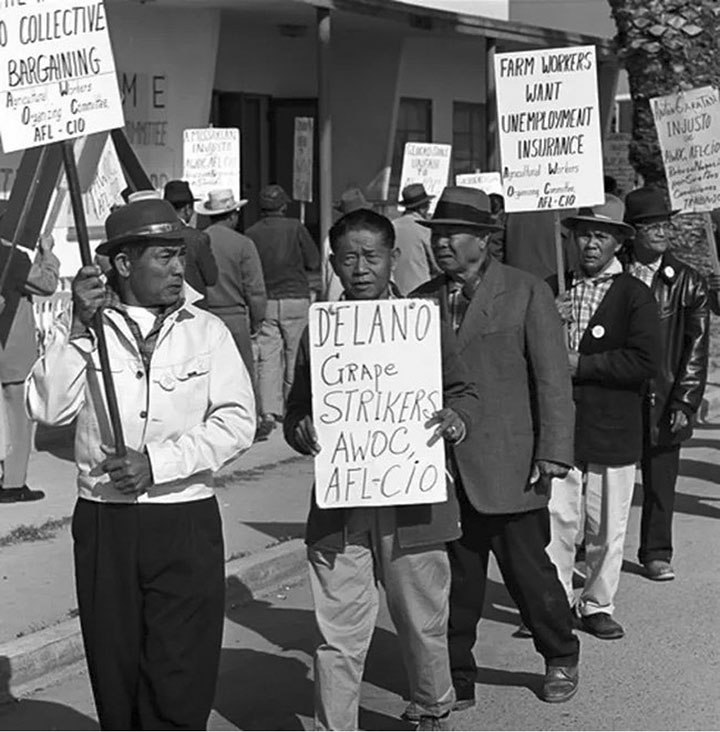
The grape strike started in Delano on September 8, 1965, when Filipino pickers walked off the fields. Mexican workers joined them two weeks later. The strike went on for five years, until all California table grape growers were forced to sign contracts in 1970. The strike was a watershed struggle for civil and labor rights, supported by millions of people across the country, breathing new life into the labor movement and opening doors for immigrants and people of color.
Filipino workers on strike (Source: Harvey Richards Media Archive)California's politics have changed profoundly in these 52 years, in large part because of that strike. Delano's mayor today is a Filipino. That would have been unthinkable in 1965, when growers treated the town as a plantation. Children of farm worker families have become members of the state legislature. Last year they spearheaded passage of a law that requires the same overtime pay for farm workers as for all other workers-the first state to pass such a law.
The 1965 Delano grape strike did not, however, start in Delano. It was in the Coachella Valley, near the Mexican border where California's grape harvest begins, that Filipino workers struck the vineyards that summer. They won a 40¢/hour wage increase from grape growers and forced authorities to drop charges against arrested strikers. The Coachella strike was organized by Larry Itliong. After the grape harvest moved north to Delano, he and the Filipino workers of AWOC walked out again.
The timing of the 1965 strike was not accidental. It took place the year after Galarza, Bert Corona, Cesar Chavez, and other civil rights and labor activists forced Congress to repeal Public Law 78 and end the bracero contract labor program, under which growers brought workers from Mexico under tightly controlled, almost slave-like conditions. Farm worker leaders acted after the law's repeal, because once the program was ended growers could no longer bring braceros into the U.S. to break strikes.
The Delano strike was a movement of immigrant workers. To organize farm labor, both Filipinos and Mexicans wanted to keep growers and the government from using immigration policy against them. In ending the bracero program, they sought instead immigration policies favoring families and communities. In the 1965 immigration reform they established family reunification as a basic principle of immigration policy. This enabled thousands of people, especially family members of farm workers, to come from the Philippines, Mexico and other developing countries.
The Delano strike was not spontaneous or unexpected. It was a product of decades of worker organizing and earlier farm worker strikes. Many Filipino workers in Coachella and Delano were members of ILWU Local 37 in 1965, when the grape strike began. Every year they still traveled from the San Joaquin Valley (where Delano is located) to the Alaska fish canneries. Through the end of their lives, they were often active members of both Local 37 and the United Farm Workers.
Cold war fears of communism were strong in the 1960s-one reason why the contributions of Itliong and the Filipinos were obscured. The strike in Delano owes much to Cesar Chavez, Dolores Huerta, Gilbert Padilla, and other Chicano and Mexican leaders who came out of earlier community organizing movements. But the left-wing leadership of Itliong, Philip Veracruz and other rank-and-file Filipino workers was equally important.
Chavez willingly acknowledged that the NFWA hadn't intended to strike in 1965. The decision to act was made by left-wing Filipinos, a product of their history of militant fights against growers. Their political philosophy saw the strike as the fundamental weapon to win better conditions. And it was a decision made by workers on the ground, not by leaders or strategists far away.
Growers had pitted Mexicans and Filipinos against each other for decades. The alliance between Itliong's AWOC and the Cesar Chavez-led National Farm Workers Association (NFWA) was a popular front alliance of workers who had, in many cases, different politics. AWOC's members had their roots in the red UCAPAWA. NFWA's roots were in the Community Service Organization (CSO), which was sometimes hostile to Communists. Yet both organizations were able to find common ground and support each other during the strike, eventually forming the UFW.
Fred Abad and Pete Velasco, Filipino veterans of the United Farm Workers and the Agricultural Workers Organizing Committee. (Photo by David Bacon, Special Collections in Stanford University's Green Library)Strikers in Delano developed close friendships. Cesar Chavez's son Paul recalls the way the older Filipino men looked at him and other children of Mexican strikers as their own family. Most of the Filipinos were single men, because anti-miscegenation laws prohibited them from marrying non-Filipinas, and the immigration of women from the Philippines was limited until the late 1960s. In the wake of the grape strike, the UFW and scores of young activists from California cities built a retirement home for them in Delano, Paolo Agbayani Retirement Village, to honor their contribution.
Philip Vera Cruz, a Filipino grape picker who became a vice-president of the UFW and later left over disagreements with Chavez, wrote during the strike's fourth year: "The Filipino decision of the great Delano Grape Strike delivered the initial spark to explode the most brilliant incendiary bomb for social and political changes in U.S. rural life."
Philip Vera cruz, a Filipino grape picker, was one of the initial leaders of the Delano Grape Strike. Liberal mythology has hidden the true history of the grape strike's connection to some of the most radical movements in the country's labor history. The contribution of that generation of Filipino radicals, including some who went to Spain, should be honored- not just because they helped make history, but because their political and trade union ideas are as relevant to workers today as they were in 1965. Those ideas, which they kept alive through the worst years of the Cold War, led to a renaissance of farm worker organizing that is still going on.
This article was first published in "The Volunteer," February 27, 2018: https://albavolunteer.org/2018/02/human-rights-column-from-spain-to-delano-the-radical-roots-of-farm-workers-unions/