Sunday, March 19, 2023

WHEN WE SPOKE OUT AGAINST WAR

WHEN WE SPOKE OUT AGAINST WAR -

Unearthing the history of protest against the wars in Iraq and Afghanistan

Photographs © by David Bacon


March 19, 2023, is the 20th anniversary of the start of the U.S. war in Iraq in 2003.  The war in Afghanistan was already underway, having begun a year and a half earlier.  Both wars marked a generation, and the war in Iraq is still going on, at least in terms of the ongoing presence of U.S. soldiers.


Today war continues to be a fact of life in the world, and in the lives of the people of California.  The anniversary of the Iraq war gives us a moment when we can look back at the way our community responded when these conflicts started.  Then, as now, people did not accept the reality of endless war or its normalization.   They sought to change it.


These are images from the protests against the wars as they unfolded between 2001 and 2007.  While the protests against the Vietnam War has entered history as the massive events they were, the protests against the wars in Afghanistan and Iraq also brought thousands of people into the streets of San Francisco and Oakland.  But unlike the protests of the Vietnam era, these marches and demonstrations have been virtually erased from the historical record.


These photographs, taken by David Bacon, document them.  They demonstrate the depth of opposition, and the diverse faces of those involved.  


People didn't just show up once and go home; they came out again and again from 2001 to 2007.  The images show that the protesters were overwhelmingly young.  They were very diverse racially and nationally, especially the highly visible and vocal presence of African Americans and Asian Americans.


This is not surprising, since the Bay Area is home to Congresswoman Barbara Lee, who was the one vote in Congress against the military authorization bill that sanctioned the start of the wars.  While she may have been a lone voice in Congress, these photographs make clear how popular her opposition was.  African American civil rights leaders rallied around her.  The marches featured actors, singers and celebrities who sought to add their voices to hers.


The images show an extraordinary cultural diversity.  Signs and banners spoke in many languages.  Korean drummers walked with contingents that started in Chinatown's Portsmouth Square.  Dancers danced.  Elaborate banners created a colorful atmosphere.  The determination of demonstrators is obvious in their acts of civil disobedience, and the photographs show the emotion in young faces as they were arrested.


The photographs were originally taken on film, and have been scanned and digitized in a cooperative project with the Green Library of Stanford University, where David Bacon's photography archive is housed


This presesntation coincides with the 20th anniversary of the start of the Iraq war, on March 19, 2023.  Participants in these protests can identify themselves and each other, comment on the images, and add their own observations about the war and the impact of the protests, by responding to David Bacon at dbacon@igc.org.


https://www.flickr.com/photos/56646659@N05/52759801492/in/album-72177720306862427/


Wednesday, March 8, 2023

OAKLAND'S ENCAMPMENT EVICTION BETRAYS THE HUMAN RIGHT TO HOUSING

OAKLAND'S ENCAMPMENT EVICTION BETRAYS THE HUMAN RIGHT TO HOUSING
By David Bacon
Truthout, 3/7/23
https://truthout.org/articles/eviction-of-300-person-encampment-in-california-shows-scorn-for-right-to-housing/

 
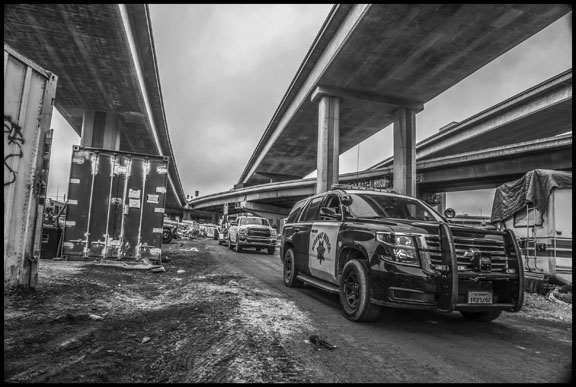
The Wood Street encampment of unhoused people under a freeway and railroad overpass was home to over 300 people. Volunteers helped residents try to resist eviction.


The words "housing is a human right" used to appear in bright colors on a painted placard at the gateway to Wood Street Commons, which until recently was the largest unhoused encampment in northern California. But this February, the California Department of Transportation (Caltrans) demonstrated how vehemently it disagrees.

Caltrans, which owns the land under an enormous freeway interchange called the Macarthur Maze, has evicted more than 300 people who had lived there for years. The U.S. Constitution does not recognize a right to housing, Caltrans asserts.  

In the end, Federal Judge William Orrick came down on the side of the state.  For months an order he issued last July had prevented Caltrans from evicting the camp dwellers.  He even endured criticism from California Governor Gavin Newsom, who said the order would "delay Caltrans' critical work and endanger the public."  But last October the judge finally accepted the agency's argument.  "I don't have the authority-because there is no constitutional right to housing-to allow Wood Street to stay on the property of somebody who doesn't want it," he admitted.

Since October the last residents living on Caltrans' land were forced to leave.  The strip of land occupied by RVs, tents and informal homes, extending for 25 city blocks, was reduced to a barren expanse of bare dirt and concrete.

The evicted occupiers are part of Oakland's homeless population, which has increased 24% over the last three years. As of early 2022, more than 5,000 people were sleeping on the streets, but the city only has 598 year-around shelter beds, 313 housing structures and 147 RV parking spaces.  All are filled.  

Nevertheless, Judge Orrick stated in his final removal order, "Though the eviction will inevitably cause hardship for the plaintiffs, that hardship is mitigated by the available shelter beds and the improved weather conditions."  The atmospheric rivers that have dumped flood-level torrents of rain on northern California all winter returned within days of the order.

The now-empty camp had a long and storied history.  It lined Oakland's abandoned Wood Street, where houses were cleared in the 1950s to build the freeway maze leading to the Bay Bridge.  Seven years ago,, as gentrification and the city's housing crisis grew increasingly acute, displaced people began setting up what became Oakland's oldest settlement of the unhoused.  

Some folks drove RVs and trailers into the huge space next to an old railroad trestle, used decades ago to move boxcars between the port and the main rail yard.  Other home seekers set up tents or other informal housing as the settlement spread.  One individual even built a room high up under the trestle beams, twenty feet off the ground.  In an environment a camp resident compared to the wild west, it provided safety and peace during the night.
 
In one small section residents and supporters erected several small homes and a common area for meetings, entertainment and other collective activities.  They built the structures of cob - a mixture of straw, clay and sand - and Cob on Wood became one of the camp's nicknames.  Other residents call the encampment Wood Street Commons.

In recent years, however, fires on Wood Street became frequent - over 90 in 2021.  Last April one man lost his life when a blaze filled his converted bus with smoke and he couldn't get out.  The worst conflagration broke out in July 2022.  Propane cylinders used for cooking and heating exploded in flames so hot that vehicles parked under or near the trestle were incinerated.  Residents fled.  


Benjamin Choyce died from smoke inhalation in a fire in this converted bus where he lived. 


Jason, a resident, looks over the remains of homes and belongings on July 20, 2022, after the big fire.


A car burned in the last big fire. When cars were burning Caltrans had to close the freeway above.


Firefighters responded to the fires, but there is no hydrant near Wood Street.  To reach the informal homes the bomberos had to stretch hoses over hundreds of feet.  Yet Wood Street wasn't the only camp to suffer blazes.  A city audit documented 988 fires in 140 encampments over the two years between 2020 and 2021.  

After the July fire Caltrans announced it would evict the residents.  Lawyers for the unhoused people convinced Judge Orrick to bar the action, and last summer he seemed sympathetic.  When he asked authorities to detail their intentions for providing replacement housing, no agency could come up with a plan.  
 
In 2022 the state gave Oakland a $4.7 million grant to house 50 of the 300 people living on Wood Street, yet the city didn't use the funds to create alternative housing.  Instead, as evictions proceeded, Oakland administrators announced that if the land was not cleared the city would lose funding to subsidize non-profit developers it claimed were planning to build 170 units of housing on the site - 85 for sale and 85 rentals.  While Oakland needs housing desperately, virtually none of the evictees would ever have been able to buy or rent one of the units.

John Janosko, a leader of the effort by residents to block the eviction, pointed to empty land just across the railroad tracks.  "We want our community to stay intact," he explained.  "And it wouldn't be hard for us to move there, especially if the city helped us build small houses and a center and community kitchen where we could have services and meetings to keep ourselves organized."  

The last 60 residents still hang on to a small patch of land between a park and the now-empty Caltrans. According to Jon Sullivan, an unhoused student and housing activist at Oakland's Laney College, "they continue to resist, and are hoping that they can negotiate some solution with the city."

When City Council member Carroll Fife proposed Janosko's solution in October, however, the city bureaucracy condemned the idea.  Moving people would cost too much, and the land might have toxic contaminants, city administrator Ed Reiskin claimed, but refused to apply to the State Department of Toxic Substances for a waiver allowing the site to be used.  Fife, a rent strike activist and organizer of Moms for Housing before she was elected, said she was "disgusted."

So Caltrans created a huge, windswept emptiness where Dustin Denega had built a tipi next to his trailer under the freeway.  Not far away Jake had created a room without a roof between two trestle pilings, complete with sofa, table and work space for an artist.  That was gone too.

Denega, an unemployed musician, said that in the four years he'd lived on Wood Street he felt safe and protected from violence that often affects people sleeping on sidewalks.  Even in the "tuff shed" cubicles the city provided for the camp dwellers, calling them alternative housing, a man was shot and killed last winter.  "That city housing is surrounded by a fence.  You can't have visitors, and it feels like a prison.  And it's not safe," he said.  


Furniture sits in the living room or artist studio built under the trestle at Wood Street.


Jake, who built a comfortable space under the railroad trestle, says he gets angry when people steal belongings, but it is still safer there than living on the streets.


A resident prepares to leave the Wood Street encampment, packing his belongings into his old truck.


Some residents and volunteers built small homes with straw and mud, called cob, in a section of the camp they called Cob on Wood.


Dustin Denega built a tipi for shelter in warmer weather, and in colder weather he slept in a trailer in the camp.


In 2018 United Nations Special Rapporteur on Adequate Housing Leilani Farha visited Oakland.  She told reporter Darwin Bondgraham, "I find there to be a real cruelty in how people are being dealt with here," and compared Oakland to what she observed in Manila, Jakarta and Mexico City.  In those cities, she observed, homelessness is basically tolerated, while in the U.S., a far wealthier country, being unhoused is criminalized.

Judge Orrick's finding that there were shelter beds available was not a statement of a real fact, but a requirement for eviction given earlier legal precedents.  In 2019 Judge Marsha Lee Berzon on the Ninth Circuit Court of Appeals held in Martin v. City of Boise that "criminal penalties for sitting, sleeping, or lying outside on public property for homeless individuals who cannot obtain shelter" were unconstitutional.  The Eighth Amendment bars cities from punishing anyone "for lacking the means to live out the 'universal and unavoidable consequences of being human.'"

The court's decision was no real protection for Wood Street, as the eviction proved, but it did at least acknowledge that being unhoused with no money was a consequence of social conditions, not a crime or personal choice or deficiency.  

The eviction pulled the bones of capitalism into plain sight.  The right to property is enshrined in law, and the legal structure of the state will enforce it, even if it leaves people on the street with no place to sleep or live.  Land is a commodity, to be bought and sold.  If the right to live on it comes first, the property of any landowner is in danger.  A clean empty space under a freeway, while people sleep in tents on sidewalks, is a preferable alternative to land occupations.

As the last of the people living on the Caltrans site were removed, following Orrick's decision permitting it, a group of day laborers appeared, taking away belongings and discarding the trash left behind.  They were some of Oakland's lowest-paid workers - Mexican and Central American jornaleros who daily look for work on city sidewalks and parking lots.  While they hauled out debris, another group of impecunious Oaklanders - the unhoused people who would soon be joining them on those sidewalks - watched.

In this last twist, according to a foreman on the site, a Caltrans contractor had hired a labor broker, who in turn went out to day labor sites to find workers to clean out the camp for the lowest wages possible.  To keep those labor costs low, the distasteful work of eviction had been contracted out - one more aspect of municipal neoliberalism, in this liberal city in this progressive state.


After BNSF Railroad and Caltrans announced they would force people to leave notices were put on vehicles warning of the impending eviction.


According to the Caltrans notice, Wood Street residents were trespassing on state property, and any possessions left behind after the eviction would be removed and destroyed.


Adam Davis lived in this trailer for several years before the Caltrans eviction notice appeared by his door.


Adam Davis poured water into a tank in his car to get it ready to move to another location after he was evicted.  "I think I have a place where I can park for awhile," he said, "but it's pretty temporary.  Basically, I'll be back living on the street."


Jeremy packed up his American flag with his other possessions as he got ready for the eviction.


Heavy equipment is brought into the Wood Street encampment to frighten residents into leaving without more protest.


The Highway Patrol escorted in workers to clear part of the encampment.


As a resident watches, a forklift hoists a resident's SUV and takes it out of the camp under the freeway.


Day laborers are brought to clear the encampment.


The day laborers brought to clear the encampment are Mexican and Central American workers, who find temporary jobs waiting on Oakland sidewalks to get hired.


Residents and supporters write their last appeals and post them on a fence they built to protect their meeting area.


A volunteer brings in sound equipment for one last jam before the eviction.


Day laborers in long lines bring items to the dumpster to be trashed.


Day laborers hoist a sofa left behind into a dumpster to get trashed.  On the freeway overpass above trucks leave the huge port of Oakland.


Dolls and a flag are ironic comments left on a vehicle under the freeway, about to be towed away.

Monday, March 6, 2023

ACROSS THE TRACKS

ACROSS THE TRACKS
By David Bacon
The Nation, 3/6/23
https://www.thenation.com/article/society/across-the-tracks/

 
The tracks divide downtown from west Fresno, and a man crosses as the rain begins.  


In the San Joaquin Valley, the most productive agricultural area in the world, poverty is endemic.  Fresno, crisscrossed by irrigation canals and railroad tracks, is the working-class capital and largest city of California's San Joaquin Valley, a city where people speak Spanish as readily as English.  

Here the polarization of rich and poor is a constant theme in its history, and the story of its present.  The banks and growers of the valley built ornate office buildings and movie palaces when the downtown was their showplace.  Now, as developers abandoned it for the suburbs, the theater entrances and building doorways have become sleeping spaces, refuges from the rain for those with no fixed home.


Crossing the tracks to the neighborhood where many of the unhoused people in Fresno live.


Fresno has one of the oldest Mexican barrios in a state where the Mexican presence goes back decades.  Here the abandonment is visible in closed theaters and dancehalls, leaving their marquee as evidence while small tacquerias try to survive.  Today the street in front of the Azteca Theater is hauntingly empty at night, but older residents remember when Cesar Chavez and a column of grape strikers stopped in front on F Street in 1966.  The strikers were marching from Delano to Sacramento, and hundreds turned out to hear Chavez speak in the street outside.

Bisecting downtown are the railroad tracks and the old Highway 99, a defining geography for the settlements of unhoused people.  Here community activists and the homeless themselves have pressured a normally-intransigent city government to provide at least enough housing to keep the dream of life off the streets alive.   In 2019 Fresno had a larger percentage of "unsheltered" homeless people than any other city in the country - that is, people sleeping on sidewalks, in cars or in places the government calls "not suitable for human habitation."


Through the Community Alliance newspaper, Mike Rhodes has been one of the most vocal opponents of the campaign by police and sherriffs to drive unhoused people from Fresno.


People try to survive no matter their circumstances.  In Fresno they often win community support as they fight for living space in a hard, bare-knuckle city.  Mike Rhodes co-founded Community Alliance, one of California's longest-lived community newspapers in California, and spent 18 years denouncing the city for its abuse of homeless people.

Rhodes' book, Dispatches from the War Zone, recounts the many efforts for years by the city to drive encampments off the streets, and the community's resistance.  At one point he asked the city manager, "With about a thousand homeless people in the downtown area, and inadequate shelter space available, what is the city going to do with people who are homeless?"  With no answer about where people should go, Lisa Apper, with the Saint Benedict Catholic Worker, stood in front of the garbage trucks where people's possessions would have been thrown, saying, "We have got to take a stand for justice."


The theater showed movies every weekend, and after it closed the entrance became a shelter to sleep out of the rain.


In the latest Community Alliance, Bob McCloskey reports that city Homeless Assistance and Response Teams "relentlessly push [people] daily to move on with no place to go."  The City Council turned down a proposal to allow people living on sidewalks in freezing temperatures to seek shelter in the city Convention Center.  Gloria Wyatt told council members, "I am not used to being homeless, but I cannot cover rent. Our tent was torn down this morning, and we have no place to go. I am scared."  

The new Mexicans in Fresno are indigenous migrants from Oaxaca and the south, as poor as their migrant predecessors, but who bring with them the cultures and celebrations of their home towns.  Rufino Dominguez, a Oaxacan migrant with roots in Mexico's leftwing social movements, started the Organization of Exploited and Oppressed People in Fresno and Madera, and led strikes when he arrived in the 1980s.  For Dominguez, a leader in the Oaxacan community until his death in 2017, keeping indigenous culture alive has been a means to survive. 


This Mixtec boy was born in Fresno, and his mother brings him to the celebration of her hometown in Oaxaca.


"Beyond organizing and teaching our rights," he said in an interview before he died, "we would like to save our language so that it lives and continues. Losing your culture is much easier in the US.  We come to the U.S. to work because there's no alternative.  We know the reasons we have to leave. Even though 509 years have passed since the Spanish conquest, we still speak our language and rescuing what we lost in terms of our beliefs."  

These photographs recreate an atmosphere of people living in an abandoned downtown, or on the wrong side of the tracks - older residents without homes.   Newer residents, lighting votive candles in a garage before going to work, bring a different culture from the south.  The images are a reality check, telling a story of poverty and migration.  They force acknowledgement of true conditions, and show survival itself as a form of resistance.


Overhead the 99 freeway, the central artery of the San Joaquin Valley, runs next to the tracks, while under it two unhoused people make the journey back from downtown.


Danny Alfiro burns paper in a trash basket to stay warm in a December night.


Along the tracks someone has abandoned a shopping cart with a few belongings.


Larry Collins was an activist living on the streets, and won a living unit when public pressure forced the construction of a small housing complex for unhoused people.   


Community activists painted a mural of the faces of people in the downtown barrio.


Joseph and his partner made a home out of the rain in a boarded up downtown doorway.


Hardy's Theater, built in 1917 in the years when the downtown was the center of Fresno's life, was abandoned, and its interior destroyed by an evangelical church.


The Chinatown Smoke Shop, in the old barrio.


At night the taco truck stayed open, even at the height of the pandemic, waiting for workers at the Amazon fullfillment center to come by after their shift.


The Tecolote, or Night Owl, dance hall and cafe, in the old strip of clubs, bars and the Azteca Theater.


In a west Fresno garage a Mixtec woman pours atole (Mexican oatmeal) into cups for people coming early in the morning for her hometown's saints day.


Before leaving for the fields a young farmworker lights a candle to honor St. Michael, the patron saint of his hometown in Oaxaca, San Miguel Cuevas.


In the downtown barrio next to the tracks, the Mexican bus station lists the towns in Mexico people might be returning to, and the towns in Washington State where they might be going to work.


The Mexican bus gets ready to leave, while a mother and her children wait to get on.

Sunday, February 5, 2023

WHAT HAPPENED TO THE FLOWER CARRIERS?

WHAT HAPPENED TO THE FLOWER CARRIERS?
From Diego Rivera's Paintings to the Fields of California
Text and Photographs by David Bacon
Dollars and Sense,  January/February 2023
https://dollarsandsense.org/archives/2023/0123bacon.html


Along West Ocean Avenue in the summer of 2022, where Lompoc, California's flower fields meet the edge of town, workers from Oaxaca and Guerrero were harvesting stock flowers. Even far from the rows where they labored, breezes carried the overpowering, almost sickly-sweet fragrance from thousands of blooms.

Stock flowers often anchor elaborate floral arrangements at funerals, their familiar smell calling up memories of churches and death. In Mexico, where Day of the Dead displays always feature brilliant orange marigolds, a family that has lost a child sometimes substitutes white stock blossoms on their altar. For them, the scent and color exercise a singular power to awaken memories of lost innocence.

Workers in the Lompoc field were harvesting stock flowers in several colors-white for funerals, as well as deep purple, pale yellow, violet, and an orangey rose. As each worker moved down a row, he'd pull up a plant, roots and all. Gathering together half a dozen stalks, he'd reach for one of the paper-covered wire ties hanging from his belt. Wrapping the tie around the stems, he'd spin the bunch of flowers like a propeller, twisting it tight and banding them together. 


Lompoc, Calif., 2022-Alberto Vasquez harvests stock flowers in the field, in a crew of Mexican farmworkers. All photographs are by (and ©) David Bacon.


Lompoc, Calif., 2022-Daniel Moreno Hernandez twists a tie around a bunch of flowers he just picked.


Lompoc, Calif., 2022-A worker carries a bunch of stock flowers on his shoulder from the field after harvesting them.


As each worker went down the field, he'd leave a trail of tied bunches behind him. Then, after harvesting enough, he'd move back up the row to collect them. With his foot he'd lever each bunch into his outstretched hand, and then throw it backwards, on top of a growing pile of flowers on his shoulders. At the end of the row his face would be virtually hidden behind hundreds of stems and blooms.

Carrying this load, the worker would arrive at a truck, and carefully lay the pile of fragrant flowers on the grass and dirt. Once one of the two flower knives was free, he'd use its guillotine-like blade to cut off the roots, and bunch by bunch pack the stalks into a plastic bucket. His last act would be to hoist the bucket up to the loader, stacking hundreds in the back of a waiting trailer.

Diego Rivera's 1935 painting "The Flower Carrier," one of his best-known canvasses, shows a man bent down by the weight of a pile of flowers on his shoulders. It is the centerpiece of the Rivera collection at the San Francisco Museum of Modern Art, and was the highlight of its recent show of the revolutionary muralist's smaller works. 


Diego Rivera, "The Flower Carrier," 1935; San Francisco Museum of Modern Art.


Eighty-seven years have elapsed between its creation and last year's flower harvest in Lompoc. But there is more than a coincidental similarity between Rivera's image of the man bent beneath a huge bunch of purple flowers, and a photograph of a man carrying a similar burden in a California field. Is the 1935 flower carrier connected in some way to today's flower harvesters? The images provoke questions. What happened to the flower workers of Rivera's era? Did the social commentary he deftly integrated into the painting in some way predict their fate?  

The man in the painting looks not unlike the workers in the Lompoc field. His pile is made up of beautiful purple blooms in a huge tight bunch, more like dahlias or zinnias than the stalky stock. But the painted sensation of weight feels the same as that felt in a photograph of a half-bent worker at the end of a row.

Like the painted figures of the man and the woman helping him to rise under his load, most workers in the Lompoc rows are short and dark-skinned. That similarity is even more pronounced in Rivera's 1926 painting of the "Flower Seller" (also part of the San Francisco Museum of Modern Art show)-which shows a woman with a basket of flowers in front of her. Rivera paints an explicitly indigenous woman, facing the viewer. Her indigenous identity is clear, as is that of the Lompoc workers, a crew made up of migrants from the Mixtec and Triqui communities of Oaxaca. 


Diego Rivera, "The Flower Seller," 1926; Honolulu Museum of Art.


According to art historian John Lear, Rivera's model for "The Flower Seller" was Luz Jimenez, a Nahuatl woman who posed for him many times. The painting gives her a specific personality, through her forthright gaze. While the painting just shows her selling the flowers, they seem to be ones she might have grown as well. Mexico's new post-revolution culture, through Rivera's depiction, views indigenous people as the true Mexicans, countering the earlier colonialist stereotypes elevating European ancestry, while treating Mexico's original inhabitants as ignorant savages.

By 1935, however, the tone of Rivera's painting has changed. The "Flower Carrier" has no specific identity. He and the woman helping him seem to be the campesinos who have grown the flowers, but the flowers have become a burden, as beautiful as the blooms might be. And if they've grown them, they don't seem to be expecting a transformation of their lives because of this labor.

Yet that was the promise of the Mexican Revolution in the early 1900s. Land reform and a political commitment to a socialist or egalitarian future, and especially support for rural indigenous communities, would provide a life with dignity, free from exploitation, or at least with less of it. Rivera's flower carrier is not celebrating this future, however. Instead, the painting raises doubts about where it's all heading.

Rivera's flower workers are farmers, producers of what they sell. They are not rural wage workers, much less migrants who labor in industrial flower production. Yet even as Rivera painted his campesinos, people from Mexico's countryside were already being displaced. A post-revolutionary wave of migration had already arrived in California and the southwest in the 1910s and 1920s. By the 1930s, when he painted the "Flower Carrier," a wave of anti-immigrant hysteria in the United States had already led to the mass deportation of tens of thousands of migrants, sending them on a return trip to Mexico.

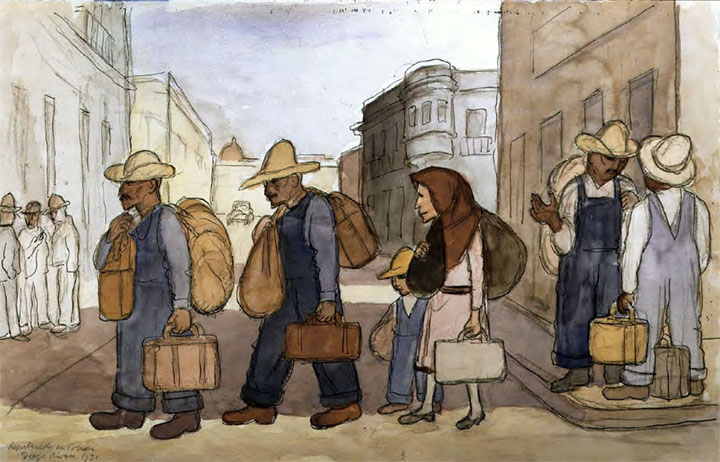
Rivera was not ignorant of this. In one watercolor from 1931, "Repatriated Mexicans in Torreón," which was painted three years before "The Flower Carrier," he shows migrants returning to Mexico after being swept up in those raids.


Diego Rivera, "Repatriated Mexicans in Torreón," 1931; private collection.


According to Lear, "While he was in Detroit [painting his famous murals of auto assembly plants], Rivera became the founder, funder, and leader of the 5,000-member Liga de Obreros y Campesinos, whose primary goals, shared with the Mexican consul, were to find local work for, or support the voluntary repatriation of, unemployed Mexicans."  

In those years, however, tens of thousands of Mexicans, and even their U.S.-citizen children, were not repatriated voluntarily at all. They were simply loaded onto boxcars and shipped to the border.

Rivera's engagement with farmworkers, as opposed to industrial workers, was much less direct. During the same visit to the United States he painted a fresco, "Still Life and Blossoming Almond Trees," in the home of Sigmund Stern in the wealthy enclave of Atherton, on the San Francisco Peninsula. In it Mexican-appearing laborers are hoeing in an orchard, while another man drives a tractor behind them. The work seems hard, although not excessively so. But the painting shows no inkling of the rebellion that was about to take place. In 1932, tens of thousands of farmworkers, a majority Mexican, mounted the largest agricultural strike in California's history, the Pixley cotton strike. It was led by the radicals and Communists who were the greatest admirers of Rivera's work. Some, like his assistant of that period, Emmy Lou Packard, went on herself to produce beautiful lithographs of working farm laborers. 


Diego Rivera, "Still Life and Blossoming Almond Trees," 1931; Stern Hall, University of California, Berkeley.


In Mexico, things had not worked out as the revolutionaries of the 1910s and 1920s had hoped. The revolution's changes slowed and eventually stalled, making life as an independent farmer in rural Mexico untenable, while the migrant labor of displaced Mexican campesinos became indispensable to the growth and profits of industrial agriculture in California. Eventually, Mexican farmers' displacement and Californian landowners' hunger for labor created the flower workers of Lompoc. The trajectory between Rivera's paintings and the photographs in California's fields traces visually the social transformation of the people who were once Rivera's subjects, and then became migrants cutting flowers 2,000 miles away, a border and almost a century apart.

In Mexico's countryside, by 1970 over 70% of small farmers could not live on the crops they were able to grow, or what they were able to earn by selling them, as Rivera's flower sellers must do. From 1950 to 1976 Mexico's population doubled, and the number of people living on each square kilometer of farmland did also, from 36 to 67. By then two-thirds of rural families couldn't afford to eat meat most weeks. Mexico City's growth couldn't provide jobs for all those coming in from rural indigenous communities. Migration north to the maquiladora cities of the border, and across the border into U.S. fields, was increasingly the answer for survival.

According to the late Rufino Dominguez, one of the founders of the Frente Indigena de Organizaciones Binacionales, about 500,000 indigenous people from Oaxaca lived in the United States by 2000, 300,000 in California alone. Many came from communities whose economies are totally dependent on migration. The ability to send a son or daughter across the border to the north, to work and send back money, makes the difference between eating chicken or eating salt and tortillas. Migration means not having to cut furrows in dry soil for a corn crop that can't be sold for what it costs to grow it. It means that dollars arrive in the mail when kids need shoes to go to school, or when a grandparent needs a doctor.  

Mexico's National Council of Population reported in the Census of 2000 that in Oaxaca 12.5% of people lived with no electricity, 26.9% lived in homes with no running water, and children got an average of 6.9 years of school. The displacement of people from Oaxacan communities tracks with the growth in poverty. By 2000, 18% of Oaxaca's people had left for other parts of Mexico and the United States. As a result, according to the Indigenous Farmworker Study, one-third of the 700,000 farm workers in California come from Oaxaca and other states in southern Mexico. Of all farm workers in California, indigenous workers receive the lowest pay. According to the study's author, Rick Mines, one-third reported earning the minimum wage, and an additional one-third reported earning less than the minimum-a wage that violates California state law. Most indigenous families live in crowded conditions in apartments or trailers. In some areas the most recent arrivals live outside in tents-even under trees. 


Lompoc, Calif., 2022-Daniel Moreno Hernandez harvests stock flowers in the field. 


Lompoc, Calif., 2022-A worker uses his foot to lever a bunch of flowers into his hand as he gathers the ones he has just picked.


But despite bad housing, low wages, and discrimination in the United States, migration is not just the preferable, but sometimes the only recourse for ensuring survival. "There are no jobs in Oaxaca, and NAFTA [the North American Free Trade Agreement] made the price of corn so low that it's not economically possible to plant a crop anymore," Dominguez asserted in an interview in 2008. "We come to the U.S. to work because we can't get a price for our product at home. There's no alternative."

By 2010, 49.3% of Mexicans lived in poverty, an increase of 6 million people in the previous two years of economic recession, according to estimates from the Economy and Business Investigation Center of the Monterey Technology Institute for Higher Studies. The year of 2008 marked the peak in Mexican migration during the quarter century after NAFTA went into effect, in which the number of Mexican migrants in the United States rose from 4.6 to 12.6 million. 


Lompoc, Calif., 2022-A worker then throws a bunch he has just picked onto the pile of flowers he car-ries on his shoulders. 


Lompoc, Calif., 2022-A worker cuts a bunch of stock flowers using the cutting knife at the truck.


These photographs document the work of Mexican campesinos who are part of that wave of migration, migrants who had to leave Mexico for their families to survive. They've become wage workers in industrial flower production, part of the U.S. working class that Rivera admired. In the Lompoc photographs the flower workers are all men. In many crops in California agriculture, including this one, single men dominate migrant labor in the fields. This is especially true today, when the H-2A contract labor visa program last year alone allowed growers to recruit 317,000 people, almost all rural Mexican farmers, to work here. It is a repeat of what happened in the 1950s, when the exploitative Bracero program brought hundreds of thousands of workers from a previous generation into U.S. fields every year. 


Lompoc, Calif., 2022-A worker lifts the bucket of bunches of stock flowers he has just picked into the arms of the loader in the back of the truck. 


Lompoc, Calif., 2022-A crew of celery harvesters leaving work in a field at the end of their day.


Rivera's images treat flower growing and selling as a family operation. Now it is wage work performed by hired hands on industrial-scale farms far from the workers' original homes. The system of modern migration has put a tremendous burden on many Mexican families, with mostly men leaving, and then sending money home to those left behind. The H-2A program escalates this, even allowing growers to refuse jobs to women, the old, or anyone who can't keep up with the fierce pace of production.

The workers in the fields in Lompoc, working at that rapid pace, use a unique coordination of body movements to keep up. The skill takes weeks of experience to acquire, and those who can't or don't get it quickly find themselves looking for another job. Harvesting flowers is exhausting but takes such skill and strength that it's obvious to workers that what they do is essential, and that not everyone can, or is willing, to do it. In the field next to the flowers, another crew walks to the road after harvesting celery all day. Here the workers who have been packing the vegetables are women. Their rubber aprons flap in the wind as they stride confidently down the rows. Neither the flower nor the celery crew looks ground down by the labor. They may no longer be farmers on their own land, but they work and walk with the assurance of the skilled wage earners they've become.


David Bacon is a California-based writer and photographer. He is the author of several books about migration. His latest book, More Than a Wall/Mas que un Muro, was just published by the Colegio de la Frontera Norte (Tijuana). He was a factory worker and union organizer for two decades, and has been documenting the lives of migrants and farm workers through photographs and journalism since 1986.