Tuesday, August 16, 2022

OAKLAND'S LARGEST HOMELESS CAMP DODGES THE BULLET, FOR NOW

OAKLAND'S LARGEST HOMELESS CAMP DODGES THE BULLET, FOR NOW
Photoessay by David Bacon
The Nation, 8/17/22
https://www.thenation.com/

 
"Housing is a Human Right!"

 
OAKLAND, CA  7/26/22 -- Seven years ago people began setting up what became Oakland's largest and oldest encampment under a freeway maze by a train yard, as the city's housing crisis grew increasingly serious.  Some folks drove RVs and trailers into the huge space next to an old railroad trestle, used decades ago to move boxcars between the port and army base and the main rail yard.  Other home seekers set up tents or even more informal housing.  One enterprising individual even built a room up under the trestle ties twenty feet off the ground.  In an environment a camp resident compared to the wild west, it  provided safety and some peace during the night.
 
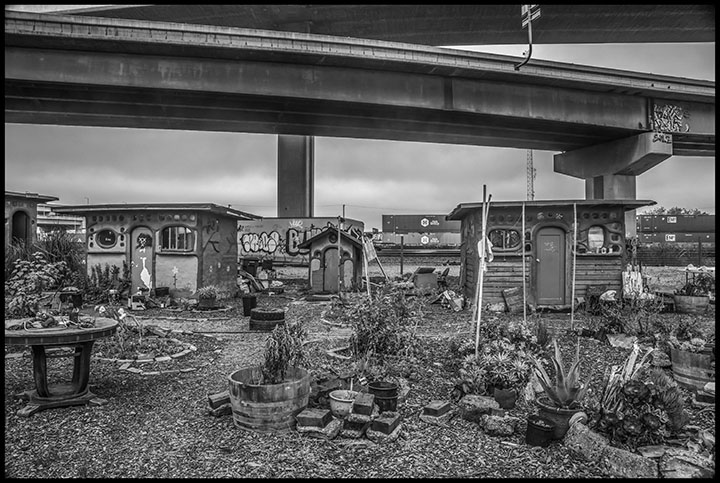
The camp lines Oakland's old Wood Street, which was cleared to build the freeway maze leading to the Bay Bridge.  In one small section residents and supporters erected several small homes and a common area for meetings, entertainment and other collective activities.  The structures are made of cob - a mixture of straw, clay and sand - so they called it Cob on Wood.
 
Fires in the camp began to increase a year ago - over 90 in the last year.  The worst broke out two weeks ago, on July 11.  Propane cylinders used for cooking and heating exploded in a blaze so hot that vehicles parked under or near the trestle were incinerated.  Residents fled.  This time no one died, but last April one man lost his life in a smaller conflagration, when his converted bus filled with smoke and he couldn't get out.  
 
Firefighters responded to these fires, but there is no hydrant near Cob on Wood.  To reach the informal homes they have to stretch hoses over hundreds of feet.  A city audit in April, 2021 documented 988 fires in 140 encampments over the previous two years.  Fires in camps of unhoused people made up 12.5 percent of all Oakland blazes requiring fire department response, and cost the lives of two people during that time.
 
A week after Cob on Wood's last big fire CalTrans announced it would close the area and evict the residents.  The day after the announcement, however, unhoused people signed individual legal complaints, and their lawyers convinced Superior Court Judge William Orrick to issue a temporary restraining order barring CalTrans' planned action. While the injunction was still temporary, residents feared the eviction would happen anyway, and appealed to supporters to come bear witness.  The day following the judge's order a Highway Patrol SUV showed up, escorting a group of workers and heavy equipment.  After standing around for an hour they left, perhaps in compliance with the TRO or maybe to evade interfering photographers and witnesses.  
 
Two days later Orrick extended his order, saying that replacement housing had to be found for residents before they could be displaced.  "I understand everybody wants to wash their hands of this particular problem, and that's not going to happen," he told authorities during a zoom hearing.  When he asked them to detail their plans for providing replacement housing, none could provide any.  Residents say, however, that CalTrans and the railroad have been slowly clearing areas under the freeway and near the train tracks for weeks.  Last week Oakland city police tased and then arrested one camp resident when he resisted efforts to remove people from the section of the area that is city land.  In this property checkerboard some pieces belong to Oakland, some to CalTrans and some to the BNSF Railroad.  Residents have no way to know which piece of land belongs to whom.
 
Last May the state gave Oakland a $4.7 million grant to house 50 of the 200+ people who live at Cob on Wood, but the city hasn't used it to create any housing.  Nevertheless, Governor Gavin Newsom criticized the judge's decision, unhappy with any delay in moving the residents out.  "This encampment is risking public health and safety," he said in a press statement.
 
More than 5000 unhoused people live in Oakland, but the city only has 598 year-around shelter beds, 313 housing structures and 147 RV parking spaces.  All are filled.  United Nations Special Rapporteur on Adequate Housing Leilani Farha visited Oakland in 2018, and told reporter Darwin Bondgraham, "I find there to be a real cruelty in how people are being dealt with here," comparing Oakland's treatment to what she observed in Manila, Jakarta and Mexico City.  In those cities, she observed, homelessness is basically tolerated, while in the U.S., a far wealthier country, being unhoused is criminalized.
 
"These are communities," Cob on Wood resident John Janosko told Oaklandside reporter Natalie Orenstein following the July 22 hearing.  "People stay at these places because they feel safe there."  Nevertheless, the judge made it plain that the respite was temporary, and that eventually the encampment dwellers would have to go.  Where is still the big question, however.

Captions.


Small homes created by residents and supporters.


The Highway Patrol bring in workers to clear part of the encampment.


Workers brought to clear the encampment.


Authorities bring in a big scoop on caterpillar treads.


Trailers, toys and tires.


A resident loads belongings into a pickup truck.


Zelda Fitzgerald, a supporter, walks into the camp.


A home built above the ground, under the tracks.


Jason is a resident.


"Keep the fuck out!'


Jason looks at the impact of the last fire.


Someone is fixing up this motorcycle.


Jake gets angry about people who steal belongings.


"Under video surveillance"


A wall of picture frames and plywood.


A living room or artist studio.


A car burned in the last fire.


When these cars were burning they had to close the freeway above.


Devastation under the freeway.


How hot the fire must have been!


All that's left is this tire rim.


Each space under the pilings is a room.


Who or what is the trash?


Benjamin Choyce died from smoke inhalation in his converted bus.

Monday, August 15, 2022

CALIFORNIA FARMWORKERS MARCH TO URGE NEWSOM TO SIGN VOTING RIGHTS BILL

CALIFORNIA FARMWORKERS MARCH TO URGE NEWSOM TO SIGN VOTING RIGHTS BILL
By David Bacon
Capital & Main, 8/15/22
https://capitalandmain.com/california-farmworkers-march-to-urge-newsom-to-sign-voting-rights-bill


Veteran farmworker activist Yolanda Chacón-Serna leads the 24-day march to expand California farmworker's voting rights into Visalia. All photos by David Bacon.


Lourdes Cardenas has worked the fields in the San Joaquin Valley for more than 20 years. "I've worked in all the crops - grapes, cherries, peaches, nectarines. I'm marching because I want representation and to be respected," she said. The respect she and other farmworkers seek is not only from their employers, but also from Gov. Gavin Newsom.

Cardenas and members of the United Farm Workers (UFW) are supporting a proposed law to make it much more difficult for growers to use workers' fear against them in unionization votes. Their proposal would extend to farmworkers the right to vote at home instead of in the fields, among other protections.

Cardenas said that change would mean they would "not be intimidated by the bosses because we want a union. If we have to vote in front of them, they intimidate us, make us fear they'll fire or suspend us." According to the California Poor People's Campaign, "AB 2183 would give more choices to farmworkers so they can vote free from intimidation - in secret, whenever and wherever they feel safe."

California legislators have agreed. Fifty signed on as sponsors of AB 2183, the Agricultural Labor Relations Voting Choice Act, authored by Assemblymember Mark Stone (D- Santa Cruz). It passed the State Assembly on May 25 by a wide margin, and was sent to the Senate floor on August 11, where its passage is virtually certain.

Newsom, however, has not made a commitment to sign it. A march to gain the governor's signature began in Delano on August 3. Twenty-six people made a commitment to walk for 24 days up the San Joaquin Valley, all the way to Newsom's Sacramento office. Each day marchers and supporters cover between 9 and 18 miles. UFW Secretary Treasurer Armando Elenes even counts the steps in a program on his cellphone. On the fifth day it recorded 14,000 paces.


A priest holds a short service with the marchers early in the morning before they start walking.


In August, the heat in the San Joaquin Valley is intense. "As we're walking in temperatures over 100 degrees," says UFW President Teresa Romero, "I look to my right and I see farmworkers working. That's what they do every day, day in and day out. They can't do what we just did. When we get tired we can take a 10-minute break whenever we feel like it."

Newsom vetoed a similar bill last year. His rejection of the legislative mandate came after the union had campaigned for him in his successful effort to defeat a recall.

Last year, when Romero asked to meet with Newsom to discuss the voting proposal, he refused. In fact, he vetoed that bill the day after a similar march began, asking him to sign it. The union was so outraged it then marched from the swanky French Laundry restaurant in Napa Valley wine country, where Newsom had held a controversial fundraiser, to his PlumpJack vineyard.


After a short service, marchers who will walk all 24 days think about the reasons for walking to Sacramento. From left: UFW march captain Antonio Cortez, farmworker Lourdes Cardenas, UFW President Teresa Romero, unidentified marcher.


Once again, "we're at the last step, which is his signature," Romero said. "We're trying to paint a picture for him of what farmworkers go through - the intimidation, the threats, losing their jobs. We asked one worker to make a video about it, and she said, 'No, I can't. If my employer sees it he'll fire me.' We're trying to relay that to the governor."

Lourdes Cardenas described how one grower created that fear. "When I was working in the peaches once, some friends came to work with union leaflets," she remembers. She helped hand them out. "My foreman said, 'There's no more work for you.' I never was able to work with him again. He wanted to scare the other people in the crew by what he did to me."


A young marcher comes out with his family before going to the first day of school in Farmersville.


One of the starkest examples of worker intimidation occurred in 2013, when one of the world's largest peach and grape growers, Gerawan Farming, was preparing for a vote to get rid of its obligation to negotiate a contract with the United Farm Workers. The company's effort began by sending foremen and anti-union workers into the orchards and grape rows, demanding that pickers sign a petition against the union. According to a complaint by the California Agricultural Labor Relations Board (ALRB), supervisor Sonia Martinez "went row by row and provided the employees in her crew with the signature sheet."

Supervisors then shut down work entirely, blocked entry to the fields and packing sheds, and handed out the petitions and demanded that workers sign. Agustin Rodriguez, a UFW supporter, told Capital & Main that "they stopped whole crews because of their union activity.

One worker, Jose Dolores, explained, "People were afraid they'd be fired if they supported the union. I heard it all the time. 'If I do that they'll fire me.'" According to another UFW supporter, Severino Salas, "Some of the pro-company workers said that if the company had to sign a contract with the union, it would tear out the grapevines or trees. This threat was coming from the foremen, but they would get other workers to say it."

On Nov. 5 of that year workers then cast ballots in an election held by the ALRB, in which they had to choose if they were for or against the union. Voting was conducted in the same fields where the intimidation had taken place. When the votes were finally counted, the union lost. Workers no longer had the right to negotiate a union contract.

California's labor law for farmworkers, the Agricultural Labor Relations Act, prohibits the use of intimidation. Decades of ALRB hearings, however, amply demonstrate that growers' use of fear to prevent unionization is widespread. Yet the ALRB almost invariably conducts union elections in the growers' fields, where the fear is often intense.

Workers' immigration status can increase the fear. According to UFW President Teresa Romero, "The majority of farmworkers are undocumented. When growers see them coming to vote, workers know there will be repercussions." She adds that when workers are targeted for their union support, it can affect whole families. "Often wives, husbands, brothers, sisters all work for the same farm," she explains.


UFW President Teresa Romero leads the march as it heads out of Farmersville on the way to Visalia, on the sixth day of the march.


March captain Antonio Cortez says that even if the law goes into effect, the union will have to educate thousands of workers about the new system for voting. The march itself is part of that process. Word spreads as laborers see the marchers passing the fields where they're working, or hear about it from friends.

Cortez believes that the law can potentially inspire a wave of farmworker elections California hasn't seen since the 1970s. "I think there are two places with a lot of organizing potential," he explains. "In crops like the strawberries on the coast, the wages are very low, just the minimum, and workers have no benefits. They have very little to lose there. And in crops like the wine grapes, the wages are higher, but the cost of living in liberal areas like Sonoma County is so high that workers can't survive."

The campaign for the law can also lead to greater community support for worker organizing, which would help convince growers to sign contracts when workers win elections. "This march is grassroots organizing," Romero says. "It's not about money. It's not about lobbying. It's about the people who are marching here today and their rights. It's about respect."

"I hope the governor is listening," Cardenas says. "We deserve this law."


As a child, Yolanda Chacón-Serna was part of the historic 1966 farmworker march to Sacramento led by Cesar Chavez.


Paul Boyer, mayor of Farmersville, marches with the workers as the march leaves town.


Lourdes Cardenas, a lifelong farmworker, leads one of the most frequent chants shouted by marchers to keep spirits up: "¡Newsom, escucha, estamos en la lucha!" ("Newsom, listen, we're ready to fight!") and "Que queremos? ¡Que se firme la ley!" ("What do we want? That he signs the bill!")


One supporter brings his children and a sign linking farmworkers' efforts to win healthy living and working conditions with their rights to vote for a union.


Miguel Trujillo carries the banner of the Virgin of Guadalupe, the Catholic symbol for the struggle of the poor.

Monday, July 11, 2022

BACK FORTY - FIELD LESSONS

BACK FORTY - FIELD LESSONS

Photoessay by David Bacon

Food and Environment Reporting Network - The Back Forty

https://thefern.org/blog_posts/back-forty-field-lessons/


Santa Maria, CA - 5/18/22 - Snow peas are a rare crop among the miles of Santa Maria fields devoted to broccoli and lettuce.  Each of these crops demands from growers a unique cycle and system for planting and cultivation, but for workers the labor makes a constant demand - speed.  Almost all crops are harvested on the piece rate, and to make any money a woman or man must work so fast that the movement of hands becomes a blur.


Not long ago I pulled my car to the side of the highway when I saw a crew almost hidden in tall rows of vines.  It was a small group, working for a small grower, Bautista Farms, harvesting snow peas.  


Read the rest of this story at the Food and Environmental Reporting Network.  https://thefern.org/blog_posts/back-forty-field-lessons/


SANTA MARIA, CA - 18MAY22 - Enrique Acuña works in a crew of Mexican immigrants picking snow peas for Bautista Farms.


Ivan Gallardo reaches into the vine to grab snow peas.


Ivan Gallardo has his cellphone by his ear under his hood, and laughs as he hears a joke told by a member of his family in Mexico.


Ivan Gallardo's hands have to work fast, grabbing a bunch of peas at a time, without damaging them.


The expression on the face of Pedro Gallardo, Ivan's cousin, reveals the concentration it takes to do this work.


Pedro Gallardo's bucket is almost full, as it hangs from his belt while he picks.


His bucket full, Pedro Gallardo slings it over his shoulder and carries it down the row to the weighing station.


Pedro Gallardo passes his cousin Ivan, who is still picking, as he carries his full bucket down the row.


Pedro Gallardo empties his bucket into a bin so that it can be weighed.


Sofia, a picker in the crew, stops for a moment with her full bucket.


Sofia manhandles the bin she's filled so that it can be weighed. 


Alberto Vasquez, a young worker, empties his bucket into a bin.


Berto Bautista, owner of Bautista Farms, puts a bin of snow peas onto the scale to be weighed.  Workers are paid by amount they pick, measured by weight.


After weighing a bin, Berto Bautista carries it to the truck for sorting.


Jorge Ariza sorts and checks the harvested snow peas.  He fills shallow boxes that won't crush or damage them, which are then stacked onto the truck taking them from the field.


Wednesday, July 6, 2022

SHOULD L.A. GET A NEW DEAL FROM ITS POWERHOUSE PORTS?

SHOULD L.A. GET A NEW DEAL FROM ITS POWERHOUSE PORTS?
By David Bacon
Capital & Main, 7/6/22
https://capitalandmain.com/

 
At the peak of last year's supply chain crisis, the typically invisible operations of the nation's ports came under a glaring media spotlight. But with the focus on consumer frustration, little attention was paid to whether massive public investment in the ports was producing commensurate benefits to the public.

A report released last week raises a host of questions about the country's largest port complex - the ports of Los Angeles and Long Beach. Produced by the Economic Roundtable, a nonprofit research group, "Someone Else's Ocean" looks at the role of the ports and the overall labor force, the California economy and the public benefits that the ports are required to provide under law. The report was funded by the International Longshore and Warehouse Union, which is currently negotiating a contract with the Pacific Maritime Association, an employer organization representing the companies that run the shipping lines and operate the cargo terminals in all U.S. mainland ports on the Pacific Coast. The last contract between the union and the companies, negotiated in 2015 and extended in 2019, expired on July 1, creating a big pile of issues that dockworkers want resolved. One of the thorniest is the impact of automation on the docks, especially sharp in Los Angeles and Long Beach where two terminals have already been automated.  

Capital & Main spoke with Daniel Flaming, president of the Economic Roundtable, about the outsize impact of the ports and the effort to protect the interests of adjacent communities. The interview has been edited for length and clarity.


Capital & Main: The report says that three international shipping alliances control 83% of container movements around the world. It sounds like longshore workers are David facing a global Goliath.

Daniel Flaming: These aren't mom and pop operations doing stevedore work. These are under the control of companies in Asia and in Europe. They've been exempted from antitrust law in Europe, so they're able to set shipping fees collaboratively rather than engage in competition.  They juggle cargo between ships of different lines and coordinate schedules. In effect, they're able to operate as a gigantic single company to their own great profit. So it's very difficult for a small group of workers to negotiate their survival and favorable employment terms with these giants.

The State of California grants the ports the right to use the land for the benefit of California residents. But in reality shipping is controlled by three global conglomerates that also own most of the terminals in the ports. So the ports wind up serving the interests of foreign manufacturers and foreign shippers rather than California residents.

Capital & Main: The report says dockworkers in San Pedro Bay earn an average hourly wage of $62.44. What impact does this high level wage have on local communities in the San Pedro and Los Angeles area?

Daniel Flaming: It has a powerful, multiplier effect. It enables the workers themselves to be homeowners in many cases, rather than precariously housed. In Los Angeles, as well as the Bay Area, that's not a trivial matter. And in the San Pedro area, the immediate area around the ports, the buying power of dockworkers accounts for about 34% of consumption by the community - restaurants, doctors, grocery stores, hardware stores. That makes ILWU members an important economic force in the community.

Capital & Main: Yet the report also states that union longshore workers are making $89,560 a year, while workers in local communities overall are making $34,345, which is an enormous difference. Doesn't this make longshoremen an island of high wages in a sea of low wages? What should the union do about this?

Daniel Flaming: Nearly three quarters of shipping containers leave the port empty. They come in full, and go out empty. Those outgoing empty containers could be filled with goods we might make, including high tech products. So in terms of the relationship between higher wage dock workers and the lower wage workers who are their neighbors, part of what we recommend is that the port should support durable manufacturing industries - export industries.

In addition, the truckers who come in and out of the ports make up the biggest body of workers whose jobs are linked to the docks. They work very long hours for a little over minimum wage. Yet the ports are a capital-intensive environment, which means a lot of money is invested in equipment and in cargo, and the ports are publicly owned. People who work there should earn a decent living. The port truckers should earn at least the prevailing wage for construction truck drivers.  

Capital & Main: There's a long history of efforts by port truckers to organize themselves in various ways. The ILWU also has an historic organizing strategy called The March Inland - the idea of organizing the workers who handle the goods as they move off the docks. Would supporting those efforts be one way of trying to attack this differential in income?

Daniel Flaming: Absolutely. On the one hand you have truly gigantic foreign global shipping interests, and on the about 8,000 registered longshore workers labor on the docks in LA - 13,000 if you add in the casuals [workers who get jobs on a daily basis in the hiring hall, but who are not yet registered - ed.]. Longshore workers a small force in the face of these shipping giants. This situation really calls for labor solidarity in the ports.

In addition to the truckers, railroad workers are also having a miserable time of it. The trains are understaffed and the equipment sometimes is in poor repair. Construction workers are on the docks making improvements. Then inland there are the blue-collar manufacturing workers.

Capital & Main: One of the hardest-fought issues in negotiations between longshore workers and the shipping companies is the automation of the docks. Can you detail the job losses that have been cost by automation in Long Beach and Los Angeles?

Daniel Flaming: There are two automated terminals in the ports, one in Long Beach, one in Los Angeles. The automation began at both in 2012 and was completed in 2015. In Los Angeles the terminal is called TraPac, which stands for Trans-Pacific Container Corporation. That terminal received a public subsidy of 40% of the cost of automating operations, which is not legal. The terminal's lease was negotiated and afterwards the port paid for the cost of automation without raising the lease rate. In Long Beach they took two outdated terminals, filled in the ocean between them, and created one much larger automated terminal.

We estimated that 582 jobs were lost at these two terminals - jobs that would have existed if they hadn't automated. If automation spreads to more terminals, those losses will be much larger.

Capital & Main: Presumably this is what terminal operators want - to eliminate jobs as a way of eliminating costs, right?

Daniel Flaming: Well, automation is very expensive. It was a billion and a half dollars to automate the Long Beach container terminal, and close to $700 million to automate TraPac. One governmental body, the International Transportation Forum made up of 34 countries, says there's a 7% to 12% loss in productivity at the automated terminals because they lack a steady rhythm of cargo movement. What automation does offer the shippers is that they don't have to deal with dockworkers and they don't have to deal with the union. A foreign manufacturer can have straight throughput to their consumers in this country without having to deal with American labor.

Capital & Main: What could the ILWU propose in negotiations that would put a break on job losses?

Daniel Flaming: Their existing agreements call for maintaining the labor force, but our report shows, in fact, that jobs have been destroyed. That's an issue they can take to the bargaining table. They can also act through city government and state government to preserve jobs. The argument we make is that there is no local benefit from automation. It eliminates jobs. The equipment is made in China or Germany. If there are profits, they go to Europe or Asia. Local communities pay a high cost through the impacts of all the truck and rail movements. There are lots of diesel emissions, which are a health risk, as well as noise and uncompensated road wear. Local communities simply lose through automation.

Capital & Main: Do the port commissions also have the ability to determine how much automation is going to take place?

Daniel Flaming: The terminals are publicly owned, so reconfiguring the equipment or infrastructure requires port commission approval. So the commissions do have the ability to say, "No, we don't want that done to our property."

Capital & Main: Couldn't the shippers just move cargo operations to other ports if Los Angeles tries to put the brakes on automation?

Daniel Flaming: About 35% of what comes in through the port is consumed in what they call the local region, basically the sprawling Southern California area. So this is the consumption center for cargo. The ports that are raised most often as competition are in British Columbia. It just baffles me how you could unload containers in British Columbia, get them across the Puget Sound and truck them or send them here by rail. The infrastructure doesn't exist to do that. It takes billions of dollars in infrastructure to move cargo out of the Los Angeles ports, and you just can't replicate that overnight somewhere else.

Capital & Main: At one point, there was some thought that ports in Mexico might go into competition with Southern California ports.

Daniel Flaming: That was the story before the British Columbia story. It's the same issue of infrastructure. The San Pedro Bay ports are populated with scores of huge container cranes, and rail and truck facilities. It would take many billions of dollars to replicate that. Then you would have to transport the goods across the border into this region. This is rhetorical saber rattling, and it's used to intimidate ports to make them compliant.

Capital & Main: What could the ports do to encourage more manufacturing here and more exports?

Daniel Flaming: There was a very large public investment in what's called the Alameda corridor - a subterranean freight line that moves cargo out of the ports. It runs through Los Angeles's Rust Belt, the area where we used to have tire factories, steel factories and automobile assembly plants. No one asked, "Could we connect this line to these large manufacturing sites the trains are running past?" The ports have enormous locational advantages. They can simplify inventory operations, they can reduce touch points moving cargo, they can make things move more quickly, they can give discount rates to exports. We recommend that the ports talk individually to durable manufacturing industries and listen to their needs.

Capital & Main: You also suggest that if it became more expensive to export - if there were a surcharge, for instance, placed on empty containers leaving the port - that also might encourage shippers to fill those containers up with something. Presumably that something might be products manufactured in Los Angeles.

Daniel Flaming: Or California. Right now the port of Los Angeles discounts [fees on] containers if they're empty. We're subsidizing the shippers sending empty containers. The port of Long Beach has a discount for exports, but because most outgoing containers are empty it's not doing much good.  The ports could rethink the rate structure so that it benefits the broader economic fabric of California, rather than simply meshing with the import needs of these big shippers. Ports are treated as a business extension of the shippers, but they are obligated to act on behalf of California residents.

Capital & Main: What could happen in the negotiations of the contract between the ILWU and the PMA that would have an impact on the development of more local manufacturing,? Could political action by the ILWU affect how the port commission might encourage the more local manufacturing and more exports?

Daniel Flaming: It may not happen through the contract negotiations, but it could happen through decisions by the City of Los Angeles and the City of Long Beach. People pay taxes, robots don't. There ought to be taxes on automated equipment that are like an impact fee if you destroy jobs.  It's putting a thumb on the right side of the scale. There are hundreds of thousands of manufacturing establishments in the greater LA area, and for some that will make the difference. It could begin to strengthen rather than diminish our export activity.

Capital & Main: Agricultural products are also a large percentage of exports, and the ILWU has traditionally supported agricultural workers in the United Farm Workers Union. The movement of farm products across the docks has given the union the ability to action at various times to support union strikes and boycotts. California's largest agricultural export, I believe, is almonds, and the largest exporter is The Wonderful Company, owned by Stewart Resnick, a well-known Southern California figure. Workers in the almond industry, particularly at Wonderful, have tried to organize themselves in the past. The ILWU sits in a very strategic position in relation to those efforts, because this enormous amount of product from this this one company is passing right across the LA docks.

Daniel Flaming: Agricultural exports, in fact, have been one of the few areas where we've had growth in exports.  When you export almonds, you're also exporting California water.  Water is in scarce in our state, and growing an almond takes a large amount of it. So another possible set of alliances is with environmental groups, around issues such as water consumption in the central valley, and also around cleaner trucks and fewer emissions as trucks travel 50 miles east to warehouses, and then truck the same stuff back to wealthy communities to deliver it to homes.

Capital & Main: What are the costs of running the ports that the shippers are not paying for, and that the public does?

Daniel Flaming: The picture to keep in mind is of congested freeways and big trucks. The biggest costs are from accidents, and from uncompensated road wear that the fuel taxes and the license fees don't cover. There are costs to residences from noise.  There are health costs from the emissions that in the immediate port area create a higher risk of cancer. And there are also global costs from greenhouse gases and from climate change.

Capital & Main: Is the ILWU therefore representing the interests of the broader community in the face of these costs, when it's sitting down with the Pacific Maritime Association?

Daniel Flaming: The union is saying, "We need to look at the big picture, not the little picture. We are part of a community, and we need to think about the wellbeing of that community."