Friday, May 13, 2022

MORE THAN A WALL/Mas que un muro - COLEF 2022


More Than a Wall / Mas que un muro

30 years of photographs and oral histories

By David Bacon

El Colegio de la Frontera Norte, Tijuana, Baja California

May 2022


440 pp
357 duotone black-and-white photographs
12 oral histories with incisive journalism and analysis by David Bacon, Don Bartletti, Luis Escala, Guillermo Alonso and Alberto del Castillo.

Completely bilingual in English and Spanish

$35, soft cover


More Than a Wall / Mas que un muro is a book of photographs by David Bacon and oral histories created during 30 years of covering the people and social movements of the Mexico/U.S. border.  It presents a complex, richly textured documentation of a world in newspaper headlines daily, but whose reality, as it's lived by border residents, is virtually invisible.

Published by with support from the UCLA Institute for Labor Research and Education and the Center for Mexican Studies, the Werner Kohlstamm Family Fund, and the Green Library at Stanford University

To order in the U.S., click here:  
https://david-bacon-photography.square.site/product/more-than-a-wall-mas-que-un-muro/1?cp=true&sa=true&sbp=false&q=false

To order in Mexico, click here:

https://libreria.colef.mx/detalle.aspx?id=7864


Often we only see  the border from the U.S. side, despite the fact that many more people live in the border region south of the wall than north of it.  Despite the media fascination with the wall, people their lives and organize vibrant social movements that are virtually invisible in the U.S. Yet they have a direct impact. From winter strawberries to flat panel televisions, people north of the border consume what’s produced just a few miles south of it.


The intention of these photographs, taken over three decades, is to probe more deeply into the lives of the people of the border itself, rather than simply see it as a wall, or a place people try to cross to enter the United States.


The images show children working in fields and hard scrabble miners trying to survive in the desert. They depict strikes and land occupations virtually unknown to U.S. audiences, and often even to Mexican ones outside of the border region itself. These struggles have been going on for over a century, but have never been the subject of the kind of visual and narrative documentation presented here.


These photographs and the accompanying narratives provide a broad historical view, spanning the period from late 1980s to the present.  They provide a human face and story for those who seek to come to terms with the sources of migration, and to protect the human rights of migrants and working people generally.


Taking these photographs and conducting these interviews has been a cooperative project, built on relationships over three decades with the Binational Front of Indigenous Organizations, the Coalition for Justice in the Maquiladoras and California Rural Legal Assistance.  The result is an intensive look at border communities - a unique view documenting border work life, living conditions, culture and migration through photographs and narratives of the people who live there.


"The "border" is just a line. It's the people who matter their relationships with or without or across that line. The book helps us feel the impact of the border on people living there, and helps us figure out how we talk to each other about it. The germ of the discussion are these wonderful and eye-opening pictures, and the voices that help us understand what these pictures mean." JoAnn Intili, director, The Werner-Kohnstamm Family Fund


“David Bacon is the conscience of American journalism and an extraordinary social documentarist.” 

Mike Davis, sociologist, professor at UC Irvine, author of “City of Quartz” and other works.


“Bacon is a consummate professional. His work makes an outstanding case for engaged documentary, a proud tradition reaching to the beginning of photography. It offers a contrast to much modern documentary that has become self-absorbed and abstract. There is no book that has the scope, depth, and artistry of Bacon’s project.”

Douglas Harper, Professor, Department of Sociology, Duquesne University, President, International Visual Sociological Association


“A basic preoccupation in David’s work is to honestly portray the lives and livelihoods of excluded communities - individuals and groups rarely noted as significant actors in contemporary society. These evocative documentary photographs and forceful oral histories raised conscience and consciousness about globalizing processes affecting American urban life throughout the country.”

Tomás Ybarra-Frausto, Associate Director, Creativity & Culture, The Rockefeller Foundation


More Than a Wall/Mas que un muro

Table of Contents


More Than a Wall - David Bacon on the history of this work

Preface
 - Don Bartletti, 
Pulitzer-prize photographer for the Los Angeles Times

Introduction
 - Luis Escala Rabadán and Guillermo Alonso


Part One: The Wall


Bars, crosses and graves

They called us “Baja Pollos”

41 Photographs

Deportados and their families


Sanctuary in front of the detention center

37 Photographs


Part Two: Border Rebellions


Up against the border bosses

The life of a maquiladora worker

My youth has passed me by

People are tired of the wages


39 Photographs


Communities of Resistance

We were going to have real change

39 Photographs

Indigenous migrants rise up

We paid a price to confront racism

40 Photographs


Kids in the fields, parents on strike

Why kids don’t come to school

What kind of society is this? We produce all of society

51 Photographs


Part Three: In the Desierto del Diablo

Neoliberalism’s cost - the mine and the river

Becoming a luchadora social


It was the union that demanded protections

We had to go to work on the other side

38 Photographs

Communities in the desert


The legacy of Joaquin Murrieta

23 Photographs


Part Four: North of the Wall


Living poor, working and breathing the dust

I never imagined we would suffer this way


We are just looking to make a living


53 Photographs


Afterword: A journey through images - Alberto del Castillo Troncoso


David Bacon is a California-based writer and photographer. He is the author of several books about migration: The Children of NAFTA, Communities Without Borders, Illegal People – How Globalization Creates Migration and Criminalizes Immigrants, and The Right to Stay Home, and In the Fields of the North / En los Campos del Norte. His latest book is More Than a Wall/Mas que un muro, Colegio de la Frontera Norte (Tijuana).


Bacon was a factory worker and union organizer for two decades with the United Farm Workers, the International Ladies Garment Workers and other unions. Today he documents the changing conditions in the workforce, the impact of the global economy, war and migration, and the struggle for human rights. His photography has been exhibited in the U.S. Mexico and Europe, and his articles and photoessays have been published widely.


The photography archive of David Bacon was acquired by the Special Collections of the Green Library at Stanford University in 2019.

Sunday, April 3, 2022

HONORING DOLORES HUERTA'S LEGACY

HONORING DOLORES HUERTA'S LEGACY
Photoessay by David Bacon
The Nation, April 2, 2022
https://www.thenation.com/article/society/dolores-huertas-legacy/

At 92, the iconic labor activist continues to fight for workers' rights.

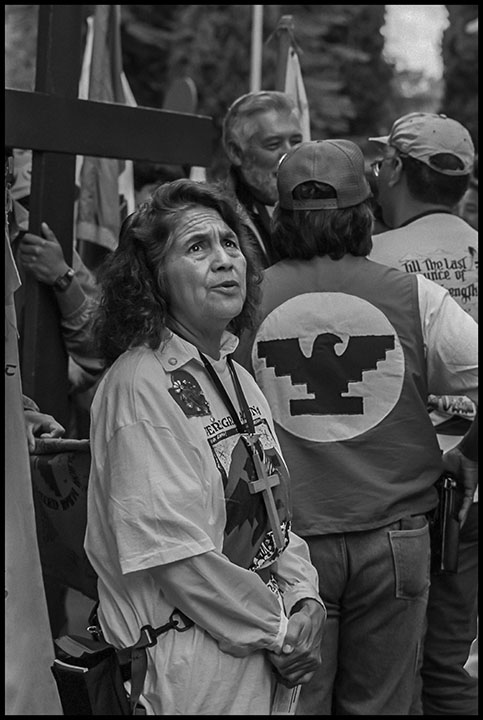
Dolores Huerta marched with family members of Larry Itliong, revered Filipino labor organizer and UFW co-founder, and Mari Perez, co-director of the Larry Itliong Resource Center, in celebration of the declaration of Larry Itliong Day by the State of California.

(All photos © by David Bacon.  These photographs are taken from a larger body of images in the David Bacon Archive in the Special Collections of the Green Library at Stanford University.  For a full selection of photos click here.)

Maria Elena Durazo, California State senator:

When I became the first woman of color to lead the Hotel Workers Local 11 of Los Angeles, Dolores Huerta was there to support me. When I became the first woman of color to lead the 800,000 workers of the Los Angeles County Federation of Labor, Dolores was there to encourage me. And when I became a California State senator, Dolores was there to inspire me.

Dolores knew who I was because she knew the world I come from. I grew up in a family of farmworkers. All of us worked in the fields, picking peaches and grapes and cotton, from the time I could walk. I never understood how it could be that our family all worked so hard, and yet never emerged from poverty. In that world of rural California, it was the grape strike and the boycotts that taught us that the only way to end that poverty and stop injustice was to organize together to change it. It was the United Farm Workers who taught us that. For me, Dolores was the best teacher among many good ones, teaching me the power of the union and nonviolent action.

Over the years, Dolores became my friend and mentor. In her I could see a woman of color who became a union leader-a leader of our movement for social justice. She never backed down or wavered. If she could do it, so could I.

Dolores Huerta turns 92 on April 10. Amazingly (or maybe not), she is still organizing, still fighting, still challenging us all to stand up, organize and make this world a better place. The best way we can celebrate this extraordinary woman is to join her. Every speech I've ever heard her give ends with her getting us all to shout out, "Si, se puede!" So let's shout it out with her now-Si, se puede! 


Dolores Huerta and other farmworkers who marched for 20 days to Sacramento wore wooden crosses to show their status as peregrinos.


Gaspar Rivera-Salgado, Chicano & labor studies professor, UCLA:

Long before the Delano Grape Strike began in 1965, Dolores Huerta earned her stripes as an organizer working with the radical Filipinos of the Agricultural Workers Organizing Committee in her native Stockton, even recruiting Larry Itliong, the veteran Filipino organizer of the canneries and fields of the Pacific Northwest. The migration of the indigenous people of Oaxaca, which brought myself, Rufino Dominguez, and other radicals into the California fields, came in the 1980s. By then Dolores was a legend, but to us someone who shared our ideas about organizing and radical social change.

Dolores Huerta's life is part of our collective history of resistance. She is a living link between radical ideas for social change that have defined today's movements for racial justice, worker rights and feminist thought.

We even owe her the chant that all of us know and use almost daily, regardless of what part of the movement we come from. In May 1972, the Arizona legislature passed a growers' bill denying farm workers the right to strike and boycott. When Cesar Chavez started a fast to protest, it fell to Dolores to build people's resistance in the streets. Everyone told her resistance was futile. In a moment of inspiration Dolores responded, ¡Si, se puede! (Yes, it's possible!). Ever since, when we need to show our strength and knowledge that we'll eventually win, we all shout out, ¡Si, se puede!

¡Que viva Dolores Huerta! 


A march and rally to organize strawberry workers in Watsonville begins with Huerta denouncing company terror tactics to the media.  


David Bacon, writer and photographer:

Last fall I walked from Poplar to Delano, Calif., in honor of Larry Itliong, who started the 1965 grape strike and boycott there, with Dolores Huerta, cofounder of the United Farm Workers (UFW). She was 91 then, and I had a hard time keeping up. She sent me a note afterward that ended, "Sí Se Puede con El Rojo Tocino." It was a beautiful joke.

"Sí Se Puede" are three words we all use now, but she invented this confident way of saying "Yes We Can!" "Tocino" was the nickname the union gave me in the years I worked as an organizer-it means "bacon," my last name. And calling me "El Rojo," or "The Red," in this way honored my politics.

When I came back from a solidarity work brigade in Cuba in the 1970s, I landed in New York City with no place to sleep. I called Dolores's daughter, Lori, a friend from California. Not only did I get space on the floor of the NYC boycott's headquarters, but Dolores and her partner, Richard, César Chávez's brother, took us out to eat. Over pizza I enthused about the island. I had stars in my eyes, for both Cuba and Dolores, and still do. I went to work for the UFW as an organizer a few months later.

There was often tension in the union about radical politics, and being called a red was sometimes the route out the door. But for Dolores and Eliseo Medina, being a good organizer was the bottom line-doing what the workers needed.

Over the years, long after I had left the UFW and worked for other unions and then as a photojournalist, I would see Dolores again and again. Going to Watsonville to cover the organizing drives of strawberry workers or to Salinas for the strikes in the vegetable fields, I knew she'd be there. It was a profound experience to watch her in union contract negotiations-this diminutive woman facing off against the beefy growers across the table-and see the sense of power it gave workers.

Returning from Iraq, where I photographed workers after the 2003 US invasion, I took her picture in the front line of marchers against the war. When we were in Sacramento trying to stop the anti-immigrant, anti-affirmative-action, anti-bilingual initiatives, she was the first to speak out.

So when she called me El Rojo Tocino, I thought, "What a compliment!" I hope I live up to it. 


At the beginning of the Iraq War, Huerta marches with actor Danny Glover and an enormous crowd demanding that the troops be brought home. 


Dolores Huerta at a march calling for making Cesar Chavez' birthday a holiday in California.  


Huerta explains to a meeting of rose workers the progress of negotiations of their union contract, at the UFW's historic Forty Acres headquarters.  


Huerta and rose workers talk about the harassment of workers and women in the fields.  


Huerta presents the union's proposals for a fair contract to the managers of the Bear Mountain Rose Nursery in the San Joaquin Valley.  


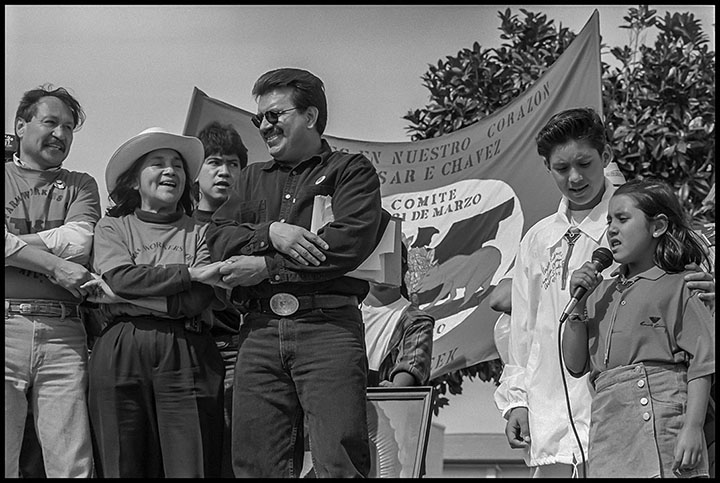
At a Watsonville rally UFW president-emeritus Arturo Rodriguez, Huerta and former organizing director Efren Barajas sing with the daughter of strawberry workers. 


The year after the death of Cesar Chavez Huerta and UFW leaders begin a march to Sacramento by ritually washing the feet of the workers who founded the union in the 1965 grape strike.  


At the Sacramento rally on the state capitol steps at the end of the march.  


Huerta marches with farmworkers in Salinas who've gone on strike against D'Arrigo Brothers Produce. 


Huerta and Rodriguez organized a march and rally in Salinas to support the campaign by John Sweeney to become president of the AFL-CIO.  


At the start of the Immigrant Workers Freedom Ride in San Francisco, Huerta and hotel workers marched to demand immigrant reform. 


Huerta, the Rev. Jesse Jackson, and the head of the National Organization of Women lead the March Against the Right in San Francisco.


Huerta, a former school teacher, talks with children at Jefferson Elementary School in Oakland.


Huerta speaks at a rally of longshoremen in San Francisco who have refused to unload coffee from El Salvador during the Central American civil wars.


Huerta speaks at a Sacramento rally supporting affirmative action, and opposing what would eventually become Proposition 209.


David Bacon is author of Illegal People-How Globalization Creates Migration and Criminalizes Immigrants (2008), and The Right to Stay Home (2013), both from Beacon Press. His latest book, More Than a Wall/Mas que un muro, will be published next month by the Colegio de la Frontera Norte.  For more information about it, write to dbacon@igc.org

Thursday, March 31, 2022

TROUBLE IN THE TULIPS

TROUBLE IN THE TULIPS
Organized Farmworkers Win Basic Demands in a Quick Strike
By David Bacon
Labornotes, March 30, 2022
https://labornotes.org/2022/03/trouble-tulips-organized-farmworkers-win-basic-demands-quick-strike


 Tulip workers take a vote. Photo: Edgar Franks


MT. VERNON, WA - Tulips and daffodils symbolize the arrival of spring, but the fields are bitterly cold when workers' labors begin. Snow still covers the ground when workers go into the tulip rows to plant bulbs in northwest Washington state, near the Canadian border.

Once harvesting starts, so do other problems. When a worker cuts a daffodil, for instance, she or he has to avoid the liquid that oozes from the stem-a source of painful skin rashes.

Yes, the fields of flowers are so beautiful they can take your breath away, but the conditions under which they're cultivated and harvested can be just as bad as they are for any other crop. "Tulips have always been a hard job, but it's a job during a time of the year when work is hard to find," says farmworker Tomas Ramon. "This year we just stopped enduring the problems. We decided things had to change."

On Monday, March 21, their dissatisfaction reached a head. Three crews of pickers at Washington Bulb accused the company of shorting the bonuses paid on top of their hourly wage, Washington's minimum of $14.69. Workers get that extra pay if they exceed a target quota set by the company for picking flowers.

The parent company of RoozenGaarde Flowers and Bulbs is Washington Bulb, the nation's largest tulip grower.

"We've had these problems for a long time," explains Ramon, who has cut tulips for Washington Bulb for seven years. "And the company has always invented reasons not to talk with us."

Workers stopped work that Monday and waited from eight in the morning to see how the owners would respond. The general supervisor was sick, they were told. Someone from the company would talk with them, but only as individuals. "We didn't want that," Ramon says. "We're members of the union, and the union represents us."

Union Wherever They Go

Over two-thirds of the 150 pickers for Washington Bulb work at the state's largest berry grower, Sakuma Farms, later in the season-where they bargain as members of Familias Unidas por la Justicia (FUJ), an independent union. Starting in 2013, farmworkers there struck and boycotted, and finally won a contract after four years. They formed Familias Unidas. At Washington Bulb there is no union contract, yet. But to Ramon and his workmates, they are members of FUJ wherever they go.

When the company wouldn't talk on that Monday, 70 workers voted to strike the following day. Another 20 joined them the next morning, when they again demanded to talk with the company. This time one of the owners told them he wouldn't talk if the president of Familias Unidas, Ramon Torres, was present.

"So we said, 'If you won't talk with our representative, we won't talk without him,'" Tomas Ramon remembers. "'We have a union and you have to make an agreement with him.' So the owner got angry and left."

That Wednesday the flowers were just waving in the breeze, waiting for someone to pick them. The day after, the company lawyer was on the phone to union attorney Kathy Barnard. With a commitment to begin negotiations, workers agreed to go back into the rows after the weekend, and talks got started.

"By the first day of the strike the workers had already met, elected a committee, and put their demands in writing," said FUJ's political director Edgar Franks. "After the four years of fighting for the contract at Sakuma Farms, they knew how to organize themselves quickly. They had community supporters on their picket lines after the first day. They had their list of demands, and finally forced the company to accept it."

Rubber Band Time

When the workers committee and Torres met with Washington Bulb president Leo Roosens on Friday, they went point by point over their 16 demands. Roosens made an oral commitment to resolve all except the demand over wage increases.


Worker leader Tomas Ramon.  Photo: Edgar Franks


 "The most important one for us was that they pay us for the time we spend putting rubber bands on the ring," Ramon says. Workers have to snap a rubber band around each bunch of flowers they cut, from hundreds of bands held on a ring. Each worker harvests thousands of bunches a day, so putting the bands on the ring takes a lot of time.

"There's never enough time, and supervisors don't want people to stop during work time. So on breaks and at lunch we're still filling the ring. They even give us a bag of bands to take home and do it there."

The company doesn't pay this extra time, so demand #7 says, "All work using rubber bands to bunch flowers will be performed during working time, excluding lunch and rest breaks. This work will not be performed off the clock." "Workers knew they had a right to this, because the union won a suit forcing Washington growers to pay for break time, even for workers working on piece rates or bonuses," Franks says.

Parking, Ointment and Bathrooms

Workers often have to walk half a mile from where they park their cars to the rows where they'll work, which the company also won't pay for. So point 3 says, "Workers will be paid the hourly rate from the time they leave their vehicles in the company's parking lots until they return to their vehicles...at the end of their daily shifts."

Gloves are $30 a pair, according to Ramon, and working without them means getting rashes from liquid from cutting daffodils. "The company has cream you can put on to help with that, but it's in the office and they often won't give it to you. Even if they do, they just give you a tiny bit, not enough." So another demand is for company-provided protective gear, and ointment available in the fields.

Of the eight people on the union committee, two are women. There's often just one bathroom for a crew of 50-60 people, and they included a demand for four bathrooms per crew, two for women and two for men, cleaned every day. They also insisted on a demand for better treatment, prohibiting favoritism from supervisors, who "will be trained to treat workers with respect ... and not pressure workers to pick flowers at unreasonable speeds."

The last demand is that the company recognize Familias Unidas por la Justicia as bargaining representative for Washington Bulb workers. If agreement is reached on that point, it will make the company the second in the state with an FUJ contract.

Strategic Timing

The annual Skagit Valley Tulip Festival is set to start on April 1, and runs for a month. The lightning job action less than two weeks before presented the Roosens, the most prominent family in the tulip industry, with the prospect of picket lines in front of fields, as tourists arrive to take photographs and buy flowers.

Almost all Washington Bulb workers have at least three years doing this work, and some as many as 15. They knew the importance of timing and the company's vulnerability. The fact that they were already organized made it easier to reach a quick decision on a job action.

The decision process relied on the collective traditions of the two indigenous groups from Oaxaca and southern Mexico who make up the workforce, Triquis and Mixtecos. Ramon, a Triqui, explains that "each community talked within itself. Each community has its own process, but we have the same kind of problems and the same experience. We all wanted to make things better, so we reached agreement." In that process community members meet, discuss, and arrive at a decision on behalf of everyone.

At Sakuma Farms, women were not elected to the union's leadership, and within the communities, women took a back seat. At Washington Bulb, however, two women were elected to the union committee, and made specific demands. "That's a big step forward for us," Ramon says. It also gives women in the fields suffering sexual harassment the ability to bring complaints to women in the union leadership, instead of men.

The Bosses' Biggest Fea

"Direct action is what makes things move," Franks says. "People put up with a lot because they're scared that they could be unemployed. But when workers go on strike, they lose that fear, they push back, and that's what makes things move. Direct action is the most valuable tool we have, and the bosses' biggest fear. When workers take that leap of faith they can see the world in a whole new say, and recognize their own true value."

Today in western Washington, a growing number of farmworkers have had that experience, and FUJ is following them into new places and farms as a result. It's not a new idea-in the 1940s, Larry Itliong followed Filipino cannery workers from Alaska, where their pitched battles formed Local 37 of the International Longshore and Warehouse Union, back to their work in the fields of the San Joaquin Valley. There, they became the heart of union organizing until the great grape strike of 1965. They eventually joined with Latino workers to form what is now the United Farm Workers.

"We're trying to make sure not to force the issue with workers here," Franks said. "The union is ready to support them once they're ready to take the step. The issues have been present for 20 years, but now, because of Sakuma, there's an ecosystem they can rely on. They can see workers winning and feel better about taking action than they would have years ago. They have a growing leadership, and don't have to put up with this anymore."


NOTE: At press time negotiations with the company had reached agreement on the workers' list of demands. While the union is not the official bargaining agent, the company agreed to treat the union committee as the representative of the workers. Workers were set to vote on the agreement on March 29.


Striking in the tulips.  Photo: Edgar Franks

Sunday, March 13, 2022

PHOTOGRAPHS OF PORTSMOUTH SQUARE - A TRIBUTE TO PAUL STRAND

PHOTOGRAPHS OF PORTSMOUTH SQUARE - A TRIBUTE TO PAUL STRAND
Photographs and text by David Bacon
Stansbury Forum, 3/13/22
https://stansburyforum.com/2022/03/13/photographs-of-portsmouth-square


In presenting these images of Portsmouth Square, in San Francisco's Chinatown, I've tried to keep in mind some of the ideas of Paul Strand, the great modernist and realist photographer.  

Strand was a radical, a founder of the Photo League in New York City in the 1930s, and a teacher who guided its work. After World War Two, as McCarthyite hysteria gripped the country, and especially the world of media and the arts, he was put on a blacklist (along with the Photo League itself) by the U.S. Justice Department.  He went into exile in France, never returning to live in the U.S.  For the next three decades he photographed people in traditional communities, and in newly independent countries during the period of decolonization and national liberation.

Strand was one of the founders of modernism in photography - the idea that photographs had to be connected with the world and depict it cleanly and simply.  He combined those visual ideas with social justice politics, not in a dogmatic or simplistic way, but in an effort to create socially meaningful art with its own philosophy and set of principles.

Strand's books were documents about place, presenting people in the context of their physical world.  The subject of this set of photographs is also a place, one very familiar to me over many years - Portsmouth Square in San Francisco. These photographs were taken over 20 years.  I've sequenced them, as Strand might have done, I think, in an order that emphasizes their social, as well as visual, content.

I was an organizer for the International Ladies Garment Workers Union in the late 1980s and early 1990s.  We set up a Garment Workers Center on Commercial Street, a block from the square.  The workers who came into the center were Chinese women and men who worked in shops all over the city, from outer Third Street to Chinatown itself.  I was just beginning to take photographs in a conscious way in those days, and because I was a union organizer, there was never a possibility that the sweatshop owners would let me inside to document the conditions.  I was a union militant, interested and committed to documenting work, so this was a big regret.  But walking through Portsmouth Square every day gave me a sense of the lives of people in this community, in the hours they spent outside the sewing shops.


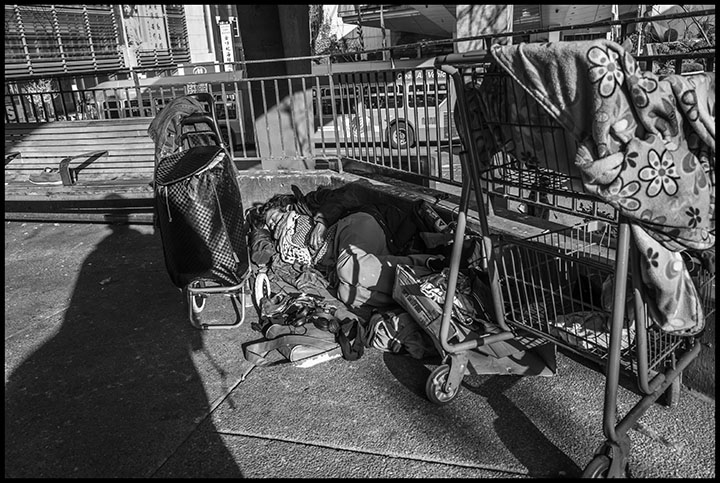
In those years the number of unhoused people on the streets was much smaller than today.  I would see perhaps one or two people sleeping on the sidewalk in the twenty blocks I traveled between our union's central office and the square, and rarely anyone sleeping the square itself.  Today that has changed.  Like any San Francisco park, Portsmouth Square has been made a home, or at least a sleeping place, by several people with nowhere else to go.  The first series of photographs shows a few of these individuals, in their relationship to the facilities of the square, including its benches, castoff cardboard boxes, and the sidewalk itself.


As an organizer I came to realize that Portsmouth Square is home to many activities, and has many levels of meaning to the people of Chinatown.  They relax, play cards and enjoy themselves on the benches whenever the city's notoriously uncertain weather permits.  Over the years I've often returned to take photographs and been struck by how many people play games here.   On one level, it is a place where people get together, in a community where many live with many family members sharing small apartments.  Portsmouth Square means space to breathe, to be noisy and extroverted, to play the games people were taught by mothers and fathers in the generations that came before.  It is a deep expression of the history and culture people share.


Organized cultural events also take place in the Square.  On a recent walk I was pulled towards the performance space by the music of the erhu and other traditional Chinese instruments.  An ensemble of musicians, organized by A Better Chinatown Tomorrow, had assembled to give a concert for the card players and the families wandering through the square.  One woman sang while another danced - stylized voice and motions in humble street clothes.


The culture of Chinatown includes the social movements in which people organized support for revolutions in China itself, and protests over the oppressive conditions and discrimination that people have faced at work.  It is an old history.  A few blocks away, in St. Mary's Square, a statue of Sun Yat Sen by Beniamino Bufano honors the fact that part of the Revolution of 1911, which overthrew the dowager Manchu empress, was planned by Chinese exiles, including those in San Francisco.   

Chinatown is one of the politically most vibrant communities in San Francisco, and Portsmouth Square has always provided space for demonstrations, marches, meetings and leafleting.  When the bombing began in Afghanistan, and the media began its deafening war drumbeat that preceded the invasion of Iraq, Chinatown's internationalists gathered in Portsmouth Square.  There they held signs calling for peace, and for spending on human needs instead of bombs.  After listening to speeches in Chinese, the contingent marched down to Market Street and joined thousands of others from homes across the city, protesting what became a 20-year war.

Perhaps Strand, who took his photographs slowly and deliberately with a large view camera, might have had conflicting feelings in seeing these photographs.  In taking them I took advantage of the mobility of a small camera, moving much more freely than he could with his large apparatus.  He carefully constructed his images, seeing them on the large ground glass at the rear of the camera.  I try to be conscious of the image and its elements as I take my pictures too.  But sometimes I feel that not everything happens on a conscious level.  Working quickly, I depend on a less conscious part of the brain to order the visual pieces of the image..  Perhaps that was also true for him.

But what I take from Strand, and what he might have seen as a commonality in our work, are his aesthetic and political principles.  In his idea of dynamic realism a successful photograph has to encompass three ideas.  It has to be partisan - committed to social change and seeing that change as necessary and possible.  Especially after he left the U.S. during the worst of the Cold War years, he worked in collaboration with radical, often Communist, activists.  They brought him to the communities he photographed, and wrote text accompanying the photographs.

Strand was a committed realist, but he believed that a successful photograph had to do more than just record the reality in front of the lens.  Mike Weaver says in his description of Strand's philosophy, "Certain realities of the world had to be made clear.  To be deeply moved was not enough."  Strand's concept of specificity meant that an image of a particular person had to go beyond her or his individuality, to encompass a more universal truth.  Commenting on a Dorothea Lange photograph he said, "The cotton picker is an unforgettable photograph in which is epitomized not only this one man bending down under the oppressive sky, but the lot of thousands of his fellows."  

Strand did not deny the individuality of the people in his images.  None could have had more dignity, or been photographed with greater care or in more detail.  But without being able to see beyond the individual to greater universality, "photography collapsed into record making, emphasizing the exceptional at the expense of the universal ... One person who has been studied very deeply and penetratingly can become all persons.  Therefore it seems to me that art is very specific and not at all general."

Strand's third principle was dimensionality, referring both to the qualities of the image itself, and how they resonate with its social content.  In an image different elements have a relationship to each other, just as the photograph has a relation to the reality it depicts.  That relationship, within the image, has to have a sensation of movement, he believed.  Even a very still, posed photograph has to have "a sensation of movement through the eye ... simply a reflection of the material fact that everything is in movement ... It is the reflection that in the world things are actually related to each other, even though sometimes we cannot readily see it."

These images of Portsmouth Square been assembled into a sequence, as Strand did in his careful juxtaposition of the images in his books  Some were taken twenty years ago and the most recent just a few weeks back.  Over this period of time I was able to work, and see Portsmouth Square, as an activist myself - an organizer and participant, or sometimes a supporter at a distance, of some of the community's social movements.  The images document the reality of people enduring the pain of marginalization, of the social networks and culture centered on this place, and the efforts to change social reality and fight for justice.

Whether the images succeed in attaining Strand's goal of specificity, or universality, and how well they work as images internally, is up to the viewer to judge.  But taking and sequencing them has forced me to reexamine my own process as a photographer.  I've always considered myself a realist and materialist.  I've paid a lot of attention to the relationships that make my work possible, and I hope socially useful.  But I've given less thought to the aesthetics or the principles behind their conception.  It's seemed enough to say that a photograph either works or it doesn't.

Strand, however, demands a greater commitment.  He voiced a political philosophy that provides a coherent way to analyze photography that is deeply connected to the world.  That forced me to give more attention to the way politics and aesthetic ideas interact in my own work.  Here's his reaction to the unconsidered and unthought realism (photojournalistic and otherwise) of his day (he died in 1976):

"We must reject both this venal realism as well as the mere slice-of-life naturalism which is completely static in its unwillingness to be involved in the struggle ... towards a better and fuller life.

"On the contrary, we should conceive of realism as dynamic, as truth which sees and understands a changing world and in its turn is capable of changing it, in the interests of peace, human progress, and the eradication of human misery and cruelty, and towards the unity of all people.  We must take sides."

Thanks to "Dynamic Realist," by Mike Weaver, in "Paul Strand, Essays on his Life and Work", Aperture, 1990

Monday, March 7, 2022

BAY AREA CALLS FOR PEACE IN THE UKRAINE AND YEMEN

BAY AREA CALLS FOR PEACE IN THE UKRAINE AND YEMEN
Photos by David Bacon
To see the full selection of photos, click here:
Ukraine rally:  
https://www.flickr.com/photos/56646659@N05/albums/72177720297173982
Yemen rally:
https://www.flickr.com/photos/56646659@N05/albums/72177720297147140

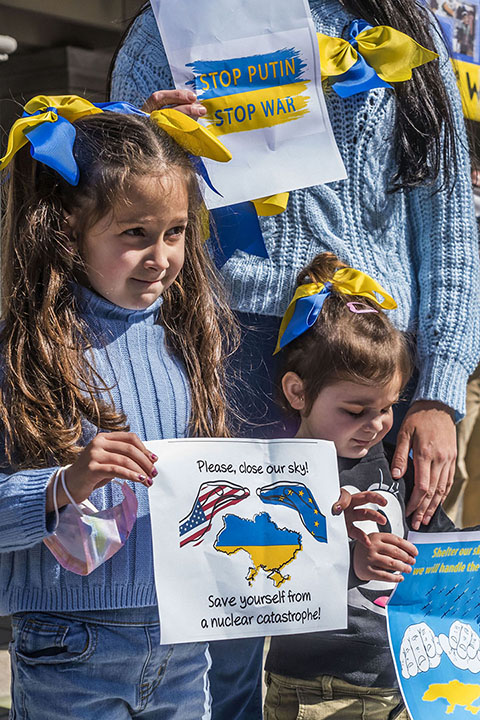
SAN FRANCISCO, CA - 06MARCH22 - Demonstrators oppose the Russian invasion of the Ukraine and the expansion of NATO. In solidarity with the people of Ukraine, under the direction of artist David Solnit, protesters recreated a painting by beloved Ukrainian painter Maria Prymachenko, "A Dove Has Spread Her Wings and Asks for Peace." Members of the Musicians Action Group played during the rally, and protesters marched along the Embarcadero. The demonstration was organized by Code Pink and other peace organizations and took place simultaneously with rallies in countries around the world.

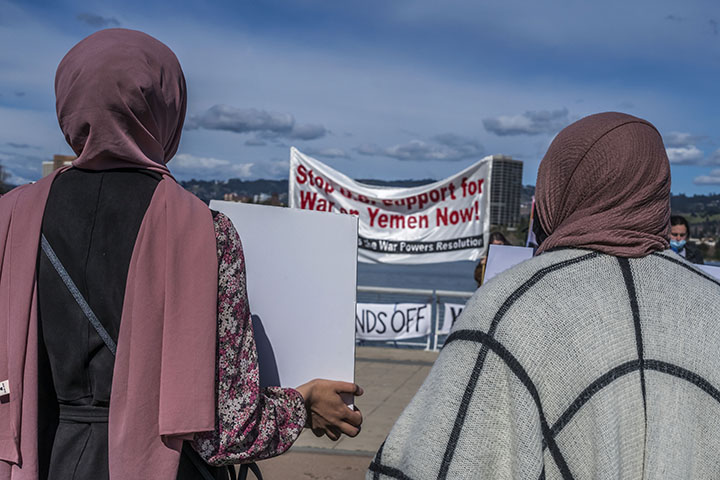
OAKLAND, CA - 5MARCH22 - Bay Area organizations protested the war on Yemen and call for Rep. Barbara Lee, Rep. Ro Khanna, and Speaker Pelosi to publicly commit to supporting the DeFazio-Jayapal War Powers Resolution, and to withdrawing U.S. support of the Saudi-UAE coalition before the 7th anniversary of the war..  This action happened in coordination with 70 organizations in several states protesting U.S. involvement in Yemen. The demonstration was organized by the Yemeni Alliance Committee, Hands Off Yemen, Arab Resource and Organization Center, Palestinian Youth Movement, Malaya Movement San Francisco, Code Pink Golden Gate, DSA and other organizations.

SAN FRANCISCO:


OAKLAND: