Thursday, March 31, 2022

TROUBLE IN THE TULIPS

TROUBLE IN THE TULIPS
Organized Farmworkers Win Basic Demands in a Quick Strike
By David Bacon
Labornotes, March 30, 2022
https://labornotes.org/2022/03/trouble-tulips-organized-farmworkers-win-basic-demands-quick-strike


 Tulip workers take a vote. Photo: Edgar Franks


MT. VERNON, WA - Tulips and daffodils symbolize the arrival of spring, but the fields are bitterly cold when workers' labors begin. Snow still covers the ground when workers go into the tulip rows to plant bulbs in northwest Washington state, near the Canadian border.

Once harvesting starts, so do other problems. When a worker cuts a daffodil, for instance, she or he has to avoid the liquid that oozes from the stem-a source of painful skin rashes.

Yes, the fields of flowers are so beautiful they can take your breath away, but the conditions under which they're cultivated and harvested can be just as bad as they are for any other crop. "Tulips have always been a hard job, but it's a job during a time of the year when work is hard to find," says farmworker Tomas Ramon. "This year we just stopped enduring the problems. We decided things had to change."

On Monday, March 21, their dissatisfaction reached a head. Three crews of pickers at Washington Bulb accused the company of shorting the bonuses paid on top of their hourly wage, Washington's minimum of $14.69. Workers get that extra pay if they exceed a target quota set by the company for picking flowers.

The parent company of RoozenGaarde Flowers and Bulbs is Washington Bulb, the nation's largest tulip grower.

"We've had these problems for a long time," explains Ramon, who has cut tulips for Washington Bulb for seven years. "And the company has always invented reasons not to talk with us."

Workers stopped work that Monday and waited from eight in the morning to see how the owners would respond. The general supervisor was sick, they were told. Someone from the company would talk with them, but only as individuals. "We didn't want that," Ramon says. "We're members of the union, and the union represents us."

Union Wherever They Go

Over two-thirds of the 150 pickers for Washington Bulb work at the state's largest berry grower, Sakuma Farms, later in the season-where they bargain as members of Familias Unidas por la Justicia (FUJ), an independent union. Starting in 2013, farmworkers there struck and boycotted, and finally won a contract after four years. They formed Familias Unidas. At Washington Bulb there is no union contract, yet. But to Ramon and his workmates, they are members of FUJ wherever they go.

When the company wouldn't talk on that Monday, 70 workers voted to strike the following day. Another 20 joined them the next morning, when they again demanded to talk with the company. This time one of the owners told them he wouldn't talk if the president of Familias Unidas, Ramon Torres, was present.

"So we said, 'If you won't talk with our representative, we won't talk without him,'" Tomas Ramon remembers. "'We have a union and you have to make an agreement with him.' So the owner got angry and left."

That Wednesday the flowers were just waving in the breeze, waiting for someone to pick them. The day after, the company lawyer was on the phone to union attorney Kathy Barnard. With a commitment to begin negotiations, workers agreed to go back into the rows after the weekend, and talks got started.

"By the first day of the strike the workers had already met, elected a committee, and put their demands in writing," said FUJ's political director Edgar Franks. "After the four years of fighting for the contract at Sakuma Farms, they knew how to organize themselves quickly. They had community supporters on their picket lines after the first day. They had their list of demands, and finally forced the company to accept it."

Rubber Band Time

When the workers committee and Torres met with Washington Bulb president Leo Roosens on Friday, they went point by point over their 16 demands. Roosens made an oral commitment to resolve all except the demand over wage increases.


Worker leader Tomas Ramon.  Photo: Edgar Franks


 "The most important one for us was that they pay us for the time we spend putting rubber bands on the ring," Ramon says. Workers have to snap a rubber band around each bunch of flowers they cut, from hundreds of bands held on a ring. Each worker harvests thousands of bunches a day, so putting the bands on the ring takes a lot of time.

"There's never enough time, and supervisors don't want people to stop during work time. So on breaks and at lunch we're still filling the ring. They even give us a bag of bands to take home and do it there."

The company doesn't pay this extra time, so demand #7 says, "All work using rubber bands to bunch flowers will be performed during working time, excluding lunch and rest breaks. This work will not be performed off the clock." "Workers knew they had a right to this, because the union won a suit forcing Washington growers to pay for break time, even for workers working on piece rates or bonuses," Franks says.

Parking, Ointment and Bathrooms

Workers often have to walk half a mile from where they park their cars to the rows where they'll work, which the company also won't pay for. So point 3 says, "Workers will be paid the hourly rate from the time they leave their vehicles in the company's parking lots until they return to their vehicles...at the end of their daily shifts."

Gloves are $30 a pair, according to Ramon, and working without them means getting rashes from liquid from cutting daffodils. "The company has cream you can put on to help with that, but it's in the office and they often won't give it to you. Even if they do, they just give you a tiny bit, not enough." So another demand is for company-provided protective gear, and ointment available in the fields.

Of the eight people on the union committee, two are women. There's often just one bathroom for a crew of 50-60 people, and they included a demand for four bathrooms per crew, two for women and two for men, cleaned every day. They also insisted on a demand for better treatment, prohibiting favoritism from supervisors, who "will be trained to treat workers with respect ... and not pressure workers to pick flowers at unreasonable speeds."

The last demand is that the company recognize Familias Unidas por la Justicia as bargaining representative for Washington Bulb workers. If agreement is reached on that point, it will make the company the second in the state with an FUJ contract.

Strategic Timing

The annual Skagit Valley Tulip Festival is set to start on April 1, and runs for a month. The lightning job action less than two weeks before presented the Roosens, the most prominent family in the tulip industry, with the prospect of picket lines in front of fields, as tourists arrive to take photographs and buy flowers.

Almost all Washington Bulb workers have at least three years doing this work, and some as many as 15. They knew the importance of timing and the company's vulnerability. The fact that they were already organized made it easier to reach a quick decision on a job action.

The decision process relied on the collective traditions of the two indigenous groups from Oaxaca and southern Mexico who make up the workforce, Triquis and Mixtecos. Ramon, a Triqui, explains that "each community talked within itself. Each community has its own process, but we have the same kind of problems and the same experience. We all wanted to make things better, so we reached agreement." In that process community members meet, discuss, and arrive at a decision on behalf of everyone.

At Sakuma Farms, women were not elected to the union's leadership, and within the communities, women took a back seat. At Washington Bulb, however, two women were elected to the union committee, and made specific demands. "That's a big step forward for us," Ramon says. It also gives women in the fields suffering sexual harassment the ability to bring complaints to women in the union leadership, instead of men.

The Bosses' Biggest Fea

"Direct action is what makes things move," Franks says. "People put up with a lot because they're scared that they could be unemployed. But when workers go on strike, they lose that fear, they push back, and that's what makes things move. Direct action is the most valuable tool we have, and the bosses' biggest fear. When workers take that leap of faith they can see the world in a whole new say, and recognize their own true value."

Today in western Washington, a growing number of farmworkers have had that experience, and FUJ is following them into new places and farms as a result. It's not a new idea-in the 1940s, Larry Itliong followed Filipino cannery workers from Alaska, where their pitched battles formed Local 37 of the International Longshore and Warehouse Union, back to their work in the fields of the San Joaquin Valley. There, they became the heart of union organizing until the great grape strike of 1965. They eventually joined with Latino workers to form what is now the United Farm Workers.

"We're trying to make sure not to force the issue with workers here," Franks said. "The union is ready to support them once they're ready to take the step. The issues have been present for 20 years, but now, because of Sakuma, there's an ecosystem they can rely on. They can see workers winning and feel better about taking action than they would have years ago. They have a growing leadership, and don't have to put up with this anymore."


NOTE: At press time negotiations with the company had reached agreement on the workers' list of demands. While the union is not the official bargaining agent, the company agreed to treat the union committee as the representative of the workers. Workers were set to vote on the agreement on March 29.


Striking in the tulips.  Photo: Edgar Franks

Sunday, March 13, 2022

PHOTOGRAPHS OF PORTSMOUTH SQUARE - A TRIBUTE TO PAUL STRAND

PHOTOGRAPHS OF PORTSMOUTH SQUARE - A TRIBUTE TO PAUL STRAND
Photographs and text by David Bacon
Stansbury Forum, 3/13/22
https://stansburyforum.com/2022/03/13/photographs-of-portsmouth-square


In presenting these images of Portsmouth Square, in San Francisco's Chinatown, I've tried to keep in mind some of the ideas of Paul Strand, the great modernist and realist photographer.  

Strand was a radical, a founder of the Photo League in New York City in the 1930s, and a teacher who guided its work. After World War Two, as McCarthyite hysteria gripped the country, and especially the world of media and the arts, he was put on a blacklist (along with the Photo League itself) by the U.S. Justice Department.  He went into exile in France, never returning to live in the U.S.  For the next three decades he photographed people in traditional communities, and in newly independent countries during the period of decolonization and national liberation.

Strand was one of the founders of modernism in photography - the idea that photographs had to be connected with the world and depict it cleanly and simply.  He combined those visual ideas with social justice politics, not in a dogmatic or simplistic way, but in an effort to create socially meaningful art with its own philosophy and set of principles.

Strand's books were documents about place, presenting people in the context of their physical world.  The subject of this set of photographs is also a place, one very familiar to me over many years - Portsmouth Square in San Francisco. These photographs were taken over 20 years.  I've sequenced them, as Strand might have done, I think, in an order that emphasizes their social, as well as visual, content.

I was an organizer for the International Ladies Garment Workers Union in the late 1980s and early 1990s.  We set up a Garment Workers Center on Commercial Street, a block from the square.  The workers who came into the center were Chinese women and men who worked in shops all over the city, from outer Third Street to Chinatown itself.  I was just beginning to take photographs in a conscious way in those days, and because I was a union organizer, there was never a possibility that the sweatshop owners would let me inside to document the conditions.  I was a union militant, interested and committed to documenting work, so this was a big regret.  But walking through Portsmouth Square every day gave me a sense of the lives of people in this community, in the hours they spent outside the sewing shops.


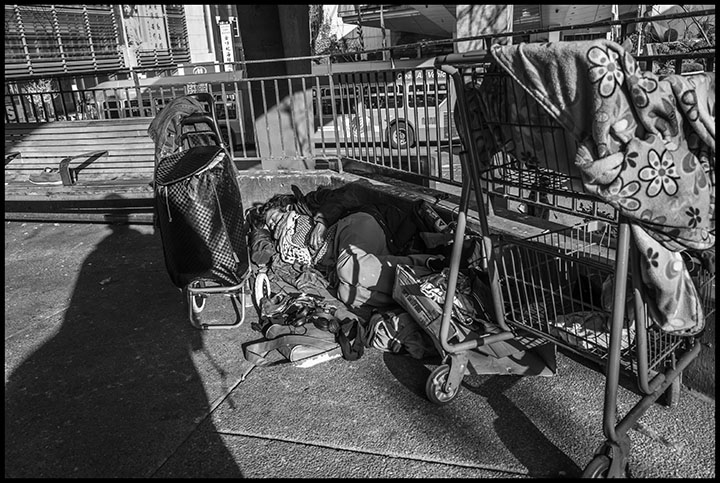
In those years the number of unhoused people on the streets was much smaller than today.  I would see perhaps one or two people sleeping on the sidewalk in the twenty blocks I traveled between our union's central office and the square, and rarely anyone sleeping the square itself.  Today that has changed.  Like any San Francisco park, Portsmouth Square has been made a home, or at least a sleeping place, by several people with nowhere else to go.  The first series of photographs shows a few of these individuals, in their relationship to the facilities of the square, including its benches, castoff cardboard boxes, and the sidewalk itself.


As an organizer I came to realize that Portsmouth Square is home to many activities, and has many levels of meaning to the people of Chinatown.  They relax, play cards and enjoy themselves on the benches whenever the city's notoriously uncertain weather permits.  Over the years I've often returned to take photographs and been struck by how many people play games here.   On one level, it is a place where people get together, in a community where many live with many family members sharing small apartments.  Portsmouth Square means space to breathe, to be noisy and extroverted, to play the games people were taught by mothers and fathers in the generations that came before.  It is a deep expression of the history and culture people share.


Organized cultural events also take place in the Square.  On a recent walk I was pulled towards the performance space by the music of the erhu and other traditional Chinese instruments.  An ensemble of musicians, organized by A Better Chinatown Tomorrow, had assembled to give a concert for the card players and the families wandering through the square.  One woman sang while another danced - stylized voice and motions in humble street clothes.


The culture of Chinatown includes the social movements in which people organized support for revolutions in China itself, and protests over the oppressive conditions and discrimination that people have faced at work.  It is an old history.  A few blocks away, in St. Mary's Square, a statue of Sun Yat Sen by Beniamino Bufano honors the fact that part of the Revolution of 1911, which overthrew the dowager Manchu empress, was planned by Chinese exiles, including those in San Francisco.   

Chinatown is one of the politically most vibrant communities in San Francisco, and Portsmouth Square has always provided space for demonstrations, marches, meetings and leafleting.  When the bombing began in Afghanistan, and the media began its deafening war drumbeat that preceded the invasion of Iraq, Chinatown's internationalists gathered in Portsmouth Square.  There they held signs calling for peace, and for spending on human needs instead of bombs.  After listening to speeches in Chinese, the contingent marched down to Market Street and joined thousands of others from homes across the city, protesting what became a 20-year war.

Perhaps Strand, who took his photographs slowly and deliberately with a large view camera, might have had conflicting feelings in seeing these photographs.  In taking them I took advantage of the mobility of a small camera, moving much more freely than he could with his large apparatus.  He carefully constructed his images, seeing them on the large ground glass at the rear of the camera.  I try to be conscious of the image and its elements as I take my pictures too.  But sometimes I feel that not everything happens on a conscious level.  Working quickly, I depend on a less conscious part of the brain to order the visual pieces of the image..  Perhaps that was also true for him.

But what I take from Strand, and what he might have seen as a commonality in our work, are his aesthetic and political principles.  In his idea of dynamic realism a successful photograph has to encompass three ideas.  It has to be partisan - committed to social change and seeing that change as necessary and possible.  Especially after he left the U.S. during the worst of the Cold War years, he worked in collaboration with radical, often Communist, activists.  They brought him to the communities he photographed, and wrote text accompanying the photographs.

Strand was a committed realist, but he believed that a successful photograph had to do more than just record the reality in front of the lens.  Mike Weaver says in his description of Strand's philosophy, "Certain realities of the world had to be made clear.  To be deeply moved was not enough."  Strand's concept of specificity meant that an image of a particular person had to go beyond her or his individuality, to encompass a more universal truth.  Commenting on a Dorothea Lange photograph he said, "The cotton picker is an unforgettable photograph in which is epitomized not only this one man bending down under the oppressive sky, but the lot of thousands of his fellows."  

Strand did not deny the individuality of the people in his images.  None could have had more dignity, or been photographed with greater care or in more detail.  But without being able to see beyond the individual to greater universality, "photography collapsed into record making, emphasizing the exceptional at the expense of the universal ... One person who has been studied very deeply and penetratingly can become all persons.  Therefore it seems to me that art is very specific and not at all general."

Strand's third principle was dimensionality, referring both to the qualities of the image itself, and how they resonate with its social content.  In an image different elements have a relationship to each other, just as the photograph has a relation to the reality it depicts.  That relationship, within the image, has to have a sensation of movement, he believed.  Even a very still, posed photograph has to have "a sensation of movement through the eye ... simply a reflection of the material fact that everything is in movement ... It is the reflection that in the world things are actually related to each other, even though sometimes we cannot readily see it."

These images of Portsmouth Square been assembled into a sequence, as Strand did in his careful juxtaposition of the images in his books  Some were taken twenty years ago and the most recent just a few weeks back.  Over this period of time I was able to work, and see Portsmouth Square, as an activist myself - an organizer and participant, or sometimes a supporter at a distance, of some of the community's social movements.  The images document the reality of people enduring the pain of marginalization, of the social networks and culture centered on this place, and the efforts to change social reality and fight for justice.

Whether the images succeed in attaining Strand's goal of specificity, or universality, and how well they work as images internally, is up to the viewer to judge.  But taking and sequencing them has forced me to reexamine my own process as a photographer.  I've always considered myself a realist and materialist.  I've paid a lot of attention to the relationships that make my work possible, and I hope socially useful.  But I've given less thought to the aesthetics or the principles behind their conception.  It's seemed enough to say that a photograph either works or it doesn't.

Strand, however, demands a greater commitment.  He voiced a political philosophy that provides a coherent way to analyze photography that is deeply connected to the world.  That forced me to give more attention to the way politics and aesthetic ideas interact in my own work.  Here's his reaction to the unconsidered and unthought realism (photojournalistic and otherwise) of his day (he died in 1976):

"We must reject both this venal realism as well as the mere slice-of-life naturalism which is completely static in its unwillingness to be involved in the struggle ... towards a better and fuller life.

"On the contrary, we should conceive of realism as dynamic, as truth which sees and understands a changing world and in its turn is capable of changing it, in the interests of peace, human progress, and the eradication of human misery and cruelty, and towards the unity of all people.  We must take sides."

Thanks to "Dynamic Realist," by Mike Weaver, in "Paul Strand, Essays on his Life and Work", Aperture, 1990

Monday, March 7, 2022

BAY AREA CALLS FOR PEACE IN THE UKRAINE AND YEMEN

BAY AREA CALLS FOR PEACE IN THE UKRAINE AND YEMEN
Photos by David Bacon
To see the full selection of photos, click here:
Ukraine rally:  
https://www.flickr.com/photos/56646659@N05/albums/72177720297173982
Yemen rally:
https://www.flickr.com/photos/56646659@N05/albums/72177720297147140

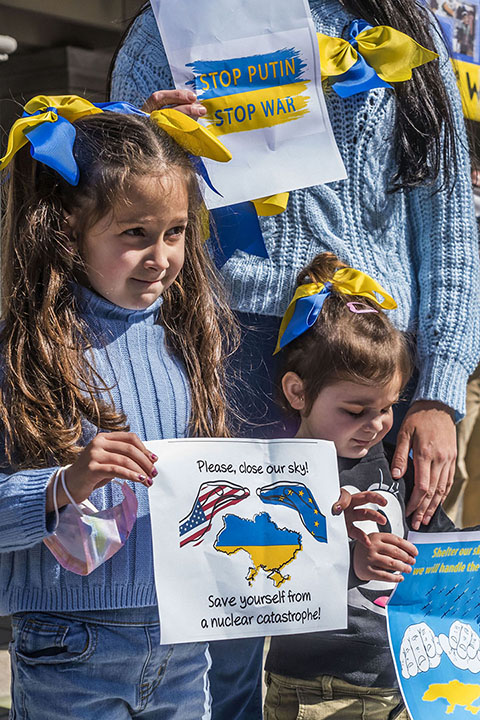
SAN FRANCISCO, CA - 06MARCH22 - Demonstrators oppose the Russian invasion of the Ukraine and the expansion of NATO. In solidarity with the people of Ukraine, under the direction of artist David Solnit, protesters recreated a painting by beloved Ukrainian painter Maria Prymachenko, "A Dove Has Spread Her Wings and Asks for Peace." Members of the Musicians Action Group played during the rally, and protesters marched along the Embarcadero. The demonstration was organized by Code Pink and other peace organizations and took place simultaneously with rallies in countries around the world.

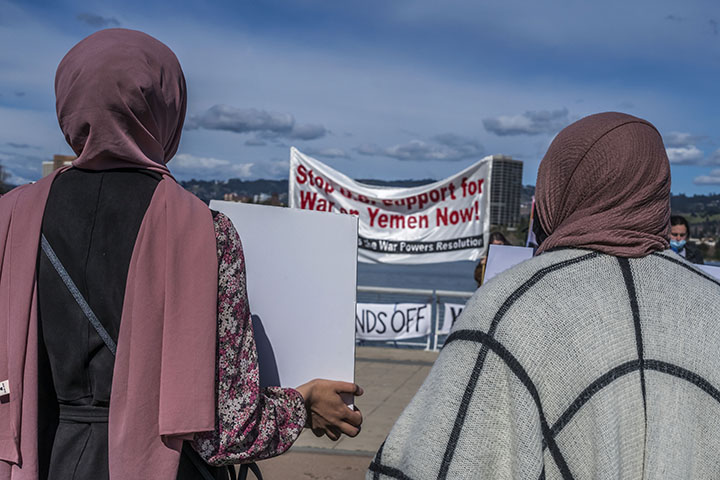
OAKLAND, CA - 5MARCH22 - Bay Area organizations protested the war on Yemen and call for Rep. Barbara Lee, Rep. Ro Khanna, and Speaker Pelosi to publicly commit to supporting the DeFazio-Jayapal War Powers Resolution, and to withdrawing U.S. support of the Saudi-UAE coalition before the 7th anniversary of the war..  This action happened in coordination with 70 organizations in several states protesting U.S. involvement in Yemen. The demonstration was organized by the Yemeni Alliance Committee, Hands Off Yemen, Arab Resource and Organization Center, Palestinian Youth Movement, Malaya Movement San Francisco, Code Pink Golden Gate, DSA and other organizations.

SAN FRANCISCO:


OAKLAND:


Wednesday, January 19, 2022

BORDER COMMUNITIES AND THEIR SOCIAL JUSTICE MOVEMENTS FOCUS OF NEW EXHIBITION AT SAN FRANCISCO MAIN LIBRARY

BORDER COMMUNITIES AND THEIR SOCIAL JUSTICE MOVEMENTS FOCUS OF NEW EXHIBITION AT SAN FRANCISCO MAIN LIBRARY


Español abajo

More Than a Wall features photographs by David Bacon that explore the border region of the United States and Mexico and the communities that call it home

On view at the Main Library, Jewett Gallery, February 12 - May 22, 2022

HIGH RES IMAGES   https://www.flickr.com/photos/185310672@N04/albums/72177720295918938

SAN FRANCISCO - For photographer David Bacon, the border region between the United States and Mexico is a land marked by life and death. Each year, at least 300-400 people die trying to cross into the U.S. in search of a better future for themselves and their families. The border is also bustling with life. The once-small towns of Ciudad Juárez and Tijuana are now home to millions of people, many of whom make up the industrial workforce of Southern California, South Texas and New Mexico. Taken over a period of 30 years, Bacon's photographs and accompanying text panels, which are presented in English and Spanish, in San Francisco Public Library's exhibition More Than a Wall explore all aspects of the border region and its vibrant social history.  

The photographs trace the social movements in border communities, factories and fields. According to Bacon, "These photographs provide a reality check, allowing us to see the border region as its people, with their own history of movements for rights and equality.  By providing this, the exhibition seeks to combat anti-immigrant and anti-Mexican hysteria, and develop an alternative vision in which the border can be a region where people live and work in solidarity with each other."

The photographs were taken in collaboration with Binational Front of Indigenous Organizations (FIOB), the Coalition for Justice in the Maquiladoras and California Rural Legal Assistance. They are featured in a new bilingual book, More Than a Wall, published by the Colegio de la Frontera Norte in Tijuana.  Bacon's photographic work is housed in the David Bacon Archive in the Special Collections of the Green Library at Stanford University.

Gaspar Rivera-Salgado, Mixtec professor at UCLA and co-founder of the FIOB, says, "David organically integrates his photographic work with the testimonies of the actors themselves, and provides thorough analysis of critical points in the lives of workers and communities on both sides of the border. The effect is shocking.  But he also describes a future with full sharpness that seems complex and full of possibilities - possibilities we may still not fully imagine."

The exhibition opens on February 12 in the Main Library's Jewett Gallery, which is located on the lower level. The public is invited to the opening event, The Media, Art and the Border, which will feature Bacon in conversation with San Francisco artists and photographers about the way the border is represented in media and the arts.  Among the participants will be Juan Gonzales, founder of El Tecolote and director of the journalism program at City College of San Francisco; Kim Komenich, a Pulitzer Prize-winning photographer and photojournalism teacher at San Francisco State University, Mabel Jimenez, border photographer and former photo editor for El Tecolote, Brooke Anderson, movement photographer and Juan Fuentes, a celebrated artist and cultural activist.

February 12, 1 p.m., Main Library, 100 Larkin Street, Latino/Hispanic Community Room

Per the City's Health Order, masks are required at all times in the Library.

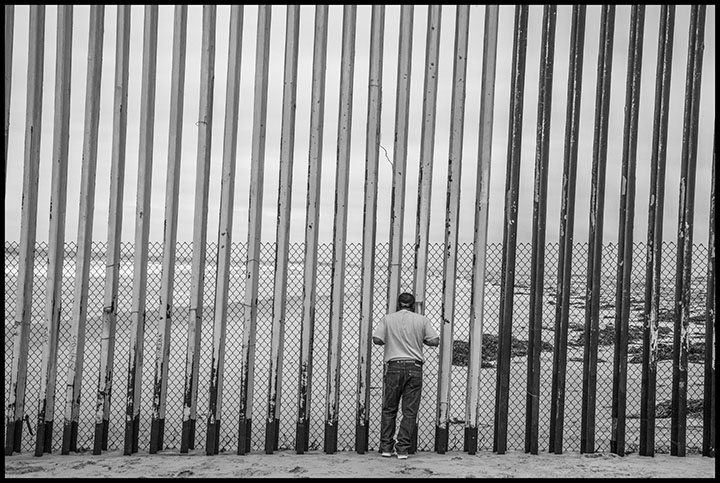
Caption: Tijuana, Baja California Norte - Catalina Cespedes, Carlos Alcaide and Teodolo Torres greet Florita Galvez, who is on the other side. The family came from Santa Monica Cohetzala in Puebla to meet at the wall. (c) David Bacon

About San Francisco Public Library
San Francisco Public Library is dedicated to free and equal access to information, knowledge, independent learning and the joys of reading for our diverse community. The library system is made up of 27 neighborhood branches, the San Francisco Main Library at Civic Center and four bookmobiles. To learn more, please visit sfpl.org and follow on Twitter @SFPublicLibrary and on Instagram @sfpubliclibrary.

MEDIA CONTACT:
Kate Patterson, San Francisco Public Library
(415) 557-4252 / kate.patterson@sfpl.org
January 14, 2022


COMUNIDADES FRONTERIZAS Y SUS MOVIMIENTOS DE JUSTICIA SOCIAL ENFOQUE DE LA NUEVA EXHIBICION EN LA BIBLIOTECA CENTRAL DE SAN FRANCISCO

More Than a Wall presenta fotografías de David Bacon que exploran la región fronteriza de los Estados Unidos y México y las comunidades que la llaman hogar
En exhibición en la Galería Jewett de la Biblioteca Central, del 12 de febrero al 22 de mayo de 2022

IMÁGENES EN ALTA RESOLUCIÓN  https://www.flickr.com/photos/185310672@N04/albums/72177720295918938

SAN FRANCISCO, 14 de enero de 2022 - Para el fotógrafo David Bacon, la región fronteriza entre Estados Unidos y México es una tierra marcada por la vida y la muerte. Cada año, entre 300 y 400 personas mueren tratando de cruzar a los EE. UU. en busca de un futuro mejor para ellos y su familia. La frontera también está llena de vida. Las que en alguna ocasión fueran pequeñas poblaciones, Ciudad Juárez y Tijuana son ahora el hogar de millones de personas, muchas de las cuales conforman la fuerza laboral industrial del sur de California, el sur de Texas y Nuevo México. Tomadas durante un período de 30 años, las fotografías de Bacon y los paneles de texto que las acompañan, que se presentan en inglés y español, en la exposición More Than a Wall de la Biblioteca Pública de San Francisco explora todos los aspectos de la región fronteriza y su vibrante historia social.
 
Las fotografías reflejan los movimientos sociales en las comunidades fronterizas, las fábricas y el campo. Según Bacon, "Estas fotografías brindan una visión de la realidad, permitiéndonos ver la región fronteriza como su gente, con su propia historia de movimientos por los derechos y la igualdad.  Por este medio, la exposición busca combatir la histeria antiinmigrante y antimexicana, y desarrollar una visión alternativa en la que la frontera pueda ser una región donde las personas vivan y trabajen de manera solidaria".

Las fotografías fueron tomadas en colaboración con el Frente Binacional de Organizaciones Indígenas (FIOB), la Coalición por la Justicia en las Maquiladoras y la Asistencia Legal Rural de California. Aparecen en un nuevo libro bilingüe, More Than a Wall, publicado en Tijuana por el Colegio de la Frontera Norte.  El trabajo fotográfico de Bacon se encuentra en el Archivo David Bacon entre las Colecciones especiales de la Green Library de la Universidad de Stanford.

Gaspar Rivera-Salgado, profesor mixteco en UCLA y cofundador del FIOB, dice: "David integra orgánicamente su trabajo fotográfico con el testimonio de los propios actores, y proporciona un análisis exhaustivo de los puntos críticos en la vida de los trabajadores y las comunidades en ambos lados de la frontera. El efecto es impactante.  Pero también describe un futuro con total nitidez que parece complejo y lleno de posibilidades, mismas que aún no imaginamos por completo".

La exposición se inaugura el 12 de febrero en la Galería Jewett, que se encuentra en la planta baja de la Biblioteca Central. Se invita al público al evento de apertura, The Media, Art and the Border (Los medios, el arte y la frontera), que presentará a Bacon en una conversación con artistas y fotógrafos de San Francisco sobre la forma en que se representa la frontera en los medios y las artes.  Entre los participantes estarán Juan Gonzáles, fundador de El Tecolote y director del programa de periodismo en City College of San Francisco; Kim Komenich, fotógrafa ganadora del premio Pulitzer y profesora de fotoperiodismo en la Universidad Estatal de San Francisco, Mabel Jimenez, fotógrafa fronteriza y exeditora de fotografía de El Tecolote, Brooke Anderson, fotógrafa de movimiento y Juan Fuentes, célebre artista y activista cultural.

12 de febrero, 1:00 p. m., Biblioteca Central, 100 Larkin Street, Salón Comunitario Latino/Hispano

Según la Orden de Salud de la Ciudad, se requieren máscaras en todo momento dentro de la Biblioteca.

Acerca de la Biblioteca Pública de San Francisco
La Biblioteca Pública de San Francisco está dedicada al acceso gratuito e igualitario a la información, el conocimiento, el aprendizaje independiente y el placer de leer para nuestra diversa comunidad. El sistema de bibliotecas se compone de 27 sucursales en los vecindarios, la Biblioteca Central de San Francisco en el Centro Cívico y cuatro bibliotecas ambulantes. Para obtener más información, visite sfpl.org y síganos en Twitter @SFPublicLibrary y en Instagram @sfpubliclibrary.

Caption: Tijuana, Baja California Norte - Catalina Cespedes, Carlos Alcaide and Teodolo Torres greet Florita Galvez, who is on the other side. The family came from Santa Monica Cohetzala in Puebla to meet at the wall. (c) David Bacon

CONTACTOS PARA MEDIOS:
Kate Patterson, Biblioteca Pública de San Francisco
(415) 557-4252 / kate.patterson@sfpl.org
January 14, 2022

Sunday, December 26, 2021

THE RIVER, THE WORKERS AND THE WALL

THE RIVER, THE WORKERS AND THE WALL
Photographs by David Bacon
Las Cruces, NM  12/22/21


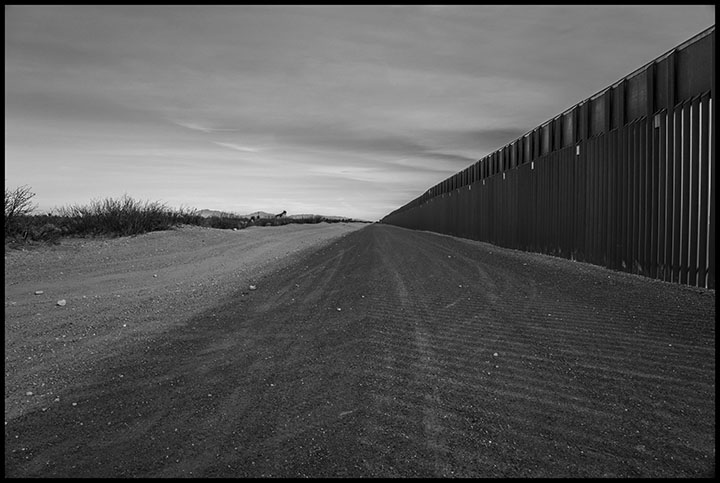
The Rio Bravo is the border between Mexico and the U.S. from El Paso and Juarez to Brownsville and Matamoros.  Just upriver from El Paso it passes through New Mexico, or it would if there were water in it.  Today, though, the mighty river is dry.
    
There are eight major dams on the Rio Bravo.  The big one at Elephant Butte, near Truth or Consequences, controls the flow down through Las Cruces and El Paso. Greeting the release of the water from Elephant Butte used to be an occasion, when people would come to greet the river as it came alive, submerging again dry sand and brush under the brown flow.
    
That flow, fed by the runoff from rains and snow in the Rockies, would begin in February and finally run dry in October.  But climate change is changing the pattern.  In 2020 water began to course down the riverbed in March, and petered out in September.  This past year the river only flowed from June through July - two months instead of nine.


Route 28 is the old two-lane road that follows the watercourse through the Mesilla Valley that extends from Las Cruces south to El Paso - the border between New Mexico and Texas.  It is pecan country, where rundown buildings line the highway as it runs through the old farmworker towns.  While its people may be poor, however, pecans are New Mexico's most profitable crop, worth over $220 million each year.  Today Doña Ana County harvests more of the nuts than any other in the country.
    
From late December through early January alligator-like machines snake through the orchards, grabbing each tree between rubber-coated jaws, shaking the pecans off the branches.  Another machine follows behind, sweeping the nuts into long rows.  
    
Then the workers arrive.  They clean out branches and debris, that would otherwise clog up the final set of machines in the groves - the giant vacuum cleaners that suck up the nuts, spit out the leaves, and haul the crop down to the sheds.
    
Pecan workers were some of the southwest's first labor activists.  Emma Tenayuca, a young Communist organizer trained at the Universidad Obrera in Mexico City, led twelve thousand young Mexican and Chicana women out on strike in San Antonio in 1938.  
    
This generation of pecan workers, however, may be the last.  The trees yield big profits for growers but they need water, and the river is drying up.  The aquifer below the valley depends on river flow, so pumping water is a solution that will only work for a while.


According to Kevin Bixby, director of the Southwest Environmental Center, "it's only a matter of time until people understand that growing pecans in the desert is not sustainable.  Water is a resource of public trust, which means that the government has the duty as an administrator to manage this resource for the benefit of all, including future generations."
    
Below the Mesilla Valley, just before the riverbed becomes the border between Mexico and the U.S., the new border wall stretches across the desert west of El Paso.  In El Paso itself, the city of Juarez is visible through an older section of the wall and its network of wire mesh.

The work of people arriving from the south produced the pecan industry and its profits. But the wall is a potent symbol of the hostility of Texas and U.S. authorities towards migrants.


Sunday, November 28, 2021

THANKSGIVING IN THE STOCKTON GRAVEYARD

THANKSGIVING IN THE STOCKTON GRAVEYARD
Photographs by David Bacon


If you drive straight ahead after passing through the cemetery gate, you soon find yourself among dark stone mausoleums.  These are the grey memorials to Stockton's Catholic elite.  Along empty tree-lined avenues leaves blow past the stones and their dark shadows.

If you turn right, though, you arrive at the corner of the graveyard where Mexicans and Filipinos bury their dead.  Innocencio Galedo, who migrated to work in Stockton fields in 1922, is buried here.  Next to him is his wife Sotera, who came from the Philippines to join him after the war.  Once a year one of their kids cleans off the two flat grave markers - picking away the crabgrass and putting flowers in the two holes in each one.  This year it's Lillian's turn.

On Thanksgiving the graves in this corner are a bewildering cacophony.  Many families clearly see visiting them as a part of the holidays.  November is just after Dia de los Muertos, and grave decorations are a jarring combination of pumpkins, skulls and babies.  Plastic flowers combine with real ones.  Votive candles bear the image of the Virgin of Guadalupe. A small statue, at first glance a dark figure from a surreal dream, resolves into a chubby infant holding a bird.

Against the fence at the edge of the cemetery, with warehouses and barrels visible through the slats, birthday balloons are the memorials left by families unable to afford elaborate gravestones.  Where the children are buried, dolls sit next to little figurines of elephants or cartoon characters, under photographs of smiling sisters and brothers.  The little pony, beloved by six-year olds, has become a blown-up metallic unicorn.

After putting her decorations on the flat gravestone in front of her, a girl sits remembering who's buried underneath.  In one large photograph a father stares out from the past.  Other families, unwilling to forget the faces of their buried dead, have set small photographic portraits into the stones of other markers.

Many tomb decorations celebrate life, as though the person in the ground is still there to party.  A bottle of brandy and a beer, a calacas with a guitar, and even a snow globe surround a flag, candles with saints, and the statue of a strangely pensive child.  It's an altar for Day of the Dead, in the campo santo, or the holy field that belongs to them.

Walking away, I notice a new burial.  An enormous flower decoration spells out DAD - another father receiving his family's tribute.  People say funerals and burial arrangements are for the living, rather than for the dead.  The dead, after all, don't live to see them.  But if they somehow were able to see what's come after they're gone, the ones buried under the flat stones and balloons are probably happier than the respectable folks in the grey mausoleums.