Saturday, November 21, 2020

WILL THE SUPREME COURT OVERRULE FARMWORKER UNION RIGHTS?

WILL THE SUPREME COURT OVERRULE FARMWORKER UNION RIGHTS?
By David Bacon
Capital & Main, November 20, 2020
https://capitalandmain.com/will-the-supreme-court-overrule-farmworker-union-rights-1120


An organizer talks at lunchtime with a D'Arrigo Brothers worker with a union button on her cap. 


All photos by David Bacon.  These photos are housed in the Special Collections of the Green Library at Stanford University.  https://exhibits.stanford.edu/bacon

Sidebar below: How a Labor Law Evened the Balance of Power in California's Fields


Not long before Donald Trump's election in 2016, the Pacific Legal Foundation filed suit against California's farmworker access rule in federal court on behalf of two companies - Cedar Point Nursery in Siskiyou County and the Fowler Packing Company in Fresno. The foundation is a conservative libertarian group that holds property rights sacred and campaigns against racial equity. It fought hard for the appointment of Amy Coney Barrett to the high court.

The access regulation, which took effect after the passage of the Agricultural Labor Relations Act in 1975, allows union organizers to come onto a grower's property in the morning before work to talk with workers. According to the labor board's handbook, "The access regulations of the Agricultural Labor Relations Board are meant to insure that farm workers, who often may be contacted only at their work place, have an opportunity to be informed with minimal interruption of working activities."


Two UFW organizers walk into a D'Arrigo Brothers broccoli field in Salinas, 1994.


The board requires that the union give notice to the employer before taking access, and that organizers not disrupt work. They can talk only for an hour before and after work and during lunch, and can take access for only a total of 120 days during a year.

Growers have always hated the access rule, and many at first refused to obey. Former United Farm Workers organizer Fred Ross Jr. remembers being arrested several times in Santa Maria for taking access. "This was all about power and who had it," he says. "Growers had it all, and their workers none. They wanted to dominate. For them, workers didn't even have the right to talk."

The suit filed by the PLF, Cedar Point Nursery v. Hassid, attracted more than the predictable support of the California and American Farm Bureaus. Amicus briefs came from a host of right-wing legal bodies, including the Mountain States and Southeastern Legal Foundations, the Pelican and Cato institutes, and even the Republican attorneys general of Oklahoma, Arizona, Arkansas, Kentucky, Missouri, Nebraska and Texas. The company brief conjured up visions of "stampedes of third-party organizers" and warned, "If such a rule proliferates, property owners throughout much of the nation will see their rights greatly diminished as governments increasingly sanction invasions of their property."

 
 During the 2007 UFW campaign to organize grape pickers for the huge VBZ grower in Delano, organizer Yolanda Serna talks to workers eating lunch.


Had the political atmosphere in the country not changed in the 40 years since the regulation has been in effect, the suit might never have been filed at all. Agribusiness challenged the access rule from its inception and went all the way to the California Supreme Court, where the growers lost in 1976. In the last decade, however, visions of a liberal U.S. Supreme Court evaporated in the final years of the Obama administration, and Trump's election led to the appointment of three right-wing justices, giving the court a 6-3 conservative majority.

 
 An organizer, on leave from his job as a lettuce worker, talks with D'Arrigo Brothers broccoli cutters on their lunch break. (1994)


When the U.S. Supreme Court agreed on Nov. 13 to hear the growers' appeal from their loss at the U.S. Court of Appeals, many legal observers became concerned. "State court decisions over state issues used to be respected by the U.S. Supreme Court," says Jerry Cohen, who helped write the law as the legal director for the UFW. "States' rights used to be a Republican issue. Now the end product is all that matters."

That end product is a continued erosion of power for farmworker unions. "Without the rule the union seems to workers like it's not legitimate, and there really is no right to talk," Ross says. "Losing it reinforces the growers' power and control. It's one more blow to the right to organize."

The mundane genesis of the current suit was a short strike in Dorris, near the Oregon border, where hundreds of farmworkers migrate from Southern California every year to trim young strawberry plants. In 2015, according to one worker, Jessica Rodriguez, the company paid low wages, had dirty bathrooms and harassed and intimidated workers. They called the United Farm Workers, which sent organizers and filed under the access rule to talk with them on the property. The strike lasted for just a day. At Fowler Packing the union filed for access to talk with an unrelated group of workers, and the company simply refused to let organizers onto the property.

 
 Julio Ramirez talks to a strawberry worker in the fields of the Gargiulo Corp. in Watsonville, 1977. Ramirez was a lettuce cutter and longtime UFW member.


Over the years the access rule became a valuable tool for organizing workers. Jerry Cohen remembers his discussions with UFW founder Cesar Chavez, during negotiations with then-Gov. Jerry Brown, who signed the law during his first term in 1975. "Cesar told us to get things that were practical, that could help workers organize," he recalls. "Where workers are together it's easier for the union to talk with them."

The access regulation came into effect at a time when the UFW was strong. The balance of power between workers and growers had shifted, and by the early 1980s more than 40,000 farmworkers had union contracts. To Eliseo Medina, who grew up in a farmworker family and became a leading organizer, "The rule was a very clear example that growers were not all-powerful. It was a huge change. People saw organizers coming onto the properties, and could have a conversation at work about their future. It gave people confidence that change was possible."

In 1996, when a huge campaign began to organize the strawberry industry in Watsonville, organizers visited picking crews in dozens of fields. They taped butcher paper on the walls of the Porta Potties, and held meetings where strawberry workers wrote down their demands for raising some of the lowest wages in agriculture, for health benefits and an end to discrimination in hiring. Then in field meetings they planned marches to the company offices, where the demands were announced.

 
 Two farmworkers, who have left their jobs to work as organizers for the United Farm Workers, hold a meeting at lunchtime with a crew of strawberry pickers, 1997.


In 2015 the access rule was used in McFarland in the San Joaquin Valley, where workers angry over a wage cut went on strike. They called in UFW organizers, who used meetings in the fields during lunch and after work to collect signatures on an election petition. After workers voted overwhelmingly for the union, the blueberry pickers chose a ranch committee and eventually negotiated a contract with Gourmet Trading.

When Pacific Legal Foundation argued its case in 2017 before the U.S. Court of Appeals for the Ninth Circuit, where it ultimately lost, its attorney Wen Fa declared, "The growers have no problem in the union talking with workers. It's where they talk with the workers. ... [There are] plenty of alternative means for the union to talk with workers ... All the workers [at Cedar Point Nursery and Fowler Packing Company] live in houses or hotels. Many have cellphones."

 
 Susana Cervantes, a Union Summer intern and student from East Los Angeles, talks to strawberry pickers on their lunch break during the first year of a big UFW organizing drive in 1997.


The ALRA had recognized, however, that it's harder for farmworkers to organize than for other workers, and set up a much quicker process for gaining union recognition than the National Labor Relations Act did for other workers in 1936. Because farmworkers work only for a season, which can last just weeks, union representation elections take place a week after workers petition for them, and within just 48 hours if there's a strike.

 
 Efren Barajas, UFW organizing director, holds a worksite meeting with strawberry workers on their lunch break during the Watsonville organizing drive of 1998.


Growers are required to furnish a list of workers with addresses. "Those lists are notoriously bad, though," Medina laughs. Most Cedar Point workers actually live hundreds of miles from their seasonal jobs. Addresses in Mexico are very hard to find, and workers on this side of the border often live in isolated colonias scattered over a huge geographical area. "By winning access it was easier to get their addresses so we could visit them, especially those who were afraid to talk in front of the foreman," Ross explains.

The difficulty of reaching workers outside of work is even greater for a growing segment of the farm labor workforce- those workers brought to the U.S. under temporary H-2A visas. In 2019 the U.S. Department of Labor allowed California growers to fill 23,321 jobs with these contract laborers. "H-2A workers would be even more impacted by losing the access rule," Medina charges. "They don't have the legal right to organize - even undocumented workers have more rights than H-2A workers. They're living in barracks under the growers' 24-hour control. In Delano growers are taking over whole motels and making them into labor camps."

The union, however, has used the access rule less frequently over the years. In her defense of it, ALRB chairwoman Victoria Hassid noted that it filed for access at only 62 of the 16,000 agricultural employers in California in 2015. "There is no indication," she wrote, "that the access regulation poses a significant problem for California farms ... petitioners have not actually alleged any negative economic impact on them (or anyone else) resulting from the regulation."

 
 In 1994 D'Arrigo Brothers workers, after a UFW march from Delano to Sacramento, were inspired to march to the office of the company after work to demand a union contract.


Pacific Legal Foundation's Wen Fa made the growers' root argument in response: "The Constitution forbids government from forcing property owners to allow unwanted strangers onto their property, and there is no exception for union activists."

In an interview with this author, Fa claimed that growers' economic losses growing out of the access rule could be "significant," but couldn't say specifically what they are. "This case is about property rights," he said. In his winning defense of the access rule before the U.S. Court of Appeals, Matthew Weiss, deputy attorney general for the ALRB, noted that the effort to knock out the rule simply "privileges private property interests over all others."

UFW general counsel Mario Martinez says the effort to knock out the access rule is further evidence of a history of racism toward farmworkers.

"The federal government has excluded farmworkers from all labor law protections under the National Labor Relations Act for 85 years," he charges. "In light of this racially discriminatory exclusion, California granted to agricultural workers important labor protections to balance the historical imbalance of power between farmworkers and growers. A court review of California's legislation appears to be another attempt to unfairly discriminate."

The U.S. Supreme Court plans to hear arguments in the case early next year and will probably rule by July.

 
 Aquiles Hernandez, an indigenous Mixtec farmworker and former teacher activist in Mexico, informs Mixtec-speaking workers at Gourmet Trading about their labor rights during a lunchtime access period in 2016.


HOW A LABOR LAW EVENED THE BALANCE OF POWER IN CALIFORNIA'S FIELDS
By David Bacon
Capital & Main, November 20, 2020
https://capitalandmain.com/how-a-labor-law-evened-the-balance-of-power-in-californias-fields-1120

 
 D'Arrigo Brothers workers demonstrate outside the company office, 1998.


In the winter of 1976, a year after the Agricultural Labor Relations Act took effect, lettuce cutters at George Arakelian Farms Inc. began organizing a union. The men lived in Mexicali, Mexico, just south of California's Imperial Valley. Every day they left home at 2 a.m. and walked to the border. After crossing it, the company labor contractor put them into cars. As each clunker was filled, it took off for the Palo Verde Valley, a two-hour drive across the desert.

Union organizers also met the workers at the border and followed the cars. When they all arrived at the fields, however, the crews couldn't immediately start work. In the winter,  water freezes inside the lettuce. If a cutter grabs a head to harvest it, the ice cuts into the leaves and they wilt. Everyone has to wait for the ice to melt, when work can start.

Next to the fields, workers lit fires in 55-gallon drums. In those moments when they stood warming their hands and talking with the organizers, the union at Arakelian Farms began to take form. The laborers asked about the benefit plans, their rights under the new labor law and when they might be able to vote the union in. They set up a ranch committee to make decisions and convince the unconvinced.

When the ice finally melted, they began to cut, almost running down the rows with their knives. Packers followed, tossing boxes of lettuce onto trucks. No one took lunch. When the company filled its daily order, workers jumped into their cars and drove back to the border. They walked home with just with enough time to eat, say hi to their kids, catch a few hours'  sleep, and then wake up again and leave at 2.

Organizing their union this way was possible because of the access regulation, formulated by the Agricultural Labor Relations Board. The regulation allowed the organizers to come onto Arakelian's property in the morning before work to talk with the lettuce cutters. After a few weeks of field meetings, workers and organizers filed a petition for an election, which the union won 139-12.

Like many growers, however, Arakelian refused to negotiate a contract. It took nearly 10 years before the California Supreme Court found Arakelian had violated its obligation to bargain with its workers. Other parts of the law had to be changed to solve that problem, and George Arakelian Farms is no longer in business. The workers have moved on. But from the beginning, the access rule was the tool they, and others like them, used to help even the balance of power with the growers.

Monday, November 16, 2020

CAPTURING THE STRUGGLE FOR SOCIAL JUSTICE IN PHOTOS

CAPTURING THE STRUGGLE FOR SOCIAL JUSTICE IN PHOTOS
by Nick Rahaim
Tropics of Meta: historiography for the masses -  November 11, 2020
https://tropicsofmeta.com/2020/11/11/the-david-bacon-photography-archive-capturing-the-struggle-for-social-justice-in-photos/
Stanford Libraries, Special Collections
https://library.stanford.edu/blogs/special-collections-unbound/2020/11/david-bacon-photography-archive-capturing-struggle-social?fbclid=IwAR3Wji2Df54rbubxa6xwyO2qw7wZz9wFDGXa7No5bjmBXvDhgN1BEU5di7o


The hands of Manuel Ortiz show a life of work


Manuel Ortiz held out his hands to the camera, revealing decades of toil - callouses, scars and creases embedded with soil that multiple hand washings wouldn't scrub clean. Photographer David Bacon first saw him in 2015 as he pushed a shopping cart full of cans and bottles through an alley in Yakima, Washington. Ortiz first came to the United States in the 1950s under the Bracero program and continued working the agricultural fields of California and Washington for six decades.

But when he met Bacon, Ortiz was in his mid-80s and too old to work in fields, so he redeemed cans and bottles to cobble together enough money for rent and food. With a single photo in Bacon's signature style - an uncropped black and white image set in a hard black border marking the edge of the full frame - he captured decades of hard labor that provided food for millions, but more importantly he reveals the continued strength Ortiz's hands hold to survive in a society that had continually undervalued his work.

"It's a powerful image," said Roberto Trujillo, associate university librarian and director of Stanford Libraries' Special Collections. "An elderly man's hands, just his powerful hand, scarred and worn from working in the fields day in and day out for probably all his adult life."

The photograph of Ortiz, entitled "The hands of Manuel Ortiz show a life of work," is one of 200,000 images spanning three decades shot by Bacon that are now housed in Stanford Libraries' Special Collections, which acquired Bacon's archive in the winter of 2019. The collection was launched this fall under the exhibit title Work and Social Justice: The David Bacon Photography Archive at Stanford, after more than a year of cataloging the images, original film negatives, color transparencies and digital files.

"David Bacon's career as a photojournalist and author represents working class history and social justice movements that transformed political landscapes internationally," said Ignacio Ornelas Rodriguez, Ph.D., a historian who works in the Department of Special Collections at Stanford who worked closely with Bacon on the acquisition of his archive. "David's work highlights communities that are often ignored by mainstream media and brings them from the margins of society to the forefront."

Bacon, 72 and a labor organizer-turned-photojournalist, has been at the frontlines of social justice movements since his youth, starting as a student activist in the Free Speech Movement in Berkeley in the mid-1960s. In the mid-1980s, after working as an organizer for the United Farm Workers and the International Ladies' Garment Workers' Union, among others, Bacon picked up a camera and began training his lens on the people he had worked with closely for nearly two decades. In the subsequent years, Bacon documented workers in the fields, strikes by teachers and hotel workers in cities, poverty and homelessness in the streets, May Day marches for immigrants' rights and even the struggle of Iraqi workers during the United States' occupation of the country following the overthrow of Saddam Hussein in 2003.

"Activism, the feeling this work is part of a movement for social justice has been central to everything I've done," Bacon said.

His work has brought him to Asia, Europe and throughout Latin America and has revealed the human faces behind many political struggles. But there's a common thread tying every photo together: People banning together to fight corporate greed, globalization and politics that both divide and displace workers and their families.

"What has always impressed me with David's work is how he purposely tried to capture the humanity of people who are struggling to make it, to just survive," Trujillo said. "His work also deals with labor and laborers at an international scale that's quite impressive for the work of a single man."

The David Bacon Photography Archive complements the Bob Fitch Photography Archive, which boasts 200,000 images from the civil rights movement and farm worker struggles of the 1960s and 1970s. Together the two archives provide nearly 400,000 images covering six decades of social movements in California and beyond.

The hands of Manuel Ortiz show a life of work captured in the single image, through the David Bacon Photography Archive at Stanford, a life's work in photos will be maintained in perpetuity. Scholars and writers scouring the archives of labor and immigrant rights activists including Bert Corona or of organizations like California Rural Legal Assistance and National Council of La Raza, all held at Stanford Libraries' Special Collections, now have access to the faces and human form behind the primary-source documents on the struggle for social justice.


Bert Corona, father of the modern immigrant rights movement, and his son, Ernesto


Bert Corona looks intently into Bacon's camera lens, but there's something enigmatic in his expression - a bemused seriousness or perhaps a stern contentment. Over Corona's left shoulder stands his young grandson, Eduardo, who's approaching adolescence and gives a quizzical look as the tip of a small American flag rises toward his face. The following year, 2001, Corona will pass at 82 years old.

"That image of Bert just stuck out," Trujillo said. "It's Bert, it's just Bert. It shows his anger, his humanity, his compassion and his passion for his work."

Corona's name might not have the recognition of some of his contemporaries in the labor and Chicano rights movements of the middle 20th century, but his impact still shapes the political landscape in California today.

"He was the father of the modern immigrant rights movement because it was Bert who said that the Mexican people, especially Mexican workers, living in the United States, especially in LA, were going to be the basis for radical social change, and he was right," Bacon said. "A lot of the work I have in archive chronicles and documents the latter part of that history."

In the 1930s Corona became an influential member of the Congress of Industrial Organizations (CIO) where he organized low-paid, mostly Spanish speaking workers in Los Angeles. Outside of labor organizing, he was active in many early Mexican American political groups including El Congreso de Pueblos de Habla Española and the Asociación Nacional Mexicano Americano. By the rise of Chicano movement in the 1960s, Corona was already a respected elder statesman who was one of the earliest champions of the rights of undocumented workers when much of the labor movement was hostile to them. For Bacon, there's a direct through-line from Corona's early activism to the May Day marches that bring millions to the streets demanding justice and dignity for those without papers.

This concern for the undocumented likely grew from Corona's binational childhood on the border. His father was an anarcho-syndicalist who was a comandante in Francisco Villa's Division del Norte during the Mexican Revolution, but had to flee after post-revolution politics in Mexico made it dangerous for him to stay in Mexico. He moved to El Paso, Texas where Corona was born. This also marks a similarity with Bacon's own life: Bacon's father was a printer and union leader in New York City who ended up on a McCarthy-era blacklist for alleged communist ties and lost his job in 1953. So at a young age Bacon moved with his family from Brooklyn to Oakland, California where his father was able to find work.

Corona's father would later be granted amnesty by the Mexican government only to be murdered shortly after for his political activity. The Bacon family was never exposed to violence, but the experience of being uprooted at an early age because of political persecution informed Bacon's politics and shaped his approach to photography.


On the Mexican side of the border wall between Mexico and the U.S. families greet other family members on the U.S. side.


In the global economy capital faces few barriers while crossing international borders, while people face many. Few images capture this fact as starkly as three family members standing at a rusted border wall with chipped paint worn by weather and sun. An older woman has placed her hands on the wall, intently looking at a family member on the other side who is hidden from view. Her face is full of love, but there is little joy in her expression, rather a longing for an embrace she's legally prohibited from giving.

Bacon took this photo at Parque de Amistad, or Friendship Park, in Tijuana, Mexico in 2017. Every Sunday families gather at the park, close to where the border wall runs into the Pacific Ocean, to speak with loved ones through metal grates. The family pictured came 1,500 miles from the state of Puebla in central Mexico for the chance to see their family.

Much of Bacon's work has focused on the border and migration, as neither are separated from the struggle for justice in fields, factories and hotels. In fact he has written numerous books on this nexus, including: The Children of NAFTA (2004), Communities Without Borders (2006), Illegal People - How Globalization Creates Migration and Criminalizes Immigrants (2008), The Right to Stay Home (2013) and In the Fields of the North/En Los Campos del Norte (2017).

While borders, walls and inhumane immigration policies keep people separated, the solidarity in the struggle Bacon has spent a lifetime documenting knows no borders.


Jane Algoso cuts dead fronds from the trunks of banana trees


Jane Algoso should have been in school, but the 11-year-old held a sickle to cut dead palm fronds from the trunk of a banana tree in Mindanao, Philippines for 50 peso a day. The child wore rubber boats to navigate the muddy ground in the Soyapa Farms banana plantation. Algoso looks strong and healthy, but she's in the middle of a chemically intensive monoculture controlled by the Dole Food Company.

Bacon travelled to the Philippines in 1997 to report on child labor and strikes by four cooperatives against the poverty-level prices Dole paid for their harvest. In a struggle to survive, many farmers pulled their children out of school to help in the fields. Bacon's article and photos ran on the front page of the San Francisco Chronicle on Christmas Day that year. His writing and pictures of Algoso and other children working in plantations added to the growing international pressure on Dole to meet the demands of the striking farmers and pay fair prices. With better pay farmers would be able to send their children to school.

"After they won their strike prices went up," Bacon said. "I went back to the community 20 years later to meet with the same people and I saw they were living a good life compared to what things were like before."

While Bacon went to the Philippians to document Filipinos organizing against exploitation by a large corporation from the United States, many photos in the David Bacon Photography Archive also document Filipinos organizing in the United States. From the earliest days of the United Farm Workers movement, Filipino Americans organized alongside Mexican Americans for justice in the fields.

Under globalization that started to accelerate in the 1990s, unions, strikes and protections against child labor were seen as "barriers to trade." Activists from across the globe descended on Seattle, Washington in November of 1999 to protest the World Trade Organization (WTO) Ministerial Conference and free trade agreements that would hurt working people in the pursuit of greater profit and economic growth. The example of children working in banana trees was one among myriad grievances brought by activists. 


 Police arrested demonstrators as they sat in and blocked intersections


A police officer in full body armor stood motionless holding a baton with eyes resting intently on something out-of-frame. At his feet were protesters sitting on the pavement with their hands zip tied behind their backs. A young woman's mouth hung slightly ajar with a look of exasperation on her face. To her left, a man with a bandaged head and scrapes on his face looked at the police officer with displeasure.

Bacon went to what would later be known as the Battle of Seattle and reported on the protests against unchecked global capitalism. More than 40,000 people took to the streets, in a coalition of labor unions, indigenous groups, environmentalists and international NGOs. There were marches, rallies, teach-ins, and a few acts of vandalism.

Some sat and laid in intersections to block traffic in direct actions to disrupt the WTO talks, many of whom were arrested by police. As demonstrations intensified police met protesters with rubber bullets and teargas. The global talks failed amidst the maylay and hundreds of people were arrested by police - 157 of whom were found to have been detained without probable cause and received settlements from the city of Seattle.

Thirty-five years prior in Berkeley, California, Bacon left a demonstration in handcuffs. Early in the Free Speech Movement he took part in the occupation of Sproul Hall at UC Berkeley in December 1964 and was the youngest person arrested. Bacon was still attending Berkeley High School but was enrolled in classes at the university at the time.

"Our finals were given while I was in jail and the university didn't let us take an incomplete or retake the final," he said. "For all intents and purposes I was thrown out, many others were too."

So Bacon, bypassed his formal academic studies and went to the factory floor before becoming a full-time union organizer like his father before him.


Outside the labor camp, the children of strikers at Sakuma Brothers Farms set up their own picket line on a fence at the gate


Six children stood on a bench behind a barbed-wire fence giving toothy, excited smiles to Bacon's camera in 2013. They had set up their own picket line as their parents went on strike for union recognition and better pay in Burlington, Washington, about an hour north of Seattle. One boy raises a fist in solidarity and a girl holds a placard that reads Justicia Para Todos, justice for everyone.

Most of their parents had migrated from to the United States from indigenous communities in Mexico for work and for a better life for their families. But work in the fields picking blueberries at Sakuma Brothers Farms left them both physically exhausted and in poverty, raising their children in labor camps. They formed a union, Familias Unidas por la Justicia, and organized for official recognition, better wages and living conditions.

Bacon's photo of the children not only showed who would benefit most from a just labor deal, but became the image Familias Unidas por la Justicia used to promote their efforts. The young girl holding the placard was incorporated in the union's logo and was printed on t-shirts.  

"As a photographer I'm also a participant," Bacon said. "I want people looking at the pictures to feel what it is to do the work of farm workers and others, but I also want the images to be useful to the people who are in them."

Three years later in 2016, workers at Sakuma Brothers Farms, the largest berry grower in Washington state, formally voted to form the union, even though their union rights as farmworkers were not recognized by the National Labor Relations Board. In an article about the organization effort for the Nation, one union member told Bacon, "From now on we know what the future of our children is going to be."

An archive of one's life work is inherently backward looking. A collection of photographs documenting social struggle often lacks the lightness of being. But, the humanity and dignity shown in the David Bacon Photography Archive gives hope. The markers of the slow progression of social justice many images capture give direction to the path forward, guiding toothy-grinned kids as they mature into adults.

Nick Rahaim is multimedia journalist and storyteller based in Monterey, California. He was a member a Pulitzer Prize-winning reporting team at The Press Democrat who covered the North San Francisco Bay wildfires in 2017. Rahaim's articles have appeared in the San Francisco Chronicle, Vox and Hakai Magazine among many other publications. In addition to journalism, he has worked in commercial fisheries from the Bering Sea to Southern California for the better part of a decade. Check out his blog at outside-in.org and follow him on Instagram and Twitter @nrahaim.

Wednesday, October 28, 2020

BUILDING A CULTURE OF SOLIDARITY

BUILDING A CULTURE OF SOLIDARITY
By David Bacon
Foreign Policy in Focus 10/29/20

TIJUANA, BAJA CALIFORNIA NORTE - 1998 - Police arrive to escort strikebreakers into the struck Han Young maquiladora.  The independent union there had the support of many unions in the U.S.


Since the North American Free Trade Agreement has been in effect, the economies of the United States and Mexico have become highly integrated.  Working people on both sides of the Mexico/U.S. border are not only affected by this integration: they are its object. Corporate-controlled integration seeks to maximize profits and push wages and benefits to the bottom, manage the flow of people displaced as a result, roll back rights and social benefits achieved over decades, and weaken working-class movements in both countries.

U.S. and Mexican workers are part of a global system of production, distribution, and consumption. It's not just a bilateral relationship. Jobs go from the United States and Canada to Mexico in order to cut labor costs. But from Mexico, those same jobs go China or Bangladesh or dozens of other countries where labor costs are even lower.

Multiple production locations undermine unions' bargaining leverage. Grupo Mexico, a giant Mexican mining corporation, can use profits gained in mining operations in Peru to subsidize the costs of breaking a strike in Cananea and then buy the copper mines in Arizona and force U.S. workers out on strike as well.

The privatization of electricity in Mexico, which the Mexican Electrical Union (SME) has fought for two decades, does not just affect Mexicans.  When Mexico's laws restricting electricity generation to the government were weakened, a prelude to attacking the union directly, companies like San Diego Gas and Electric set up plants across the border. They produce power for the U.S. grid, at lower wages and with less regulation.

Energy maquiladoras, in effect, give utility unions in the United States a reason to help Mexican workers resist privatization. Cooperation, however, requires more than solidarity between unions facing the same employer. It requires solidarity in resisting neoliberal reforms like privatization and supporting the SME when it demands renationalization, as it does today.

It's not just production. The United States also exports ideology. Education reform in Mexico comes from the Gates and Broad foundations. They are the same privatizers that attack U.S. teachers. In Mexico they're supported by USAID, and their partner is Mexicanos Primero, which is run by Claudio X. Gonzalez and Claudio Gonzalez Guajardo, one of the wealthiest families in Mexico. Their attacks on teachers set the climate for the disappearance and murder of the 43 students in Ayotzinapa. 

In both countries, the main union battles seek to preserve what workers have previously achieved, in a hostile political structure over which we have little control. Mexican unions are trapped in a state labor process, in which the government certifies unions' existence, and to a large degree controls their bargaining. In the United States, labor is endangered by economic crisis, falling density, and a pro-corporate legal and political system. Trump and COVID certainly made this worse, but the crisis existed before they came along.

When Vicente Fox and the National Action Party defeated Mexico's ruling party, the Party of the Institutionalized Revolution (PRI), in 2000, it created a new situation in which government-allied unions began to lose their privileged position. Employers and the government became more willing to use force and repression. Contingent employment became legal and widespread, as it has in the United States. Mexican unions today debate whether the situation of unions and workers has changed dramatically with the new administration of President Andres Manuel Lopez Obrador, whom the left supported. 

In the United States, labor law reform, national healthcare, and other basic pro-worker reforms have become almost politically impossible, even under Democratic presidents. The U.S. public sector, the most politically powerful section of the U.S. labor movement, has become the target of the U.S. right.

As the attacks against unions grow stronger, solidarity is becoming necessary for survival. Unions face a basic question on both sides of the border-can they win the battles they face today, especially political ones, without joining their efforts together? 

Fortunately, this is not an abstract question, because important progress has taken place over the last two decades.

The Emergence of Trans-Border Solidarity

The years after the passage of NAFTA saw a big rise in joint activity by U.S. and Mexican workers. Benedicto Martinez, general secretary of the Authentic Labor Front, described it this way: "NAFTA shocked a lot of U.S. unions out of their inertia-not so much their national leaders, but people in local unions, who began pushing to move on globalization, to form new international relations and look for solidarity. That's what moved their leaders to pay attention to the border."

Martinez and grassroots activists from both countries organized during the NAFTA debate to show U.S. workers that Mexican workers were not their enemy. They had to do this bottom-up because the AFL-CIO still supported free trade and had relations only with the most corrupt unions in Mexico, because they were the most anti-Communist. These leftwing activists went from city to city and union hall to union hall to organize the Mexican Network Against Free Trade, which still exists today.

In the solidarity upsurge of the late 1990s, many unions found counterparts across the border. The first solidarity network, the Coalition for Justice in the Maquiladoras, was created while NAFTA was still being debated. Most of its efforts were directed to supporting workers trying to organize independent unions on the border, to get out of the sweetheart protection contracts signed by pro-company unions behind their backs.

In Tijuana, workers organized an independent union at Plasticos Bajacal in 1992. When the company fired the leaders, union activists in San Diego raised the money to pay them their lost wages so they could keep on organizing. Workers rebelled at the huge Sony plant in Nuevo Laredo and were beaten and attacked with fire hoses when they tried to elect their own leaders. In the late 1990s, workers demanding their own union went on strike twice at Tijuana's Han Young factory, one of the largest, longest, and most important efforts to organize an independent union on the border. 

Other workers tried the same thing at Duro Bag, Custom Trim/Auto Trim, and Levis/Lajat, which are U.S.-owned companies. The Comite Fronterizo de Obreras organized workers at Alcoa/Fujikura, and is still doing it today in cooperation with the Mexican miners union (the Mineros) and the United Steelworkers.

The NAFTA debate helped to strengthen the relationship between the United Electrical Workers (UE) and the Authentic Labor Front (FAT),, based on equality and real campaigns on the ground. The Communications Workers of America established a close relationship with the Mexican Telephone Workers. The International Longshore and Warehouse Union sent delegations, first to Veracruz when its dockers union was smashed, and then to Pacific Coast ports as they were being privatized.

After John Sweeney was elected AFL-CIO president, the old anti-Communist policies began to change, and the AFL-CIO Solidarity Center was set up to take the place of the old Cold-War structures. The Solidarity Center assisted the formation of the Workers Support Center (CAT) in Puebla. 

CAT used cross-border leverage against Mexican and U.S. employers, producing for the U.S. market. United Students Against Sweatshops protested garments sold in college stores produced at Kuk Dong's plant in Puebla, where workers were beaten for trying to organize an independent union.  Student support helped win a contract. Auto workers in assembly plants in Michigan told Ford and GM not to bring in parts from Johnson Controls unless it signed a contract with the Mineros in Mexico. 

The Mineros and the United Steel Workers are locked in an all-out conflict with the Grupo Mexico.  During the 12-year strike in Cananea U.S. unions sent money and food across the border, organized support actions in the U.S., and gave refuge to the Mineros president in Canada when the Mexican government would have thrown him in prison. 

They built an alliance with environmentalists after a huge toxic spill from the Cananea mine devastated towns along the Sonora River. Then, even after years of deprivation, miners in Cananea sent support to their sisters and brothers in Arizona and New Mexico when Grupo Mexico forced them on strike a year ago.

U.S. unions stayed out of early fights over the privatization of electrical generation, in part because the SME was affiliated to the World Federation of Trade Unions (WFTU), a big no-no during the Cold War. That prohibition changed, and the SME got support through the Trinational Solidarity Alliance and meetings between with AFL-CIO leaders. In 2013 over 50,000 workers, students, and human rights activists demonstrated at Mexican consulates around the world.

A Tri-National Coalition to Defend Public Education was organized in 1993, the year before NAFTA took effect. During the 2006 strike by Mexican teachers against corporate education reform, teachers from Oaxaca traveled to California and spoke at the convention of the California Federation of Teachers. California has a huge number of Mexican students in its schools, and many immigrants themselves now work as teachers, so cross-border teacher solidarity is growing.

Gradually, unions are seeing the importance of workers with feet planted on both sides of the border. The UFW, for instance, developed a strategic partnership with the Frente Indigena de Organizaciones Binacionales (FIOB). It hired Oaxacan organizers, fluent in indigenous languages, and protested police harassment and immigration raids in indigenous communities in Greenfield in the Salinas Valley of California.

Between 2013 and 2105, Triqui and Mixteco farmworkers, migrants from Oaxaca, went on strike in both Baja California and Burlington, Washington. They then mounted an international boycott of Driscoll's, the world's largest berry company. They won a contract in Washington, and in Baja California they organized an independent union that's still fighting for a contract there.  Bonifacio Martinez, a farmworker in Baja California, explained, "If the companies are international now, we the workers must also become international."

In the 2000s, though, the level of cross-border activity declined. The war on terror in the United States and the drug war in Mexico had a big impact on workers and unions. Along the border, the murders of women maquila workers in Juarez, the discovery of the bodies of hundreds of migrants in mass graves, and vastly increased violence all took a toll on workers.

Despite the terror, workers went on strike for an independent union in Juarez in 2017 at some of the largest factories in North America. Then, in Matamoros, over 40,000 workers struck U.S. assembly plants when their owners refused to pay the increase in the minimum wage ordered by AMLO just as he took office in 2018. And most recently, workers struck U.S.-owned plants that refused to obey the government's order to stop production during the COVID crisis. At the Lear plant alone, 13 workers have died from the virus.

In response, the companies called on President Trump. The U.S. defense industry increasingly depends on continuous production from those plants. The U.S. State Department threatened the Mexican government, and the companies were allowed to restart production. Yet there was virtually no outcry by labor activists and leaders in the United States when the government forced workers back into those plants, knowing that many of them would die as a result. 

The Future of Cooperation

In north Mexico, the maquiladora industry is still enormous. Three thousand plants employ over 1.3 million workers. A vibrant and strong labor movement on the border would change Mexico's politics and U.S. politics too.

Millions of people coming to the U.S are a bridge between the two countries. Organizing Mexican workers at carwashes in Los Angeles and Chicago, for instance, will help U.S. unions grow, without a doubt. But it will also help unions in Mexico, by giving more power to workers who know how important it is to support miners in Cananea or electrical workers in Mexico City.

U.S. labor's support for ratification of the new trade agreement, however, did not live up to the idea of fighting together, and defied what unions know to be true from three decades of experience. U.S. unions know what the purpose of NAFTA was, on both sides of the border: to bring the U.S. and Mexican economies closer together, lower the price of labor in both countries,  and weaken unions and the social protections for workers. And they know what NAFTA did. The United States lost a million jobs. Millions of Mexicans were thrown off their land and out of their jobs as well. The number of people who had to cross the border to survive rose from 4.5 to 12 million in just 15 years. 

The purpose of the new trade agreement, the USMCA, is no different, and the large-scale impact will be the same. Labor shouldn't confuse the bones thrown to get votes in Congress with the real social, economic, and political effect they know it will have. Mexican labor law reform, something Mexican union have fought decades to win, was treated as a bargaining chip to protect jobs in factories in the United States. To defeat the free trade regime requires a common fight. 

After all, miners blacklisted in Cananea, or electrical workers fired in Mexico City, become workers and union organizers in Phoenix, Los Angeles and New York. The farmworkers of the west coast, whether they work in San Quintin, Watsonville, or Burlington, Washington, come from the same communities, speak the same languages, and face the same agribusiness giants.

As painful as it has been for Mexicans themselves, Mexican migration to the United States has been a source of strength for U.S. unions. Millions of people are a bridge between the two countries and labor movements. Fighting for the rights of Mexican and immigrant workers in the United States is part of solidarity.

A culture of solidarity means that workers understand that their own welfare is connected to the welfare of other workers, and that they're ready to act on that understanding. Workers can't simply be satisfied that they have a job and a contract with a wage that can support a family, and then turn away from a worker on strike in San Quintin or Cananea, or an electrical worker on a hunger strike in Mexico City, or a worker fighting the closure of a factory in California. 

We are all tied together.

Wednesday, September 30, 2020

RED AND BROWN FRESNO

RED AND BROWN FRESNO
By David Bacon
Capital and Main, 10/1/20
https://capitalandmain.com/fresno-red-and-brown-1001


In Fresno's barrio, the taco trucks stay open past midnight.  Young women from the neighborhood, out for fun and not ready to sleep, stand in line with a worker leaving her shift at the huge Amazon warehouse on Orange Avenue, hungry on her way home..  Inside the truck  masked cooks and servers bend and stretch to fill orders, working as hard as their customers who labor all day in fields and factories.

Masks in the taco truck are just one indication of Fresno County's alarming COVID rate, with 27,560 cases and 355 deaths reported so far.  For months the novel coronavirus has concentrated in the Latinx agricultural counties of the Central Valley.  Urban Alameda County, for instance, with a much larger population, has a significantly lower rate - 20,579 cases and 374 deaths.

Fresno, crisscrossed by irrigation canals and railroad tracks, is the working-class capital of California's San Joaquin Valley, a city where people speak Spanish as readily as English. On Fresno's main drag, Blackstone Avenue, the glowing neon names of restaurants don't bother much with English, and signs like "Central Valley's cerveza" need no translation.

If weren't for Mexicans, Fresno would never have become a city.  In the wake of the violence that engulfed Mexico during its 1910-1920 revolution, tens of thousands fled north across the border.  In Fresno they found work in the fields and homes in segregated barrios.  Then countless families were pulled off the streets as the Depression deepened, loaded into boxcars and deported.  Even U.S. citizens who looked Mexican were picked up and sent down to the border.  

Racism and anti-immigrant hysteria were only part of the reason.  Fresno in the early '30s was a city of class upheaval.  Thirty-two years before the 1965 grape strike in Delano, Mexicans rose up in an earlier vineyard rebellion -  the 1933 Fresno grape strike opened a labor war that shook California.  Strikers lost the battle in Fresno, but their union and its Communist organizers then moved 60 miles south and launched the largest farm labor strike in U.S. history.  Forty thousand cotton pickers defied grower vigilantes, despite the murder of three strikers, and won wage raises even in the heart of the Depression.

Today the street in front of the Azteca Theater is hauntingly empty at night during the pandemic.  But the oldest residents of Fresno's barrios undoubtedly remembered those earlier conflicts when Cesar Chavez, Larry Itliong, Dolores Huerta and a column of grape strikers stopped in front of the Azteca Theater on F Street in 1966.  The strikers were marching from Delano to Sacramento, and hundreds of local farmworkers turned out to hear Chavez speak in the street outside the theater.  

The city administration, no friend of strikers or Mexicans in those years, nevertheless feared a barrio uprising if they tried to prohibit the rally.  At their request, the Azteca's owner, Arturo Tirado, planned the march's route through the city.

The Azteca Theater was more than a convenient place to hold a rally.  It was the heart of Fresno's Mexican community.  From the time when growers first brought bracero contract workers from Mexico in 1942, the theater became their way to remember the life they'd left behind.  It showed films with Cantinflas and Dolores Del Rio and hosted singers like Agustin Lara.

Fresno Japanese-American poet, Lawson Fusao, writes:  When Teatro Azteca opened up /Right there on "F" Street /In the heart of "Chinatown,"/All us kids--"Hispanic"/And otherwise--got excited--/Because with a few coins/You could go in there/With the Wongs and the Washingtons/.../ In advanced or at least elementary Spanish,/"Hoy Cantinflas" on the marquee/meant just what it said: Laughs!"

Because Fresno is midway between Los Angeles and San Francisco, California's radicals often met there.  In the mid-fifties it hosted the meetings of the California Democratic Council, a network of grassroots clubs that fought to end the death penalty.  The CDC took the state from the Republican Party in its seminal campaign, Sweep the State in [19]58.  The United Farm Workers holds its conventions in the city's halls.  The Communist Party held statewide meetings at the campground of the red Finns on the San Joaquin River, a few miles south of downtown.

For local leftists, however, the city was anything but welcoming.  In the early 1900s its gambling dens ran wide open.  City police chiefs used payoffs to become growers, and the Klan had a chapter inside the police department.  In 1950 Chief Ray Wallace went to prison for tax evasion, after he'd accumulated 1700 acres.  Corruption accompanied attacks on the left.  In 2003 Aaron Kilner, an activist in Peace Fresno, was exposed as a Sheriff's Department undercover spy,  Nevertheless, county sheriff Richard Pierce said in a prepared statement that the department would continue surveillance as part of its "anti-terrorism" activity.

Despite official hostility, generations of radicals have called Fresno home. Rufino Dominguez, a Oaxacan migrant with roots in Mexico's leftwing social movements, started the Organization of Exploited and Oppressed People and led strikes when he arrived in Fresno in the 1980s.  The Binational Front of Indigenous Organizations succeeded OPEO, organizing indigenous Mexican migrants from an office in an old building on Tulare Street in the heart of Fresno's scruffy downtown.

Dominguez, before his untimely death, trained a Zapotec immigrant, Sarait Martinez, chosen this past week to head the binational center.  Martinez, an indigenous cultural activist, put her training to work helping Mixtec and Triqui migrant strikers form a new union for farmworkers, Familias Unidas por la Justicia.   Myrna Martinez, from a storied family of Mexican leftists, joins community struggles of Southeast Asian and indigenous Mexican migrants at the Pan Valley Institute.

Dominguez and radical Argentinian journalist Eduardo Stanley organized migrants through radio broadcasts at the community station, KFCF, which shares Fresno as home base with Radio Bilingue, a network of Spanish-language community stations across the U.S.  Stanley edits Community Alliance, one of the longest-lived community newspapers in California.  

Mike Rhodes, who, with other Fresno activists, co-founded Community Alliance, one of California's longest-lived community newspapers in California, spent 18 years writing articles denouncing the city for its abuse of homeless people, winning a $2.3 million class action suit in an effort to stop it.

According to the Department of Housing and Urban Development, in 2019 Fresno had a larger percentage of "unsheltered" homeless people than any other city in the country - that is, people sleeping on sidewalks, in cars or in places the government calls "not suitable for human habitation."  Last April Rhodes interviewed Dez Martinez of the Homeless in Fresno advocacy group, who accused police of routinely destroying homeless encampments.  "They do this daily," she told him.

Rhodes accuses current Fresno mayor and former police chief Jerry Dyer of seeking "the legal authority and enough officers to make homeless people's lives a living hell."  Yet in spite of obstacles, political change may be coming.  Mike Rhodes Day was declared by the city council in August, 2018, and a new Latino majority was elected that November.

Nevertheless, anger over Fresno's long history of discrimination, not unlike that which sparked the upsurges of 1933 and 1966, inspired Super_Tatt2's mural remembering Vanessa Guillen, the soldier murdered at her Texas base in April.  The city's radical artists in the Barrio Art Collective charge, "Many people in the Valley do not want new jails or more cops, they do not want more oppression or more destitution, they do not want to see homeless people in the streets struggling every day ... They want art, music and freedom."

Today the city's forlorn iron gate, which welcomed visitors when Highway 99 was a two-lane road, rises above an anonymous rail crossing, warehouses on one side and the freeway frontage road on the other.  Just down the street from this relic of old Fresno hundreds of people sleep on sidewalks and in vacant lots.  

Further out, along the Mill Ditch canal, one homeless man, Adam, has built his shelter next to a fence along the levee.  There Steve, another unhoused individual, pulls his cart loaded with blankets to the place he'll sleep at night.  Red and brown Fresno is still a bare-knuckle, hardscrabble city.


Sunday, September 6, 2020

WE WILL COME OUT OF IT A STRONGER UNION

 WE WILL COME OUT OF IT A STRONGER UNION
Anand Singh, President of UNITE HERE Local 2, interviewed by David Bacon
New Labor Forum, 9/3/2020
https://journals.sagepub.com/eprint/8D7NYU7XNNX6S4CRVKN7/full
 

Anand Singh, Nicholas Javier and Lisa Kaid sit down in the middle of Fourth Street, in coordinated national demonstrations and civil disobedience in many cities during the Marriott strike.  
 
 
When the novel coronavirus crisis hit, hotel workers everywhere were among the first to feel the massive job losses that are now worse than the Great Depression of the 1930s.  In city after city, the women and men who clean rooms, make beds and cook food found themselves wondering if they and their unions would survive.  In April 2020, David Bacon interviewed Anand Singh, President of UNITE HERE Local 2 in San Francisco, about that question. Singh's vision of the COVID crisis as a trial by fire, from which the labor movement can emerge stronger, is a welcome antidote to feeling powerless in the face of the virus.   

An important force in San Francisco, UNITE HERE Local 2 has successfully organized almost all the city's Class A hotels, through two decades of turbulent strikes and lockouts.  Its diverse membership of African American, white, Latino and Asian-American workers has made noisy drum-banging picket lines a vital part of the city's working-class culture. In 2018, UNITE HERE mounted a nationwide strike against the giant Marriott Corporation. Local 2 stayed out longest-- 61 days--and achieved a contract setting a new standard for the city of San Francisco.  

The strike won San Francisco hotel workers a dollar and a half wage increase each year for four years, with the employer continuing to pay for healthcare costs.  Housekeepers won reductions in the number of rooms cleaned each day.  The contract controls the introduction of technology in the workplace, and provides greater protection from sexual harassment and  immigration-based discrimination.  The strike stopped Marriott from contracting out room service and food service, and in San Francisco, laid-off workers can go into a pool for rehire at other hotels.

Striking Local 32 members, pictured here, remind us of the common struggles shared by workers, even in the time of COVID. 


After two weeks on strike against Marriott Hotels, hotel workers, members of Unite Here Local 2, march through downtown San Francisco.
 
 
DB:  When did the Union first realize what was going to happen with COVID-19?

 We were tracking the news, seeing the events unfold in China late last year.  A large portion of our membership emigrated from China, and they travel back and forth, so the virus was a topic of much discussion. It all came to a head in late January, when many of our members took their vacation and traveled back to China for the Lunar New Year celebrations.

Several members went to Wuhan.  When one went back to work at the Marriott, there was an outcry -that she'd been allowed to work among everyone when she had just been there. I was poring over CDC guidelines on testing and quarantine, and Marriott ended up asking the worker to go home.  The hotel paid her for 14 days, to shelter in place. I don't believe she was ever tested, and once the 14 days were up, she came back to work.  

As the crisis was worsening, we started to talk with our members about CDC guidelines and testing, which wasn't available at that point.  We tried to impress early on that this is not specific to Chinese workers or Chinese people.  This is a global crisis.  Our members got it.  Many folks in San Francisco tried to get in front of that xenophobia and the backlash against the Chinese community.  I'm sure it exists here in the Bay Area, but we have experience talking about it here, and that made a difference.

Things really started to hit in February, with cancellations of large events.  Once "shelter-in-place" went into effect, it upended everything. Every day we got notices from hotels about closures and layoffs.  

As business dropped off, hotels were not taking new bookings.  Occupancy fell to 20 percent, and then into single digits. Then they were closing entirely.

Food and beverage workers were the first to go.   Then housekeeping.  Lobbies and public areas went down to maybe a doorman to manage traffic at the doors.  The Hilton Union Square has 1900 rooms and 900 to 1000 workers.   They started the year at ninety to a hundred percent occupancy, and essentially everybody was fully employed. After shelter in place, it collapsed to about 30 workers. They ended up closing their doors altogether.

The big hotels had never had to close their doors. They don't even have a mechanism to lock them, so they had to board them up. The Fairmont Hotel had stayed open during the 1906 San Francisco fire and earthquake. Now they've closed the doors for the first time.  


Jessica Etheridge is searched in the middle of Fourth Street outside the Downtown Marriott, as she and others were arrested in an act of civil disobedience during the Marriott strike.


DB:  What was the impact on hotel workers and the union?

It was a real crisis for our members, especially the uncertainty around health care.  During the pandemic, we secured members' health care benefits through our trust fund. Without true health care reform in our country and a single-payer system, we're at the mercy of insurance companies and the medical-industrial complex, so our rank-and-file leadership has made funding benefits a priority, and we had substantial reserves.  

We demanded that the hotel industry step up and make contributions themselves to take care of their employees.  We were met with silence; no commitment to continue people's benefits.  So we made a decision to draw down some of those reserves until the end of July, and everybody's benefits are extended through then.  

 They didn't offer sick pay or continued wages either.  They simply gave people layoff notices and said see you later. Some hotels wanted workers to use their accrued time and cash out their vacation, but that's workers' money.   If they're forced to use it now, they will have no other means to survive.  Marriott Corporation offered pay to their non-union employees, and some members asked me, 'What about us?"

We're trying to figure out how to be effective in this moment.  It's going to require us to devise a campaign and engage in tactics we normally don't use.  One of the problems is that we don't have the ability to congregate.  

We are still finding our way.  We started with large conference calls and taped video messages to our larger membership on YouTube. That was insufficient because there was no real interaction. Then we began conducting Zoom meetings in small groups with our committee leaders, hotel by hotel. Some of our members have taped short videos, and we've created what we call a digital delegation to members of Congress.  They can hear workers' voices as they consider stimulus packages and corporate bailouts.  We've had some measure of success, although not nearly enough to make sure workers have a voice.


Delia Medina and other workers and supporters got arrested on Labor Day in front of the St. Francis Hotel, at the beginning of the union contract campaign that led to the strike and lockout in 2004.


DB:  What are the demands you're making on the industry?

Most important, we need continuation of health care.  I wish we lived in a country where healthcare was a right for every person, but that's not the case.  As long as we're within this system, employers have a responsibility.

Number two, when business starts to come back and the hotels reopen, we're concerned about the health and safety of our members.  They must get proper supplies and personal protective equipment and training to  use it, as well as cleaning in line with CDC and Department of Public Health recommendations.  

While we're still not at full employment, work should be offered on a voluntary basis by seniority. Some members may choose not to work and would rather be on unemployment.  They might fear for their own safety or somebody else in their home, or maybe they're part of a vulnerable community.
 
When things do return to as normal as they can be, our members' livelihood should also return to normal.  During the 9/11 and 2008 crises, the employers said we all had to share the pain.  But when things returned to normal, they kept staffing levels where they were during the crisis. They capitalized on crisis, like war profiteers.  Now they're pandemic profiteers.  We want an assurance that when things return to normal our members share in those gains.

In the models we see coming out of Europe right now, the government essentially takes over certain employers for a period of time. That leads to stability. When the crisis abates, the workers are still on the payroll. They're secure and can be plugged back in and start working again.  

But that's not good enough for U.S. companies.  They are lobbying for corporate bailouts with no strings attached.  They want to be able to pay their lenders and enrich themselves.  Over the last several years, all they've cared about is returning dividends to their shareholders and stock buybacks to inflate the worth of their companies.    Survival of the companies is important.  We understand that.  But they have no regard for their employees.  They see them as disposable.

Undocumented workers especially have very little to fall back on.  Employers have a real responsibility to step up for them, whether or not they want to acknowledge who's been doing the work, day in and day out.


Workers at the Fairmount wait to find out if they're going to work, as the lockout begins.


DB:  The union also includes workers in the airline kitchens.  Aren't they considered essential workers?

Airline catering is the largest segment of our membership that continues working.  Hundreds of our members are still in airline kitchens preparing food. They are clearly essential workers and at risk every day of contracting the virus and passing it on to co-workers. Yet most don't have health care to cover their family members.

Several tested positive for COVID-19.  One worker went on a ventilator, in an induced coma.  When she came out of the coma, she discovered that her father, who lived at home with her, had also contracted COVID-19 and had passed away.

We say that essential workers are heroes.  Applauding their efforts is just lip service when you don't provide them with what they need.  Health care would cost just a fraction of the bailout money companies are receiving from the government.  Unfortunately, the agenda has been hijacked by corporations looking to enrich themselves.  It's all a cash grab.

American Airlines, the kitchens' biggest client, was one of the companies with its hand out. They got money, but I haven't heard they passed any on to the kitchens.  I don't believe subcontractors got any of it.  We constantly get shuffled around in the shell game of "it's not our responsibility." Workers are caught in the crossfire.


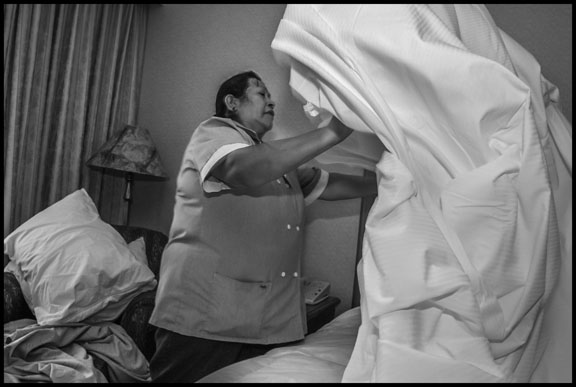
Lupe Chavez, a leader of Local 2, makes up a bed at the Hilton.   


DB:  Some Local Two members are now working in hotels that are being used to house people who were living on the streets.  What are they saying about that?

About two weeks prior to the stay-at-home order, the city told us they were planning a large-scale quarantine operation, using hotels to shelter individuals who couldn't otherwise be isolated.  The first question folks had was, "Am I going to be forced to work?"  They have the right to say no without being disadvantaged or their unemployment benefits cut off. There are folks who opted not to work in that setting, but hundreds of our members are ready and willing. So far, we haven't had to go beyond those who normally work in each hotel to staff them.

Over the phone we worked out an agreement for our members to make sure that anybody in an environment with COVID-positive patients would be protected in every way possible.  We have a number of hotels now set up as quarantine facilities, and that agreement ensures our members get all their PPE and supplies.

In the quarantine hotels, three meals are provided a day, so you have cooks and dishwashers.  A room server delivers those meals but they don't actually talk to patients.  They leave the meal at the door and knock.  Workers clean public spaces, over and over, using enhanced cleaning measures.  Before our members actually enter any rooms, they have to be sanitized by Department of Public Health special crews.

I asked one member, a bellman, how he felt.  He said, "Look, when I get to the hotel everything is fine. They give us what we need, the masks, the gloves.  We get trained by nurses. But I'm scared every day riding the bus to my job. I don't know if I'm going to get the virus and take it back home to my wife and my kids.  That's what scares me."  That really got to me.  There's so much beyond what we can control in an agreement.  

In the first few days of shelter-at-home, we called our entire membership, over 12,000 members, to see how they're doing. We asked if they or somebody they were living with had contracted the virus.  About 30 people said yes, and we've been following up since. A lot of folks have recovered, but one member died.  He worked at the ballpark, and his wife was also on a respirator.

Certainly there are hundreds more that have likely contracted the virus, whether they're symptomatic or not.  We still don't have adequate testing. But we've been demanding on-site testing at quarantine hotels, and it's now available there. 


The hands of a hotel housekeeper.  This is one of several photographs taken during union contract negotiations in 1999, to show hotel operators that making beds with the new thick mattresses took a toll on the hands and bodies of workers.


DB:  What do you expect when shelter-in-place ends?

There's going to be a return to normalcy for a lot of the world, but not for our members.  Tourism has been hit hard and that's going to continue for some time. When business does return, workers must be able to come back to their jobs. The companies will make a case that there's no money.  Our response is that they've done quite well over the last ten years and are not destitute.  They have adequate means to provide health care to workers, to make sure they are safe and secure.  

The crisis has had a real financial impact on the union. Over 90% of our members are laid off and aren't required to pay their union dues.  We're working with our staff on how to put people on workshare for a while.  We told our top rank-and-file leaders that we're strapped, and we expect them to step up.

To a person, our staff and leaders, in their bones, love and believe in this organization.  They're not going to allow it to stumble or perish.  Everybody's committed to making sure we get through this.

I was reading a book on the history of HERE published years ago, called Union House Union Bar.  There's a picture in it from shortly after the 1906 earthquake and fire of the temporary union office.  It's a tent at the corner of 7th and Mission Street. The world has collapsed, everything has burned to the ground, and yet members didn't let their union disappear. They erected a tent and kept the union running.   Ten years later, in 1916, those same members ran a general strike for the 8-hour workday.

We're resilient. It's baked into our DNA.   This moment is a challenge certainly, but I'm confident in our ability to weather this storm and come out stronger.

We're not in control of events - we're dealing with a virus that is indiscriminate and can strike anyone at any time.  But there are things we can control. We can control the fact that we will not lie down and accept peanuts from a company like the Marriott Corporation, because that's what they've offered us.  We're going to be a fighting union coming out of this. We're going to make demands of this industry like we never have before.

Our union has to speak out, not just for members of Local 2, but for all hotel workers in the city, union and non-union.  Nobody else is going to shoulder that burden. It's challenging to do it while we're sheltered.  Once that order is lifted, it'll make things slightly easier, but we've got a long road ahead of us.

Between reopening and our contract expiration in 2022, it's  going to be a period of protracted struggle. We're going to have to fight day in and day out on the shop floor to get back what we had in years past.  Workers everywhere will have to fight to get back what we're losing.    It can be a great opportunity if we come together.  Working people will be spoiling for the chance to fight back. The pandemic profiteers will overreach as they always do.  That's a moment for us. The power of working people in this country could grow in a way we haven't seen in decades, if we seize it and organize and come together.


Hotel workers listen to UNITE HERE Local 2 President Anand Singh explain the terms of the contract settlement ending the Marriott strike before workers vote on it.


After 61 days on the picket lines UNITE HERE Local 2 President Anand Singh explains the terms of the contract settlement ending the Marriott strike before workers vote on it.