Friday, July 5, 2019

THE SOCIAL MOVEMENT PHOTOGRAPHY OF DAVID BACON - THE YEAR CESAR DIED: Rebuilding the UFW

THE SOCIAL MOVEMENT PHOTOGRAPHY OF DAVID BACON
THE YEAR CESAR DIED:  Rebuilding the UFW - March/April, 1994
Photographs and text by David Bacon
The Progressive, 7/2/19
https://progressive.org/dispatches/the-social-movement-photography-of-david-bacon-Peregrinos-190702/


We're delighted to share the fourth of a multi-part series from the archives of photographer David Bacon. This part tells of a march held a year after the death of human rights and labor organizer Cesar Chavez and subsequent rebuilding of the union. Chavez, with Dolores Huerta, Larry Itliong and others, co-founded the United Farm Workers.

A former union organizer, Bacon's thirty years of photographs and writing capture the courage of people struggling for social and economic justice in countries around the world. His images are now part of Special Collections in Stanford University's Green Library.


A year after Cesar died, and we had marched in his memory, I was in Delano again, this time thinking not so much about the UFW's past as about its future.  For a year his death had won some attention for farm workers from mainstream reporters.  But always they saw the union as his personal creation, so their endlessly repeated question was, "Will the UFW survive the death of Chavez?"

I remembered what workers in Cesar's funeral march kept telling me - "We're still here."  Having spent twenty-five years as an organizer, I knew what they were saying:  "We are the union."  The media question was irritating not because the union's future didn't deserve attention, but because the way it was framed made the workers invisible, as though they didn't count.

I'd been hosting a labor interview show for our community radio station for two years by then - the beginning of two decades in front of a radio microphone.  Chuy Varela, our program manager, disliked the media question as much as I did.  So when the UFW announced that it was going to retrace the route of its seminal 1966 march from Delano to Sacramento, he gave me one of the station's battered tape recorders (we recorded on tape in those days), and an old mike on a cable. 

I put my camera strap around my neck, the recorder strap over one shoulder, and the mike and an extra lens in a pocket.  They weighed a ton, especially at the end of a day's marching.  Thankfully cameras and recorders later became digital and much lighter.  But in Delano they helped me discover a way to collect sound and images that stayed with me for many years. 

This method made it possible, not just to be both a writer and a photographer, but to combine transcribed interviews and photographs in a way that was often more powerful than either treated separately.  It led to two books - Communities Without Borders (Cornell University/ILR Press, 2006) and In the Fields of the North/En los campos del norte (Colegio de la Frontera Norte/University of California Press, 2017).

Studs Terkel was my model - I'd often tell people I was just Studs with a camera.  And the first person whose voice and images I tried to put together was Dolores Huerta, who'd known Cesar, married his brother Richard, and worked with union cofounders Larry Itliong and Gilbert Padilla from the very beginning.

Arriving at the UFW's old headquarters at the Forty Acres in Delano, I learned the march would start with a mass, which they often did, and also with another ritual.  In the Catholic tradition, Dolores and the union's new president, Arturo Rodriguez, would wash the feet of the veterans who'd walked in the 1966 march, and who would walk to Sacramento once again. The march itself was called a "pereginacion" and the marchers "peregrinos" - pilgrimage and pilgrim in Spanish.

Knowing the room at the Forty Acres from many meetings over the years, I could see that my fellow photographers were in the wrong place.  As things got underway, I squeezed myself into position so that when Dolores dipped the damp cloth into the water, and then gently wiped the feet of her former husband Richard, I was facing her with the feet and bowl clearly in view.  In the background were the two dozen photographers, whose cameras unfortunately only captured the back of her head. 


Over the years I've taken many more photographs of Dolores Huerta, and interviewed her many times.  Her interactions with other people fascinate me.  The photographs show her reporting about negotiations in the front of a room full of workers, sitting with them and gossiping, or taking a hard line with a grower across a negotiating table.  In interviews she always said what she really thought - no canned messaging - a rare thing in a union leader. 

Washing the feet of those older workers was not just an emotionally moving tribute.  For Arturo and Dolores it was intended to demonstrate the continuity of their leadership with Cesar Chavez, at a time when the union had to change in order to survive.

By1994 the grape strike was 25 years in the past.  The era of many contracts was largely unknown to a new generation of workers in California fields.  A majority were so young that they were only small children when the formative battles of the union were fought.  People joked that to these youth Cesar Chavez was the name of a Mexican boxer, not a union leader.

By the 90s workers were also drawn much more from Mexico's indigenous population than they were in the mid-60s, when the grape strike started.  Most of the Mexicans who walked out in 1965 came from the states of central Mexico, especially Michoacan, Zacatecas, Guanajuato and Jalisco, where the colonial European legacy is strong. 

Starting in the mid-1980s waves of immigrants began arriving from southern Mexico - Oaxaca, and even Chiapas.  Many often didn't speak Spanish, only the indigenous languages of Mixteco, Triqui, Zapoteco  and Purepecha.  Recognizing this shift in demographics, a year before the 1994 march the UFW began a relationship with the Mixtec/Zapotec Binational Front (now called the Binational Front of Indigenous Organizations - FIOB), an organization of indigenous people with chapters on both sides of the border.

Growers took advantage of changing demographics in the fields, with the arrival of migrants with little knowledge of labor rights in the U.S., to lower wages drastically.  They were assisted by Republican governors, who paralyzed enforcement of the state's farm worker labor law, rendering it virtually unusable by workers and the union. 

From 1965 to 1980, the UFW had raised the base wage for field work in California from $1.25 to about $5.50 per hour - at the time more than twice the minimum wage.  Between 1980 and 1994, the field labor wage in California fell backwards.  Taking inflation into account, by the time of the Delano-to-Sacramento march wages hovered around the legal minimum, and often fell below for thousands of workers.  Labor contractors, who assemble crews of workers and then sell their labor to growers, returned to the fields after being virtually eliminated under UFW contracts. 

By the time of Cesar's death things were so bad that farm workers began organizing spontaneous work stoppages to force a change.  In 1989 workers struck the tomato fields around Stockton.  In 1992, 4000 grape workers in the Coachella Valley walked out, and won their first general wage increase in a decade - 40¢ an hour.

When the UFW marched from Delano to Sacramento in 1994, it was making a bid to lead those uprisings.  As the long trail of Chavistas with their red and black flags wound through the fields and small valley towns along State Route 99, workers were its main audience.  As many as 500 a day signed union authorization cards as marchers stopped along the way.

And while the march wound up the San Joaquin Valley, the union sent organizers into the fields in other valleys.  I accompanied two organizers to Salinas, where we went to talk with a crew cutting broccoli for the D'Arrigo Brothers.   The union and the company had been fighting since the first 1969 lettuce and vegetable strike.  The company bitterly opposed unionization, but under the farm worker labor law organizers could "take access" - go into the fields to talk with the workers on their lunch break.

We found several broccoli machines stopped for mealtime.  The women who sorted and packed the broccoli above the conveyor belts climbed down.  As they sat eating the organizers told them about the march to Sacramento.  Several took flags with the union's black eagle and wore them as bandannas.  The men who'd been cutting the broccoli heads in front of the machine, tossing them onto the belt, sat down to eat in the rows.  They too listened to news of the march, and stuck union buttons on their hats. 

There was little fear.  I learned later that a union committee, organized in the 1969 strike, had been functioning in the company ever since.  "We have to go back to the tactics we were using when we first built the union, in the sixties and seventies," Dolores told me when, back at the march, I described what I'd seen and photographed. 

Passing through Stockton and Lodi, the march grew from a couple of hundred participants to 5000 as it approached Sacramento.  It finally became a sea of fifteen thousand people as it reached the state capitol on the last morning.  And although supporters arrived by the busload from cities in the Bay Area and Los Angeles, it was overwhelmingly a march made up of farm workers.  

At the rally at the end of the march, the union announced that it had affiliated the United Farm Workers of Washington state, whose leaders shared the platform in Sacramento.  The union in Washington had been locked in a years-long struggle with Chateau St. Michelle winery. The affiliation bore fruit a year later, when the winery agreed to an election that the union won.  With the help of skilled organizers, workers then negotiated a first contract, which has been in place ever since.

In the months that followed the arrival of the peregrinos the union received the certification to negotiate with a number of companies in California.  Dolores credited the march with creating the pressure that finally ended the paralysis at the labor board.  In the year that followed the Sacramento march, the union won eight elections to represent farm workers, and negotiated contracts covering 3700 workers.

After the Delano-to-Sacramento march the UFW also began organizing marches to protest Proposition 187 in small valley towns throughout the state.  Proposition 187 would have prohibited education and medical care for undocumented immigrants, and forced public employees, from teachers to librarians, to turn the undocumented in to immigration authorities for deportation. 

According to the U.S. Department of Labor, a majority of all farm workers in this country are undocumented, and the percentage is higher in California.  A majority of UFW members are therefore undoubtedly themselves undocumented (although the union doesn't ask).  Proposition 187 would have therefore affected the UFW and its members more than any other union in California.

Few of them can vote, however, because they are not citizens.  "Even though they can't vote, they can still go out and knock on doors and talk to people who can," Dolores explained.  To mobilize its members, "in every single town where we have a union office we organized a march." 

In Stockton the march involved over a thousand tomato workers who were fighting for a contract. At the world's largest rose company, Bear Creek, whose fields have supplied flowers to California cities for over a century, workers decided to participate as well.  "We just got angry at the injustice of it," one of their leaders, Daniel Sanchez, told me.  "That helped make us strong enough to organize." Like workers at D'Arrigo Brothers, they formed union committees, and eventually won an election and negotiated a union contract.

Generating anti-immigrant hysteria through Proposition 187 was the key to the successful election strategy of Republican Governor Pete Wilson.  For a time that hysteria kept Republicans in power in Sacramento. Even San Joaquin Valley Democrats who supported 187 lost in that election.  "Why vote for a fake Republican if you can get a real one?" Dolores asked bitterly.

But in the years that followed, Proposition 187 became the Republican Party's undoing.  Immigrants holding green cards flocked to citizenship classes.  In rural districts they and their citizen children became a new force in California politics.  Democrats retook the San Joaquin Valley's Congressional seats.  In the state legislature, Latino elected officials, some of them from farm worker families, led the effort to win overtime protection for agricultural laborers, 80 years after they'd been excluded from Federal labor standards.

A new law put teeth into the Agricultural Labor Relations Act a decade after the 1994 march, requiring the mandatory mediation of first-time contracts where workers vote for union representation.  The union used it to negotiate agreements with the tomato companies where workers had struck in 1989.  Even D'Arrigo Brothers decided to make peace with the union, and agreed to a contract in 2015, after decades of labor conflict.

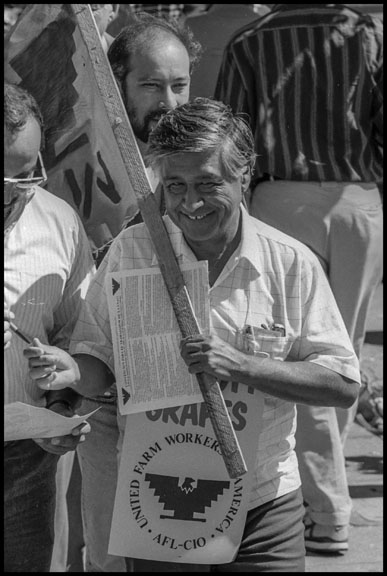
So Cesar's death and the march a year later did turn out to be watershed moments for the United Farm Workers.  And the photographs of the faces of the marchers, and the workers on the broccoli machines, document what they felt at that critical moment. 


Veterans of the 1966 march from Delano to Sacramento


Dolores Huerta and Martin Sheen, before the 1994 march begins


Dolores Huerta, with Arturo Rodriguez holding the carafe of water, washes the feet of Richard Chavez


Fred Abad and Pete Velasco, Filipino veterans of the United Farm Workers, and the Agricultural Workers Organizing Committee in the years before the UFW


Arturo Rodriguez and Dolores Huerta


The 1994 march leaves Delano, as reporters converge on marchers to get interviews


D'Arrigo Brothers workers cutting and packing broccoli


Two UFW organizers walk into a D'Arrigo Brothers broccoli field


An organizer talks with broccoli cutters on their lunch break


An organizer talks with a worker with a union button on her cap


The marchers on State Route 99


UFW President Arturo Rodriguez talks with a class from a school in Atwater, where the marchers have stopped for a break


A priest says mass in the morning before marchers start from Merced.


A marcher outside of Sacramento


A tired Dolores Huerta in Sacramento, as the march reaches its end after a month


Arturo Rodriguez, Dolores Huerta and other UFW leaders are accompanied by (then) former governor Jerry Brown


Veterans of the 1966 march, who also marched all the way from Delano in 1994, wear the wooden cross that means they've walked the whole way


Marchers in Sacramento


Marchers head for the state capitol building


Filipino community organizations from the Bay Area came to Sacramento for the conclusion of the march


Thousands of marchers and UFW supporters in front of the capitol building


In Salinas a D'Arrigo Brothers worker gets off work, ready to join a rally to demand a union contract


D'Arrigo Brothers workers, after the 1994 Sacramento march, are inspired to march to the office of the company to demand a union contract


D'Arrigo Brothers workers show their support for the union.  It took another ten years before they finally won their first union agreement, but the union committee kept pressure on the company for all that time.

Monday, July 1, 2019

THE HIDDEN HISTORY OF THE ARNAUTOFF MURAL

THE HIDDEN HISTORY OF THE ARNAUTOFF MURAL
By David Bacon
The Stansbury Forum, 6/28/19
https://stansburyforum.com/2019/06/28/the-hidden-history-of-the-arnautoff-mural

I respect the feelings of the students who testified at the San Francisco Board of Education meeting about the mural at George Washington High School, and their desire to have their communities and histories treated in a respectful way.  They deserve, not just respect, but solidarity in fighting the pervasive racism and exploitation in our society.  The mural was painted in solidarity with that fight.  I think it is a mistake, therefore, to interpret it as a symbol of colonialism, white supremacy and oppression.

The mural was created in 1936 by Victor Arnautoff, a Russian immigrant and a Communist, who painted it as a critique of the racist boosterism that was the way high school history was taught in that era (even when I was in high school in the early 60s).  The 1930s were the years when the left and the Communist movement were strong in San Francisco.  These were the years of the General Strike of 1934, which broke the color line on the docks - the reason the longshore union created in that strike, Local 10 of the ILWU, is a majority-African American union today.  These were the years of the organization of the Chinese Workers Mutual Aid Association in San Francisco, many of whose members belonged to the Communist Party. 

Arnautoff belonged to the Communist Party as well.  In that party African American and white longshore and Chinese laundry and garment workers and red painters like Arnautoff would have undoubtedly known each other and talked about the politics they shared.  Fighting racism and class exploitation, and supporting revolutionary movements against imperialism, was the common ground among those radicals - the basis of their politics.  For an artist like Arnautoff, painting was therefore a political act, a responsibility to oppose racism and class exploitation in the art he produced.

The mural he painted in the high school was a critique of earlier murals produced for the Pan American Exposition, an imperialist celebration and world's fair on Treasure Island, paid for by San Francisco's wealthy elite.  That "official" artwork showed California history as the advance of "civilization" triumphing over "savagery."  The Admiral Dewey statue in Union Square, celebrating the colonization of the Philippines, was the same kind of art produced in that earlier era.  An even uglier example is the art shown in the Forbidden Book, a book and exhibition of racist and imperialist cartoons collected by Abraham Ignacio and published a few years ago.  This is what Arnautoff was reacting against.  When the WPA, that is, the New Deal, began paying unemployed artists, it meant that artwork could be created that didn't have to please the Crockers and other elite San Francisco families, and could therefore tell the truth about U.S. history.  Arnautoff's murals were a product of that short-lived political space. 

When the mural shows the grey hordes of settlers advancing past the body of a dead Native American, it was a powerful truth for that time, especially because these settlers are being urged onward by George Washington.  The school was named for Washington, so Arnautoff's message to students was to take a hard look at who he was.  Showing that the wealth is being produced by Black slaves, for the rich white colonial merchants who owned them, is telling the truth again.  It doesn't glorify slavery - it attacks it, and even more important, it shows who got rich from it.  Washington was a plantation slave-owner.


Two sections of the Arnautoff mural at George Washington High School.

The mural shows Native Americans with arms, which is also an historical truth - that many Native people fought against the American Revolution because they had suffered massacres by the settlers.  In this depiction, Arnautoff goes beyond the radical murals of Anton Refregier in the Rincon Annex post office.  Refregier shows native people doing the work for a California mission, with the Spanish padre who enslaved them in the background.  That in itself contradicted the stereotype of the missions as happy places that brought European religion and culture to native people (for which Father Junipero Serra was recently beatified, when he should have been condemned). 

But Arnautoff goes further.  He shows native people as active resisters to colonization, in their war dress, ready to battle the settlers.  Such resistance was the key to survival.  Indigenous historian Roxanne Dunbar Ortiz, speaking of this resistance in California, says, "Without this resistance, there would be no descendants of the California Native peoples of the area colonized by the Spanish." 

Exposing the resistance by both slaves and native people to the rebelling colonists in the American Revolutionary War is not just correcting history, but helps understand the present.  Marxist historian Gerald Horne, in "The Counter Revolution of 1776", charges, "Despite the alleged revolutionary and progressive impulse of 1776, the victors went on from there to crush indigenous polities, then moved overseas to do something similar in Hawaii, Cuba, and the Philippines, then unleashed its counter-revolutionary force in 20th-century Guatemala, Vietnam, Laos, Cambodia, Indonesia, Angola, South Africa, Iran, Grenada, Nicaragua, and other tortured sites too numerous to mention."

Arnautoff studied with Mexican muralist Diego Rivera, who came to San Francisco twice in the 1930s.  His work, including the murals at the City College of San Francisco and the San Francisco Art Institute, inspired Arnautoff and his generation of muralists to inform their work with social criticism, as Rivera did. 

Arnautoff painted a critique of George Washington because of that history of slavery and genocide, so you can imagine how much opposition there was to it.  It was the art of social realism, the same approach to art by artists in China and the Soviet Union after those revolutions, when artists believed that art had to take sides with workers and oppressed people, and tell social truth.  Many artists who created socially committed art in the U.S. were later blacklisted in the 1950s for what was then called "subversive" art.  That kind of art was suppressed - you won't find it in the San Francisco Museum of Modern Art. 

Arnautoff belonged to the American Artists Congress, which was put on the Attorney General's list of banned Communist/subversive organizations, and the San Francisco Artists and Writers Union.  At the height of the Cold War in the 1950s he was called before the House Un-American Activities Committee.  This was not long after the Committee sent ten screenwriters to prison for their radical politics, and the Hollywood blacklist denied work to many more.  Arnautoff had a job teaching art at Stanford University and rightwing politicians tried to get him fired, which Stanford refused to do.  At the end of his life Arnautoff returned to the Soviet Union, where he continued his work as an artist, and died in Leningrad.

The school district, which is responsible for the mural, should have taught students about its politics - who it was defending and who it was attacking.  If the students weren't aware of this history, it's in part because the school district didn't do its job.  Maybe it was afraid of the work's radicalism, or simply didn't know or understand the mural itself.  The left in the Bay Area should also be self-critical for not having talked more about the mural and its message, helping to make students and their communities feel like they were being defended, rather than being alienated by the work, as so many said in their comments to the school board.

But painting over the mural doesn't redress the historical crime that the mural shows - if anything, it covers up the critique of it, a goal the McCarthyites and their committees were never able to achieve.  Painting it over robs the students themselves - of the chance to discover and evaluate for themselves this history of struggle in the arts, of the chance to appreciate progressive art that tells the truth about our history, and of the chance to respond by making art and critiques of their own.  If students are critical of Arnautoff himself, and point out blind spots he had, I'm sure he would have liked the idea.  He certainly didn't consider his work some untouchable sacred object, but a tool to move forward the fight against racism and class exploitation, a fight in which he stood up for justice.

Wednesday, June 19, 2019

THE SOCIAL MOVEMENT PHOTOGRAPHY OF DAVID BACON - THE YEAR CESAR DIED: Cesar's Funeral March - April, 1993

THE SOCIAL MOVEMENT PHOTOGRAPHY OF DAVID BACON
THE YEAR CESAR DIED:  Cesar's Funeral March - April, 1993
Photographs and text by David Bacon
The Progressive, 6/19/19
https://progressive.org/dispatches/the-social-movement-photography-david-bacon-the-year-cesar-died-190619/


We're delighted to share the third of a multi-part series from the archives of photographer David Bacon. This part tells of the funeral march for human rights and labor organizer Cesar Chavez, April, 1993. Chavez, with Dolores Huerta, Larry Itliong and others, co-founded the United Farm Workers.  The next part will include images of the rebuilding of the union in the year after Chavez' death.

A former union organizer, Bacon's thirty years of photographs and writing capture the courage of people struggling for social and economic justice in countries around the world. His images are now part of Special Collections in Stanford University's Green Library.


I drove down to Delano the night before Cesar's funeral with my wife Lillian and my daughter Miki, who must have been four.  Lillian was one of the Filipina students who worked on building the Agbayani Village retirement housing, for her father's generation of Filipino farm workers, the manongs. 

The kitchen in the Village was just shutting down as we got there.  The manongs were gone by then of course.  A young man coming from the islands in the 1920s would have been in his nineties by the time Cesar died.  Their lives were too hard for anyone to survive to that age, working in the fields of the Pacific coast.  The union built the Village for them in the 1970's, and it had given them a place to stay once they couldn't work any longer.

We looked at what the students had built twenty years earlier, and then slept in the car.  In the morning we headed into Delano to meet up with the people gathering for Cesar's funeral march.  Even as early as six, men and women were already standing in the dusty dawn with their children, waiting for it to start.  Everyone carried flags with the union's black eagle - some adding "Arizona" or the name of some other state they'd arrived from.

I didn't want to take photographs of the funeral service at the Forty Acres .  It was too formal, and there were plenty of photographers there to do that anyway.  Instead, I began taking pictures of the people as they gathered.  Then the march started.  Following the young people carrying Cesar's plain pine coffin, we all walked through Delano and up the Garces Highway to the union's old headquarters on the Forty Acres a mile outside of town.

There were notable people, like Jesse Jackson, at the head of the march.  But most important folks were already waiting in the huge tent where the service would be held.  The hundreds of people marching in the dust along the highway were almost all farm workers and their families. 

I wanted to see and understand through taking the photographs how people felt and how they reacted to Cesar's death.  There were certainly people overcome with emotion, crying as they walked or stood in the April sun.  But most walked and talked as they might have in any other march.  Stoicism, restraint, determination - that's what I saw on their faces and what showed in the photographs.

Alfredo Figueroa and his daughter Carmela brought guitars and a huge banner, proclaiming Blythe and the Palo Verde Valley the "valle de puro triunfo" (the "valley of nothing but victory"). Alfredo claimed the union had never lost a campaign in his desert community next to the Colorado River.  Having been an organizer there, sleeping on the floor of the school he organized, I know the claim is true.

In some ways the photos were a tribute to those years I spent as an organizer for the United Farm Workers in the 1970s.  I took them with the same spirit of concentration on the workers that I remembered from those times when Cesar went with me to the fields, to visit crews I was organizing.  He always made a point of showing workers (and the organizers) that workers had the first claim on his attention.  Even if I had some urgent question I had to discuss, he'd cut me off and turn to a woman in the grape vines trying to get a moment to speak with him.

For thousands of farm workers Cesar was more than just a symbol.  He was the leader of the movement to which they'd given a good deal of their lives.  But his death and the march came at the end of a long period in which the union had lost most of the contracts won at its height in the 1970s.  And Cesar had made enemies of many people who'd given their lives to build the union.  While the bitterness was fresh enough to keep some away, others came despite it.

Alfredo, who'd known Cesar's family long before the union started, came as much to recognize his own history as he did to honor Cesar's.  For most of the people on the march, recognizing Cesar's passing was a way to pay tribute to him as a person, but also to the movement they built together.  I heard many people say, "Cesar is gone, but we are still here.  The union is still here."

When I took the photograph of Lillian and Miki in front of the memorial set up by Delano's Filipino community, it had that message.  Many Filipinos were antagonized by Cesar's trip to the Philippines while Ferdinand Marcos was still dictator, and felt sidelined in the union itself.  Yet recognizing Cesar at his funeral was also a way of recognizing themselves, and the contributions they'd made, going far back to years long before the great grape strike of 1965-70.

The United Farm Workers was and is the product of a social movement, and Cesar would have been the first to say so.  He was not the single author of the boycotts or the strategic ideas the union used in fighting for its survival.  No one person could have been, because they evolved as the responses of thousands of people to the age-old problems faced by farm worker unions for a century - of strikebreaking, geographic isolation, poverty and grower violence.  That movement produced other leaders - women like Dolores Huerta and Jessica Govea, Filipino labor leaders Larry Itliong and Philip Vera Cruz, African American Mack Lyons and many white organizers from the civil rights and student movements of the day.

In the years since the first grape strike in 1965, farm worker unions have grown to over a dozen, in Washington, Oregon, Arizona, Texas, Ohio, North Carolina, Connecticut, Florida, New Mexico and Pennsylvania, in addition to California.  To one degree or another, all draw inspiration from the movement that started in Coachella and Delano.  When workers walked out at Sakuma Farms in Washington in 2013, forming their new union Familias Unidas por la Justicia, and then spent four years striking and boycotting to get a contract, they were using lessons farm workers learned in Delano in 1965. 

The year before Cesar died, five thousand workers struck the grape fields of Coachella, winning the first wage increase they'd had in a decade.  Every year spontaneous work stoppages like it, although perhaps not on that scale, take place in U.S. fields.

A union that doesn't lead and organize the anger that produces those job actions becomes irrelevant to workers.  Organizing depends on taking that anger and need, and transforming it into a powerful economic weapon.  And any union depends on organizing to survive.  If there's inspiration to be drawn from Cesar's example, it is that this can be done.  The social movement sparked half a century ago is still capable of transforming life for farm workers, and in the process, much of the rest of our world as well.

That was the possibility that I saw on the faces, and heard in the voices, of the people marching at Cesar's funeral.  It is what I still see in those photographs I took then, and in the ones I take today.

The following are a selection of the images.  For a full set, click here.


Farm workers and their families, joined by Jesse Jackson, wait for the march to start.


Young people hoist Cesar's plain pine casket onto their shoulders, and carry it at the head of the march.


Children and mothers walking up the Garces Highway.  Some came with a group of Aztec dancers, and danced as they marched.


Alfredo and Carmela Figueroa came from Blythe, carrying their guitars, and sang the songs of the farm worker movement as they walked.


Some workers carried irises which they handed out to other marchers.  Lillian holds a tired Miki in her arms as she stands in front of the Filipino community's memorial to Cesar.


Cesar Chavez in San Francisco and Delano, 1989 and 1991

Thursday, June 13, 2019

DETENTION, DEPORTATION, INCARCERATION AND THE BORDER

DETENTION, DEPORTATION, INCARCERATION 
AND THE BORDER
Images from Bay Area and Los Angeles Activist Photographers


Silicon Valley De-Bug's Class Conscious Photographers presents images that shine a light on the impact on our communities of the incarceration of people, whether in prisons or in immigrant detention centers, and the deportation of migrants and the border itself.

Advocating for social change is part of a long tradition of social documentary photography in the United States and Mexico, and the work of the photographers in this show contributes to this tradition today. We are activist photographers, participants in the movements for social justice. These movements are the subject of our photographs, which have a role in helping our movements grow.

Photographers:
Brooke Anderson, David Bacon, Richard Bermack, Charisse Domingo, Najib Joe Hakim, Stacy Johnson, RJ Lozada, Jean Melesaine, Abraham Menor, Ronald Orlando and Leopoldo Peña

Asian Resource Gallery
310 8th St,
Oakland, CA 94607

June 5 - August 31, 2019?
Artist reception: Friday, June 28, 6-8PM


This exhibition is a project of Class Conscious Photographers/Silicon Valley De-Bug, curated by Greg Morozumi and East Side Arts. It is supported by the East Bay Asian Local Development Corporation, and cosponsored by Guild Freelancers, a unit of Pacific Media Workers Guild - CWA Local 39521, the National Network for Immigrant and Refugee Rights, and the Interfaith Movement for Human Integrity.

IF SAN PEDRO SULA IS MURDER CAPITAL OF THE WORLD, WHO MADE IT THAT WAY?

IF SAN PEDRO SULA IS MURDER CAPITAL OF THE WORLD, WHO MADE IT THAT WAY?
By David Bacon
The American Prospect, June 13, 2019
https://prospect.org/article/if-san-pedro-sula-murder-capital-world-who-made-it-way

Refugees flee this Honduran city, which has long been a vast, American-owned sweatshop.


Women and children in one of the poorest barrios of San Pedro Sula.


A 30-second search on the internet produces at least two dozen stories from U.S. newspapers and other media about San Pedro Sula in Honduras. "Honduran City is World Murder Capital," announces Fox News. Business Insider calls it "the most violent city on earth."  In an attempt to explain the motivation for migrant caravans traveling to the U.S.-Mexico border, NPR labels it "one of the most violent cities in the world."

This wave of media attention has been going on for at least half a decade, as tens of thousands of Hondurans arrive at the border seeking refuge. President Trump's rhetoric portraying the caravans as a threat has focused even more attention on this Honduran city.

Fear of violence is a completely legitimate reason for leaving home and making the dangerous journey north. Violence and gangs, however, are often presented by U.S. media as the only explanation for the exodus of Hondurans from this metropolis. Yet more than a century of history connects the city with the United States, in a close but unequal, and usually abusive, relationship, at least for Hondurans.

Over that time, San Pedro Sula has been the capital of banana exports, a city wracked by war and death squads, and a factory town for the garment industry. Most recently, it has become a community hit by deindustrialization as hard as any textile town in New England. The media almost always ignores this history, yet it is this long relationship that has produced the migration with which the media seems obsessed.

That "murder capital" narrative, however, is being challenged increasingly by U.S. organizations calling for a deeper look. Some of them started as defenders of migrants incarcerated in U.S. detention centers, and now seek to clarify the root causes of migration as a way to support migrants and their home communities.

A recent four-page spread in The New York Times Magazine described in detail the lives of young people in San Pedro Sula's Rivera Hernández neighborhood. Its author, Azam Ahmed, explained to readers that he wanted to "bear witness," "to capture just how inescapable the violence was," in the context of "tens of thousands fleeing the region." Honduras's state of crisis, he wrote, is a result of "warring gang factions."

Accompanying the article were Tyler Hicks's dark photographs of gang members, their faces wrapped in bandannas, one holding his gun loosely by his side. Both text and images present these young people as the "other"-a vision to frighten comfortable middle-class readers with what seems an inside look into an alien and violent world.

The Timespiece is only the latest of many that paint this picture. Four years ago, Juan José Martínez D'Aubuisson wrote an even longer article about the same neighborhood. Pastor Daniel Pacheco arranged the meetings with the gangs, as he did for Ahmed and Hicks. That article, appearing in InSight Crime, concluded: "The violence here is difficult to understand. ... The people live with the violence without thinking about it, like how the Eskimos spend their days without thinking about the snow that surrounds them."

Steven Dudley, InSight Crime's co-founder and a former bureau chief for the Miami Herald, at least acknowledged the link between violence in San Pedro Sula and U.S. deportation policy. "Gangs' emergence in the mid-1990s," he wrote in another article, "coincided with state and federal initiatives in the United States. ... The number of gang members deported quickly increased, as did the number of transnational gangs operating in [Central America]. ... With the deportations, the two most prominent Los Angeles gangs-the Mara Salvatrucha 13 and the Barrio 18-quickly became the two largest transnational gangs."

Some 129,726 people convicted of crimes were deported to Central America from 2001 to 2010, 44,042 to Honduras. U.S. law enforcement pressured local police in the region to adopt a "mano dura," or hard-line approach to them. Many young people deported from the U.S. were incarcerated as soon as they arrived. Prisons became schools for gang recruitment.

The Trump administration argues today that violence is not a basis for an asylum claim by refugees at the border, but this and previous U.S. administrations have cited that violence as a threat to Americans. When Marine Corps General John Kelly was commander of the U.S. Southern Command under President Obama, before his stint in the Trump White House, he framed Central American migration as a national-security threat, calling it a "crime-terror convergence." And the gangs and violence became a justification for U.S. funding of the Central American Regional Security Initiative, which supplied $204 million to the corrupt Honduran government for army and police in 2016-2017, and another $112 million for economic development.

There is indeed violence in San Pedro Sula. But that violence has a long history, and is intimately tied to the city's relationship with the U.S. That relationship is so close that the most basic decisions affecting the lives of its residents have often been made by powerful Americans.


A young driver of a rig bring down goods from the San Pedro Sula factories shows that the tread on his tires has worn so thin that the metal belt is exposed.


The first was Samuel Zemurray, who founded the Cuyamel Fruit Company, and eventually became the head of United Fruit (which we know today as Chiquita Banana, or formally, Chiquita Brands International). A Russian immigrant who settled in New Orleans, Zemurray started as a banana importer in 1898, and then in 1910 bought 5,000 acres along the Cuyamel River, near the small town of San Pedro Sula, which he made the headquarters of his banana empire.

When the Honduran government wouldn't give him land concessions and low taxes, Zemurray hired mercenaries, Guy "Machine Gun" Molonyand Lee Christmas. In 1912,they overthrew the president, and installed Manuel Bonilla in his place. Zemurray developed the port of Puerto Cortes, 30 miles from San Pedro Sula on the Caribbean coast, to handle his cargo, and a railroad to connect them. He ruled every aspect of the lives of the people in the region, leading the U.S. embassy to call his holdings "a state within another state."

Successive Honduran governments protected Cuyamel, and, in its later incarnation, United Fruit. Banana workers organized a strike in 1920, and the U.S. sent a warship to put it down. In 1932, General Tiburcio Carías Andino outlawed strikes, and for good measure, the Honduran Communist Party. Despite the repression, however, Hondurans organized one of the most active labor movements in Central America, starting on the banana plantations.

Zemurray became known as the "banana king," with huge investments throughout Central America backed by Lehman Brothers and Goldman Sachs. In U.S. politics, Zemurray was a liberal, supporting the New Deal and even The Nation magazine. His investments were threatened, however, when Jacobo Arbenz was elected president of Guatemala in 1951, promising land reform. Zemurray then hired pioneering public-opinion manipulator Edward Bernays to convince the U.S. Congress that Guatemala had become a Soviet "threat," and Arbenz was overthrown in a CIA-orchestrated coup.

A succession of generals governed Honduras from 1963 to 1981, taking bribes from United Fruit and tolerating the growing drug trade. At the end of that period, during the presidency of Ronald Reagan, the United States began using the country as a base to fight to overthrow the Sandinista government in Nicaragua, and to train the Salvadoran army to defeat the Farabundo Marti Front for National Liberation (FMLN) in El Salvador's civil war.

Honduras had its own small guerrilla movements, like the others challenging landed elites and their U.S. partners throughout the region. In September 1982, leftist guerillas took 100 businessmen and government officials hostage for eight days in San Pedro Sula. For its part, the government sponsored death squads in San Pedro Sula and Tegucigalpa. U.S. Senator Tom Harkin accused the CIA and U.S. military advisers of organizing Battalion 316, which was responsible for murdering and "disappearing" more than 150 leftists and trade unionists from 1981 to 1984, one of them an American Jesuit priest, James Carney.

The point person for U.S. policy in Honduras was Ambassador John Negroponte, who'd been a political officer in Vietnam during the Vietnam War. According to a 1982 Newsweek article by John Brecher, John Walcott, David Martin, and Beth Nissen, "Negroponte forged close ties with powerful Hondurans, especially the commander of the armed forces, Gen. Gustavo Adolfo Alvarez. ... 'They discuss what should be done, and then Alvarez does what Negroponte tells him to,' a member of the military high command said matter-of-factly."

Hondurans didn't accept these policies passively. Some 40,000 people demonstrated in San Pedro Sula against the U.S. "contra war" in next-door Nicaragua, and another 60,000 in Tegucigalpa. Opposition grew so strong that after elections were re-established, President José Azcona Hoyo ordered the "contras" to leave in 1988.

As the Central American wars ramped up, Honduras opened its first industrial free-trade zone in 1976. Beginning in the late 1980s after the wars ended, the U.S. Agency for International Development initiated a large program to develop export processing zones in San Pedro Sula.

USAID financing paid for road construction, sewers, buildings, transportation, and the basic infrastructure for manufacturing. U.S. companies were then wooed to either invest directly in building plants themselves, or guaranteeing work to contractors to operate factories for them. By the 2000s, the country had become the fifth-largest exporter of clothes to the United States, and the biggest in cotton socks and underwear. That production was concentrated in San Pedro Sula, which became the industrial heart of Honduras. The goods were shipped out through Puerto Cortes.


Carol Vasquez, daughter of Hector Vasquez, an owner-operator and leader of job actions by the Honduran port truckers' union.


San Pedro Sula became a factory town. Lining its main arteries were roughconcrete buildings housing enterprises that sewed garments, packed shrimp, or ran injection molding machines churning out plastic parts. At shift change, young women streamed through the gates, while men piloted the trucks carrying containers of merchandise to the nearby docks in Puerto Cortes.

One of San Pedro Sula's workers, Claudia Molina, came to the U.S. in 1995 to describe conditions in the plants. "Our work day is from 7:30 a.m. to 8:30 p.m.," Molina told me in an interview, "sometimes until 10:30, from Monday to Friday. On Saturday we start at 7:30 a.m. We get an hour for lunch, and work until 6:30 p.m. We take a half hour again to eat, and then we work from 7 p.m. until midnight. We take another half hour rest, and then go until 6 on Sunday morning. Working like this I earned 270 lempiras per week [about $30 at the time]."

Molina worked for a company, Orion, that sewed garments for big U.S. clothing lines. On June 10, 1995, a company security guard shot a worker three times in the head. He'd gone into the plant without an ID card to collect his paycheck. Workers stopped work. "We demanded that the company give the worker's family the pay they owed him, and that they recognize our union," Molina recalled. Instead, Orion fired more than 600 people.

Many factories had a company doctor to see to it that workers didn't qualify for disability payments, she charged. As well, the U.S.-owned companies in San Pedro Sula were intensely preoccupied with the sex lives of young women workers. At Orion, the doctor handed out contraceptives. Distribution of birth control pills in factories was not motivated by a concern for the reproductive rights of the women workers, however, but by the companies' desire to keep women working on the production lines.

Price Waterhouse, the large U.S. accounting firm, got two U.S. government contracts to evaluate USAID programs, and to identify problems hindering the growth of the plants in San Pedro Sula. These studies, in October 1992 and May 1993, identified the main problem faced by employers as a potential labor shortage, which would exert an upward pressure on wages. Fifty factories in Honduran free-trade zones employed 22,342 workers by March 1992. Price Waterhouse predicted that 287 factories would soon employ 105,000. Consequently, "EPZ's labor demands could not be met by natural population growth." The most important way to solve labor needs, it said, was through "an increase in the labor participation rates of young women," that is, by drawing more young women into the workforce and keeping them there.

At the time, women made up 84 percent of the workforce in Honduran maquiladoras, over 95 percent of them younger than 30, and half younger than 20. They were at the point in their lives where most wanted to begin their own families. Price Waterhouse noted with disapproval that "the pregnancy rate among women of childbearing age was 4 percent in June 1992, up from 2.5 percent six months earlier. This is regarded as too high (3 percent would be the maximum acceptable)."

To keep women from getting pregnant and leaving the factory to have children, USAID funded the Honduran Association for Family Planning, which established "contraceptive distribution posts staffed by nurses in three EPZ factories: Monty, and Hanes ... and MAINTA (OshKosh B'Gosh)." As the companies began to run out of girls in their late teenage years, younger and younger girls were drawn into the plants. One study featured a table showing that children between 10 and 14 made up 16 percent of the women either employed or seeking jobs. A footnote claimed "the legal minimum working age in Honduras is 15, but in the rural economy it is normal to work from ten onwards."

In 2005, the U.S. and Central American governments negotiated a free-trade agreement to protect the rights of foreign investors in economies based on exports to the U.S. When the Central America Free Trade Agreement came up for a vote in the U.S. Congress, supporters claimed it would produce jobs in maquiladoras and slow down migration. Honduran social movements wouldn't drink the Kool-Aid, however. When the Honduran Congress took up ratification, more than a thousand demonstrators filled the streets of Tegucigalpa, angrily denouncing the treaty. After the Congress ratified CAFTA anyway, the crowd was so angry that terrified deputies fled.


Erasmo Flores, president of the union for Honduran port truckers, talks with drivers and union members about their workplace problems.


"We chased them out, and then we went into the chambers ourselves," said Erasmo Flores, president of the Sindicato Nacional de Motoristas de Equipo Pesado de Honduras (SINAMEQUIPH), the union for the port truckers of San Pedro Sula and Puerto Cortes, in an interview. "Then we constituted ourselves as the congress of the true representatives of the Honduran people, and voted to scrap Congress's ratification." While admittedly an act of political theater by the left-wing Bloque Popular, the protest showed how unpopular the agreement was in Central America among workers and farmers-those people most likely to become migrants.

In November of that year, progressive Honduran parties finally elected a president, Manuel Zelaya, a rancher in a cowboy hat. They couldn't stop implementation of CAFTA, but Zelaya announced a program of economic and social reforms, including raising the minimum wage, giving subsidies to small farmers, cutting interest rates, and instituting free education. All of these were measures that, by raising living standards, would have given people a future at home in Honduras. But in 2009, Zelaya was overthrown by the military and put on a plane out of the country. After a weak protest, the Obama administration gave de facto approval (and more military aid) to the coup regime that followed.

If the social and political change that Zelaya was beginning had been allowed to continue, fewer Hondurans would be trying to come to the U.S.

CAFTA also required privatization of state-owned assets to create investment opportunities for foreign corporations. Honduras's General Union of Dock Workers twice beat back government efforts to privatize the docks of Puerto Cortes, mobilizing the whole town in the process. "We put our union's assets, like our soccer field and clinic, at the service of the town," said Roberto Contreras, a union officer and Honduran representative for the International Transport Workers' Federation, in an interview. "When the government tried to privatize our jobs, we told people that if we didn't cooperate to defeat it, the whole town would lose, not just the port workers."

Despite this opposition, the coup government that replaced Zelaya finally did privatize the shipping terminals in Puerto Cortes in 2013, and gave a contract to a company from the Philippines, ICTSI, to run them. As an incentive, it gave the company the freedom to fire workers who belonged to the union. When dockworkers saw newly hired laborers in jobs they'd done for generations, they protested. The government sent in the army and arrested 129 of the protestors, charging them with "terrorism." Attackers broke into the home of the union's general secretary, Victor Crespo, and a truck mysteriously hit and killed his father in front of their home. Crespo had to leave the country.

By 2006, San Pedro Sula had half a million inhabitants, working in more than 200 factories. By 2011, it was generating two-thirds of Honduras's GDP. Nevertheless, the country remained one of the poorest in Latin America, with the greatest income inequality. Hurricane Mitch had already devastated the banana plantations in 1998. Garment production began to decline after the U.S. recession hit in 2008, and plants relocated to countries where labor costs were even cheaper.

According to the Center for Economic and Policy Research, the coup against Zelaya and the U.S. recession had devastating impacts on Hondurans. The post-coup government of Porfirio Lobo reduced social spending. By 2012, 66 percent of Hondurans lived in poverty, and 46 percent in extreme poverty. Unemployment went from 6.8 percent in 2008 to 14.1 percent in 2012, while the number of people working full time for less than the nation's minimum wage (86 cents per hour in 2014) went from 28.8 percent to 46.3 percent.

As a migration-preventing strategy, CAFTA and the poverty-wage economic model imposed on San Pedro Sula was a bust. In 2014, the U.S. Border Patrol apprehended 90,968 Honduran migrants at the border. That number fell in 2015 to 33,445, and then went up to 52,952 in 2016 and 47,260 in 2017,when the number of people detained while traveling with children reached 39,439.

Blaming the wave of migration on violence, however, is too simple. From 2011 to 2017, the number of killings in Honduras actually dropped, from 87 per 100,000 to 44. Pastor Daniel Pacheco told Los Angeles Times reporter Kate Linthicum, "I can ask them to leave the gang, but I don't have anything else to offer them. Even if they graduate high school, they can't get a job."

Soon, going to school, or getting medical attention for their injuries, will become more difficult. On May 2, Radio Progreso in San Pedro Sula exposed an agreement between the Honduran government and the International Monetary Fund calling for cuts in the budget for education and health care.The story predicted that cuts will include the firing of teachers and health-care workers and less money for buying medicine.

The IMF, in which U.S. representatives often decide policy, demanded that the government hand over administration of public hospitals to private foundations, and that it privatize the state-owned electricity and telephone companies. Radio Progreso noted that "these enterprises are experiencing firings and the reduction of their budgets."


Longshoremen load a container of goods from San Pedro Sula factories onto a ship bound for the U.S.


Conditions for women still working in San Pedro Sula's factories have deteriorated as well, leading the Collective of Honduran Women to organize an Occupy-style "planton," or encampment, on May Day. The group denounced the government for approving rising production quotas, "in which supervisors stand behind the workers with a stopwatch to time their movements. They prohibit them from leaving the line to go to the bathroom, much less get a drink of water, because they must continue working." The collective charged that women as young as 22, 25, or 30 are already incapacitated by carpal tunnel syndrome.

The government's cuts were met throughout May by mass protests, including highway blockades by teachers and health workers. Police used teargas against demonstrators, some of whom were wounded by gunshots and others detained. In Tegucigalpa, teachers began a national strike on May 30 with a march by 20,000 people. The tear- and pepper gas used by police against the demonstrators was so intense that it closed the international airport.

The government signing the agreements with the IMF is headed by Porfirio Lobo's successor as president, Juan Orlando Hernandez, who has continued the policies of rolling back Zelaya's reforms. Last year, U.S. prosecutors charged the president's brother Tony Hernandez with transporting cocaine through Central America in cooperation with government officials. The drug trade that counts in Honduras, it seems, isn't the one in the Rivera Hernández barrio.

Defying the Honduran Constitution's ban on re-election, Hernandez held on to power in 2017 in a contest marked by allegations of widespread fraud. The left's candidate, Salvador Nasralla,was leading in the polls, and Honduras's Supreme Electoral Tribunal called his lead "irreversible." Then the computers counting the ballots mysteriously went down, and a day later Hernandez claimed he'd won. Widespread protests followed, and Hernandez declared a state of emergency limiting the right to assemble. According to Radio Progreso, at least 1,351 people were arrested.

The Unitarian Universalist Service Committee (UUSC) sent a delegation to Honduras to take testimony on the election and ensuing protests, and found that the Honduran National Police, and special units of the security forces, the Cobras and the Tigres, had beaten and tortured people. The U.S. military has trained all three.

The UUSC and other groups with ties to progressive movements in San Pedro Sula are supporting a bill in the U.S. Congress, HR 1945, introduced by Democratic Representatives Hank Johnson, Jan Schakowsky, Jose Serrano, and Marcy Kaptur. The bill would suspend U.S. military aid and discourage loans from international development banks until the Honduran government prosecutes those guilty of human rights violations.

U.S. unions have also sent delegations to Honduras to investigate the root causes of migration. In 2014, AFL-CIO Executive Vice President Tefere Gebre led one such group and in early 2015 produced a widely discussed report on its return. "What we witnessed," he said, "was the intersection of our corporate-dominated trade policies with our broken immigration system, contributing to a state that fails workers and their families and forces them to live in fear." The report, "Trade, Violence and Migration: The Broken Promises to Honduran Workers," was unusually critical of U.S. foreign and immigration policies. It demanded that the U.S. extend refugee status to people, especially children, fleeing violence and persecution, and end the mass detention of migrants. It supported "trade policies that lead to the creation of decent work," and "ending all aid to the military."

Recently, another labor delegation was led by President Stuart Appelbaum of the Retail, Wholesale and Department Store Union. It focused on violence against unions and workers. "Gang violence is a result of economic insecurity and high poverty," Appelbaum said in an interview. "Unions and workers fighting for their rights are victimized by the same violence, and by government sanction of it."

U.S. immigration policy makes a major distinction between migrants who claim refugee status based on their fear of persecution and so-called economic migrants who flee poverty and hunger. Yet for many people leaving San Pedro Sula, this is adistinction with no difference. People leave home because staying becomes untenable, often for a combination of reasons. They flee from the violence. They leave because they were laid off as teachers or nurses, or because they couldn't get an education for their kids or medical care in a hospital.

The Pew Research Center reports 96 percent of Hondurans deported from the U.S.say they migrated because of grinding poverty. Even if you don't fear being beaten or murdered, you still don't want to die poor and hungry.

But the reality is also that people don't want to leave. Even the gang members interviewed by Azam Ahmed say they don't intend to leave San Pedro Sula: "But the surviving members of Casa Blanca," he writes, "who once numbered in the dozens, do not want to flee, like tens of thousands of their countrymen have. They say they have jobs to keep, children to feed, families, neighbors and loved ones to protect."

They are, as Reverend Deborah Lee of the Interfaith Movement for Human Integrity, who has led several faith-based groups to Honduras, says, "fighting to stay home." That perspective gives her a deeper insight into the lives of people in San Pedro Sula than the stereotype of "murder capital of the world." She says that the purpose of her investigation and documentation, and of her political activism, isn't to stop migration. It's to stop its forcible nature, and give people a choice. She was one of the architects of the three declarations of faith that her organization has put forth. "We envision a world where migration is not forced," it says, and where it is not criminalized. "We defend migration as a choice for self-determination and a life free from violence and insecurity." And finally, this vision recognizes history. "We must bear responsibility for our role in the root causes driving forced migration, and support those for whom it is too late."

Reverend Lee's delegations arose from a seven-year campaign to force the closure of the jail holding immigrants for deportation in Richmond, California. In the course of many vigils and demonstrations, her group formed relationships with imprisoned Central American migrants in the detention center, which led them to question why people had left their homes to begin with. Eventually, they found themselves looking at San Pedro Sula's long relationship with the U.S.

The vision directly contrary to Lee's-the nativist vision-was on display a few years ago, when buses carrying immigrant children in detention rolled into Murrieta, California, and were met by nativist protesters. One waved a sign reading, "Send them back with birth control!"

But the U.S. had already tried that, in its San Pedro Sula factories.

Monday, May 27, 2019

THE SOCIAL MOVEMENT PHOTOGRAPHY OF DAVID BACON: WORKING CLASS LIFE ON IRAQ'S OIL RIGS

THE SOCIAL MOVEMENT PHOTOGRAPHY OF DAVID BACON:  WORKING CLASS LIFE ON IRAQ'S OIL RIGS
Photographs and text by David Bacon
The Progressive, 5/27/19
https://progressive.org/dispatches/the-social-movement-photography-of-david-bacon-part-two-190527/


Editor’s note:  These photographs, shown in the halls of California oil workers and longshoremen, revealed to them how their counterparts in Iraq were treated, often by the same oil monopolies.  We’re delighted to share the second of a multi-part series from the archives of photographer David Bacon. A former union organizer, Bacon’s thirty years of photographs and writing capture the courage of people struggling for social and economic justice in countries around the world. His images are now part of Special Collections in Stanford University’s Green Library. Part Two tells of his visit to the oil fields of post-war Iraq and what the refinery workers told him about how they forced Halliburton out of Basra—one of the first big victories of the time for Iraqi unions.


As millions of people marched against the invasion of Iraq in the early 2000s, many carried signs pointing an accusing finger at Dick Cheney and Halliburton - "No Blood for Oil!"  But seeing that oil was a motivating factor for the war did not necessarily mean that people understood much about Iraq as a country, the role oil plays in its national life, or about the workers who pump it from the ground and refine it.

In 2013 I went to Baghdad with a longshore union leader, Clarence Thomas, to learn how the occupation was affecting Iraq's workers and unions.  I documented factory life, and took photographs and talked with workers in the Daura oil refinery.  There I began to see oil's central role in Iraq's life.  I realized that further documentation meant going to southern Iraq, where most of the industry is located.

A year after returning from Baghdad I met oil workers in London, and Hassan Juma'a, president of their newly-reorganized union, asked me to come to Basra.  With the help of Ewa Jasciewicz, in 2015 I arrived with several British activists, there to attend a conference organized by the union to oppose handing over the country's oil industry to the giant oil monopolies.

In Basra workers told me that in the occupation's first year, Halliburton, the company formerly headed by U.S. Vice President Dick Cheney, had been given a contract to take over all the financial operations of the civil administration in the south, including paying the wages of oil workers.  If you worked on a rig or in the refinery, you had to hand in your time sheet at the Halliburton office to get paid.

Yet people in the U.S. and Europe were generally unaware of this corruption, and knew almost nothing about the workers who make the oil industry function.  I went to Basra determined to take photographs and record interviews that would pierce this invisibility.  I wanted to give unions and workers in the U.S. a sense of who their brothers and sisters were, and how they were affected by the occupation.

Originally organized under the British in the early 1920s, the oil union was always the heart of the country's labor movement.  Iraq's two biggest strikes, in 1946 and 1952, were organized by oil workers, and helped build the movement for Iraq's social revolution in 1958.  The reorganization of the oil union in Iraq is a heroic story, one that we told in The Progressive in an article I wrote after my return:  https://progressive.org/magazine/iraqi-unions-defy-privatization/

In that article I recounted what the refinery workers told me they did to get rid of Halliburton and its subsidiary KBR.  At the Basra refinery a small group took a crane out to the gate, and lowered it across the road.   Behind it, dozens of tanker trucks began stacking up, unable to leave with their loads of oil and gasoline.  Sonn a heavily armed military escort pulled up to get Halliburton's oil moving again.

"At first there were only 100 of us, but workers began coming out," I was told by Faraj Arbat, one of the plant's firemen.  "Some took their shirts off and told the troops, 'Shoot us.'  Others lay down on the ground."  Ten of them even went under the tankers, brandishing cigarette lighters.  They announced that if the soldiers fired, they would set the tankers alight.

The soldiers did not fire.  Instead, by the end of the day, the workers had been paid the wages Halliburton had been withholding.  Within a week, everyone at the refinery had joined, and. the oil union in Basra had been reborn.  Finally, oil workers took action to stop Halliburton and its subsidiary KBR from raking off profits from their wages.  They stopped work.  Three days of paralysis in the oil fields was enough to force Halliburton out of Basra - one of the first big victories of Iraqi unions.

I came back with stories like these, and photographs showing what life in the oil fields was like for the people working there.  US Labor Against the War then managed to get visas for a handful of Iraqi union leaders to come to the U.S. and tell their stories in person.  Two spoke to audiences on the east coast, and another pair went to the midwest.  Oil union leaders Hassan Juma'a and Falih Abood traveled the west coast from southern California to Washington.

In Los Angeles the U.S. oil workers union gave the Iraqis laptop computers.  An exhibition of photographs in the oil workers' and later the longshoremen's halls showed California workers how their counterparts in Iraq were treated, often by the same oil monopolies.  Iraqis explained that they saw the country's oil as the people's property - the only resource that could pay the enormous cost of rebuilding their country after decades of war.

In city after city, audiences rose to their feet applauding when Hassan Juma'a and Falih Abood walked in to speak.  The relationships they built then with U.S. unions have endured through the years since.

Another Iraqi union leader from Basra, Hashmeya Muhsin, the head of the electrical workers union and first woman to lead a national union in Iraq, came to the U.S. in the years afterwards.  By the time she arrived, some union women here already knew her from the photograph I took of Hashmeya at a union meeting in Basra.  I hope  the photograph helped inspire the invitation to come and speak.

These photographs were documentation with a purpose.  Photographers often speak about "putting the human face" on a particular social problem or movement.  These images certainly introduced the human faces of Iraqi oil workers to workers here.  They also helped to bring them to the United States where they could speak for themselves, finding common ground with the workers of the country occupying theirs. So if they helped to encourage peace and solidarity, the photographs served a good purpose.

In the years since they were taken I've written many other articles about Iraq and its workers.  The latest, about the political alliance formed by Iraqi unions and left activists in the 2018 election, can be found here:
https://fpif.org/iraq-elections-a-step-toward-rebuilding-popular-power/


A worker in the Basra oil refinery. 

To see the complete set of images, click here.

Read the first installment in this series here.