ORGANIZING WASHINGTON'S MIGRANT FARMWORKERS
By David Bacon
For a Better World, Spring/Summer 2019
https://fairworldproject.org/land-and-liberty-how-migrant-farmworkers-are-organizing-for-a-better-future/
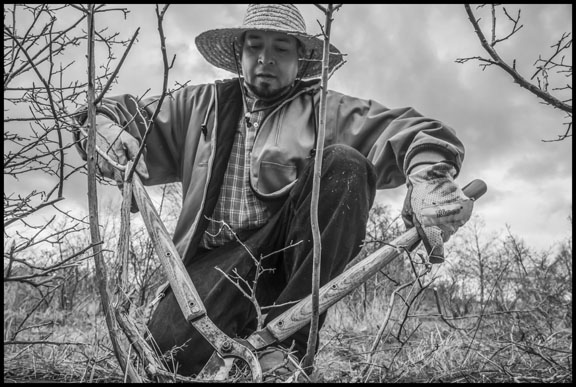
Ramon Torres, President of Familias Unidas por la Justicia, prunes blueberry bushes on the land of the union's new cooperative, Tierra y Libertad.
In 2013, in Washington State, Familias Unidas por la Justicia was born when migrant indigenous Mexican blueberry pickers refused to go into the fields of Sakuma Brothers Farms after one of them had been fired for asking for a wage increase. Workers then organized work stoppages for the next four years to raise the piece-rate wages. At the same time, they organized boycott committees in cities on the Pacific Coast to pressure Sakuma's main customer, the giant berry distributor Driscoll's Inc. In 2017, the farm's owners agreed to an election, and the union won. Familias Unidas then negotiated a two-year contract with Sakuma Brothers Farms.
"We know this contract is going to change our lives," says Ramon Torres, FUJ president. "We have always been invisible people, but now our children will have the opportunity to keep studying. Its not that we want to get them out of the fields but we want them to have an opportunity to decide they want. Our members understand that we are not just farmworkers. We are part of a community."
Since signing the contract, work stoppages have occurred on many nearby ranches. Most of those workers are also Mixtec and Triqui migrants from Oaxaca and Guerrero in southern Mexico, who now live permanently in rural Washington. Familias Unidas has been able to help workers in these spontaneous strikes. The piece rate for picking berries at Sakuma Brothers Farms has increased dramatically, with some workers earning as much as $30 per hour. Now farmworkers at other farms have taken action to raise their own wages.
"The wages on the other farms are much lower," Torres explains. "So our vision is to help form independent unions and negotiate contracts there also. Everything is led by the workers. The purpose is to grow the union, so that all of us have fair wages."
After winning its contract, FUJ members organized the Co-operativa Tierra y Libertad. Rosalinda Guillen, director of Community2Community Development in Bellingham, helped workers form both the union and the co-op. "Today the production of food is based on how much profit a farmer or a corporation can make," she charges. "Farmworkers are a cost. Growers don't invest in us because they don't believe we're worth it."
Farm workers and their supporters march to protest the death of Honesto Silva, on the anniversary of his death a year earlier. Hosesto Silva was a guestworker recruited to work at Sarbanand Farms. Other farm workers charge that he died because of excessive heat and pressure by the company to keep working.
But she believes the culture of indigenous farm workers is a resource for developing sustainable agriculture. "Many migrants coming to the U.S. were farmers in Mexico and Central America. Because of the trade agreements like NAFTA, they were displaced and moved north. Many are in the caravans, and now in the detention centers in the U.S. But they know how to grow food with no chemicals, how to conserve water, how to take care of the land. We have to organize these farmers and see them as a resource, because the corporate food system is poisoning the earth and the water. Farmworkers suffer illness from the pesticides, and broken bodies because of the pressure to work fast, in bad conditions. The average lifespan of a farmworker is 49 years. Fourteen years ago it was 47."
In the eyes of Torres and the workers, the co-operative is an alternative for workers to the wage exploitation they've suffered since coming to the U.S. This co-op uses the tradition of mutual help that is part of the indigenous culture of the workers themselves. "In the co-op we are educating workers," he says. "We want to be an example. We do not need supervisors or managers. We do not need owners. We can be the owners - we just need land."
Tierra y Libertad has just signed an agreement to purchase 65 acres in Everson, in addition to the two acres it is already farming near Sumas. Twenty acres are planted in red raspberries, seven in blueberries and four in strawberries. In addition to the handful of founding members, five more families are being trained in the co-op's operations. Last year it sold berries in community food co-ops, stores on Kamano Island, local fruterias, and even in front of churches after services. When the harvest begin next spring it hopes to expand to other areas as well.
"We want a system in which we can live and buy locally," Torres says, "where our gains stay here in the county. At the same time we will compete with the corporations that have been making money from us."
Basic to the vision of both FUJ and the co-op is the idea that farm work is skilled, and should provide a decent life and respect for those who do it. One of the biggest obstacles, however, is the growth of the H-2A visa program, that treats immigrant farmworkers as temporary labor, contracted for the harvest and then sent back to Mexico once it's over.
Farm workers and their supporters march to the office of Sakuma Farms, a large berry grower where they went on strike in 2013. They demanded that the company bargain a contract with their union, Familias Unidas por la Justicia.
Companies using the H-2A program must apply to the U.S. Department of Labor, listing the work and living conditions and the wages workers will receive. The company must provide transportation and housing. Workers are given contracts for less than one year, and must leave the country when their work is done. They can only work for the company that contracts them, and if they lose that job they must leave immediately.
In 2017 Washington growers were given H-2A visas for 18,796 workers, about 12,000 of whom were recruited by the Washington Farm Labor Association (WAFLA). Last year about 200,000 H-2A workers were brought to the U.S. and this year the number will exceed 240,000. "In the capitalist system we are disposable and easily replaceable," Guillen says. "The guest worker program is a good example. You bring people in and ship them out and make money off them. It's time to end that. We're human beings and we're part of the community."
In the summer of 2017 seventy H-2A workers refused to work at Sarbanand Farms in Sumas, after one of the fellow workers collapsed in the field, and later died. The strikers were then deported because workers with these visas have no right to strike. "The impact of this system on the ability of farm workers to organize is disastrous," Guillen charges. Workers faced replacement at Sakuma Brothers Farms as well, before the union contract was negotiated.
The flow of workers isn't the only cross-border issue facing Washington farmworkers. Recently two leaders of the new independent union for agricultural laborers in Baja California's San Quintin Valley visited FUJ and the new co-op. "Workers in Mexico and the United States work for the same companies, like Driscoll's. says Lorenzo Rodriguez, the general secretary of the National Independent Democratic Union of Farm Workers (SINDJA in its Spanish initials). "It's important to form alliances with the workers of different countries. That's the only way we can face the companies. They are all coordinated. We must cooperate also."
Adds Abelina Ramirez, SINDJA's secretary for gender equality, "regardless of what country we live in we have basic rights to education, to health care, to the welfare of our children. If we unite and organize, we can win these rights."
Modesto Hernandez, a member of Familias Unidas por la Justicia, prunes blueberry bushes on the land of the union's new cooperative, Tierra y Libertad.
Monday, April 22, 2019
Wednesday, April 10, 2019
PHOTOGRAPHS FROM THE ARCHIVES - COACHELLA'S PALMEROS - 1992
Photoessay by David Bacon
Photographs from the Archives are occasional photoessays, based on images from David Bacon's film archive of photographs taken between approximately 1988 and 2005.
I saw my first immigration raid long before I became a photographer. I was an organizer for the United Farm Workers in the Coachella Valley. One morning I drove out to a grove of date palms to talk with the palmeros working high in the trees. As I pulled my old white Valiant (the only kind of car the union had) down a row between the palms, I saw a green Border Patrol van. The workers I'd talked with the night be- fore in the union hall were all staring at the ground, handcuffed behind their backs.
I felt helpless to stop the inexorable process in which they were loaded into the van. I chased it to the holding center in El Centro, two hour's drive south, but then stood outside the barbed wire, wondering what I could do to help the families left behind. It was one of the watershed experiences of a lifetime.
There were other immigration raids during the time I worked for the UFW, often and by no coincidence during the times workers were organizing. It was easy to see how detentions and deportations are not just violations of human rights, and cause devastating pain for families, but are a weapon in a war to keep immigrants from organizing.
I carry my camera as a tool to help stop this abuse, and to take photographs that will help people organize. Part of the effort is to give personality and presence to the people involved. When I began working as a photographer I thought right away about going to the Coachella Valley and taking photographs of the communities where I'd worked as an organizer. I thought especially about the palmeros, not just because of that raid, but because the work they do requires such skill and courage.
The Coachella Valley, two hours drive north of the Mexican border, is the only place outside of the Middle East and North Africa where dates are grown. Palmeros are a special, almost exclusive group among farm workers, bound together by pride in their skill, and their willingness to do dangerous work at great heights. "Only a Mexican," they say, "has the courage to do this work."
These photographs were taken in 1992, and since then the work process has changed a lot. In this old process, the palmero steps off his ladder onto the fronds of the palm, walking around the crown of the tree as he works, about 30 feet off the ground. He pollinates and ties together the flowers of the palm, which will later ripen and become dates. Palmeros are paid by the tree, and have to work quickly in order to make a living. They wear no safety lines, and practically run as they work.
Taking these photographs (with the help of Doug and Debbie Adair) I met Pilar Sandoval, a palmero, carrying his ladder from one tree to another. He was not only a member of the United Farm Workers, but was working for a company where I'd helped negotiate the first union contract many years earlier. Because of his union seniority rights, he'd been able to keep this same job for over 20 years by the time I took his photograph. This is rare for most farm workers, who are plagued by extreme job insecurity.
I took photographs that year of the rundown camps where some workers lived, and of the much better conditions in the Indio farm labor camp - one of those built originally in the 1930s under pressure from the unions of that era, as well as from people like Paul Taylor, Dorothea Lange and Carey McWilliams. Some of the photographs captured the children of the workers, and others I took of the then-new wave of workers from Oaxaca coming into California fields.
I've been back to take more photographs and interview more workers many times since then. These are one series among many in my archive. The Coachella Valley and its people have become very important to me. They changed my life and I hope my photographs do them justice.
Full selection of photos - click here.
Photoessay by David Bacon
Photographs from the Archives are occasional photoessays, based on images from David Bacon's film archive of photographs taken between approximately 1988 and 2005.
I saw my first immigration raid long before I became a photographer. I was an organizer for the United Farm Workers in the Coachella Valley. One morning I drove out to a grove of date palms to talk with the palmeros working high in the trees. As I pulled my old white Valiant (the only kind of car the union had) down a row between the palms, I saw a green Border Patrol van. The workers I'd talked with the night be- fore in the union hall were all staring at the ground, handcuffed behind their backs.
I felt helpless to stop the inexorable process in which they were loaded into the van. I chased it to the holding center in El Centro, two hour's drive south, but then stood outside the barbed wire, wondering what I could do to help the families left behind. It was one of the watershed experiences of a lifetime.
There were other immigration raids during the time I worked for the UFW, often and by no coincidence during the times workers were organizing. It was easy to see how detentions and deportations are not just violations of human rights, and cause devastating pain for families, but are a weapon in a war to keep immigrants from organizing.
I carry my camera as a tool to help stop this abuse, and to take photographs that will help people organize. Part of the effort is to give personality and presence to the people involved. When I began working as a photographer I thought right away about going to the Coachella Valley and taking photographs of the communities where I'd worked as an organizer. I thought especially about the palmeros, not just because of that raid, but because the work they do requires such skill and courage.
The Coachella Valley, two hours drive north of the Mexican border, is the only place outside of the Middle East and North Africa where dates are grown. Palmeros are a special, almost exclusive group among farm workers, bound together by pride in their skill, and their willingness to do dangerous work at great heights. "Only a Mexican," they say, "has the courage to do this work."
These photographs were taken in 1992, and since then the work process has changed a lot. In this old process, the palmero steps off his ladder onto the fronds of the palm, walking around the crown of the tree as he works, about 30 feet off the ground. He pollinates and ties together the flowers of the palm, which will later ripen and become dates. Palmeros are paid by the tree, and have to work quickly in order to make a living. They wear no safety lines, and practically run as they work.
Taking these photographs (with the help of Doug and Debbie Adair) I met Pilar Sandoval, a palmero, carrying his ladder from one tree to another. He was not only a member of the United Farm Workers, but was working for a company where I'd helped negotiate the first union contract many years earlier. Because of his union seniority rights, he'd been able to keep this same job for over 20 years by the time I took his photograph. This is rare for most farm workers, who are plagued by extreme job insecurity.
I took photographs that year of the rundown camps where some workers lived, and of the much better conditions in the Indio farm labor camp - one of those built originally in the 1930s under pressure from the unions of that era, as well as from people like Paul Taylor, Dorothea Lange and Carey McWilliams. Some of the photographs captured the children of the workers, and others I took of the then-new wave of workers from Oaxaca coming into California fields.
I've been back to take more photographs and interview more workers many times since then. These are one series among many in my archive. The Coachella Valley and its people have become very important to me. They changed my life and I hope my photographs do them justice.
Full selection of photos - click here.
Tuesday, February 26, 2019
OAKLAND TEACHERS FIGHT FOR PUBLIC EDUCATION
By David Bacon
Truthout Photoessay, 2/26/19
https://truthout.org/articles/photo-essay-oakland-teachers-fight-for-public-education/
Teachers and students carry a banner from their school, Oakland Technical High School.
Students and parents have come out en masse to join the marches and picket lines of the ongoing teachers strike in Oakland, California. All say that they are trying to save the city's public school system.
"This is a strike to save our district," said Heath Madom, who's taught 10th grade English for three years at Oakland Technical High School, which is referred to as "Tech" by educators and pupils. "Our Tech community is committed to saving public education. Twenty-four schools are on the chopping block. We could become like New Orleans, with no public schools and all charters, if this keeps going."
Like other teacher strikes around the country, the Oakland conflict is fueled both by a determination to protect the public school system itself and by the crisis in funding that has led to huge classes and deteriorating conditions in the schools themselves. According to Madom and the Oakland Education Association, only 5 percent of the district's 37,000 students have passed through their schools' doors over the last three days - evidence of vehement parent and community support.
Parents, students and teachers all condemn the rise in class sizes. "My class is a catch-all, because all students have to take it, so class size is a huge issue," said Rho Seidelman, who's taught ethnic studies at Tech for three years. "There's no tracking, which is great, because we have students from all backgrounds and previous schools. But it's hard to build community among the students when there are so many. The contract says 32 is the limit, and I routinely have at least 33. Research shows that the best learning environment is in a class of 18, where students can really learn and build community. When students are absent and my class size goes down to 28 or 26, I'm really happy."
Madom says most classes at Tech have 35-40 students, and the school, built for 1,800, has a student body of 2,000. "We only have two part-time nurses for 2,000 students, and they don't have the time or resources to deal with all their medical problems. We have a beautiful library, but haven't had a librarian for years. Our counselors have a caseload of 500 students apiece. If they saw every student, they would only be able to spend a few minutes with each," Madom said. The hiring of more nurses, librarians and counselors is part of the strike demands of the union, the Oakland Education Association, which is affiliated with the National Education Association (NEA).
Teachers' pay is also part of the strike demands. The union wants a 12 percent raise over 3 years, and the district is stuck at 7 percent with a bonus. "The only reason I can live in Oakland is because I live with a partner who has a good income," Seidelman said. "What I make is not enough to live here. I'm still paying off my school loans, and rent takes up almost half my income. My job would clearly be improved if we won the demands of our strike, and I, and other teachers too, would be more likely to stay."
"People here are struggling," Madom added. "Some teachers are commuting long distances to get here. We had seven excellent teachers leave this year, including two English teachers with more than five years [of] experience."
Prior to the strike, a state fact-finder's report found that the teacher retention crisis in Oakland is worse than most other districts in the state, which the state attributes to substandard pay, the lowest among the Bay Area's districts. The fact-finder also mandated reducing class sizes, especially for special education classes, and concluded that school privatization was hurting students.
Slating 24 schools for closure is part of the privatization regime, Madom argued, adding that the closures are hitting communities that have been historically underserved the hardest. "At the same time, the district has allowed charter schools to proliferate, which is a direct reason why enrollment has declined in public schools they now want to close," Madom added. "Yet there's no discussion of closing any of the charters." Those charter schools already enroll 13,000 students in Oakland.
Seidelman said these priorities are part of a culture in Oakland that favors development to benefit the affluent. "If it was up to a popular vote, our community would support the strike's demands overwhelmingly. But our community is not in control of the basic decisions in the city. The strike has exposed the political corruption in Oakland city politics. The terrible condition of our schools is a consequence of the policies imposed by business interests. The resources of the city go to gentrification, which benefits them, but not our communities. It's true all over the country, which is why there are strikes now in so many places. It's not just a problem of Oakland."
But the national teachers' strike wave is challenging those priorities. "It's shifting the narrative on public education," Madom said. "The charter industry has claimed that poor students don't get the education they deserve because of poor teachers. Public school teachers haven't been heard until now. We do need great teachers, but the problems of our schools aren't due to individual teachers. The district for years hasn't funded classrooms adequately, but the state also has grossly underfunded education. California has a massive amount of wealth. I can't believe we're living in one of the richest states in the country, and yet there's no money for education. We're tired of putting up with austerity. The strike wave is happening because teachers are standing up, and saying 'enough is enough'."
After talks broke down on February 24, sending the strike into its third day, Keith Brown, president of the Oakland Education Association, told reporters that the district had "returned to the table without a proposal that would begin to meet our core bargaining demands [which include an obligation to] fully fund our schools and provide a living wage to keep teachers in Oakland."
Novelist Alice Walker was among many celebrities and political figures to rally behind the teachers. "You should be given, really, anything you ask for," she said in a letter. "It is criminal that you are not. Especially when we see it is the war effort, more often than not, that is supported lavishly. An effort that often cuts short the very lives you have lovingly prepared to live with understanding and intelligence in this world. Know that you have sisters and brothers who stand with you, heart to heart."
The majority of the following photographs were taken on the strike's first day, February 21, when teachers, parents and students rallied in front of the Oakland City Hall, and then marched through downtown streets to the offices of the Oakland Unified School District. All photos (c) David Bacon.
Keith Brown, president of the Oakland Education Association, and other teachers lead a march through downtown Oakland.
Teachers and community members support one of the strike's demands - funding the district's restorative justice program, an alternative to traditional school discipline.
Students, parents and teachers demonstrate support for the strike.
The strikers march behind their banner down Broadway, in downtown Oakland.
Liz Ortega, executive secretary of the Alameda Labor Council, behind the banner during the march.
Striking teachers during the march.
Teachers and community members march behind a banner opposing the closure of 24 schools, which targets schools in the Oakland flatlands, predominantly low-income communities of color.
A student shows her support for raising teachers' salaries.
Students and parents sing, "Which side are you on?"
Teachers and community activists in a rally before the march.
Teachers with the basic demand of the strike - funding public schools.
Students and parents at the rally in front of Oakland City Hall.
Heath Madom talks with other teachers at a meeting in front of Oakland Technical High School.
By David Bacon
Truthout Photoessay, 2/26/19
https://truthout.org/articles/photo-essay-oakland-teachers-fight-for-public-education/
Teachers and students carry a banner from their school, Oakland Technical High School.
Students and parents have come out en masse to join the marches and picket lines of the ongoing teachers strike in Oakland, California. All say that they are trying to save the city's public school system.
"This is a strike to save our district," said Heath Madom, who's taught 10th grade English for three years at Oakland Technical High School, which is referred to as "Tech" by educators and pupils. "Our Tech community is committed to saving public education. Twenty-four schools are on the chopping block. We could become like New Orleans, with no public schools and all charters, if this keeps going."
Like other teacher strikes around the country, the Oakland conflict is fueled both by a determination to protect the public school system itself and by the crisis in funding that has led to huge classes and deteriorating conditions in the schools themselves. According to Madom and the Oakland Education Association, only 5 percent of the district's 37,000 students have passed through their schools' doors over the last three days - evidence of vehement parent and community support.
Parents, students and teachers all condemn the rise in class sizes. "My class is a catch-all, because all students have to take it, so class size is a huge issue," said Rho Seidelman, who's taught ethnic studies at Tech for three years. "There's no tracking, which is great, because we have students from all backgrounds and previous schools. But it's hard to build community among the students when there are so many. The contract says 32 is the limit, and I routinely have at least 33. Research shows that the best learning environment is in a class of 18, where students can really learn and build community. When students are absent and my class size goes down to 28 or 26, I'm really happy."
Madom says most classes at Tech have 35-40 students, and the school, built for 1,800, has a student body of 2,000. "We only have two part-time nurses for 2,000 students, and they don't have the time or resources to deal with all their medical problems. We have a beautiful library, but haven't had a librarian for years. Our counselors have a caseload of 500 students apiece. If they saw every student, they would only be able to spend a few minutes with each," Madom said. The hiring of more nurses, librarians and counselors is part of the strike demands of the union, the Oakland Education Association, which is affiliated with the National Education Association (NEA).
Teachers' pay is also part of the strike demands. The union wants a 12 percent raise over 3 years, and the district is stuck at 7 percent with a bonus. "The only reason I can live in Oakland is because I live with a partner who has a good income," Seidelman said. "What I make is not enough to live here. I'm still paying off my school loans, and rent takes up almost half my income. My job would clearly be improved if we won the demands of our strike, and I, and other teachers too, would be more likely to stay."
"People here are struggling," Madom added. "Some teachers are commuting long distances to get here. We had seven excellent teachers leave this year, including two English teachers with more than five years [of] experience."
Prior to the strike, a state fact-finder's report found that the teacher retention crisis in Oakland is worse than most other districts in the state, which the state attributes to substandard pay, the lowest among the Bay Area's districts. The fact-finder also mandated reducing class sizes, especially for special education classes, and concluded that school privatization was hurting students.
Slating 24 schools for closure is part of the privatization regime, Madom argued, adding that the closures are hitting communities that have been historically underserved the hardest. "At the same time, the district has allowed charter schools to proliferate, which is a direct reason why enrollment has declined in public schools they now want to close," Madom added. "Yet there's no discussion of closing any of the charters." Those charter schools already enroll 13,000 students in Oakland.
Seidelman said these priorities are part of a culture in Oakland that favors development to benefit the affluent. "If it was up to a popular vote, our community would support the strike's demands overwhelmingly. But our community is not in control of the basic decisions in the city. The strike has exposed the political corruption in Oakland city politics. The terrible condition of our schools is a consequence of the policies imposed by business interests. The resources of the city go to gentrification, which benefits them, but not our communities. It's true all over the country, which is why there are strikes now in so many places. It's not just a problem of Oakland."
But the national teachers' strike wave is challenging those priorities. "It's shifting the narrative on public education," Madom said. "The charter industry has claimed that poor students don't get the education they deserve because of poor teachers. Public school teachers haven't been heard until now. We do need great teachers, but the problems of our schools aren't due to individual teachers. The district for years hasn't funded classrooms adequately, but the state also has grossly underfunded education. California has a massive amount of wealth. I can't believe we're living in one of the richest states in the country, and yet there's no money for education. We're tired of putting up with austerity. The strike wave is happening because teachers are standing up, and saying 'enough is enough'."
After talks broke down on February 24, sending the strike into its third day, Keith Brown, president of the Oakland Education Association, told reporters that the district had "returned to the table without a proposal that would begin to meet our core bargaining demands [which include an obligation to] fully fund our schools and provide a living wage to keep teachers in Oakland."
Novelist Alice Walker was among many celebrities and political figures to rally behind the teachers. "You should be given, really, anything you ask for," she said in a letter. "It is criminal that you are not. Especially when we see it is the war effort, more often than not, that is supported lavishly. An effort that often cuts short the very lives you have lovingly prepared to live with understanding and intelligence in this world. Know that you have sisters and brothers who stand with you, heart to heart."
The majority of the following photographs were taken on the strike's first day, February 21, when teachers, parents and students rallied in front of the Oakland City Hall, and then marched through downtown streets to the offices of the Oakland Unified School District. All photos (c) David Bacon.
Keith Brown, president of the Oakland Education Association, and other teachers lead a march through downtown Oakland.
Teachers and community members support one of the strike's demands - funding the district's restorative justice program, an alternative to traditional school discipline.
Students, parents and teachers demonstrate support for the strike.
The strikers march behind their banner down Broadway, in downtown Oakland.
Liz Ortega, executive secretary of the Alameda Labor Council, behind the banner during the march.
Striking teachers during the march.
Teachers and community members march behind a banner opposing the closure of 24 schools, which targets schools in the Oakland flatlands, predominantly low-income communities of color.
A student shows her support for raising teachers' salaries.
Students and parents sing, "Which side are you on?"
Teachers and community activists in a rally before the march.
Teachers with the basic demand of the strike - funding public schools.
Students and parents at the rally in front of Oakland City Hall.
Heath Madom talks with other teachers at a meeting in front of Oakland Technical High School.
Saturday, February 23, 2019
A CONVERSATION WITH DAVID BACON, PHOTOGRAPHER AND ACTIVIST
By Meredith Blasingame
February 1, 2019, The Guardsman [Community College of San Francisco]
http://theguardsman.com/1_culture_bacon_blasingame/
Activist, journalist and documentary photographer, David Bacon has dedicated his life to social activism. Mild-mannered and matter-of-fact with a quiet sense of humor, Bacon has a way of putting people at ease-a skill that has no doubt served him well through many years of labor organizing and taking photographs to reveal and resolve inequities.
Bacon was born in New York City where his father, a printer and the head of the Book and Magazine Guild union, was blacklisted during the McCarthy era. He grew up in Oakland, and his father and mother gave him a first-hand look at what it takes to organize a group of people behind a common cause.
"Organizing and printers ink both run in the blood," he says, referring to the fact that he, like his father, worked as a printer for a time. Bacon worked to organize a union during his first job as a factory worker, launching a career that spanned two decades, both as a factory worker and union organizer. He has worked with the United Farm Workers, the International Ladies Garment Workers, and other labor organizations.
Bacon's time as a union organizer evolved into documentary photography and journalism in the mid-1980s. Today he documents labor, the global economy, war and migration, and the struggle for human rights. He has written for publications including The Nation, The American Prospect, TruthOut and In These Times, and he is the author of several books.
In the prologue to his most recent book. In the Fields of the North/En Los Campos del Norte (2017), Bacon states, "For three decades I've used a method that combines photographs with interviews and personal histories. Part of the purpose is the 'reality check;' the documentation of social reality, including poverty, homelessness, migration and displacement."
"The Reality Check" is also the name of Bacon's blog, where he documents topics ranging from the working conditions of Iraqi oil refineries to California farm workers to hotel and school workers on the job.
I sat down with the documentary photographer to learn more about his career path, his goals and motivations, lessons from the field, and next steps in his lifelong mission to sow the seeds of change.
The interview follows the photos. Photos with permission by David Bacon/Special to the Guardsman
Hotel workers, members of Unitehere Local 2, go on strike against Marriott Hotels in San Francisco, protesting low wages that force many workers to work an additional job besides their job at the hotel.
Workers picket the Marriott Union Square Hotel on Oct. 4, 2018.
San Francisco hotel workers vote to ratify their contract at the end of their strike against Marriott Hotels on Dec. 3, 2018.
After a week on strike against Marriott Hotels, hotel workers, members of Unitehere Local 2, are arrested for sitting down and blocking Fourth Street in San Francisco in an act of civil disobedience. The sit-in took place in front of the Marriott Marquis Hotel, the flagship Marriott hotel in the city. Workers were protesting low wages that force many workers to work an additional job besides their job at the hotel.
After 61 days on their picket lines, San Francisco workers celebrate the end of the strike and the agreement on a new union contract on Dec. 3 2018. Workers protested low wages that force many workers to work an additional job besides their job at the hotel.
MB: How did you get into photography?
DB: I was into it as a teenager, but my camera got stolen and life moved on. I didn't come back to it until later.
I was a union organizer for a number of years. In the mid-1980s, I picked up a camera again to take pictures of the strikes that we would organize. That beginning was utilitarian in a way - to publicize strikes, give prints to people on the picket line to take home to their families to show that they were standing up. Then I began to realize that the photographs themselves had a meaning beyond what I was using them for, in that they were a documentation, especially at that point, of the changing demographics of the workforce - especially in factories here in the East Bay.
On the one hand, we had a lot of factory closures. Also, lots of Mexicans and Central Americans were coming into the workforce. Before I got there, Black workers had broken racial barriers at work too, so you could see that. The photographs showed this, and people's response to it, which in my case was to organize unions and go on strike. That was the root of the kind of work that I did, and in a way it still really has a lot in common with what I do.
MB: You were a factory worker at one point. Is that how you first got involved in union organizing?
DB: Yes and no. I needed a job. I had kids and a family, and I needed an income. But also in the 60s and 70s radical movement a lot of people thought that workers were going to be the engine for social change. It was important to be in the factory; it was important to be where workers were to help people organize. So pretty much as soon as I started going to work, I started trying to organize unions. I got fired from a printing shop in San Francisco for doing that, as well as from other jobs, including from National Semiconductor in Silicon Valley.
MB: At what point did photojournalism become a large portion of your work?
DB: I started working for unions partly because I was really interested. The first union I worked for was the farm workers. I think it was partly because I wanted to understand. I grew up in Oakland. I didn't know anything about farm workers or Mexicans or Spanish. The union taught me about all those things. It was a real education for me. That's still part of what I'm doing today. My latest book included oral histories of farm workers in California, which goes directly back to that experience.
But also, especially after I got fired and blacklisted in Silicon Valley, working for unions made sense. It seemed like important work - helping to build the union. I did that for a long time - over 20 years.
At the end of that, I started taking pictures and writing short articles about what we were doing, and it kind of took over my life. It became more important. I took classes in the photography program at Laney College in Oakland, while I also worked as an organizer. That was a little crazy because organizers don't have a lot of free time. But I could begin to see that I really liked doing this work and that I thought it was important. Also, I looked at it as being another form of organizing.
Organizing people is really all about changing the way people think. Organizers do it by holding house meetings or talking to people at work. If you do the kind of work I do, you're really still trying to change the way people think, but you're doing it through different means - sort of on a broader scale but also less directly.
For instance, I just did a big project on documenting the Marriott hotel strike in the Bay Area, all the way from last March when they were first thinking about it to the end of the strike. It's still basically trying to document what happens to us as working people - what our lives are like, but also with a perspective of seeing us as actors, as social actors.
We're not just victims of bad circumstances. We are also capable of changing them, and in fact I think that's the process that's really the most interesting - the combination where you see the world that people are living in, and how people respond to it, and then what they do. And that's kind of my approach to writing and photography both; that's what I'm doing.
MB: When you say "we," who do you mean?
DB: When I say what happens to "us" as workers, I'm talking about workers as a whole, in general. But obviously, some working people are at more of a disadvantage than others. Some people are more conscious than others. Some people do something about it and other people don't. I mean - how many workers are there in the United States? We are not just a majority of the population, we are like 80 or 85% of the people who live in this country. So obviously, there's an enormous, huge, variety. That's one of the things that makes this fascinating.
MB: What is it that you think actually makes people do something about it? Out of all of those people, there's a large portion that doesn't proactively work for change.
DB: First of all, generally speaking, people still need to be pushed into it. Usually. Not always. You know, in my generation, a lot of people got swept up in the civil rights movement, in the anti-war movement, and went into workplaces to help organize workers. That was a product of people's political understanding, I guess you would say. But that's by far not the way most people wind up becoming part of social movements in this country.
Usually, people are responding to a crisis in their lives or a general feeling of frustration or dissatisfaction. Looking for answers. And that is very widespread in this country. I think that most people, actually, are frustrated and angry and looking for answers. But we are taught, as people in this country, to be distrustful of politics, cynical, and kind of susceptible to hot button quick answers, without really having to try to understand how the system works. One of the obstacles that organizers have to overcome is that you have to help people understand how the system here works - that Trump-type answers - "build the wall" - are not good answers for us. But to help people understand why that's not a good answer, for instance, they have to understand why people are coming here to begin with.
So it's a process. I think it's a combination of the pressure on people and people's feelings of anger and frustration about it, but also things that set off sparks in people's minds, that help them think more deeply about their situation. And that can be a lot of things. It can be reading books, or some organizer knocks on your door, or reading about Bernie Sanders in the newspaper and saying, "God, that makes sense to me." But it's that combination of the impact of ideas and the base of circumstances. It's not to say that comfortable people don't struggle, because they do. But I think the big motivating force for change in this country comes out of social and economic crisis.
For example, the anti-war movement had a lot to do with the fact that we had a draft. Young people had to think about whether or not they wanted to go, and what the war was about. And the civil rights movement had to do with the unbearable conditions for African American people in a lot of parts of the South, plus this rising idea that we're not going to take it anymore and that we don't have to. You can trace it to people coming home from WWII, to having seen something of the world. You can trace it to radical organizations in the South, that agitated over all those years against lynching and for civil rights. Those seeds got planted and finally they grew. So I think that's how social change takes place.
So what's my part in it? I used to be on the organizer side and now I'm on the idea planting side. But really, they're so closely related that it's hard to tell them apart sometimes.
MB: For migrant workers who are undocumented, is there a disincentive to organize due to the risks associated with their undocumented status, or have you seen instances of undocumented workers organizing?
DB: I went to work with the United Farm Workers Union in the 70s, which is when I first started learning about immigration and immigrant rights. I saw my first immigration raid, and tried to understand what it was like to be Mexican living in the United States. That's when I first started getting interested in Mexico. If things are as bad as they are for people here, I thought, then why are people coming here? That led to a whole interest in Mexico, and now I write a lot about Mexico.
I'm an activist - a journalist, or an activist documentarian. One of the places where that activism happens is in the immigrant rights movement. I've been an immigrant rights activist for a long long time. The first people who taught me about it were farm workers. One of the things I could see was that, as you said, not having papers makes it riskier to go out on strike or join a union. But it doesn't stop people. In fact, most of the people who belong to the United Farm Workers union are undocumented. So obviously it didn't stop people. It's not to say that there aren't conflicts between people who have papers and those who don't. But certainly I could see that people were willing to struggle.
My work as an organizer was almost always talking with immigrants and people of color, and a lot of it talking with people who had no papers in foundries and factories. That was mostly who we were organizing.
So it wasn't just learning that people could do it, but trying to figure out as an organizer, with those workers, how they could defend themselves against the risk you're talking about. What you can do if your boss threatens to call the migra on you. What to do if the migra actually shows up at the factory where you're working. Very practical questions like that also lead to a certain level of political immigrant rights activism.
I've been part of working groups to change immigration laws, with big debates over whether we need to have enforcement, or what the border should look like. I'm very involved in that too.
In fact a new book I'm working on is about the border. It's trying to look at the border, not just as a wall, and not just a place people cross in order to come here, but as s a place where people live. It is also, especially on the Mexican side, the scene of lots and lots of social movements and social struggles about the conditions for people there. It comes from almost 30 years of photographs and interviews, which try to document the border as a region of people in movement.
MB: So what seeds are you trying to sow through projects like that?
DB: You know, I originally called my blog the "reality check," because the idea is that, if we're going to talk about immigration laws or migration or the workplace, let's look at who's there. What do those situations look like? Let's listen to the people who are there, and then try and figure out what to do based on that. So that's what the seed planting idea is. When I was an organizer, I used to write a lot of leaflets, which were urging people to immediate action - go on strike or boycott or whatever. I had to cure myself of that when I started, to move away from being an organizer and work as a journalist.
So now what it's trying to do is to draw a picture of the world, or part of it, in an accurate way, in a fair way, but certainly in a partisan way too.
I don't believe in neutrality. I don't think that anyone is really neutral about anything. I have a war with journalism schools and the way that they treat neutrality in journalism, because I think often that is used as a pretext for ensuring that the politics that appear in the newspaper reflect the editorial position of the owners and the people who manage it.
If you read the foreign coverage of the New York Times no one in their wildest imagination would believe that this is objective journalism. The reports don't even pretend it is. They just try to assume this is the only way you can possibly see the world. But objective and neutral?! Not in a million years.
We choose what to write about; choose who to talk to; choose whose eyes we're gonna take a look at the world through {or the lens through which you tell a story]. Our mainstream media looks at the world through the eyes of people who have power. Unfortunately, where working people and people of color appear in our media world, they generally tend to appear as victims. There is a certain muckraking tradition in journalism here and a lot of lip service is paid to it, but it doesn't necessarily see people as actors very much, who are able to change it. I very consciously try to do the work I do in a way that pays attention to how people analyze their world and change it.
For example, I wrote a long political biography of Rufino Dominguez about a year ago, right after he died. Rufino, apart from being a friend, was a very crucial figure in the migration of people from Oaxaca to the United States, and helped to organize some very important organizations both here and in Oaxaca. I was trying to present the ideas he contributed - and he contributed to some really brilliant ones. He talked about the duality, for instance, of the fight for the rights of migrants in the countries they're going to, as well as fighting for the right to not migrate in the places people are coming from. In other words, there have to be political and economic alternatives in the towns where people are growing up so that a young person can actually decide, in a voluntary way, whether to leave and go to the US, or whether to stay and have a future with dignity. Rufino was a very important person in developing that idea. In fact, I was so enamored of that idea that I wrote a book about it called The Right to Stay Home.
The whole biography tried to figure out Rufino's political history. Where did he come from politically? What were the currents of thought that helped him to develop both the ability to organize people and also his ideas. This is really a very important part of documentary work. We listen to how people analyze their world and understand the ideas that they come up with. We don't just treat people as victims.
MB: Do you photograph people in Mexico to highlight circumstances there as well?
DB: Absolutely. That border book I was talking about - there's a section in the book called "Communities of Resistance." This is a Mexican phrase, and they are communities along that northern part of Mexico, along the border. If you go back 60 or 70 years, very few people lived there. Now there are cities of millions of people. So one of the things that's happened is that people - poor people - have sometimes organized themselves to take over land owned by the Federal government. Before they changed Mexico's constitution, basically to help investors become secure in their land-holding titles, people could settle on Federal land if nobody else was there. They changed the constitution to throw that out because, you know, it was not a good policy for attracting foreign investment.
There are a number of communities where I have taken photographs, settled by people who were looking for a place to live. Because they're communities of very poor people, the first thing you see in the photographs is how poor they are. But they are also communities willing to create these settlements, and to do that, you have to fight the government. The government's going to bring in the police and try to stir up contra movements within your own community. Leaders will be sent to prison. So these are very activist communities. And some of the struggles in the factories to organize independent unions have come out of those communities. They're really interesting to me because they have this combination, and you can see it visually. You can see the poverty of people but you can also see them in action. It's the way I try to document what's happening in Mexico - looking at that combination of things over and over and over again. It's real easy in Mexico.
MB: When you take photographs, what are you looking for in a "good" photograph - one that is trying to convey your desired message or achieve your desired result?
DB: I'm not basically a landscape photographer, so usually its people. One of the things I'm looking for is emotion - a feeling of intimacy, a feeling of closeness. I was at Horace Mann Elementary School in Frank Lara's class (a teacher and community activist in the Mission). You know, kids are fun. They're very aware you're there and have this desire to mug for you and you have to wait for it to pass. But they're also very accepting so it's easy to get close.
I take a lot of photos with a wide angle lens - getting really close so you can see the person big in the frame but you can also see the context. That's sort of a classic environmental portraiture technique.
Timing. You know, still photographs are a slice [in time] - they're different before and different afterwards. You're just going to pick out that one moment. You're always looking for moments - you're trying to predict what's going to happen and where you want to be. I've been doing this for a long time, and it gets to the place where I'm not really thinking about it. Some of it feels below the level of consciousness - I'm in the zone. You have to trust yourself and develop your instinct to do that, and timing is a very important part of it. Watching people and seeing what's going on with them. I'm always looking for people expressing something with the way that they're moving or the expression on their face.
MB: I read that, from your perspective, photos and writing individually are not as strong as they are together. How do they work best together?
DB: It works in two or three different ways. The classic way is - for example, the latest book that I have [In the Fields of the North/En los campos del norte] is basically photos and oral histories. Even the captions on the photos are sometimes extended quotes from someone in the picture. We're listening to voices and looking at the images and the combination is giving us a much richer idea of that part of the world and the people in it - what they think, what they have to say, what they look like. You're getting a deeper understanding. So that's one way of doing it.
There's another way. I do a lot of writing. For example, I covered a meeting between a farm workers union in Baja California and one in Washington State. I wrote about the things they found they had in common with each other - which was a lot. So the article was illustrated by photographs of some of the people quoted in the article, or who the article talked about. The photos are used to illustrate the story.
Generally speaking, especially now, I don't think I will actually sell an article without pictures. If you want an article from me, you have to run the pictures. I don't have to fight so much [with editors] anymore because they know this is what I do and they like it.
Occasionally I'll do what I call photo essays. They're really basically a string of photographs together. Newspapers, magazines, and websites are run by editors who are word people. They will almost never run a selection of photographs made up of just the photographs, or photos with captions. They'll want a story, even if it's a brief one. So I'll give them the story. But they're really pieces that are carried by the photographs. So that's another way of doing it.
I think in some journalism schools, young photographers are taught that the photograph must be iconic, meaning that it has to stand by itself regardless of the context, with no explanation. I find this a kind of problematic idea. Especially in documentary work, context is very important. You can change the meaning of a photo by changing the context in which someone is looking at it.
Words and images react with each other to produce the politics. So when they talk about the iconic image, journalism schools are trying to pull the politics out of journalism - a way of making it more conservative, more acceptable to the New York Times' owners or whatever.
Think of the young girl naked running down the road with smoke rising from the burning village behind her [Nick Ut's photograph of the child fleeing the bombing of her village during the Vietnam war]. You can understand that picture without knowing it's the Vietnam War. I think most people will understand that it's war. But if you understand which war, and if you understand who bombed the village, the photograph becomes much more political. The reason it helped end the Vietnam war was not just because it was a generic photograph of a young girl fleeing a burning village, but because it symbolized the horror of that particular war, that our bombers were bombing that village and that young girl was fleeing the napalm into the arms, ironically, of the US soldiers who were participating in it.
MB: Regarding the photo essay "Mexicans Greet Their New President" what were you trying to convey there?
DB: It was a project borne out of necessity. I guess if I'd really wanted to, and really tried, I might have been able to engineer myself into the group of photographers that were on the stage when [Mexico's new president] Lopez Obrador received the staff of office from indigenous leaders. That was certainly a very important thing in Mexican history. We all knew what was going to happen and why it was important. Lopez Obrador was recognizing that Mexico is a multi-cultural country. He is the first president of Mexico ever to talk about the cultures of Mexico - plural. But I didn't really want to do that, partly because there were already people taking photographs of the ceremony.
I was more interested in how people were reacting to this enormous political change - ordinary people interested enough to come to the Zocalo [Mexico City's central plaza] to see the thing happen, but not the powerful and influential people sitting on stage or in the Mexican Congress. I watched Lopez Obrador's speech to the Congress on TV, which preceded the event in the Zocalo, and thought it was a remarkable and very important speech.
As a photographer, I wanted to look at what was happening to people. In some ways, you could predict what some of it would look like. People were moving down these avenues in downtown Mexico City, which are lined with the old colonial buildings, so it's a great environment in which to take pictures. Then they'd be in the Zocalo, a huge square with a million people in it.
So I just walked around taking pictures of people. Some of the pictures are very overtly political. Lots of people had flags, banners, signs that all have "AMLO (Andres Manuel Lopez Obrador] Mexico" and similar writing on them. To me, that's important to have in a photograph. That's what people are saying through what they're carrying.
One of the pictures is a guy who was part of a bus drivers' movement that I documented 25 years ago. In the Zocalo he was appealing to Lopez Obrador for justice for their cause, which they are still fighting for. So in the background you have part of the banner, which says Andres Manuel Lopez Obrador and you can read enough of it to know his name is there. But what you're really doing is reading the emotion on his face. It's really all about what's going on in his face.
Other photographs were not overtly political. I'm just trying to shoot what's there. The world is a rich and complicated and marvelous place, so I'm not trying to limit it by saying that the only pictures we're going to show are people with banners marching down the road, although there are some of those too.
I was actually looking for people marching into the square, and there were not a lot of people marching. Then at the end, as I was leaving, there were these people marching down one of the avenues. I was like "Oh, thank God!"
MB: Do you see any changes occurring as a result of the politics with respect to immigration here in the U.S.?
DB: There have been lots of changes. We could talk for hours about the terrible things that Trump has done. On the other hand, people spontaneously went out to the airports when he issued the first anti-Muslim order and shut them down - in San Francisco they got 50 people out of detention - I haven't seen that before. All the women who came out on two marches a year apart.
People are upset, angry, trying to organize in different ways. I've been taking pictures - at the marches. It's one of the reasons that I was taking pictures at the Local 2 [Marriott Hotel] strike. I would have been there anyway, but it was really interesting and a morale booster that this happened right in the middle of all this Trump shit. Here they do a strike against the largest hotel chain in the world and they win! You know, life is not just full of terrible news.
MB: Do you have any upcoming projects?
DB: I'm trying to get enough time to finish this book; or at least get a proposal together. Then we'll see. Publishing photo books is really really hard. The last one I was able to publish because a university in Mexico decided to do it and then I was able to use that to convince the University of California to co-publish it. They all take an extraordinary amount of effort and luck. I've published books that are just text - it's easier to be a professional writer than a photographer.
By Meredith Blasingame
February 1, 2019, The Guardsman [Community College of San Francisco]
http://theguardsman.com/1_culture_bacon_blasingame/
Activist, journalist and documentary photographer, David Bacon has dedicated his life to social activism. Mild-mannered and matter-of-fact with a quiet sense of humor, Bacon has a way of putting people at ease-a skill that has no doubt served him well through many years of labor organizing and taking photographs to reveal and resolve inequities.
Bacon was born in New York City where his father, a printer and the head of the Book and Magazine Guild union, was blacklisted during the McCarthy era. He grew up in Oakland, and his father and mother gave him a first-hand look at what it takes to organize a group of people behind a common cause.
"Organizing and printers ink both run in the blood," he says, referring to the fact that he, like his father, worked as a printer for a time. Bacon worked to organize a union during his first job as a factory worker, launching a career that spanned two decades, both as a factory worker and union organizer. He has worked with the United Farm Workers, the International Ladies Garment Workers, and other labor organizations.
Bacon's time as a union organizer evolved into documentary photography and journalism in the mid-1980s. Today he documents labor, the global economy, war and migration, and the struggle for human rights. He has written for publications including The Nation, The American Prospect, TruthOut and In These Times, and he is the author of several books.
In the prologue to his most recent book. In the Fields of the North/En Los Campos del Norte (2017), Bacon states, "For three decades I've used a method that combines photographs with interviews and personal histories. Part of the purpose is the 'reality check;' the documentation of social reality, including poverty, homelessness, migration and displacement."
"The Reality Check" is also the name of Bacon's blog, where he documents topics ranging from the working conditions of Iraqi oil refineries to California farm workers to hotel and school workers on the job.
I sat down with the documentary photographer to learn more about his career path, his goals and motivations, lessons from the field, and next steps in his lifelong mission to sow the seeds of change.
The interview follows the photos. Photos with permission by David Bacon/Special to the Guardsman
Hotel workers, members of Unitehere Local 2, go on strike against Marriott Hotels in San Francisco, protesting low wages that force many workers to work an additional job besides their job at the hotel.
Workers picket the Marriott Union Square Hotel on Oct. 4, 2018.
San Francisco hotel workers vote to ratify their contract at the end of their strike against Marriott Hotels on Dec. 3, 2018.
After a week on strike against Marriott Hotels, hotel workers, members of Unitehere Local 2, are arrested for sitting down and blocking Fourth Street in San Francisco in an act of civil disobedience. The sit-in took place in front of the Marriott Marquis Hotel, the flagship Marriott hotel in the city. Workers were protesting low wages that force many workers to work an additional job besides their job at the hotel.
After 61 days on their picket lines, San Francisco workers celebrate the end of the strike and the agreement on a new union contract on Dec. 3 2018. Workers protested low wages that force many workers to work an additional job besides their job at the hotel.
MB: How did you get into photography?
DB: I was into it as a teenager, but my camera got stolen and life moved on. I didn't come back to it until later.
I was a union organizer for a number of years. In the mid-1980s, I picked up a camera again to take pictures of the strikes that we would organize. That beginning was utilitarian in a way - to publicize strikes, give prints to people on the picket line to take home to their families to show that they were standing up. Then I began to realize that the photographs themselves had a meaning beyond what I was using them for, in that they were a documentation, especially at that point, of the changing demographics of the workforce - especially in factories here in the East Bay.
On the one hand, we had a lot of factory closures. Also, lots of Mexicans and Central Americans were coming into the workforce. Before I got there, Black workers had broken racial barriers at work too, so you could see that. The photographs showed this, and people's response to it, which in my case was to organize unions and go on strike. That was the root of the kind of work that I did, and in a way it still really has a lot in common with what I do.
MB: You were a factory worker at one point. Is that how you first got involved in union organizing?
DB: Yes and no. I needed a job. I had kids and a family, and I needed an income. But also in the 60s and 70s radical movement a lot of people thought that workers were going to be the engine for social change. It was important to be in the factory; it was important to be where workers were to help people organize. So pretty much as soon as I started going to work, I started trying to organize unions. I got fired from a printing shop in San Francisco for doing that, as well as from other jobs, including from National Semiconductor in Silicon Valley.
MB: At what point did photojournalism become a large portion of your work?
DB: I started working for unions partly because I was really interested. The first union I worked for was the farm workers. I think it was partly because I wanted to understand. I grew up in Oakland. I didn't know anything about farm workers or Mexicans or Spanish. The union taught me about all those things. It was a real education for me. That's still part of what I'm doing today. My latest book included oral histories of farm workers in California, which goes directly back to that experience.
But also, especially after I got fired and blacklisted in Silicon Valley, working for unions made sense. It seemed like important work - helping to build the union. I did that for a long time - over 20 years.
At the end of that, I started taking pictures and writing short articles about what we were doing, and it kind of took over my life. It became more important. I took classes in the photography program at Laney College in Oakland, while I also worked as an organizer. That was a little crazy because organizers don't have a lot of free time. But I could begin to see that I really liked doing this work and that I thought it was important. Also, I looked at it as being another form of organizing.
Organizing people is really all about changing the way people think. Organizers do it by holding house meetings or talking to people at work. If you do the kind of work I do, you're really still trying to change the way people think, but you're doing it through different means - sort of on a broader scale but also less directly.
For instance, I just did a big project on documenting the Marriott hotel strike in the Bay Area, all the way from last March when they were first thinking about it to the end of the strike. It's still basically trying to document what happens to us as working people - what our lives are like, but also with a perspective of seeing us as actors, as social actors.
We're not just victims of bad circumstances. We are also capable of changing them, and in fact I think that's the process that's really the most interesting - the combination where you see the world that people are living in, and how people respond to it, and then what they do. And that's kind of my approach to writing and photography both; that's what I'm doing.
MB: When you say "we," who do you mean?
DB: When I say what happens to "us" as workers, I'm talking about workers as a whole, in general. But obviously, some working people are at more of a disadvantage than others. Some people are more conscious than others. Some people do something about it and other people don't. I mean - how many workers are there in the United States? We are not just a majority of the population, we are like 80 or 85% of the people who live in this country. So obviously, there's an enormous, huge, variety. That's one of the things that makes this fascinating.
MB: What is it that you think actually makes people do something about it? Out of all of those people, there's a large portion that doesn't proactively work for change.
DB: First of all, generally speaking, people still need to be pushed into it. Usually. Not always. You know, in my generation, a lot of people got swept up in the civil rights movement, in the anti-war movement, and went into workplaces to help organize workers. That was a product of people's political understanding, I guess you would say. But that's by far not the way most people wind up becoming part of social movements in this country.
Usually, people are responding to a crisis in their lives or a general feeling of frustration or dissatisfaction. Looking for answers. And that is very widespread in this country. I think that most people, actually, are frustrated and angry and looking for answers. But we are taught, as people in this country, to be distrustful of politics, cynical, and kind of susceptible to hot button quick answers, without really having to try to understand how the system works. One of the obstacles that organizers have to overcome is that you have to help people understand how the system here works - that Trump-type answers - "build the wall" - are not good answers for us. But to help people understand why that's not a good answer, for instance, they have to understand why people are coming here to begin with.
So it's a process. I think it's a combination of the pressure on people and people's feelings of anger and frustration about it, but also things that set off sparks in people's minds, that help them think more deeply about their situation. And that can be a lot of things. It can be reading books, or some organizer knocks on your door, or reading about Bernie Sanders in the newspaper and saying, "God, that makes sense to me." But it's that combination of the impact of ideas and the base of circumstances. It's not to say that comfortable people don't struggle, because they do. But I think the big motivating force for change in this country comes out of social and economic crisis.
For example, the anti-war movement had a lot to do with the fact that we had a draft. Young people had to think about whether or not they wanted to go, and what the war was about. And the civil rights movement had to do with the unbearable conditions for African American people in a lot of parts of the South, plus this rising idea that we're not going to take it anymore and that we don't have to. You can trace it to people coming home from WWII, to having seen something of the world. You can trace it to radical organizations in the South, that agitated over all those years against lynching and for civil rights. Those seeds got planted and finally they grew. So I think that's how social change takes place.
So what's my part in it? I used to be on the organizer side and now I'm on the idea planting side. But really, they're so closely related that it's hard to tell them apart sometimes.
MB: For migrant workers who are undocumented, is there a disincentive to organize due to the risks associated with their undocumented status, or have you seen instances of undocumented workers organizing?
DB: I went to work with the United Farm Workers Union in the 70s, which is when I first started learning about immigration and immigrant rights. I saw my first immigration raid, and tried to understand what it was like to be Mexican living in the United States. That's when I first started getting interested in Mexico. If things are as bad as they are for people here, I thought, then why are people coming here? That led to a whole interest in Mexico, and now I write a lot about Mexico.
I'm an activist - a journalist, or an activist documentarian. One of the places where that activism happens is in the immigrant rights movement. I've been an immigrant rights activist for a long long time. The first people who taught me about it were farm workers. One of the things I could see was that, as you said, not having papers makes it riskier to go out on strike or join a union. But it doesn't stop people. In fact, most of the people who belong to the United Farm Workers union are undocumented. So obviously it didn't stop people. It's not to say that there aren't conflicts between people who have papers and those who don't. But certainly I could see that people were willing to struggle.
My work as an organizer was almost always talking with immigrants and people of color, and a lot of it talking with people who had no papers in foundries and factories. That was mostly who we were organizing.
So it wasn't just learning that people could do it, but trying to figure out as an organizer, with those workers, how they could defend themselves against the risk you're talking about. What you can do if your boss threatens to call the migra on you. What to do if the migra actually shows up at the factory where you're working. Very practical questions like that also lead to a certain level of political immigrant rights activism.
I've been part of working groups to change immigration laws, with big debates over whether we need to have enforcement, or what the border should look like. I'm very involved in that too.
In fact a new book I'm working on is about the border. It's trying to look at the border, not just as a wall, and not just a place people cross in order to come here, but as s a place where people live. It is also, especially on the Mexican side, the scene of lots and lots of social movements and social struggles about the conditions for people there. It comes from almost 30 years of photographs and interviews, which try to document the border as a region of people in movement.
MB: So what seeds are you trying to sow through projects like that?
DB: You know, I originally called my blog the "reality check," because the idea is that, if we're going to talk about immigration laws or migration or the workplace, let's look at who's there. What do those situations look like? Let's listen to the people who are there, and then try and figure out what to do based on that. So that's what the seed planting idea is. When I was an organizer, I used to write a lot of leaflets, which were urging people to immediate action - go on strike or boycott or whatever. I had to cure myself of that when I started, to move away from being an organizer and work as a journalist.
So now what it's trying to do is to draw a picture of the world, or part of it, in an accurate way, in a fair way, but certainly in a partisan way too.
I don't believe in neutrality. I don't think that anyone is really neutral about anything. I have a war with journalism schools and the way that they treat neutrality in journalism, because I think often that is used as a pretext for ensuring that the politics that appear in the newspaper reflect the editorial position of the owners and the people who manage it.
If you read the foreign coverage of the New York Times no one in their wildest imagination would believe that this is objective journalism. The reports don't even pretend it is. They just try to assume this is the only way you can possibly see the world. But objective and neutral?! Not in a million years.
We choose what to write about; choose who to talk to; choose whose eyes we're gonna take a look at the world through {or the lens through which you tell a story]. Our mainstream media looks at the world through the eyes of people who have power. Unfortunately, where working people and people of color appear in our media world, they generally tend to appear as victims. There is a certain muckraking tradition in journalism here and a lot of lip service is paid to it, but it doesn't necessarily see people as actors very much, who are able to change it. I very consciously try to do the work I do in a way that pays attention to how people analyze their world and change it.
For example, I wrote a long political biography of Rufino Dominguez about a year ago, right after he died. Rufino, apart from being a friend, was a very crucial figure in the migration of people from Oaxaca to the United States, and helped to organize some very important organizations both here and in Oaxaca. I was trying to present the ideas he contributed - and he contributed to some really brilliant ones. He talked about the duality, for instance, of the fight for the rights of migrants in the countries they're going to, as well as fighting for the right to not migrate in the places people are coming from. In other words, there have to be political and economic alternatives in the towns where people are growing up so that a young person can actually decide, in a voluntary way, whether to leave and go to the US, or whether to stay and have a future with dignity. Rufino was a very important person in developing that idea. In fact, I was so enamored of that idea that I wrote a book about it called The Right to Stay Home.
The whole biography tried to figure out Rufino's political history. Where did he come from politically? What were the currents of thought that helped him to develop both the ability to organize people and also his ideas. This is really a very important part of documentary work. We listen to how people analyze their world and understand the ideas that they come up with. We don't just treat people as victims.
MB: Do you photograph people in Mexico to highlight circumstances there as well?
DB: Absolutely. That border book I was talking about - there's a section in the book called "Communities of Resistance." This is a Mexican phrase, and they are communities along that northern part of Mexico, along the border. If you go back 60 or 70 years, very few people lived there. Now there are cities of millions of people. So one of the things that's happened is that people - poor people - have sometimes organized themselves to take over land owned by the Federal government. Before they changed Mexico's constitution, basically to help investors become secure in their land-holding titles, people could settle on Federal land if nobody else was there. They changed the constitution to throw that out because, you know, it was not a good policy for attracting foreign investment.
There are a number of communities where I have taken photographs, settled by people who were looking for a place to live. Because they're communities of very poor people, the first thing you see in the photographs is how poor they are. But they are also communities willing to create these settlements, and to do that, you have to fight the government. The government's going to bring in the police and try to stir up contra movements within your own community. Leaders will be sent to prison. So these are very activist communities. And some of the struggles in the factories to organize independent unions have come out of those communities. They're really interesting to me because they have this combination, and you can see it visually. You can see the poverty of people but you can also see them in action. It's the way I try to document what's happening in Mexico - looking at that combination of things over and over and over again. It's real easy in Mexico.
MB: When you take photographs, what are you looking for in a "good" photograph - one that is trying to convey your desired message or achieve your desired result?
DB: I'm not basically a landscape photographer, so usually its people. One of the things I'm looking for is emotion - a feeling of intimacy, a feeling of closeness. I was at Horace Mann Elementary School in Frank Lara's class (a teacher and community activist in the Mission). You know, kids are fun. They're very aware you're there and have this desire to mug for you and you have to wait for it to pass. But they're also very accepting so it's easy to get close.
I take a lot of photos with a wide angle lens - getting really close so you can see the person big in the frame but you can also see the context. That's sort of a classic environmental portraiture technique.
Timing. You know, still photographs are a slice [in time] - they're different before and different afterwards. You're just going to pick out that one moment. You're always looking for moments - you're trying to predict what's going to happen and where you want to be. I've been doing this for a long time, and it gets to the place where I'm not really thinking about it. Some of it feels below the level of consciousness - I'm in the zone. You have to trust yourself and develop your instinct to do that, and timing is a very important part of it. Watching people and seeing what's going on with them. I'm always looking for people expressing something with the way that they're moving or the expression on their face.
MB: I read that, from your perspective, photos and writing individually are not as strong as they are together. How do they work best together?
DB: It works in two or three different ways. The classic way is - for example, the latest book that I have [In the Fields of the North/En los campos del norte] is basically photos and oral histories. Even the captions on the photos are sometimes extended quotes from someone in the picture. We're listening to voices and looking at the images and the combination is giving us a much richer idea of that part of the world and the people in it - what they think, what they have to say, what they look like. You're getting a deeper understanding. So that's one way of doing it.
There's another way. I do a lot of writing. For example, I covered a meeting between a farm workers union in Baja California and one in Washington State. I wrote about the things they found they had in common with each other - which was a lot. So the article was illustrated by photographs of some of the people quoted in the article, or who the article talked about. The photos are used to illustrate the story.
Generally speaking, especially now, I don't think I will actually sell an article without pictures. If you want an article from me, you have to run the pictures. I don't have to fight so much [with editors] anymore because they know this is what I do and they like it.
Occasionally I'll do what I call photo essays. They're really basically a string of photographs together. Newspapers, magazines, and websites are run by editors who are word people. They will almost never run a selection of photographs made up of just the photographs, or photos with captions. They'll want a story, even if it's a brief one. So I'll give them the story. But they're really pieces that are carried by the photographs. So that's another way of doing it.
I think in some journalism schools, young photographers are taught that the photograph must be iconic, meaning that it has to stand by itself regardless of the context, with no explanation. I find this a kind of problematic idea. Especially in documentary work, context is very important. You can change the meaning of a photo by changing the context in which someone is looking at it.
Words and images react with each other to produce the politics. So when they talk about the iconic image, journalism schools are trying to pull the politics out of journalism - a way of making it more conservative, more acceptable to the New York Times' owners or whatever.
Think of the young girl naked running down the road with smoke rising from the burning village behind her [Nick Ut's photograph of the child fleeing the bombing of her village during the Vietnam war]. You can understand that picture without knowing it's the Vietnam War. I think most people will understand that it's war. But if you understand which war, and if you understand who bombed the village, the photograph becomes much more political. The reason it helped end the Vietnam war was not just because it was a generic photograph of a young girl fleeing a burning village, but because it symbolized the horror of that particular war, that our bombers were bombing that village and that young girl was fleeing the napalm into the arms, ironically, of the US soldiers who were participating in it.
MB: Regarding the photo essay "Mexicans Greet Their New President" what were you trying to convey there?
DB: It was a project borne out of necessity. I guess if I'd really wanted to, and really tried, I might have been able to engineer myself into the group of photographers that were on the stage when [Mexico's new president] Lopez Obrador received the staff of office from indigenous leaders. That was certainly a very important thing in Mexican history. We all knew what was going to happen and why it was important. Lopez Obrador was recognizing that Mexico is a multi-cultural country. He is the first president of Mexico ever to talk about the cultures of Mexico - plural. But I didn't really want to do that, partly because there were already people taking photographs of the ceremony.
I was more interested in how people were reacting to this enormous political change - ordinary people interested enough to come to the Zocalo [Mexico City's central plaza] to see the thing happen, but not the powerful and influential people sitting on stage or in the Mexican Congress. I watched Lopez Obrador's speech to the Congress on TV, which preceded the event in the Zocalo, and thought it was a remarkable and very important speech.
As a photographer, I wanted to look at what was happening to people. In some ways, you could predict what some of it would look like. People were moving down these avenues in downtown Mexico City, which are lined with the old colonial buildings, so it's a great environment in which to take pictures. Then they'd be in the Zocalo, a huge square with a million people in it.
So I just walked around taking pictures of people. Some of the pictures are very overtly political. Lots of people had flags, banners, signs that all have "AMLO (Andres Manuel Lopez Obrador] Mexico" and similar writing on them. To me, that's important to have in a photograph. That's what people are saying through what they're carrying.
One of the pictures is a guy who was part of a bus drivers' movement that I documented 25 years ago. In the Zocalo he was appealing to Lopez Obrador for justice for their cause, which they are still fighting for. So in the background you have part of the banner, which says Andres Manuel Lopez Obrador and you can read enough of it to know his name is there. But what you're really doing is reading the emotion on his face. It's really all about what's going on in his face.
Other photographs were not overtly political. I'm just trying to shoot what's there. The world is a rich and complicated and marvelous place, so I'm not trying to limit it by saying that the only pictures we're going to show are people with banners marching down the road, although there are some of those too.
I was actually looking for people marching into the square, and there were not a lot of people marching. Then at the end, as I was leaving, there were these people marching down one of the avenues. I was like "Oh, thank God!"
MB: Do you see any changes occurring as a result of the politics with respect to immigration here in the U.S.?
DB: There have been lots of changes. We could talk for hours about the terrible things that Trump has done. On the other hand, people spontaneously went out to the airports when he issued the first anti-Muslim order and shut them down - in San Francisco they got 50 people out of detention - I haven't seen that before. All the women who came out on two marches a year apart.
People are upset, angry, trying to organize in different ways. I've been taking pictures - at the marches. It's one of the reasons that I was taking pictures at the Local 2 [Marriott Hotel] strike. I would have been there anyway, but it was really interesting and a morale booster that this happened right in the middle of all this Trump shit. Here they do a strike against the largest hotel chain in the world and they win! You know, life is not just full of terrible news.
MB: Do you have any upcoming projects?
DB: I'm trying to get enough time to finish this book; or at least get a proposal together. Then we'll see. Publishing photo books is really really hard. The last one I was able to publish because a university in Mexico decided to do it and then I was able to use that to convince the University of California to co-publish it. They all take an extraordinary amount of effort and luck. I've published books that are just text - it's easier to be a professional writer than a photographer.
Thursday, February 7, 2019
THE REBIRTH OF MEXICO’S ELECTRICAL WORKERS
The Mexican Electrical Workers Union (SME) is Mexico's most important independent union on the Left. Ten years ago, it was nearly destroyed. Today, its members are rebuilding through a new labor cooperative.
By David Bacon
NACLA Reporting on the Americas -February 7, 2019
https://nacla.org/news/2019/02/07/rebirth-mexico%E2%80%99s-electrical-workers
Electrical workers march for their jobs. (Photo by David Bacon)
Mexico's new President, Andres Manuel López Obrador (AMLO), probably the only head of state to give two press conferences a day and then post them online, is accustomed to having his statements cause headlines. Last week it was a reporter's question that caused a hot controversy, seemingly intended to drive a wedge between AMLO and one of his most important labor allies, the Sindicato Mexicano de Electricistas (Mexican Electrical Workers union, SME).
Reporter Rosa Elena Soto, of Acustik Noticias y La Neta Noticias, alleged corruption between Lopez Obrador's predecessor and the union, over contracts for operating the huge Necaxa hydroelectric power station. "Many of these contracts have indications that they were plagued by corruption," she charged.
In his response, AMLO called the union "possibly the most democratic union in Mexico's history, until they viciously destroyed it in the neoliberal period." Noting that its 44,000 members had been fired in 2009, he called for a solution to the conflict. Any corruption, he emphasized, wasn't attributable to workers but to companies that took advantage of the situation. But López Obrador also called for consulting the discredited former leaders of the union, who had accepted government's payoffs after the firings.
This response provoked outrage from the union's leaders. SME General Secretary Martín Esparza replied: "We walked miles and miles in demonstrations, faced with dignity those who fired the workers. We did not sell out, even as our families suffered, and we didn't just sit back with our arms folded and wait for answers. In fact, we proposed viable and novel solutions."
Leobardo Benítez Álvarez and other workers lived in a tent in front of the office of the Federal Electircity Commission on the Reforma in downtown Mexico City for a year to protest the firing 44,000 electrical workers and trying to smash their union. (Photo by David Bacon)
That solution is a cooperative that has taken over many of the facilities where SME members formerly worked, including the Necaxa power station in the reporter's question. This "novel solution" represents the union's hope of putting back to work the thousands of electrical workers thrown into the street a decade ago.
When López Obrador carefully noted the union's reputation, he was acknowledging the importance of its 100-year history on the Mexican left. The Mexican Electrical Workers Union, the oldest democratic union in Mexico, was founded in 1914 when the armies of Emiliano Zapata took Mexico City. Almost a century later, in 2009, the Felipe Calderón administration attempted to destroy the union and the nationalized company that employed its members. But thousands of the SME's members refused to give up their union. Instead, they spent the next eight years "en resistencia" (in resistance).
This willingness to fight for principled labor policies is not only crucial to the country's political left but has an impact across the border as well. Today, electrical workers in the U.S. work on an energy grid increasingly integrated with Mexico's. To avoid the whipsawing and job competition familiar in industries like auto, U.S. unions will need Mexican partners with the kind of class-oriented unionism the SME has championed. That class-based unionism has a long history. In its new cooperative, that history is not only still alive, but has been adapted to the realities of an integrated economy dominated by pro-corporate reforms.
SME engineers march to protest their firing. (Photo by David Bacon)
The origins of the SME's class-based unionism
In 1898, the Compania Luz y Fuerza del Centro (the Power and Light Company of Central Mexico, LyF) was founded in Canada, and granted a concession by President Porfirio Díaz to generate, transmit, distribute, and sell electricity in central Mexico. In the middle of the Mexican Revolution, LyF workers organized the SME primarily because Mexican workers were paid much less than those working for the company from Canada and the United States.
In 1916, the SME organized Mexico's first general strike. Union leaders were imprisoned and condemned to death, but their lives were ultimately spared after huge demonstrations. In 1936, the SME went on strike against the U.S., British, and Canadian owners of Luz y Fuerza. Mexico City went without electricity for ninety days, except for emergency medical services. The strike was successful and led to the negotiation of one of the most important labor contracts in Latin America. This contract preserved SME's independence from the government, unlike other Mexican unions, and made it an important organization on the Mexican left.
In 1937, Amendment 27 of the Mexican Constitution made the oil and electrical industries the property of the state. Then, in 1949, the Comisión Federal de la Electricidad (Federal Electricity Commission, CFE) was established to provide power to all of Mexico-except for the area served by LyF. Nevertheless, private companies like Luz y Fuerza continued to operate under government concessions.
In 1960, the SME began to push for the nationalization of electrical power. The Mexican government subsequently purchased 90% of LyF shares, making it a state-owned and operated company. Then-President Adolfo López Mateos added a paragraph to Article 27 determining that the Mexican government has the exclusive right to provide electricity to the country.
The Sindicato Único de Trabajadores de Electricidad de la República Mexicana (Sole Union of Mexican Electricity Workers, SUTERM), headed by Rafael Galván, was established in 1972 for CFE workers. Galván, however, was expelled from the union for opposing government policy. He then organized the Tendencia Democrática del SUTERM, (Democratic Tendency of SUTERM), whose leaders were all fired. The union consequently became a pillar of support for Mexico's governing party, the PRI. Since then, the two unions have represented the two poles in Mexican labor: an independent democratic organization with left politics, and a bureaucratized union tied to the PRI and the government.
An SME member protesting her firing. (Photo by David Bacon)
The SME contract with LyF carried strong protections, such as the guarantee of a safe workplace, vacation time, sick leave, and leaves of absence. A fund helped workers find adequate housing, and even build or buy a home. Workers also received an aguinaldo [an extra month's salary distributed at the end of the year] and a savings fund in which the company matched workers' contributions.
"Basically, our contract meant that we had the minimum conditions for a decent life," says SME's External Affairs Secretary Humberto Montes de Oca. "It wasn't some kind of privilege, but rights that cost a lot to win." The contract set the standard for electrical workers-not just in Mexico-but throughout Latin America, Montes de Oca says. It also gave the SME the ability to mobilize workers in support of progressive politics, giving it an important presence on the left.
Fighting to Survive Neoliberal Reforms
SME's progressive contract and politics made it a target of large corporations and their political allies, especially when the SME opposed privatization and corporate economic reform in the 1990s. In 1994, President Carlos Salinas de Gortari reversed the push towards nationalization of the electricity sector when he issued a decree allowing private companies to generate electricity and sell it to the CFE-despite the constitutional prohibition on doing so.
The first foreign electric generators, led by San Diego's Sempra Energy, began to build plants along the U.S. border in 2002. As foreign companies moved in, government managers of LyF stopped investing in the modernization of the generation and distribution systems for the publicly-owned utility. The company was forced to buy electricity at high prices from CFE and sell it at low prices to government and large- scale users. LyF's deficit ballooned, while the company's infrastructure deteriorated.
In the late '90s, President Ernesto Zedillo proposed an electricitya reform to open the electricity market to further private investment. He also cut the rate subsidy for the poor, asnd rates shot up 30%, notes Montes de Oca. The SME responded by forming the Frente Nacional de Resistencia a la Privatizacióon de la Industria Electrica (National Front of Resistance to the Privatization of the Electrical Industry) in 1999. In three weeks, it collected 2.3 million signatures on a petition opposing privatization., and Zedillo then abandoned his proposal.
But the next two administrations would seek to push similar reforms. In 2002, Vicente Fox proposed a similar, World Bank-backed reform. The backlash was strong: thousands of SUTERM workers marched alongside the SME in Mexico City, defying their own leadership and forcing Fox to withdraw his proposal. At that time, LyF had 5.7 million customers, serving an area with a total population of about 20 million, according to Montes de Oca.
The next administration under Felipe Calderón tried a different strategy to try to soften opposition to another privatization effort. Under Mexican labor law, the government has to certify the election of union leaders and can use this power to intervene in them. Calderón did just that by refusing to recognize the reelection of SME General Secretary Martín Esparza, provoking an internal struggle over the union's leadership.
A week later, President Calderón declared Luz y Fuerza "non-existent" and ordered the army and police to occupy the generating plants and all other facilities. The SME was also declared "non-existent." The government seized $80 million in union funds and tried to expel it from its union hall, where the SME's history is celebrated in a huge mural by David Alfaro Siqueiros. The union's members defended the hall, but all 44,000 were ultimately fired. The CFE took over the operation of LyF facilities and SUTERM supplied the workers to replace the SME members.
The government offered severance pay to SME members who would renounce claims to their jobs. Facing a future with no job or income, about 28,000 accepted. The government promised jobs to former LyF workers to entice them to take the severance but never made good on its promise. More than 16,000 refused to take the payment, and declared themselves "in resistance." With new, less experienced workers working the electrical grid, Mexico City suffered frequent service cuts and blackouts. Thirty scabs were killed by accidents on the job in the first two years afterwards.
In 2010, after staging hunger strikes in front of the CFE and the Mexican Congress, the SME declared a national strike and tried to put up strike flags on the former LyF facilities. Under Mexican law, when workers in a legal strike string the flags across the gates into the workplace, not even the owners and managers can enter, much less strikebreakers. Police, however, tear gassed and beat the strikers. Police arrested SME members and invaded activists' homes, including that of SME General Secretary Martín Esparza.
Two years later, in 2012, the SME organized a hunger strike in El Zócalo, Mexico City's central plaza. A Day of Indignation drew a million demonstrators. Supported by a solidarity campaign initiated by the AFL-CIO-allied Solidarity Center and the IndustriALL international labor federation, the SME negotiated a settlement with Interior Minister Francisco Blake Mora. The government agreed to reemploy the SME's members and free 12 imprisoned leaders. Mora then died in a plane crash and the government backed out of the agreement.
The Peña Nieto administration introduced a constitutional amendment in 2013 to eliminate the exclusive right of the government to generate, transmit, distribute, and sell electricity. Once again, the SME entered negotiations for a settlement. In compensation for the $80 million in union funds the government had taken in 2009, the government agreed in 2016 that the SME could organize a cooperative, with the right to operate the former LyF generation plants and take over its former offices and other worksites.
Organizing electrical workers across borders
After NAFTA passed, electrical workers in the U.S., Canada, and Mexico began to see a future in which they would eventually be connected by a common electrical network and would face the same employers. Indeed, in 2001, Enron created 64 subsidiaries to operate within the Mexican power market, and its executives advised then-President Vicente Fox on energy policy. San Francisco-based construction giant Bechtel Enterprises partnered with Shell Generating Ltd. to set up Intergen Aztec Energy and built a plant near Mexicali, which generates 750 megawatts. Two-thirds of the power the plant generates is sold in Mexico and a third is exported to California. San Diego's Sempra Energy Resources built another power station near Mexicali. The 600 megawatts it generates goes to the U.S. The gas for its boilers comes from the U.S. in a Sempra-built pipeline, making the plant the first true energy maquiladora.
Meanwhile, as private plant construction surged ahead, Mexico stopped almost all new construction of its own power plants. Twenty-three foreign companies were granted licenses after 2000. Even some leaders of Mexico's ruling PRI party, including its chair Manuel Bartlett, became vocal opponents. "Look at the energy chaos in California," he declared. "Do they want to sell the American failure to us?" After switching to MORENA, the party of López Obrador, Bartlett now heads the CFE.
Martín Esparza (Photo by David Bacon)
Below SME General Secretary Martín Esparza explains the challenges of the last years:
In reality, one purpose of Mexico's electricity reform is to permit the generation of electricity in one country (the U.S. or Mexico) in exchange for its sale and use in the other. Many multinational corporations have entered the markets. And because this year Mexico ratified the ILO Convention No. 98 about collective bargaining, unions can organize in those companies. So it's extremely important that we have ties with unions in the U.S., to work together to organize and improve the conditions of the workers.
Yet these companies operate with no collective bargaining agreements, and avoid it by subcontractings. We want to force them to recognize unions and bargain. Our union has a national registro (legal status) that allows us to represent workers in any part of this industry, in any company. And while the transmission lines can only be operated by the Federal Electricity Commission [which has a company union, SUTERM] the government is not obligated to bargain only with it. The workers have the freedom to choose what union they want to belong to.
Right now the workers in SUTERM have a terrible contract. In the past, when the SME won important rights and benefits, all workers in the industry could ask for the same things, including workers in SUTERM. Now, because we lost our contract, workers in SUTERM are losing those benefits.
The corrupt Mexican governments of the past always support SUTERM and attacked us. We are expecting that this will change with the new administration of Andrés Manuel López Obrador. The new Labor Secretary, Maria Luisa Alcalde, has always supported democratic unions. We think the new government will support the freedom to organize and struggle, so we have to organize to help these workers win a good contract.
International solidarity is important for another reason also. The government is building transmission lines using direct current and new technology. Unions in the U.S. and Europe can help share the necessary skills and knowledge, to enable our members to work anywhere in the world.
The Luz y Fuerza Cooperative
Today, in the union's new Luz y Fuerza cooperative, some SME members have been able to return to work in the electrical sector. Some of them work for the cooperative itself, and others for a partnership called Fenix, between Mota Engil, a Portuguese construction company (51% of the shares) and the SME (49% of the shares). Fenix operates two generating stations, including the large Necaxa complex, and employs 49 people. Once it begins operating other stations returned by the government, the union hopes it will employ 500-600 people.
About 1,400 people currently receive some income from the cooperative. The other 15,000 people, including some who've already retired, are still "in resistance." In the nine years since its members were fired, SME members have done many jobs, with some in the United States. Many returned to school and can now perform more sophisticated work, including as engineers. The union hopes they'll return to help bring the recovered plants on line, according to Montes de Oca.
Humberto Montes de Oca (Photo by David Bacon)
As Humberto Montes de Oca, SME Secretary for External Affairs, says:
We always sought a solution that would put us back to work in the electrical sector. The government even proposed training us as barbers, but we would not give up. The electrical industry has changed a lot, however, and the CFE is on the brink of bankruptcy. We can't go back to where we were. So we had to look for ways to get back into the sector in concessions to operate hydroelectric plants, or in other kinds of work we've done in the past, from construction to fixing vehicles.
We had to create a new generating company that could recover the installations of the old company Luz y Fuerza. That is the cooperative. If the electrical industry went back to the public sector, that would certainly be better. We'd get our contract and our jobs back. But the cooperative is also an answer for us. In generation, we were forced into an alliance with a group of Portuguese investors. But we also have control of some facilities that can directly employ our members, without partners. These are small plants, but the construction of new plants that could generate more power. A lot depends on whether the new government decides to finance this project.
In 2019, providers other than the CFE will be able to purchase blocks of energy and sell it to consumers in Mexico City. When this happens, we are planning to set up a project called Subase. We already have trained people who've done this job for years. We know the management systems. That could reintegrate 2,000 workers.
Electricity rates have gone up 700%, and there's great dissatisfaction with CFE's service provided. It cuts off service to people too poor to pay. The members of SUTERM working for the CFE just come and cut their power. People angry about this have been organizing with us in the National Assembly of Electricity Users. They've declared a strike in payments to the CFE. Membership in the Assembly is now up to 60,000, and we've filed a complaint with the Federal prosecutor for consumer affairs.
Eduardo García (Photo by David Bacon)
Despite an agreement with the government, regaining control of the facilities of the former company Luz y Fuerza was not automatic. In fact, workers had to force their way in, and then rebuild what they found, as the president of the cooperative, Eduardo García, explains:
We had to force our way into this worksite [speaking about the large facility of several acres where the coop's offices are located]. We had a court order saying they had to turn it over, but the CFE refused to let us in. In our 103 years as a union, we've learned how to deal with things like that. We put ladders up against the wall, distracted the guards, and then opened up the main gate. We've learned in this country that workers' rights can only be won through struggle and resistance, not because the government gives something to us.
After we recovered our workplaces, and went inside, we had to rebuild everything. It took a lot of work. We had to learn how to bid on jobs, and we are now offering over 500 different services, from cleaning offices to building generation stations. We have more than 400 engineers. We have about 4,000 people who can work on live lines, and we run generation plants, and install photovoltaic cells. We're even setting up a dining hall because we have chefs in the union, and a textile department that makes our uniforms. We're all cooperating so that we can go back to the kind of work we did before.
As the exchange in López Obrador's press conference makes clear, the relationship between these two old allies is not going to develop without obstacles and frustrations. SME members were among López Obrador's strongest allies when he was mayor of Mexico City from 2000 to 2005. When he ran for President in 2006, and was then denied victory by electoral fraud, SME members heeded his call to occupy Mexico City's main thoroughfare, the Reforma, in tents for months. And although the SME, because of its rules about political independence, did not endorse his 2018 presidential campaign, the union's members were overwhelmingly supportive.
In his speech to the Mexican Congress, and later to the public in the capital's Zocalo, López Obrador, promised to halt the privatizations and reverse reforms he characterized as 36 years of neoliberal policies. Reestablishing the state-owned Luz y Fuerza is not likely, however. And as Montes de Oca points out, keeping the current electrical network operated by the CFE solvent and in the public sector will be a challenge.
Two members of the SME cooperative, Luz y Fuerza. (Photo by David Bacon)
SME members could be rehired by the CFE into the jobs they did before 2009, as the scuttled deal with Blake Mora would have provided. The new labor legislation already in the Mexican Congress, initiated by Lopez Obrador's party Morena, would allow the SME's existence inside the CFE, perhaps eventually even challenging the SUTERM's right to represent all workers in the enterprise. That would shift the politics in Mexican labor sharply to the left.
In the short term, however, the main issue will be the level of support the López Obrador administration will give to the Luz y Fuerza cooperative. Contracts to help build and operate solar and wind farms, and new direct-current transmission lines bringing the power to Mexican cities, would create many jobs for SME's members. Putting up a roadblock to that was perhaps one motivation for the accusations of corruption in Rosa Elena Soto's question in the press conference, and for the controversy now grabbing headlines in the Mexican press.
David Bacon is a California writer and photographer, and former union organizer. He has written about Mexican labor and politics for 30 years. He is the author of The Children of NAFTA (UC Press, 2004), The Right to Stay Home (Beacon Press, 2013), and most recently In the Fields of the North / En los campos del norte (Colegio de la Frontera Norte and UC Press, 2017).
The Mexican Electrical Workers Union (SME) is Mexico's most important independent union on the Left. Ten years ago, it was nearly destroyed. Today, its members are rebuilding through a new labor cooperative.
By David Bacon
NACLA Reporting on the Americas -February 7, 2019
https://nacla.org/news/2019/02/07/rebirth-mexico%E2%80%99s-electrical-workers
Electrical workers march for their jobs. (Photo by David Bacon)
Mexico's new President, Andres Manuel López Obrador (AMLO), probably the only head of state to give two press conferences a day and then post them online, is accustomed to having his statements cause headlines. Last week it was a reporter's question that caused a hot controversy, seemingly intended to drive a wedge between AMLO and one of his most important labor allies, the Sindicato Mexicano de Electricistas (Mexican Electrical Workers union, SME).
Reporter Rosa Elena Soto, of Acustik Noticias y La Neta Noticias, alleged corruption between Lopez Obrador's predecessor and the union, over contracts for operating the huge Necaxa hydroelectric power station. "Many of these contracts have indications that they were plagued by corruption," she charged.
In his response, AMLO called the union "possibly the most democratic union in Mexico's history, until they viciously destroyed it in the neoliberal period." Noting that its 44,000 members had been fired in 2009, he called for a solution to the conflict. Any corruption, he emphasized, wasn't attributable to workers but to companies that took advantage of the situation. But López Obrador also called for consulting the discredited former leaders of the union, who had accepted government's payoffs after the firings.
This response provoked outrage from the union's leaders. SME General Secretary Martín Esparza replied: "We walked miles and miles in demonstrations, faced with dignity those who fired the workers. We did not sell out, even as our families suffered, and we didn't just sit back with our arms folded and wait for answers. In fact, we proposed viable and novel solutions."
Leobardo Benítez Álvarez and other workers lived in a tent in front of the office of the Federal Electircity Commission on the Reforma in downtown Mexico City for a year to protest the firing 44,000 electrical workers and trying to smash their union. (Photo by David Bacon)
That solution is a cooperative that has taken over many of the facilities where SME members formerly worked, including the Necaxa power station in the reporter's question. This "novel solution" represents the union's hope of putting back to work the thousands of electrical workers thrown into the street a decade ago.
When López Obrador carefully noted the union's reputation, he was acknowledging the importance of its 100-year history on the Mexican left. The Mexican Electrical Workers Union, the oldest democratic union in Mexico, was founded in 1914 when the armies of Emiliano Zapata took Mexico City. Almost a century later, in 2009, the Felipe Calderón administration attempted to destroy the union and the nationalized company that employed its members. But thousands of the SME's members refused to give up their union. Instead, they spent the next eight years "en resistencia" (in resistance).
This willingness to fight for principled labor policies is not only crucial to the country's political left but has an impact across the border as well. Today, electrical workers in the U.S. work on an energy grid increasingly integrated with Mexico's. To avoid the whipsawing and job competition familiar in industries like auto, U.S. unions will need Mexican partners with the kind of class-oriented unionism the SME has championed. That class-based unionism has a long history. In its new cooperative, that history is not only still alive, but has been adapted to the realities of an integrated economy dominated by pro-corporate reforms.
SME engineers march to protest their firing. (Photo by David Bacon)
The origins of the SME's class-based unionism
In 1898, the Compania Luz y Fuerza del Centro (the Power and Light Company of Central Mexico, LyF) was founded in Canada, and granted a concession by President Porfirio Díaz to generate, transmit, distribute, and sell electricity in central Mexico. In the middle of the Mexican Revolution, LyF workers organized the SME primarily because Mexican workers were paid much less than those working for the company from Canada and the United States.
In 1916, the SME organized Mexico's first general strike. Union leaders were imprisoned and condemned to death, but their lives were ultimately spared after huge demonstrations. In 1936, the SME went on strike against the U.S., British, and Canadian owners of Luz y Fuerza. Mexico City went without electricity for ninety days, except for emergency medical services. The strike was successful and led to the negotiation of one of the most important labor contracts in Latin America. This contract preserved SME's independence from the government, unlike other Mexican unions, and made it an important organization on the Mexican left.
In 1937, Amendment 27 of the Mexican Constitution made the oil and electrical industries the property of the state. Then, in 1949, the Comisión Federal de la Electricidad (Federal Electricity Commission, CFE) was established to provide power to all of Mexico-except for the area served by LyF. Nevertheless, private companies like Luz y Fuerza continued to operate under government concessions.
In 1960, the SME began to push for the nationalization of electrical power. The Mexican government subsequently purchased 90% of LyF shares, making it a state-owned and operated company. Then-President Adolfo López Mateos added a paragraph to Article 27 determining that the Mexican government has the exclusive right to provide electricity to the country.
The Sindicato Único de Trabajadores de Electricidad de la República Mexicana (Sole Union of Mexican Electricity Workers, SUTERM), headed by Rafael Galván, was established in 1972 for CFE workers. Galván, however, was expelled from the union for opposing government policy. He then organized the Tendencia Democrática del SUTERM, (Democratic Tendency of SUTERM), whose leaders were all fired. The union consequently became a pillar of support for Mexico's governing party, the PRI. Since then, the two unions have represented the two poles in Mexican labor: an independent democratic organization with left politics, and a bureaucratized union tied to the PRI and the government.
An SME member protesting her firing. (Photo by David Bacon)
The SME contract with LyF carried strong protections, such as the guarantee of a safe workplace, vacation time, sick leave, and leaves of absence. A fund helped workers find adequate housing, and even build or buy a home. Workers also received an aguinaldo [an extra month's salary distributed at the end of the year] and a savings fund in which the company matched workers' contributions.
"Basically, our contract meant that we had the minimum conditions for a decent life," says SME's External Affairs Secretary Humberto Montes de Oca. "It wasn't some kind of privilege, but rights that cost a lot to win." The contract set the standard for electrical workers-not just in Mexico-but throughout Latin America, Montes de Oca says. It also gave the SME the ability to mobilize workers in support of progressive politics, giving it an important presence on the left.
Fighting to Survive Neoliberal Reforms
SME's progressive contract and politics made it a target of large corporations and their political allies, especially when the SME opposed privatization and corporate economic reform in the 1990s. In 1994, President Carlos Salinas de Gortari reversed the push towards nationalization of the electricity sector when he issued a decree allowing private companies to generate electricity and sell it to the CFE-despite the constitutional prohibition on doing so.
The first foreign electric generators, led by San Diego's Sempra Energy, began to build plants along the U.S. border in 2002. As foreign companies moved in, government managers of LyF stopped investing in the modernization of the generation and distribution systems for the publicly-owned utility. The company was forced to buy electricity at high prices from CFE and sell it at low prices to government and large- scale users. LyF's deficit ballooned, while the company's infrastructure deteriorated.
In the late '90s, President Ernesto Zedillo proposed an electricitya reform to open the electricity market to further private investment. He also cut the rate subsidy for the poor, asnd rates shot up 30%, notes Montes de Oca. The SME responded by forming the Frente Nacional de Resistencia a la Privatizacióon de la Industria Electrica (National Front of Resistance to the Privatization of the Electrical Industry) in 1999. In three weeks, it collected 2.3 million signatures on a petition opposing privatization., and Zedillo then abandoned his proposal.
But the next two administrations would seek to push similar reforms. In 2002, Vicente Fox proposed a similar, World Bank-backed reform. The backlash was strong: thousands of SUTERM workers marched alongside the SME in Mexico City, defying their own leadership and forcing Fox to withdraw his proposal. At that time, LyF had 5.7 million customers, serving an area with a total population of about 20 million, according to Montes de Oca.
The next administration under Felipe Calderón tried a different strategy to try to soften opposition to another privatization effort. Under Mexican labor law, the government has to certify the election of union leaders and can use this power to intervene in them. Calderón did just that by refusing to recognize the reelection of SME General Secretary Martín Esparza, provoking an internal struggle over the union's leadership.
A week later, President Calderón declared Luz y Fuerza "non-existent" and ordered the army and police to occupy the generating plants and all other facilities. The SME was also declared "non-existent." The government seized $80 million in union funds and tried to expel it from its union hall, where the SME's history is celebrated in a huge mural by David Alfaro Siqueiros. The union's members defended the hall, but all 44,000 were ultimately fired. The CFE took over the operation of LyF facilities and SUTERM supplied the workers to replace the SME members.
The government offered severance pay to SME members who would renounce claims to their jobs. Facing a future with no job or income, about 28,000 accepted. The government promised jobs to former LyF workers to entice them to take the severance but never made good on its promise. More than 16,000 refused to take the payment, and declared themselves "in resistance." With new, less experienced workers working the electrical grid, Mexico City suffered frequent service cuts and blackouts. Thirty scabs were killed by accidents on the job in the first two years afterwards.
In 2010, after staging hunger strikes in front of the CFE and the Mexican Congress, the SME declared a national strike and tried to put up strike flags on the former LyF facilities. Under Mexican law, when workers in a legal strike string the flags across the gates into the workplace, not even the owners and managers can enter, much less strikebreakers. Police, however, tear gassed and beat the strikers. Police arrested SME members and invaded activists' homes, including that of SME General Secretary Martín Esparza.
Two years later, in 2012, the SME organized a hunger strike in El Zócalo, Mexico City's central plaza. A Day of Indignation drew a million demonstrators. Supported by a solidarity campaign initiated by the AFL-CIO-allied Solidarity Center and the IndustriALL international labor federation, the SME negotiated a settlement with Interior Minister Francisco Blake Mora. The government agreed to reemploy the SME's members and free 12 imprisoned leaders. Mora then died in a plane crash and the government backed out of the agreement.
The Peña Nieto administration introduced a constitutional amendment in 2013 to eliminate the exclusive right of the government to generate, transmit, distribute, and sell electricity. Once again, the SME entered negotiations for a settlement. In compensation for the $80 million in union funds the government had taken in 2009, the government agreed in 2016 that the SME could organize a cooperative, with the right to operate the former LyF generation plants and take over its former offices and other worksites.
Organizing electrical workers across borders
After NAFTA passed, electrical workers in the U.S., Canada, and Mexico began to see a future in which they would eventually be connected by a common electrical network and would face the same employers. Indeed, in 2001, Enron created 64 subsidiaries to operate within the Mexican power market, and its executives advised then-President Vicente Fox on energy policy. San Francisco-based construction giant Bechtel Enterprises partnered with Shell Generating Ltd. to set up Intergen Aztec Energy and built a plant near Mexicali, which generates 750 megawatts. Two-thirds of the power the plant generates is sold in Mexico and a third is exported to California. San Diego's Sempra Energy Resources built another power station near Mexicali. The 600 megawatts it generates goes to the U.S. The gas for its boilers comes from the U.S. in a Sempra-built pipeline, making the plant the first true energy maquiladora.
Meanwhile, as private plant construction surged ahead, Mexico stopped almost all new construction of its own power plants. Twenty-three foreign companies were granted licenses after 2000. Even some leaders of Mexico's ruling PRI party, including its chair Manuel Bartlett, became vocal opponents. "Look at the energy chaos in California," he declared. "Do they want to sell the American failure to us?" After switching to MORENA, the party of López Obrador, Bartlett now heads the CFE.
Martín Esparza (Photo by David Bacon)
Below SME General Secretary Martín Esparza explains the challenges of the last years:
In reality, one purpose of Mexico's electricity reform is to permit the generation of electricity in one country (the U.S. or Mexico) in exchange for its sale and use in the other. Many multinational corporations have entered the markets. And because this year Mexico ratified the ILO Convention No. 98 about collective bargaining, unions can organize in those companies. So it's extremely important that we have ties with unions in the U.S., to work together to organize and improve the conditions of the workers.
Yet these companies operate with no collective bargaining agreements, and avoid it by subcontractings. We want to force them to recognize unions and bargain. Our union has a national registro (legal status) that allows us to represent workers in any part of this industry, in any company. And while the transmission lines can only be operated by the Federal Electricity Commission [which has a company union, SUTERM] the government is not obligated to bargain only with it. The workers have the freedom to choose what union they want to belong to.
Right now the workers in SUTERM have a terrible contract. In the past, when the SME won important rights and benefits, all workers in the industry could ask for the same things, including workers in SUTERM. Now, because we lost our contract, workers in SUTERM are losing those benefits.
The corrupt Mexican governments of the past always support SUTERM and attacked us. We are expecting that this will change with the new administration of Andrés Manuel López Obrador. The new Labor Secretary, Maria Luisa Alcalde, has always supported democratic unions. We think the new government will support the freedom to organize and struggle, so we have to organize to help these workers win a good contract.
International solidarity is important for another reason also. The government is building transmission lines using direct current and new technology. Unions in the U.S. and Europe can help share the necessary skills and knowledge, to enable our members to work anywhere in the world.
The Luz y Fuerza Cooperative
Today, in the union's new Luz y Fuerza cooperative, some SME members have been able to return to work in the electrical sector. Some of them work for the cooperative itself, and others for a partnership called Fenix, between Mota Engil, a Portuguese construction company (51% of the shares) and the SME (49% of the shares). Fenix operates two generating stations, including the large Necaxa complex, and employs 49 people. Once it begins operating other stations returned by the government, the union hopes it will employ 500-600 people.
About 1,400 people currently receive some income from the cooperative. The other 15,000 people, including some who've already retired, are still "in resistance." In the nine years since its members were fired, SME members have done many jobs, with some in the United States. Many returned to school and can now perform more sophisticated work, including as engineers. The union hopes they'll return to help bring the recovered plants on line, according to Montes de Oca.
Humberto Montes de Oca (Photo by David Bacon)
As Humberto Montes de Oca, SME Secretary for External Affairs, says:
We always sought a solution that would put us back to work in the electrical sector. The government even proposed training us as barbers, but we would not give up. The electrical industry has changed a lot, however, and the CFE is on the brink of bankruptcy. We can't go back to where we were. So we had to look for ways to get back into the sector in concessions to operate hydroelectric plants, or in other kinds of work we've done in the past, from construction to fixing vehicles.
We had to create a new generating company that could recover the installations of the old company Luz y Fuerza. That is the cooperative. If the electrical industry went back to the public sector, that would certainly be better. We'd get our contract and our jobs back. But the cooperative is also an answer for us. In generation, we were forced into an alliance with a group of Portuguese investors. But we also have control of some facilities that can directly employ our members, without partners. These are small plants, but the construction of new plants that could generate more power. A lot depends on whether the new government decides to finance this project.
In 2019, providers other than the CFE will be able to purchase blocks of energy and sell it to consumers in Mexico City. When this happens, we are planning to set up a project called Subase. We already have trained people who've done this job for years. We know the management systems. That could reintegrate 2,000 workers.
Electricity rates have gone up 700%, and there's great dissatisfaction with CFE's service provided. It cuts off service to people too poor to pay. The members of SUTERM working for the CFE just come and cut their power. People angry about this have been organizing with us in the National Assembly of Electricity Users. They've declared a strike in payments to the CFE. Membership in the Assembly is now up to 60,000, and we've filed a complaint with the Federal prosecutor for consumer affairs.
Eduardo García (Photo by David Bacon)
Despite an agreement with the government, regaining control of the facilities of the former company Luz y Fuerza was not automatic. In fact, workers had to force their way in, and then rebuild what they found, as the president of the cooperative, Eduardo García, explains:
We had to force our way into this worksite [speaking about the large facility of several acres where the coop's offices are located]. We had a court order saying they had to turn it over, but the CFE refused to let us in. In our 103 years as a union, we've learned how to deal with things like that. We put ladders up against the wall, distracted the guards, and then opened up the main gate. We've learned in this country that workers' rights can only be won through struggle and resistance, not because the government gives something to us.
After we recovered our workplaces, and went inside, we had to rebuild everything. It took a lot of work. We had to learn how to bid on jobs, and we are now offering over 500 different services, from cleaning offices to building generation stations. We have more than 400 engineers. We have about 4,000 people who can work on live lines, and we run generation plants, and install photovoltaic cells. We're even setting up a dining hall because we have chefs in the union, and a textile department that makes our uniforms. We're all cooperating so that we can go back to the kind of work we did before.
As the exchange in López Obrador's press conference makes clear, the relationship between these two old allies is not going to develop without obstacles and frustrations. SME members were among López Obrador's strongest allies when he was mayor of Mexico City from 2000 to 2005. When he ran for President in 2006, and was then denied victory by electoral fraud, SME members heeded his call to occupy Mexico City's main thoroughfare, the Reforma, in tents for months. And although the SME, because of its rules about political independence, did not endorse his 2018 presidential campaign, the union's members were overwhelmingly supportive.
In his speech to the Mexican Congress, and later to the public in the capital's Zocalo, López Obrador, promised to halt the privatizations and reverse reforms he characterized as 36 years of neoliberal policies. Reestablishing the state-owned Luz y Fuerza is not likely, however. And as Montes de Oca points out, keeping the current electrical network operated by the CFE solvent and in the public sector will be a challenge.
Two members of the SME cooperative, Luz y Fuerza. (Photo by David Bacon)
SME members could be rehired by the CFE into the jobs they did before 2009, as the scuttled deal with Blake Mora would have provided. The new labor legislation already in the Mexican Congress, initiated by Lopez Obrador's party Morena, would allow the SME's existence inside the CFE, perhaps eventually even challenging the SUTERM's right to represent all workers in the enterprise. That would shift the politics in Mexican labor sharply to the left.
In the short term, however, the main issue will be the level of support the López Obrador administration will give to the Luz y Fuerza cooperative. Contracts to help build and operate solar and wind farms, and new direct-current transmission lines bringing the power to Mexican cities, would create many jobs for SME's members. Putting up a roadblock to that was perhaps one motivation for the accusations of corruption in Rosa Elena Soto's question in the press conference, and for the controversy now grabbing headlines in the Mexican press.
David Bacon is a California writer and photographer, and former union organizer. He has written about Mexican labor and politics for 30 years. He is the author of The Children of NAFTA (UC Press, 2004), The Right to Stay Home (Beacon Press, 2013), and most recently In the Fields of the North / En los campos del norte (Colegio de la Frontera Norte and UC Press, 2017).
Subscribe to:
Posts (Atom)


