Wednesday, July 26, 2017

MAY DAY MARCH FOR "UN OTRO MUNDO"

MAY DAY MARCH FOR "UN OTRO MUNDO"
Photographs by David Bacon
The Progressive / On The Line - 7/21/17
http://progressive.org/magazine/on-the-line-the-changing-face-of-work-and-poverty-in-yakima/


The old Boise Cascade plywood mill, closed in 2006.  The original mill complex on the Yakima River was started in 1903.


The face of work and poverty in Yakima ranges from a closed mill of the city's past to the agricultural fields of its present. 

At the edge of town is the rusting structure of the old Boise Cascade plywood plant, where many of this small city's people worked for over a hundred years.  Little houses in the surrounding neighborhood were originally built for mill workers. Now many are the homes of laborers in the valley's fields and packing sheds.  Yakima always was and still is a farm worker town.

The closure of the plant is one reason why those homes have seen better days. Rick, who lives in a tent camp set up by homeless people on the street downtown, says he'd like things to go back to the way they used to be. "There was work for everyone," he remembers. 

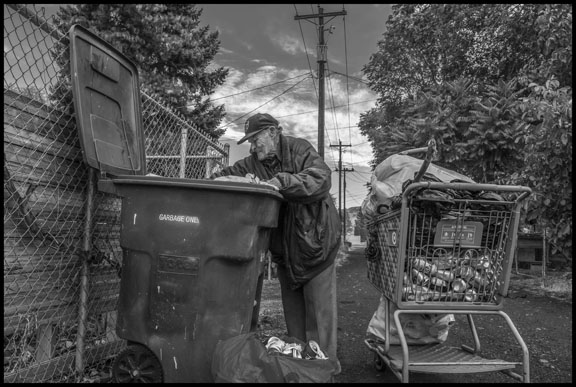
Not all memories of that work are so pleasant, though.  Manuel Ortiz, age 85, came to the US in the 1950s as a bracero. After a lifetime of labor in the fields, today he collects cans to pay his rent.  In Moxee, just a few miles away, Mario Magaña and Martin Gutierrez cut weeds between the rows of tall hop vines, whose fruit will soon be fermenting in the vats of one of the Washington State's many craft breweries.  Their workday is 10 hours of bending over double, swinging a machete.

Long work days, or days of no work at all, were on the minds of hundreds of workers on May Day in this central Washington city. Farm workers marched with activists from the indigenous nation for whom the city is named.  One group of workers, carrying the red flags of the United Farm Workers, came from the Chateau Ste. Michelle Winery.  A few growers and packing shed owners closed for the day, but most workers just took the day off on their own, risking their jobs.

Their growing movement, visible in the streets, is challenging Yakima's old power relations. New city councilmembers - Latinos have won three of seven seats - spoke to the marchers and condemned immigration raids.  As they spoke, detainees in the Tacoma immigrant detention center, just two hours away, organized a hunger strike to protest deportations. 

Others recalled the immigrants executed in Chicago in 1886, when the global movement for May Day was born in the fight for the eight-hour day. Yet in Yakima Valley hop fields the work day is still 10 hours, a hundred years later.

"We need an 8-hour day, but 8-hours with a wage we can live on, and a union," one speaker urged.  "We don't believe in a world of violence and war and prison and unemployment and low wages and deportations.  We can build a better one!  Like the Zapatistas say, 'Un Otro Mundo es Posible!'"


A home in a poor neighborhood of Mexican workers in Yakima.


Rick lives in a tent camp set up by homeless people on the street in downtown Yakima.


Manuel Ortiz has lived in Yakima for 30 years.  He collects cans for recycling to get money to buy food.


Mario Magaña chops weeds growing in the rows between hops vines, before the hops are harvested for making beer.


 Celina Arcos thins fruit on apple trees.


 May Day marchers in Yakima.


Members of the United Farm Workers at Chateau Ste. Michele Winery took off work to come to the May Day march.


 A young indigenous Yakima woman leads the May Day march.


 A rail line leaves Yakima through the gate of the old Boise Cascade plywood mill.

Tuesday, July 25, 2017

HISTORIC STATE FAIR EXHIBIT RECOGNIZES FARMWORKERS

HISTORIC STATE FAIR EXHIBIT RECOGNIZES FARMWORKERS
by David Bacon
Capital & Main, 7/25/17
https://capitalandmain.com/historic-state-fair-exhibit-recognizes-farmworkers-0725


Cutting the ribbon at the farmworker exhibition (left to right): Assemblymember Blanca Rubio, United Farm Workers President Arturo Rodriguez, State Sen. Ben Hueso, Assemblymembers Kevin McCarty and Freddie Rodriguez, Cesar Chavez Foundation President Paul F. Chavez, Assemblymember Anna Caballero, State Fair CEO Rick Pickering (partially obscured), Sacramento City Councilmember Eric Guera, State Sen. Ed Hernandez (partially obscured), State Treasurer John Chiang and Sacramento County Supervisor Phil Serna.


For over 160 years the California State Fair/Cal Expo has been run by growers to showcase the wonders and wealth of the state's agriculture. And for over 160 years the fair did this without mentioning the people whose labor makes agriculture possible: farmworkers.

This year that changed. Rick Pickering, chief executive officer of the California Exposition & State Fair, and Tom Martinez, the fair's chief deputy general manager, asked the United Farm Workers to help put together an exhibit to remedy this historical omission. As a result, for the first time the fair, which runs through July 30, has an exhibition that not only pays tribute to field laborers, but also acknowledges the long history of their struggle to organize unions.


Growers are not happy, and fair organizers got some pushback. But at the ceremony inaugurating the exhibition, State Senator Ben Hueso (D-San Diego), the head of the California Latino Legislative Caucus, explained why they no longer have veto power. "We wouldn't be here without the work of farmworkers," he said. "The legislature now includes members who worked in the fields themselves, or have family who did, who know what it's like to work in 100 degree heat, to suffer the hardest conditions and work the longest hours. We want our families to work in better conditions and earn more money."

Some of the farmworkers who came as guests of the fair were veterans of that long struggle. Efren Fraide worked at one of the state's largest vegetable growers, D'Arrigo Brothers Produce, when the original union election was held in 1975. However, it was only after the legislature passed the mandatory mediation law, forcing growers to sign contracts once workers voted for a union, that the first union agreement went into force at the company in 2007, covering 1,500 people.

D'Arrigo workers maintained their union committee through all the years between 1975 and 2007, organizing strikes and work stoppages to raise conditions and wages. "I'm very proud to see that we're included here," Fraide said, gesturing toward the photographs on the walls in the cavernous exhibition hall. "It shows who we are and what we went through. Si se puede!"


As the workers were introduced by UFW President Arturo Rodriguez, they stood up from their seats to applause. Rodriguez noted that some farmworkers, like those working at Monterey Mushrooms' sheds near Morgan Hill and Watsonville, now make a living wage of between $38,000 and $42,000 in year-round jobs with benefits. "This exhibition recognizes that farm labor is important work, and that it can be a decent job if it includes labor and environmental standards. It can come with job security, and can be professional work," he emphasized.

"What's been lacking is an acknowledgment of the people who do the work," charged Sacramento County Supervisor Phil Serna, son of the capital city's late mayor, Joe Serna, and nephew of former UFW organizer Ruben Serna. "This exhibition documents their political activism. We wouldn't be here if it were not for the farmworkers movement."

Sunday, July 9, 2017

LIVING IN THE SHADOWS - LOS FOTOGRAFOS TOMAMOS PARTIDO

LIVING IN THE SHADOWS
Book Review By Paul Von Blum
Truthdig, Posted on Jun 30, 2017
http://www.truthdig.com/arts_culture/item/en_los_campos_del_norte_20170630


"In the Fields of the North/ En los Campos del Norte"
A book by David Bacon


"When Mexico sends its people, they're not sending their best. . . They're sending people that have lots of problems, and they're bringing those problems with us. They're bringing drugs. They're bringing crime. They're rapists. And some, I assume, are good people."

-Donald Trump, June 16, 2015

We live in a despicable era of racism and xenophobia, fueled by the anti-immigrant fervor of the Trump regime and abetted by right-wing media forces. Mexican immigrants have borne the brunt of much of this public animus, including countless verbal assaults and some egregious examples of physical violence. Few perpetrators of this hostility recognize the long historical origins of their nativist outpourings. Even fewer realize the deep humanity and the powerful suffering of the Latino farmworkers who have come north to the United States to escape grinding poverty and hunger and try to eke out marginal livings for themselves and their families.

A new bilingual book by David Bacon offers both a dramatic antidote to the deplorable reality of racism and a majestic life-affirming view of these hidden women, men and children. "In the Fields of the North" is a landmark fusion of journalism and documentary photography. Bacon is an accomplished writer and photographer, with a long record of union organizing for the United Farm Workers, the United Electrical Workers, the International Ladies Garment Workers Union and others. He has effectively documented the impact of globalization, the degrading conditions of workplaces for many immigrants, the human consequences of migration, the political struggles for workers' and human rights, and many related topics in his books and commentary.

But above all, Bacon is a documentary photographer of extraordinary power, insight and skill. In his introductory comments to the book, he is modest-too modest-about contributing to the long history of socially conscious photography: "I hope my work contributes to this tradition today." I have had the privilege and pleasure of teaching and writing for many years about some of the giant American figures of this tradition, including Jacob Riis, Lewis Hine, Ben Shahn, Dorothea Lange, Margaret Bourke-White, Roy DeCarava and Gordon Parks.

I have followed Bacon's work for decades and it is entirely reasonable to view him as the legitimate heir of these iconic photographic artists. Like these men and women, Bacon professes his deep commitment to the people whose images he celebrates with his camera. He refuses to stand apart from the human beings he photographs and repudiates the absurd notion, which is still popular in some academic and critical circles, that photographers must be objective and neutral. He takes his stand strongly and without ambiguity: "We are not objective but partisan."

Like his distinguished predecessors and contemporaries, Bacon understands that his photographs of immigrant workers, predominantly from Mexico, are part of a broader movement for social change. Like the entire tradition of socially committed art, his works are not merely a decorative adjunct to political protest, but are fully integral to the continuing struggle for justice and dignified lives for immigrant workers in the agricultural fields of the United States. No detached observer, Bacon stands proudly on the side of the people in his book.

In words and images, he narrates the lives, travails and occasional triumphs of mostly undocumented people who have migrated north, often under extremely perilous conditions. He encourages his readers to enter their homes, which too often consist of temporary shelters in desolate regions, of plywood shacks and tents made of tarps, in trailer camps, in vans and cars, or worst of all, nothing but an open space in an agricultural field. Bacon photographs entire families living without basic services. Many must bathe in rivers while others drink polluted water, causing gastrointestinal illnesses and probable long-term serious health consequences. 

Many of these families come from indigenous cultures and speak only their native languages. This further isolates them, not only from other indigenous refugees from Mexico but also from the majority Spanish-speaking refugees from Mexico and Central America. These human beings exist in a dreadful cycle of poverty, moving seasonally throughout California, Oregon and Washington, working the fields for subminimal wages while experiencing horrific racism and exploitation from growers, labor contractors and field foremen.

Readers and viewers of "In the Fields of the North" find its heart in the deeply moving stories and images of the people whom Bacon chronicles so effectively. He allows these disenfranchised workers the rare opportunity to tell their stories about their lives under a system of American feudalism. All the narratives in the volume are powerful and each reader inevitably finds some specific ones especially compelling.

The story, for example, of Rómulo Muñoz Vásquez reveals the harrowing lives of many Mexican migrant farmworkers who lack U.S. documentation. Originally a farmer and later a police officer in Oaxaca, he was unable to support his family. He crossed the border and first rented an apartment in San Diego, but couldn't afford the rent, food and transportation, and still send money back to his family.

Vásquez found a spot under a tree and used nylon tarp to build himself a shelter. He purchased water for a dollar a gallon and he bathed in a stream on the other side of the hill where he "lived." The water was dirty and other residents of this makeshift colony sometimes got sick and sometimes they worked so late that they were unable to bathe at all. He reveals that from his personal experience, many other Mexican migrants died trying to enter the United States, their bodies devoured by coyotes, birds and bears; others were caught by the border patrol, locked up for a few days, and deported to Tijuana.

Bacon relates that shortly after Vásquez told his story, the fascistic anti-immigrant group the Minutemen appeared and threatened the hillside dwellers. Subsequently, county deputy sheriffs removed everyone there, forcing them to find new shelter. This too is a feature of the lives of people living in the shadows as they struggle to support themselves and their families back home.

Lucretia Camacho's story adds another poignant dimension to the book. Bacon titles her narrative with an especially apt phrase: Making a Life, but not a Living. An older woman, Camacho was born in a small indigenous town in Oaxaca, which had a language and culture hundreds of years before the arrival of the Spaniards. She began working when she was 9 years old, picking cotton and other crops in northern Mexico. She began working in the fields of Oxnard, California, in 1985 and continued until very recently. A single mother, she earned paltry wages doing piecework picking strawberries in Oxnard and peppers and tomatoes in Gilroy, California. She became a legal resident in 1989 under the amnesty program.

Her comments about her work speak volumes about the life of America's migrant farmworkers: "The strawberry harvest looks easy enough, but once you try it, it's hard. I don't wish that kind of work on my worst enemy." After a lifetime of backbreaking labor, Camacho suffers from arthritis, osteoporosis and swollen feet-human realities about migrant farmworkers that few privileged Americans, even in California, comprehend when they buy their fruits and vegetables in area supermarkets and elsewhere. Perhaps she is one of Trump's "good people" because of her protracted suffering.

Bacon's more than 300 images in the book are a stunning addition to the body of contemporary socially conscious documentary photography. Many are haunting while others are hopeful, but all represent the fusion of excellent technique and incisive social and political commentary. All reveal the multiple experiences of the marginalized workers who labor anonymously in the agricultural fields of the North.

One of them, memorialized in a striking photograph, is Isabel Pulado, a Mexican immigrant who picks grapes, dates, peppers and other crops in the Coachella Valley. Thirty-two years old and a single mother of three children, her face shows the strains of a hard life that will likely be unchanging. Bacon captures her pain, her resilience and perhaps even her defiance. She epitomizes the antithesis of Trump's repulsive comments during his campaign.

Likewise, Bacon's photograph of Justino Macías repudiates the president's racist remarks, attitudes and policies. A migrant from Mexicali, he lives in a van with a friend, parked next to a highway and an irrigation ditch. A few weeks before Bacon took the photograph, Macías was beaten and robbed, an all too common experience for agricultural migrants, who cannot easily use banks. His facial expression reveals his anguish that far transcends the specific violent act he endured.

Photographs from "In the Fields of the North" also feature people of other national and ethnic groups, including Punjabis, Hondurans and Nicaraguans. And in one dramatic image, Bacon depicts a pregnant African-American woman in Stockton, California, standing in her large apartment complex full of mostly black residents. The complex is grotesque; it is infested with cockroaches and bedbugs, broken fixtures and trash. California Rural Legal Assistance provided help in bringing action against the landlord. This photograph is powerfully reminiscent of the socially critical works of Parks and many other masters who documented the grinding poverty that African-Americans have faced throughout the centuries.

Lest prospective readers and viewers think that this book is little more than gloom and doom about worker exploitation and misery, hopeful signs are apparent as well. Bacon adds many strong photographic images that reveal these workers' commitment to organizing, protesting and rebelling. Their defiance in the face of brutal work and living conditions is a major feature of the book, especially in some of the photographs showing these women and men in poses of impressive solidarity.

Several images stand out; all are superb compositionally, but they are especially valuable for their stirring political content. One photograph shows farmworkers from the Gallo wine ranch in Sonoma County, California, holding hands and singing to protest the company's failure to sign a union contract. These activities are part of the United Farm Workers culture and are reminiscent of the classic era of civil rights activism of the 1960s and 1970s. Bacon captured the workers' facial expressions revealing their energy, resilience and collective strength.

In another photograph, he depicts migrant farmworkers on strike against a large berry grower in Washington state. They are blocking the entrance to the labor camp where they live and carry signs in English and Spanish demanding respect and reinforcing their unity. This is a classic labor image and joins a long tradition of photography and other artistic forms that highlight and support collective worker militancy.

In the same Washington state action, Bacon also photographed several women and children from the labor camp on strike. They are indigenous Mixtec and Triqui migrants from Oaxaca and southern Mexico and reveal different emotions in the image. Some look tired and exhausted and others look hopeful. He captures the range of emotions that inevitably exist in all struggles for workers' rights and social justice.

The new wave of labor activism shown in this dramatic volume is encouraging, especially in the Trump era of increasing repression against Latinos. As recently as June 13, the acting director of Immigration and Customs Enforcement, Thomas Homan, told a House committee that his agency would follow up on Trump's campaign promise to drive out more undocumented immigrants. His words were chilling: "You should look over your shoulder, and you need to be worried."

We need more courageous, socially conscious writers and photographers like Bacon. We need more determined farmworkers who stand up against oppression like those he documented in this book. Above all, we need people to resist the horrific policies of the most dangerous and reactionary government in U.S. history.

_______________________________________


LOS FOTOGRAFOS TOMAMOS PARTIDO
David Bacon: "Los fotógrafos tomamos partido"
Entrevista por Melina Balcázar Moreno
20/05/2017 06:03 AM
Milenio.com Laberinto
http://www.milenio.com/cultura/laberinto/david_baconm-fotografia-melina_balcazar-laberinto-milenio_0_959904035.html


El libro En los campos del norte documenta la ruda cotidianidad de los migrantes a través de un discurso textual y visual. La siguiente conversación gira en torno de la foto como objeto estético.


Thermal, California. Campo agrícola Chicanitas. Una niña montada en su bicicleta. El polvo que abunda en el sitio provoca asma en muchos de los niños. (Foto: David Bacon)

París

En su más reciente libro, En los campos del norte (In the Fields of the North / En los campos del norte, University of California Press/ Colegio de la Frontera Norte, California/ México, 2017), el fotógrafo estadunidense David Bacon (Nueva York, 1948) da cuenta de la compleja realidad social de los trabajadores migrantes en Estados Unidos. Su atención no se concentra únicamente en las dificultades que enfrentan o en la precariedad de sus condiciones de vida, sino que pone énfasis también en sus acciones de resistencia, en su lucha por una vida digna. Durante más de tres décadas, ha seguido paso a paso -tanto gráficamente como a través de testimonios- la vida de quienes han logrado llegar al norte, motivado "por la fuerte convicción del poder de la imagen y de las palabras para impulsar transformaciones".[1] La obra de David Bacon se distingue por su persistencia y determinación por estar presente en los momentos definitorios en la vida de los trabajadores.


Al igual que en sus libros anteriores, como El derecho a quedarse en casa (2015), este libro combina fotografías con entrevistas e historias personales. ¿Por qué esta necesidad de reunir la imagen y el testimonio?

Es una cuestión un tanto polémica. Por lo menos en Estados Unidos, es muy común encontrar en las escuelas de periodismo la ideología de que una imagen tiene que ser completamente autónoma, constituirse en un icono. Todo tiene que ser autorreferencial como si no hubiera necesidad de palabras y la imagen debiera sostenerse por sí misma. A mi parecer, eso forma parte de la despolitización de la fotografía, que consiste en separar del contexto en el que se encuentra tanto el sujeto como el fotógrafo, cuyas intenciones tratan de borrarse de esta forma. Como lo hemos visto en la historia de la fotografía, la misma imagen puede significar diferentes cosas según el contexto. Por ello, creo que es importante establecer el contexto político y, en mi práctica como fotógrafo de la izquierda, mi trabajo conlleva intenciones sociales, por lo que es importante establecer el contexto de las imágenes. Esto lo hago mediante varios medios. Uno de ellos es dar importancia a las palabras que contiene la fotografía. Por ejemplo, en la última foto del libro, se ve a unos niños que están haciendo su propia manifestación, y las palabras que aparecen ahí, "Justicia para todos", son entonces muy importantes, porque son algo que ellos mismos producen, es su propia manera de entender la huelga en la que sus padres están involucrados. El contexto de la foto lo establece además el título que explica en dónde están y lo que ocurría en su entorno en aquel momento.

Así, palabras e imágenes trabajan juntas para crear un documento de la vida de esos trabajadores. Juntas adquieren un poder que ninguna de ellas posee por sí misma. En mi práctica, han influido autores como Studs Terkel, que en su programa de radio en Chicago otorgó un lugar privilegiado a la gente anónima, en sus famosas historias orales. He intentado aprender de él, de su estilo. De ahí que al momento de transcribir las entrevistas que realizo con la gente que fotografío elimine las preguntas, a fin de darle la forma de un testimonio, de restituir su fuerza como historia.

Hay muchos fotógrafos que me inspiran, en particular de la década de 1930, como Otto Hegel y Hansel Mieth, que participaron con sus cámaras en la gran huelga de algodón de 1933 y la huelga de los muelles de la Costa Oeste en 1934, o Matt Herron. Y desde luego fotógrafos como Tina Modotti y Nacho López.

Tengo dos frases favoritas de fotógrafos. La primera es de Alexander Rodchenko: "Debemos tomar fotografías desde todos los ángulos, excepto desde el centro". En la década de 1920, él y sus compañeros fotógrafos en Moscú fueron pioneros en utilizar ángulos extremos, la composición en diagonal y los primeros planos como un medio para sacudir la perspectiva del espectador y liberarlo de la complacencia. Hoy damos por sentadas estas técnicas, pero poco sabemos sobre su origen y propósito original. La otra frase es de Nacho López: "la fotografía no fue pensada como arte para adornar las paredes, sino para hacer evidente la crueldad ancestral del hombre contra el hombre".


¿Vería su trabajo como algo artístico o se concentra más bien en su carácter documental? Pienso en las fotos que dedica a los niños, en particular una en la que se observa a una niña en bicicleta, rodeada de una nube de polvo.

No hay una respuesta sencilla a esta pregunta. Como fotógrafo, tengo un respeto por esa tradición, por ese modo de comunicación, que es también una forma de arte, pues los fotógrafos son artistas, crean imágenes, lo cual implica responsabilidad. Por un lado, busco que las imágenes sean bellas, no soy un fotógrafo que solo se concentra en sus propósitos políticos y descuida la imagen. No hay una contradicción entre propósitos sociales, políticos, y propósitos estéticos. De hecho, la tensión, la relación entre ellos es lo que resulta más emocionante.

Actualmente, lo que fue un vínculo evidente se percibe a menudo como un peligroso conflicto de intereses. El canon dicta que los fotógrafos deben ser objetivos y neutrales y deben mantenerse alejados de la realidad que documentan. Sin embargo, creo que nuestro trabajo adquiere poder visual y emocional de su cercanía con los movimientos sociales que documentamos. No somos objetivos, sino que tomamos partido: documentar la realidad social es parte del movimiento por el cambio social.

Como fotógrafo, entiendo el contexto que estoy capturando. Por ejemplo, en la foto de la niña hay algo de ambos aspectos. Estuve en el campamento agrícola Chicanitas en Thermal, California, porque me interesa ese sitio que concentra muchos trabajadores de los campos. Hay alrededor de 400 remolques. La mayoría vienen de Michoacán, son purépechas. Como conozco bien la zona, el desierto en que se encuentra -ya había estado ahí antes en otras ocasiones por mi actividad como sindicalista-, sé que el lugar puede ser bello pero al mismo tiempo muy problemático para la gente que vive ahí, en especial para los niños que sufren graves problemas respiratorios debido al polvo que aparece en la imagen. Sin embargo, la niña que vemos trata de disfrutar de la vida como lo hace cualquier otro niño y se divierte con su bicicleta. Esta foto combina aspectos positivos y negativos pues su vida es así. No quiero presentar a la gente como víctima, en primer lugar porque no se ve de esa forma. Trato de mostrar la complejidad de su situación, por lo que es necesario recurrir a una leyenda que contextualice y permita profundizar el entendimiento de la foto.


Me parece que en el libro se esbozan dos líneas de reflexión que pueden ilustrar los títulos de los capítulos "Ganando la vida sin vivirla" y "Las cosas pueden cambiar". ¿Cómo se manifiesta su compromiso como fotógrafo? ¿Lo conduce a tomar decisiones técnicas específicas?

Cuando tomo fotos, conservo en mente a Rodchenko y su manera de rechazar la identificación y forzar al espectador a pensar, como lo creía también Brecht. Utilizo los ángulos oblicuos por razones políticas, pero también por el dinamismo que aportan. Cuando se utilizan con una persona en el campo, en los surcos, se muestra su condición de trabajador; es una manera de hacer ver que el trabajador es más importante que el producto. De ahí que tome las fotos de muy cerca y que utilice un lente de ángulo amplio que me permite agrandar a la persona y además incluir el lugar donde se encuentra. Como se trata de un trabajo manual, es importante mostrar las manos, lo que la persona hace con ellas, lo que les ocurre al trabajar. Trato de incluir la información ligada a sus condiciones de trabajo, cómo están vestidos para protegerse, la dificultad, por ejemplo, de trabajar ocho horas continuas agachado. No es fácil tomar esas fotos, porque uno tiene que lograr acceder al campo, conseguir el permiso del capataz -si no lo hago me echan fuera-, pero también de la misma gente. Tengo que mostrarles que, con mi cámara, no soy alguien peligroso.

No olvido que mi propósito es social y que soy solo uno de los innumerables fotógrafos que han tenido este objetivo. Por mi experiencia como organizador sindical, me interesa promover los movimientos sociales de la gente marginada. En otro momento de mi vida lo hice apoyando a la gente a formar sus sindicatos, ahora lo hago utilizando otras herramientas, pero el propósito sigue siendo el mismo: la justicia social.


¿A quién se dirige En los campos del norte?

El libro está en inglés y en español, ya que se dirige a la gente en ambos lados de la frontera. Es el resultado de una coedición, es nuestra respuesta a Donald Trump, nuestra manera de decirle que si él construye muros, nosotros vamos a saltarlos por medio de los libros y de la cooperación. El hecho de que sea bilingüe también se debe a que la gente en el libro lo es. Aunque la mayoría habla español y se encuentra confrontada con el inglés, practica cotidianamente otras lenguas, como el mixteco (de hecho me gustaría poder ofrecer sus testimonios en sus lenguas, es un proyecto que tenemos y esperamos poder realizar en el futuro). Hemos intentado mostrar nuestro respeto por la cultura de la gente que aparece en el libro, representando los diferentes aspectos de sus vidas.

El libro se dirige, desde luego, al público en general, para mostrar una realidad que no es muy visible para la mayoría de la gente, ni en Estados Unidos ni en México. Las fotos aunadas a los testimonios permiten entender mejor la situación de estos trabajadores que dan de comer a todo un país. Es fundamental hacer que el consumidor entienda lo que está detrás de las frutas y verduras que lleva a su mesa. Al mismo tiempo, el libro se dirige a la misma gente que participó en él, que es, de hecho, el producto de una cooperación con ellos, pues la fotografía es un proyecto cooperativo. Es una manera de devolver a la comunidad las imágenes y palabras que nos ha brindado para que a su vez pueda emplearlas en sus luchas y continúe avanzando.

Podría decir que está dirigido también a los estudiantes. Creo que puede contribuir a convencer a los jóvenes para que tomen parte en la lucha social, ya sea como organizadores, fotógrafos o escritores. He constatado que cuando ven que lo que viven se toma en serio, ellos mismos tienen ganas de hacer algo con sus vidas.

Finalmente, podría decir que se dirige a los fotógrafos. De cierta manera es un libro polémico, porque la verdad es que la fotografía ligada a los movimientos sociales no es muy popular en Estados Unidos. Los grandes museos como el Whitney, el MoMA de New York o de San Francisco no se interesan por este tipo de foto; están todavía muy embelesados con el posmodernismo y no quieren nada que tenga que ver con lo social. Trato de aportar mi voz a ese debate y recalcar que la foto tiene un objetivo, un efecto real, y que no es justo hacer de lado la fotografía social documentalista y marginada al afirmar mediante políticas culturales que lo único que vale la pena ver es todo aquello que no está ligado a los movimientos sociales. No hay que olvidar que las tradiciones de fotografía social en Estados Unidos y México han estado muy ligadas. Aunque sean claramente diferentes, siempre ha existido un intercambio de experiencias, desde los años 1920, en el que busco inscribirme. Hay que fomentar, explorar y popularizar todo lo que compartimos porque eso nos hace más fuertes.


¿Cree que su trabajo se verá afectado con la presidencia Trump?

He sido también activista en el movimiento pro-inmigrante desde hace casi 40 años. Nos estamos preparando ahora para una nueva ola de represión debido a las medidas de Trump, que traerán consigo más redadas, arrestos, deportaciones. No es que no hayamos confrontado este problema durante la administración Obama, que multiplicó los centros de detención. Hubo 12 millones y medio de deportaciones en los últimos ocho años, pero ahora es claro que el problema se agudizará. Estamos organizando a la comunidad, intentando proteger a los trabajadores indocumentados para respaldarlos y defenderlos y veo que lo mismo ocurre en todo el país, lo que me da esperanza y ánimo.

Creo que el trabajo de documentación social es hoy más importante que nunca, ya que vamos a enfrentar una ola de propaganda que proclamará que lo único que importa es el dinero, ser rico. Necesitamos rechazar esa mitología y mostrar la realidad del país. La documentación fotográfica es también una herramienta para conseguir justicia social y vamos a necesitarla aún más porque la situación de los trabajadores se agravará.


[1] Ana Luisa Anza (Claroscuro), en su prefacio al libro, "Nos permite estar presentes de primera mano".

Monday, June 26, 2017

A NEW FARM WORKER UNION IS BORN

A NEW FARM WORKER UNION IS BORN
Indigenous Oaxacan farm workers win themselves a union in the Pacific Northwest.
By David Bacon
The American Prospect, June 26, 2017
http://prospect.org/article/new-farm-worker-union-born


Danny Weeden signs the contract as Ramon Torres looks on


Bob's Burgers and Brew, a hamburger joint at the Cook Road freeway exit on Interstate 5, about two hours north of Seattle, doesn't look like a place where Pacific Northwest farm workers can change their lives, much less make some history. But on June 16, a half-dozen men in work clothes pulled tables together in Bob's outdoor seating area. Danny Weeden, general manager of Sakuma Brothers Farms, then joined them.

After exchanging polite greetings, Weeden opened four folders and handed around copies of a labor contract that had taken 16 sessions of negotiations to hammer out. As the signature pages were passed down the tables, each person signed. Weeden collected his copy and drove off; the workers remained long enough to cheer and take pictures with their fists in the air. Then they too left.

It was a quiet end to four years of strikes and boycotts, in which these workers had organized the first new farm-worker union in the United States in a quarter-century-Familias Unidas por la Justicia (FUJ).

The union itself will not be like most others. At the ratification meeting held the previous night, many of the people packed into the hall of Mt. Vernon's Unitarian Church spoke with each other in Mixteco or Triqui. Members of Familias Unidas por la Justicia come originally from towns in Oaxaca and southern Mexico where people speak indigenous languages that were centuries old when the Spanish colonized the Americas.

"We are part of a movement of indigenous people," says Felimon Pineda, FUJ vice president. An immigrant from Jicaral Cocoyan de las Flores in Oaxaca, he says organizing the union is part of a fight against the discrimination indigenous people face in both Mexico and the United States: "Sometimes people see us as being very low. They think we have no rights. They're wrong. The right to be human is the same."

According to Rosalinda Guillen, director of Community2Community, an advocacy organization that helped the workers organize, "Indigenous culture plays a huge role, especially people's collective decision-making process. The strong bonds of culture and language give the union a lot of its strength."


Sakuma Brothers Farms hires about 450 workers every year to pick its strawberries and blueberries from June through October, in its fields in Burlington and Mt. Vernon, Washington. About half live in the local area, and half come north for the picking season from Santa Maria, Madera, Livingston, and other farm-worker towns in California. The migrants from the south live in the company's labor camps for the duration of the work.

Almost all Sakuma workers arrived from Mexico years ago, and have been living in the United States ever since.

Almost all Sakuma workers arrived from Mexico years ago, and have been living in the United States ever since. They depend on this seasonal job picking berries for a large part of their yearly income.

In 2013, workers grew angry about a low piece rate and bad conditions in the labor camps, and protested to company managers. One was fired and told to leave the camp where his family was living. The rest of the company's workers then stopped the harvest to get his job and housing back. In the weeks that followed they began negotiating with the farm's owners, the Sakuma family. They elected a committee to speak for them, which became the nucleus of Familias Unidas por la Justicia.

In the course of negotiations, the workers discovered that the company had recruited 78 laborers in Mexico, and brought them to the United States under the H2A visa program. These contracted workers could only work for the employer that recruits them, and could only stay for the duration of a work contract limited to several months, after which they had to return to Mexico.

"In 2013, the wages for the H2A workers were $12 an hour, and our wages were $9.37," says Ramon Torres, one of the original strikers. "When we found that out, our first demand was that we get the same pay."

Under the H2A program rules, employers have to show they can't find workers in the United States before they can recruit contract workers abroad. After the 2013 picking season ended, Sakuma Farms sent letters to the workers involved in the work stoppages, saying they'd been terminated for missing work. The farm then applied to the Department of Labor for visas to bring in 479 workers-enough to replace its entire workforce.

Torres calls this a watershed moment for the workers, whose response to Sakuma's visa request was brilliantly effective. "We wrote letters, to prove to the government that we were ready to work. When people heard that the company was saying that they couldn't find any workers, everyone signed the letter. Everyone. We filled out 489 letters."

After union members and supporters handed in the letters at Department of Labor offices in San Francisco, Seattle, Washington, D.C., and Chicago, the company withdrew its application. With no H2A workers to pick the berries, it was forced to rehire the strikers for the 2014 season. "That made our members even stronger in their support for the union," Torres says. "Everyone understood then that the company wanted to replace us, and that we needed a union to protect ourselves. That made our struggle easier."


Because Torres, who hails from Guadalajara, speaks Spanish, his coworkers, many of whom only speak Mixteco, asked him to be their spokesperson during those first negotiations. Then they elected him president of Familias Unidas por la Justicia. Today they call him "Homie," a joking way of saying he shares their life even if not their indigenous culture. When the company fired him in 2013, they remained fiercely loyal; Pineda even quit his own job in solidarity.

In those 2013 negotiations, Torres and the FUJ committee proposed a way to calculate the piece rate that was simpler than the company's system, and that would produce an average wage of $12 an hour for most workers. The company began to use it. But when workers' earnings jumped, the company discarded the new way. Over the next four years, workers then mounted work stoppages to force increases in the piece rate.

"Strikes were the easiest way for us to get the company's attention," Torres says. "We didn't have any other way. And strikes helped develop people's understanding that if we had a union contract, we'd be stronger. Even if we won an increase in the piece rate one day, the company could lower it again the next day. It was a way for us to win over the people."

When negotiations broke down in 2013, FUJ-resurrecting a tactic from Cesar Chavez's efforts to organize California's farm workers-organized a boycott of the company's berries. "At first the boycott was against Sakuma," Torres recalls, "and we were able to get their berries taken off the shelves in the markets. Then we saw in the fields that the boxes of the berries didn't have Sakuma's label on them anymore. They had the Driscoll's Berries label instead."

As the union began boycotting Driscoll's, it set up committees of supporters in cities in Washington, Oregon, and California. Some committees depended on students to picket stores, while others relied on support from other unions. Members and supporters of FUJ also organized a series of marches (invariably passing by Bob's Burgers and Brew) to Sakuma's offices, demanding that Driscoll's acknowledge their right to better wages and a union contract.


A worker votes to ratify the contract.


At many of those marches, Jeff Johnson, secretary of the Washington State Labor Federation, AFL-CIO, spoke in support of the farm workers. Other unions helped. "One day the longshore union even refused to load Driscoll's fruit onto a ship, and left it sitting on the dock," Torres remembers.

Driscoll's became a target of farm workers in Mexico as well. In 2015, thousands struck fields in Baja California, where a Driscoll's subsidiary, BerryMex, is the largest berry grower. Those workers also come from indigenous towns in Oaxaca. Many Sakuma workers have family members working in Baja's San Quintin Valley, and worked there themselves before coming to the United States. The boycotters demanded higher wages and better conditions for workers in both countries.

The alliances supporting the workers also included an organization of indigenous migrants with chapters in Oaxaca, Baja California, and California-the Binational Front of Indigenous Organizations (FIOB in its Spanish initials). As soon as the strike started in 2013, FIOB's binational coordinator, Bernardo Ramirez, flew in from Oaxaca to help. His presence dramatized the strike's importance in Mixteco and Triqui communities. After a meeting at the FIOB office in Fresno, California, the organization helped collect letters from those Sakuma workers who live in California, and travel to Washington for the harvest every year. That helped thwart the farm's attempt to bring in H2A replacements.

In the fall of 2016, Sakuma Brothers Farms finally announced it was willing to sit down with Familias Unidas por la Justicia, if workers showed they supported the union in an election. There is no law in Washington state like that in California, establishing a process for union elections for farm workers. FUJ and its lawyers had to negotiate a memorandum of understanding with Sakuma, laying out a process for voting.

Torres and Guillen are sure that the reason why Sakuma decided to negotiate was pressure from Driscoll's.

On September 12, 195 workers voted for the union and 58 against. The company refused to allow the votes to be counted on its property because Torres was present, and the tally was made instead on the bed of a pickup truck in a nearby schoolyard.  Commenting on the scope of the communities that supported the workers' efforts, the AFL-CIO's Johnson called it "as much a public victory as a union victory."

Contract negotiations then started between FUJ and Sakuma managers. The new union relied on another labor supporter, Jason Holland of the Washington Public Employees Association, a local unit of the United Food and Commercial Workers. "We'd never done this and didn't know how to negotiate a contract," Torres says. "But our members learned who we really were in relation to the company. And in the end we got a lot of what we wanted."

Primary among the union's gains in this new contract is the re-establishment, in effect, of the piece-rate system Torres designed four years earlier. Three workers chosen by the union will go into a field to make a "test pick" before the work starts. Depending on the amount of fruit and field conditions, a piece-rate price is then set so that an average worker can make the equivalent of at least $15 per hour. All workers are guaranteed a $12 hourly minimum.


Danny Weeden and Ramon Torres shake hands


When the system was explained at the meeting before the ratification vote, there were many questions. "It's a complicated system and I want to understand it better," said picker Josefina Ortiz. "I'm a slow picker, and I don't make much. We always want the company to pay more, and the company is always trying to lower the price to make us work hard. We hope we'll make better [wages] with this new system."

"The most important thing for us was the wages," Torres responded. "Our main vision for the contract was to achieve a fair wage of $15 that you could earn without killing yourself. And that was what we won."

The implementation of any new contract is a difficult process, requiring the company to change old methods, and to recognize the authority of the union. After the first test pick following the signing of the agreement, the union had to file its first grievance, saying the process wasn't being implemented fairly. Now, however, there is a grievance procedure in place, supplanting the workers' previous practice of striking over rates they didn't like.

In addition, the contract contains other protections for workers. One provision requires a just cause for any discipline-a sensitive issue given the firings that took place during the four-year campaign. Eight union representatives will be able to represent members in grievances. A seniority system will ensure that workers doing the work this year will be able to return in following years. The contract will last two years, and a labor-management committee will try to draft a retirement plan for workers by the end of that period.

FUJ members, meanwhile, are filled with ideals, starting with their own organization.

FUJ members, meanwhile, are filled with ideals, starting with their own organization. Its principles for organization sound like those of radical unions throughout U.S. history. Union leaders should be workers, and the rank and file should make all decisions. No leader or staff member should have a salary higher than a worker in the fields. The union shouldn't accumulate property and large bank accounts. "If there's money in the union bank account after ten years, it will be given back to the members," Torres promises. "We don't want rich unions and poor workers."

FUJ members' vision extends beyond the limits of their contract and the structure of their union. They also are planning to acquire land and set up a cooperative farm. They see their union as part of a larger community, and while its members are immigrants, they are not just temporary residents. Over the past four years, Guillen especially has fought the stereotype of immigrant farm workers as transient, unskilled labor. "We've always felt that we are invisible people. We're treated as disposable, and it's time to end that," she asserts. "We're human beings and we're part of the community."

From the beginning, workers on other farms on Washington's Pacific coast with the same dissatisfaction with low wages have talked quietly with Sakuma workers. Many share the indigenous culture of FUJ members. Sakuma Brothers Farms will now have a wage level substantially above the surrounding growers, and FUJ plans to use that to inspire other workers to set up their own independent unions, Torres says.

"That's the priority-to raise our living standards. We know the contract will change our lives. Now, if we make a little more, our children will have other possibilities. It's not that we want to take them out of the fields, but we want them to have opportunities other children have."

Predicted Tomas Ramon, a member of the union negotiating committee: "Things won't be the same as they were before. We're a recognized union now, and everything will be different." To make that difference real, over the next two years FUJ will have to train workers to enforce their own contract at Sakuma Brothers Farms. And to survive, the union will have to help workers organize on other ranches as well. That will require confronting the growing use of H2A workers in Washington state, whose numbers have increased from 2,000 to more than 13,000 in the last five years.

Fifty years ago, the United Farm Workers was built by thousands of farm workers in fields across California, who believed the union spoke for their needs, whether or not they were working under a union contract. Today on the Washington coast, a growing number of field laborers look at FUJ in the same way. It is a small union, with very limited resources. But if it speaks for the needs of Washington farm workers, and those who migrate north from California every season, FUJ, too, may inspire a movement far beyond its own numbers.

Saturday, June 24, 2017

FIGHTING FOR THE SANCTUARY WORKPLACE

FIGHTING FOR THE SANCTUARY WORKPLACE
Unions Mobilize to Protect Undocumented Workers
By David Bacon
Truthout | Report 6/24/17
http://www.truth-out.org/news/item/40964-fighting-for-the-sanctuary-workplace-unions-mobilize-to-protect-undocumented-workers


 Local 2850 organizers and activists take part in an anti-Trump march in Oakland, California, after Trump's ascension to the presidency. (Photo: David Bacon)


Sanctuary churches. Sanctuary schools. Sanctuary cities.

Sanctuary workplaces?

Albeit far from its intentions, the Trump administration has put the idea of sanctuaries on steroids -- spaces free from the threat of raids and deportations. As immigrant workers, unions and their allies look for creative ways to counter anti-immigrant onslaughts, they're adopting the sanctuary framework to deal with the dangers faced on the job.

This is not just a recent response to administration threats of increased enforcement. Immigrant workers have been battling jobsite raids and firings for many years, seeking ways to prevent la migra (immigration agents) from using their employment to sweep them into the enforcement net. Says Wei-Ling Huber, president of UNITE HERE Local 2850, the hotel union in the East Bay area of northern California, "When we go to work, we should be valued for the contributions we make, and we should be able to do our jobs free from fear of deportations."

Those contributions should be obvious. One in every ten workers in California is undocumented. So are over half the nation's farm laborers and 9 percent of its restaurant workers.

In April, Huber's union went before the Oakland City Council, asking for a policy that would protect immigrants on the job. The council passed a resolution, noting it has been a "City of Refuge" since the anti-apartheid movement of the mid-1980s, a policy reaffirmed last November, just days after Trump's election. "The City Council ... calls upon all employers to establish safe/sanctuary workplaces where workers are respected and not threatened or discriminated against based on their immigration status," the measure stated.

Local 2850 wanted the statement as a way to define public policy, but actual implementation of an enforcement-free workplace requires more than resolutions. Ten years ago, the union headed a fight in next-door Emeryville, when the Woodfin Suites, a hotel in the southern California-based chain, fired 12 immigrant women housekeepers. Emeryville had just passed a living-wage ordinance for hotel employees, and at the Woodfin Suites workers demanded its enforcement. The hotel accused the 12 women of not having legal immigration documents, and protests over the retaliatory firings went on for four years. Eventually the company had to pay several hundred thousand dollars in back pay. In the process, the Emeryville City Council became committed defenders of the housekeepers.

Moving further toward making the sanctuary workplace a reality, Local 2850 began negotiating protections into union contracts. The union is trying to make one key provision a standard, which cautions that "Should a federal immigration agent or a Department of Homeland Security agent demand entry into the Employer's premises or the opportunity to interrogate, search or seize the person or property of any employee, then the Employer shall immediately notify the Union by telephone to the union's office. Except as required by law, the Employer shall not permit the agent(s) to enter the premises without a valid warrant."

The contract prohibits retaliation against workers because of their immigration status. Once the hotel accepts the documents provided by workers when they're hired, it can't go back later and use the government's E-Verify database to revisit their immigration status.

The need for this was evident in a recent change in one hotel's ownership, when the new owners wanted all the employees to submit new evidence of their legal status. The workers banded together and refused, thus protecting anyone who might have trouble doing so. The company backed down, and everyone went back to work. In San Francisco, when another boutique hotel chain changed hands, UNITE HERE Local 2 mobilized community pressure to stop the new owners from similarly re-verifying workers' immigration status.

At issue is a provision of the 1986 Immigration Reform and Control Act, which, for the first time in US history, prohibited employers from hiring undocumented workers. The law required employers to verify workers' immigration status when they are hired, and led to the creation of the huge E-Verify database of all workers' immigration status.

After 1986, undocumented workers could no longer apply for Social Security numbers. Since then, to get hired, workers without papers have made up numbers or used those of other people. Employers deduct contributions from their paychecks for Social Security -- about $13 billion/year. But workers without papers can't collect the benefits the contributions pay for. In the meantime, the government uses the discrepancy in numbers as a tool for immigration enforcement.

Another purpose, therefore, of the sanctuary workplace is to prevent Immigration and Customs Enforcement (ICE) agents from using Social Security numbers to identify undocumented workers and force employers to fire them. In some cases, ICE (and its predecessor, the Immigration and Naturalization Service) have even sent workers to federal prison, charging that providing a bad Social Security number constitutes "identify theft."

In Local 2850's contract language, hotels can't terminate workers simply because Social Security questions their numbers -- a protection won by San Francisco's Local 2 several years ago. And if undocumented employees gain legal status, and a new valid number, the company must recognize their continuing seniority and job rights. Workers are even given a paid holiday on the day they're sworn in as new citizens.

The strategy used in the Oakland resolution, and unions' contract language, has also become the basis of a bill introduced into the California state legislature, at the initiative of the SEIU United Service Workers West -- the union for janitors, security guards and airport workers. AB 450, the Immigrant Worker Protection Act, requires employers to ask for a judicial warrant before granting ICE agents access to a workplace. It prohibits employers from sharing confidential information, like Social Security numbers, without a court order. This bill also says employers must notify the state Labor Commissioner if ICE demands employee information.

United Service Workers West, like the hotel unions, also has a history of fighting workplace immigration raids and firings. In 2011 Los Angeles janitors sat down in city intersections to protest immigration-based firings by Able Building Maintenance. The union fought similar firings in Stanford University cafeterias, and among custodians in the Silicon Valley buildings of Apple and Hewlett-Packard. UNITE HERE members in San Diego mounted a hunger strike outside the Hyatt Hotel over the same issue. Over 200 Molders Union members in Berkeley at the Pacific Steel foundry fought firings for almost a year.

A number of unions are beginning to train workers to act together on the job to resist raids and firings. This spring, in a session organized by the International Longshore and Warehouse Union (ILWU), Filipino Advocates for Justice and several other groups, workers acted out scenarios that used job action to protect each other. ILWU members from a local recycling company, Alameda County Industries, dramatized their own strike three years ago, when they stopped work to keep the company from firing employees for not having papers. In another skit, they suggested that workers take action to demand that their boss bar ICE agents from the workplace, if they have no court order. Other unions described their experiences over the past decade in organizing workers to fight off raids and firings.

As a result of this activity, unions with a significant membership of immigrants, and a history of fighting to defend them, were very visible in May Day's "Day Without Immigrants" marches. Many had participated in the crowds that shut down airports in January, in response to Trump's attempted ban on migrants and travelers from Muslim countries. As workers did in 2006 -- when marches protested a bill in Congress to make undocumented status a federal felony -- marchers this year protested similar threats from Attorney General Jeff Sessions.

In a highly publicized event in April on the Arizona-Mexico border, Sessions told the press that enforcement would now prioritize identity theft, among other factors. "And it is here that criminal aliens, and the coyotes, and the document-forgers seek to overthrow our system of lawful immigration," he announced. By employing phrases like "identity theft" and "document-forgers," Sessions once again treats giving a bad Social Security number to an employer as a criminal offense. The Pew Hispanic Center estimates that over 8 million undocumented people are in the workforce, working under bad numbers, making them potentially subject to these charges.

Anger over workplace enforcement actions has a long history in California. One of the first battles took place at the Kraco car radio factory in the early 1980s. In an action that preceded the sanctuary debate by over 30 years, workers joining the United Electrical Workers stopped the plant to force the owner to deny entry to immigration agents. Later that decade, the Molders Union Local 164 in Oakland joined the Mexican American Legal Defense and Educational Fund in suing the Immigration and Naturalization Service over its practice of having agents bar the doors of factories, holding workers prisoner, and then interrogating them and detaining those without papers. The case went to the US Supreme Court, which found the practice unconstitutional.

In the Day Without Immigrants actions, unions and immigrant rights organizations sought to tap into this history, and linked the sanctuary workplace to the enforcement of labor rights in general. Sixty workers from Oakland and Emeryville hotels left their jobs and picketed the site of a proposed new hotel that has refused to guarantee workers' freedom to organize. After tearing down a symbolic "Trump wall," they joined the main May Day march.

In New York City, immigrant workers at one of the world's largest suppliers of photography materials, B&H Photo Video, struck for the day, protesting a plan to relocate 330 jobs from Brooklyn, New York, to Florence Township, New Jersey. Workers have been trying to negotiate a union contract with the help of the Laundry Workers Center and the United Steel Workers, and they have accused the company of using the move to punish workers for their union support.

A thousand people marched in Yakima, in the heart of central Washington's apple orchards. Most were farm workers who had taken off work for the day, including a large contingent from the Chateau Ste. Michelle winery who belong to the United Farm Workers. Some workers were released for the day by their employers at local packing sheds. Mike Gempler, executive director of the Washington Growers League, criticized the Trump administration, calling officials like Sessions "very zealous." Trump's enforcement program, he said, "will economically destroy much of the agriculture industry, and I think we will also end up treating people unfairly."

And a week after May Day, the country's newest farm worker union, Familias Unidas por la Justicia, marched 17 miles from Lynden to Bellingham in Washington. In addition to protesting Trump's anti-immigrant policies, farm workers demanded that Washington grower Sakuma Brothers Farms sign a union contract. The union mounted a three-year boycott of Driscoll's Berries, which markets the berries they pick for Sakuma. Combined with strikes in the fields, the boycott forced the grower to agree to a union election, won by workers last September. Their march coincided with a hunger strike by immigrants held in Tacoma, Washington's Northwest Detention Center. Familias Unidas por la Justicia has a history of support for the center's detainees, in part because they are forced to do all the work at the privately-run prison (except guarding themselves), at an illegal wage of $1 a day.

In the mobilizations around May Day, support grew on a national level for immigrant workers facing raids. Four unions (Communications Workers of America, Amalgamated Transit Union, National Nurses United and the United Electrical Workers) sent out a letter urging workers and labor activists to participate in the Day Without Immigrants strikes and marches.

"As leaders of the unions who supported Bernie Sanders for president, we refuse to go down that road of hatred, resentment and divisiveness," they declared. "We will march and stand with our sister and brother immigrant workers against the terror tactics of the Trump administration."

Over a month later, the Trump administration appears strangely reluctant to implement Sessions' threats on a wide scale in the nation's workplaces, but organizers are far from declaring victory. According to Agustin Ramirez, an organizer for the International Longshore and Warehouse Union in California, "The threats from Trump tell us this is coming. We just don't know when."

Thursday, June 22, 2017

THE APPLE PICKERS OF THE YAKIMA VALLEY

THE APPLE PICKERS OF THE YAKIMA VALLEY
A photo essay by David Bacon
The Atlantic, 6/22/17
https://www.theatlantic.com/business/archive/2017/06/apple-pickers-yakima-photo-essay/530967/


Even after having worked as a farmworker for a few years, Eva Chavez still had trouble coping with how exhausted she was after a day of picking apples. "I'd barely make it home because I was so tired," she remembers. "I'd just park the car outside my house and sleep in the car. I didn't even want to go inside."

She saw her fellow farmworkers get similarly worn down. She said she worried when she saw someone in charge of a job distribute pain pills and Coca-Cola. Some of her friends drank cans of Red Bull or Monster Energy so often that if they stopped, they got sleepy and lost their motivation to work. "We put our lives out there in the fields for a job that will never give our health back," says Chavez. Another farmworker I talked to, who once picked tobacco on a farm in Kentucky, said that the exposure to the nicotine in the leaves left him with a sensation "like a hangover multiplied by 10."

For decades, farmworkers living in Washington like Chavez have been an integral part of the state's fruit production, which includes apples, apricots, and berries. Once she gained experience, Chavez could pick as many as 10 4x4x3-foot bins of apples a day.

The prevailing pay for picking a bin, according to Washington's Employment Security Department, ranges from $20 to $28, depending on the variety of apple. Although this price rate is higher than when Chavez started more than a decade ago, the state reports that the average farmworker earned just under $25,000 in 2015. That's usually only enough to rent a trailer or a run-down home.

Many farmworkers try to save up as much as they can to support their families back in Mexico. There, pay for a day's work on a farm might yield 110 pesos, or about $6; the average hourly wage for apple pickers in Washington's Yakima County, the county that produces the most apples in the U.S., is $13.46.

However, the immigrant farmworkers who have lived in Washington for years are no longer sure to get the work that has historically sustained rural communities such as Wapato, Yakima, and Royal City. Growers are increasingly recruiting Mexican workers to come to the U.S. on H-2A visas, which let them work on contract for a few months, but only for the employer that sponsored them.

If they are laid off (for protesting working conditions, for instance), they lose their visa and must leave the country. The H-2A is an arrangement that growers say they prefer because it gives them a steadier supply of labor. In 2006, Washington growers brought in 814 workers on H-2A visas, mostly to pick apples. Last year they brought in 13,641-about a quarter of the state's farm labor force that year.

At recruiters' instructions, contract workers assemble by the hundreds in centrally-located cities in Mexico, and board company buses heading north. Once they arrive in Washington, many live four to a room, with bunk beds, in the prefab barracks that growers have built. Some are arranged around soccer fields, and most are built in the countryside, in the orchards themselves, among blossoming apple trees. The workers come up on buses and don't have cars of their own, so if they want to go into town, they depend on the grower to provide transportation.

Men, women, and families are well represented among the population of resident farmworkers in Washington. The H-2A contratados, though, are almost all men. Their growing number is making the workforce more male in an industry in which sexual harassment is all too common. Chavez mentions hearing of cases in which men higher up on a job were charged with rape, and says she was careful not to wear tight pants or blouses.

"Women wear loose clothes and cover their faces," she says. "They don't want to show anything so they won't be seen as objects." When she worked in the fields, Chavez could never say openly that she is gay. "It's not that I don't want to talk about my sexuality," she explains, "but sometimes people are just so closed-minded that they cannot understand. Sometimes there are even men who have this devil's thinking, that, 'Oh, you're gay-I'm gonna make you a woman.'"

For the H-2A farmworkers, some of the deepest pain doesn't come from the physical work, but the loneliness of being away from home. In the evening, groups of men walk around the grassy space between the barracks, or sit with their backs against the buildings' walls, talking on their cellphones to their families back home.

"I miss my wife," says Sergio Alberto Ponce, an H-2A visa holder who lives in a workers' camp near Royal City. "I've never been apart from her before. We still sleep in each other's arms. But here I call her every day. She'll send me a text, and then I'll call her the next chance I get-in a break at work, or at lunch."

Scenes from the daily lives of farmworkers in central Washington are depicted in the images below, which were taken in the spring and summer of 2016 and the spring of 2017.


Carlos Gutierrez and Eduardo Lopez, two H-2A contract workers recruited in Mexico, string up wire supports for planting apple trees. (David Bacon)


Juana Rivera, an immigrant from Michoacan, Mexico, thins apple blossoms, so that the remaining blossoms will grow to a large size. Rivera taped up her fingers because the work has made them raw. (David Bacon)


These apple trees are planted on trellises so that they'll have enough light and space to grow, and so they'll be easier to harvest. (David Bacon)


Maria Romero, an immigrant who lives in the Yakima Valley, pulls apricots from the bunches on a tree, so that the fruit will have space to grow. (David Bacon)


Jose Luis Cocia, an immigrant from Michoacan, works on a ladder in an apricot orchard. When reaching some high branches, losing his balance could mean a fall of as much as 15 feet. (David Bacon)


Juan Infante, a Mexican immigrant who lives in the Yakima Valley, thins the fruit on Red Delicious apple trees. (David Bacon)


H-2A contract workers in the kitchen of the barracks where they were living while picking cherries and thinning apple blossoms. (David Bacon)


Francisco Ramos, an H-2A visa holder, holds up his phone, on which he has several pictures of his wife and children, who live in Oaxaca, Mexico. He usually calls them after work. (David Bacon)


B. Mendoza Vasquez, an H-2A contract worker, sits on a bed in the room he shares with three other workers in a dorm built by his employer. (David Bacon)


Sergio Alberto Ponce, an H-2A contract worker, in the kitchen of his employer-provided dorm. (David Bacon)


Two H-2A guest workers grill carne asada outside their dorm. (David Bacon)


A house in a neighborhood in Yakima, Washington, where many Mexican immigrant families live (David Bacon)


Farmworkers at the Chateau Ste. Michelle winery, near Seattle, left work to march through Yakima as part of the "Day Without Immigrants" protests. (David Bacon)


Eva Chavez, a former farmworker, in Toppenish, Washington. Chavez came from Manzanillo, Mexico, when she was 18. She recently graduated from Central Washington University, which she attended while also working in the fields. She now works for a marketing agency. (David Bacon)


Manuel Ortiz collects cans and bottles to recycle. Ortiz came to the U.S. from Mexico as a bracero in the late 1950s, and spent decades working on farms in California and Washington. Today he is 85 years old and can no longer work in the fields, so he earns money by redeeming cans and bottles. (David Bacon)


Manuel Ortiz's hands show a lifetime of work. (David Bacon)

This story was produced with support from the Economic Hardship Reporting Project.

Thursday, June 1, 2017

THE RETURN OF WORKPLACE IMMIGRATION RAIDS

THE RETURN OF WORKPLACE IMMIGRATION RAIDS
BY David Bacon
Capital and Main / The American Prospect, 4/27/17
https://capitalandmain.com/fire-and-ice-california-gets-ready-for-workplace-immigration-raids-0426
http://prospect.org/article/fire-and-ice-return-workplace-immigration-raids


SAN FRANCISCO, CA - David Huerta, President of United Service Workers West, SEIU, speaks at a meeting of San Francisco janitors and other workers supporting AB 450, a bill protecting workers during immigration raids and enforcement actions. 


At the end of February immigration agents descended on a handful of Japanese and Chinese restaurants in the suburbs of Jackson, Mississippi, and in nearby Meridian. Fifty-five immigrant cooks, dishwashers, servers and bussers were loaded into vans and taken to a detention center about 160 miles away in Jena, Louisiana.

Their arrests and subsequent treatment did more than provoke outrage among Jackson's immigrant rights activists. Labor advocates in California also took note of the incident, fearing that it marked the beginning of a new wave of immigrant raids and enforcement actions in workplaces. In response, California legislators have written a bill providing legal protections for workers, to keep the Mississippi experience from being duplicated in the Golden State.

Once the Mississippi restaurant workers had been arrested, they essentially fell off the radar screen for several days. Jackson lawyer Jeremy Litton, who represented three Guatemalan workers picked up in the raid, could not get the government to schedule hearing dates for them.  He was unable to verify that the other detained immigrants were being held in the same center, or even who they were.

The Geo Corporation, formerly known as the Wackenhut Corporation, operates the LaSalle Detention Facility in Jena. Geo's roots go back to the Pinkerton Detective Agency, which became notorious in the nineteenth and first half of the 20th century for violent assaults on unions and strikers.

Today Geo operates 16 immigrant detention centers around the country, according to its 2015 annual report. It runs privatized prisons as well, some of which have been investigated by the federal government after allegations of bad conditions and understaffing. The LaSalle facility has 1,160 beds. Litton says it is normally full, so taking in an additional 55 detainees would result in severe overcrowding.

The use of Jena's immigrant jail to hold workers detained in workplace raids has a bitter history in Mississippi. In 2008 481 workers were arrested at a Howard Industries electrical equipment factory, in Laurel, Mississippi, in the middle of union negotiations. They, too, were taken to the LaSalle detention center. There they were fed peanut butter sandwiches at mealtimes, and according to Patricia Ice, attorney for the Mississippi Immigrant Rights Alliance (MIRA), “There weren’t even enough beds and people were sleeping on the floor.” Eight workers detained in that raid were charged with aggravated identity theft in federal court, for having given a false Social Security number to the employer when they were hired.

“This latest raid is causing a lot of fear in our community,” says MIRA director Bill Chandler.  “There's fear everywhere now because of the threats from Trump, but here in Mississippi our history of racism makes fear even stronger.”

Agustin Ramirez, an organizer for the International Longshore and Warehouse Union in California, told me that the Mississippi raids have heightened fear among West Coast immigrants, too. “What we have seen in the past, and the threats from Trump, tell us this is coming. We may not have had a raid like this here yet, but we can see the sky is dark, and we know it's going to rain. We just don't know when.”

In California, with many times the immigrant population of Mississippi, the potential impact of workplace raids is enormous. Of the nation's estimated 11 million undocumented immigrants, over 2.6 million live in this state—almost one in every 10 California workers is undocumented. They make up almost half of its farm workers, and over 20 percent of its construction workers. The National Restaurant Association says that of the country's 12 million restaurant workers, 9 percent are undocumented, while the Restaurant Opportunities Center estimates that in large cities they make up almost half of that industry’s workforce.

The legislative response in California came from United Service Workers West (USWW), the union for janitors, security guards and airport workers affiliated with the Service Employees International Union. “We want to lead the nation with the strongest resistance efforts to protect workers, not just in the community, but in the workplace,” explained David Huerta, USWW’s president.

In cooperation with labor attorney Monica Guizar, USWW worked with San Francisco Assemblymember David Chiu to craft Assembly Bill 450. The bill, called the Immigrant Worker Protection Act and introduced March 24, addresses workplace immigration raids in four ways:

-- AB 450 requires employers to ask for a judicial warrant before granting access to a workplace by agents of Immigration and Customs Enforcement (ICE)

-- The bill prohibits employers from sharing confidential information, like Social Security numbers, without a court order.

-- If there is an immigration raid, or if an employer is told by ICE to hand over information that employees provide on I-9 immigration-status forms, the bill requires the employer to notify the state labor commissioner, the workers themselves and their union representatives.

-- AB 450 authorizes the labor commissioner to certify workers who report claims against their employers, prohibiting employers from retaliating against them, and helping them to gain visa status as witnesses in legal proceedings.

Assembly Bill 450 was co-authored by Bay Area Assemblymembers Phil Ting and Rob Bonta, and State Senator Scott Weiner. “Trump's threats of massive deportations are spreading fear among California workers, families and employers,” Chiu told a news conference, adding that the bill “goes beyond California's existing defense of immigrants to offer new legal protections for individuals in our workplaces.”

In a highly publicized April 11 event on the Arizona-Mexico border, Attorney General Jeff Sessions emphasized the Trump administration's hard line on enforcement. Chiu cited Sessions’s previous statements and orders as a reason for the bill's new measures of protection. Sessions told the press in Arizona that enforcement would now prioritize identity theft among other factors. “And it is here that criminal aliens, and the coyotes, and the document-forgers seek to overthrow our system of lawful immigration,” he announced.

By using phrases like “identity theft” and “document-forgers,” Sessions is treating as a criminal offense the means used by every undocumented worker to get a job. Like all other workers, undocumented immigrants must supply Social Security numbers to employers to get hired. But since the 1986 Immigration Reform and Control Act, they have been prevented from applying for them. Workers therefore invent Social Security numbers or use numbers belonging to others.

In the past, the federal government has occasionally interpreted this as not only as a reason for deportation, but as a federal crime. Sessions is threatening to make these occasional charges mandatory in every case. The irony is that undocumented workers, using those bad numbers, contribute about $13 billion annually to the Social Security Trust Fund, and are disqualified from receiving any benefits that those contributions are supposed to pay for.

Heavy immigration enforcement against workers is hardly new. Under President George W. Bush, large-scale raids led to the detention and deportation of thousands of workers, especially in meatpacking plants. At Smithfield Foods in North Carolina and Agriprocessors in Iowa, 389 immigrants were jailed, charged with felonies for using bad Social Security numbers. Under President Obama, ICE agents audited the information provided by workers on I-9 forms, comparing it with the Social Security database. ICE then told employers to fire those immigrants whose information didn't pass muster. The government developed an enormous database, called E-Verify, for rooting out undocumented workers. Thousands were fired, and in 2010 alone ICE audited about 2,000 employers.

Anger over these enforcement actions has a long history in California. Los Angeles janitors, members of USWW, sat down in city intersections to protest firings by Able Building Maintenance in 2011. The union fought similar firings in Stanford University cafeterias, and among custodians in the buildings of Apple and Hewlett-Packard. Two thousand seamstresses protested their firings at Los Angeles’s American Apparel. Members of UNITE HERE, the union for hotel workers, mounted a hunger strike outside the Hyatt in San Diego over the same issue. In the Bay Area, 214 workers at the Pacific Steel foundry fought firings for almost a year, while at the Alameda County Industries recycling plant in San Leandro, they even went on strike to try to stop them.

Over the years, unions have charged that employers use the firings when workers try to organize, or when they are negotiating contracts. Marielena Hincapié, executive director of the National Immigration Law Center, says, “raids drive down wages because they intimidate workers—even citizens and legal residents. The employer brings in another batch of employees and continues business as usual, while people who protest get targeted and workers get deported. Raids really demonstrate the employer’s power.”

To help workers protect themselves in the workplace, the ILWU, Filipino Advocates for Justice and several other groups organized a training session about actions workers can take on the job, in the face of a raid or I-9 firings. Workers from Alameda County Industries acted out a teatro-based sketch on their own strike to stop the company from terminating them for not having papers. In another skit, they dramatized the way workers might demand that their boss bar ICE agents from the workplace if the latter have no court order. Other unions described their experiences over the past decade in organizing workers to fight off raids and firings.

“Our experience tells us that workers can resist raids at work, and the more they do that the better off they are,” Agustin Ramirez says. “We are getting prepared, trying to give people as much information as possible. We're trying to spread this idea that in addition to AB 450, workers can take action on the job to protect themselves.”


HAYWARD, CA - ILWU organizer Agustin Ramirez speaks at a training meeting of workers, unions, community organizations and people of faith preparing for workplace immigration raids, threatened by President Trump and the Department of Homeland Security.


-- Capital and Main's Bobbi Murray interviews David Bacon:  "David Bacon's Portraits of 'Invisible' Farmworkers'
https://capitalandmain.com/david-bacons-portraits-of-invisible-farmworkers-0522