Wednesday, June 28, 2023

FARM WORKERS ON STRIKE AGAINST WISH FARMS

FARM WORKERS ON STRIKE AGAINST WISH FARMS


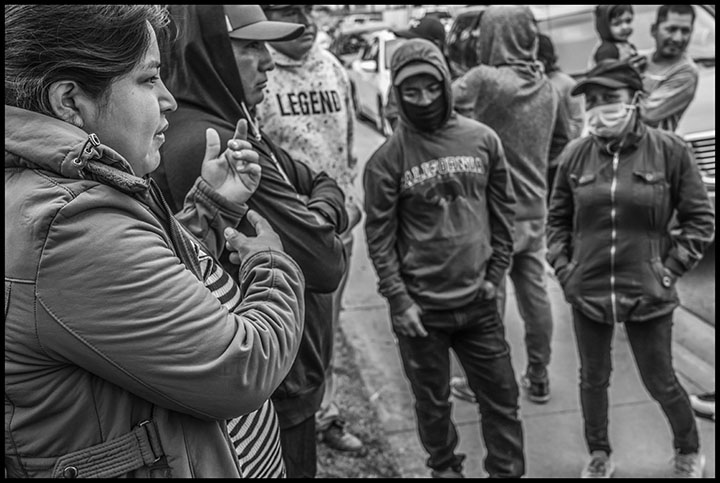
GUADALUPE, CA - 13JUNE23 - Strawberry workers went on strike against Wish Farms, a large berry grower in Santa Maria and Lompoc, for two days.  They demanded that the company stop cutting piece rates, and live up to promises of better pay.   

The workers rallied in front of the company office in Guadalupe, a small farmworker town near Santa Maria on the central coast.  After trying unsuccessfully to negotiate with the company manager on the phone, they went to a nearby strawberry field and called on the workers there to leave and join the strike.  Some did, before the company called the sherriff. 

Workers then went back to the company office where they continued meeting.  The company eventually agreed to raise the wages, and workers went back to work the following day.  They decided to keep organizing a union, which they called Freseros por la Justicia, or Strawberry Workers for Justice.

Most pickers are indigenous Mixtec migrants from Oaxaca and southern Mexico, but who now live in the U.S.  The company also brings in contract H-2A contract workers from Mexico.  The strike was supported by the Mixteco Indigenous Community Organizing Project.  People who want to support the workers can contact Fernando Martinez, (805) 940-5528, fernando.martinez@mixteco.org

Photos copyright David Bacon.  Additional photos here:  https://www.flickr.com/photos/56646659@N05/albums/72177720309076488


Thursday, May 4, 2023

MAY DAY IN MT. VERNON

MAY DAY IN MT. VERNON

Photographs by David Bacon

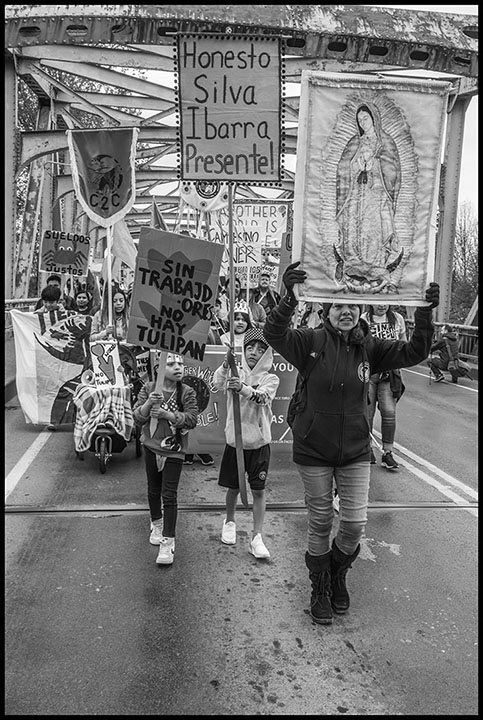
In Mt. Vernon, Washington, hundreds of farmworkers and supporters marched in celebration of May Day in the annual Marcha Campesina.  It was the height of the tulip season in the Skagit valley, and marchers carried signs reminding growers of the strike a year ago that forced them to recognize workers' committees for the first time.  As many signs declared, "Sin trabajadores no hay tulipanes" or "Without workers there are no tulips."  Roofing workers facing union busters in their strike for an independent union gathered support.  And marchers brought their children in a celebration of their future.  The march was organized by Community 2 Community Development and Familias Unidas por la Justicia.


Sunday, April 23, 2023

WOOD STREET COMMONS FINAL STAND

WOOD STREET COMMONS FINAL STAND
Photoessay by David Bacon
Capital and Main, 4/24/23
 

A community supporter moves a chain link fence section to bar access into the Wood Street Commons encampment.


Since Monday, April 10, 60 of Oakland's unhoused people have been facing earth movers with metal jaws, piling their belongings and refuse into garbage and dumpster trucks.  Their encampment, which they call Wood Street Commons, occupies two city blocks between Wood Street and the freeway maze leading to the San Francisco Oakland Bay Bridge.  Spaced across the area are tents, RVs, trailers and even a two-story plywood house.  

This is the last remnant of what was once the largest homeless encampment in northern California.  It is the southern tip of an area that extended from the edge of the old 16th Street railroad station to beyond 34th Street - at least 17 blocks - under the freeway maze itself and next to a train trestle that once brought goods in and out of the old army base.

The two-block Wood Street Commons is part of the old Prescott neighborhood of West Oakland, once one of the poorest in the city, where rundown homes sat next to small factories and warehouses.  Just beyond a chain link fence bordering the area is the old 16th Street Station, where the last train stopped in 1994.  The ornate but abandoned structure is being restored as an historic jewel, and  is rented as a site for private events by its owner BUILD, an affiliate of BRIDGE Housing.

Across the street from the Commons begin new townhouse developments that go on for blocks.  They are the future, and these unhoused residents are in the way.  In 2005 Oakland adopted the Wood Street Development Project.  "The area surrounding the intersection of Mandela Parkway and West Grand Avenue will be a major employment area," it said, "with preservation of existing historic buildings and the addition of compatibly scaled larger development."  The Final West Oakland Specific Plan was last updated on January 20th, 2021.

In 2007 the city purchased the 3.2 acres the Commons occupies for $8.5 million, and In 2018 found a developer, MIDPEN Housing Corporation and Habitat for Humanity, which promised to build 170 units of affordable housing on the site.  That's not much consolation for the unhoused residents being evicted, however.  With no income, no fixed residence and having to wait for years for construction, it's unlikely that any would ever be able to live in the promised homes, any more than they can live in the blocks of new townhouses.

The California Department of Transportation began an effort to evict residents from the larger area under the freeway a year ago, where approximately 300 people were living.  Last July Federal Judge William Orrick issued a temporary restraining order (TRO) to stop those evictions, but in August lifted it because, he said "there is no constitutional right to housing-to allow Wood Street [residents] to stay on the property of somebody who doesn't want it."

People were forced to leave shortly afterwards, and today that huge area is a barren expanse of dirt under the freeway.  That left those living on the two-block area of the Wood Street Commons, on land belonging to the city.  On January 9 residents, represented by the East Bay Community Law Center, filed for a TRO against the city to stop their eviction.  

On February 3 Judge Orrick lifted the order, however, after Oakland announced that replacement housing for the displaced people was available.  On February 24 the city declared that it had opened the Wood Street Community Cabin site eight blocks away, with 32 bed spaces available, and an RV parking area with 28 spaces on 66th Avenue in East Oakland.  

In a statement announcing a demonstration by residents and supporters on the day the evictions started, leaders of Wood Street Commons said, "Many residents moved to Wood Street from other locations around the city, after Oakland police officers instructed them to move here. We believe that given how long people have lived here, that we deserve more than "adequate shelter." Additionally, the fact that these so-called evictions are taking place while Alameda County's eviction moratorium remains in place exemplifies the fact that Oakland's unhoused residents do not have the same legal rights as renters."

People facing the earthmovers argue that the city's cabins, often called "tuff sheds" after the temporary structures sold at Home Depot, are not permanent housing.  Stays are limited to 90 days with possible renewals, and people can be evicted at the discretion of the managers.  There is no space for the vehicles where many residents currently sleep.

Dustin Denega, who was forced from the CalTrans area last fall, said in an interview at the time that in the four years he'd lived on Wood Street he felt safe and protected from violence that often affects people sleeping on sidewalks.  "What the city calls alternative housing is surrounded by a fence.  You can't have visitors, and it feels like a prison.  And it's not safe," he said.  

The city has told Wood Street Commons that it will take two weeks to clear their encampment.  Every day since Monday that cleared section moves slowly from Wood Street toward the freeway wall.  It seems inexorable.  Jon Sullivan, an unhoused Laney College student and activist at Wood Street Commons, said some residents have agreed to move to the "community cabins" and the RV parking area, but  said others are staying put as the city continues to clear the area and risk losing their belongings.


The City of Oakland posted notices on vehicles announcing that it would begin removing vehicles, which are the homes of most residents, starting on April 10.  Behind the SUV an earthmover loads an item into a garbage truck.


As residents and supporters watch behind a barrier, an earthmover loads an item into a garbage truck.


As Kelly, a resident, speaks, Jon Sullivan (in a light-colored sweater), one of the leaders of Wood Street Commons, listens.  Sullivan, who previously lived in Sacramento, is an unhoused student at Laney College in Oakland.  "Hundreds of students at Laney are couch surfing or sleep in vehicles around the campus," he said. "People are dying because of those types of policies.  Even in Oakland housing is not seen as a human right. I want to learn how the system works in order to change it."  


Commons leader John Janosko speaks at a protest the day the evictions started.  He proposed last fall that the city allow residents to move onto the old army base on the other side of the freeway.  "We want our community to stay intact," he explained in an interview.  "And it wouldn't be hard for us to move there, especially if the city helped us build small houses and a center and community kitchen where we could have services and meetings to keep ourselves organized."  After city administrators refused to implement his proposal, city councilperson Carroll Fife, former organizer for Moms for Housing, said she was "disgusted."  


Beyond the tent of a resident, the new townhouses are visible across the street.


Gawit (David) Mesfin tries to move the many bicycles and parts next to his living area before the earthmovers arrive.  He repaired bicycles, and sometimes stored them, for many residents and other unhoused people.


Gawit (David) Mesfin and a helper move a panel from the structure where he lived to an area where a truck might be able to pick it up to bring it to another site.


Gawit (David) Mesfin was born in Ethiopia.  "I left when I was 8, because of the wars, after my parents were killed.  I was taken to India first, but then I was deported.  I finally I got to the U.S. when I was 18, and I'm 38 now.  I've been living here for seven or eight years."


Tommygun Goodluck stands in the doorway of the two-story house he built.  He said that the construction took him two years.


Inside his house are the tools and other machinery that Tommygun Goodluck uses to fix things for other residents of Wood Street Commons.


"I came here with my friend of Jeff four years ago," Tommygun Goodluck said.  "I'm a carpenter, and I lived in an RV for a few years in Las Vegas.  I wanted to go to Venice because I had this dream of parking my RV by the beach, where I could just step out the door onto the sand.  But Jeff convinced me to come here.  There was hardly anyone here when we came.  This house did have a third story with a garden, but the wind took it.  It has a two-car garage in back, where my Harleys are."  I asked Tommygun what he thought would happen to his house now. "Things aren't going to go well for me," he answered. "I'm probably going to lose everything.  Hopefully not the Harleys."


Tommygun's friend Jeff outside the RV where he's lived for four years.  "This is the best place I've ever lived," he said. "People here help and support each other, like if you want a cup of sugar you can just ask.  I'm trying to rescue the cats and especially the kittens, before the dumpsters get them."


Tariq, an unhoused resident who didn't want to talk, moves some of the items around his living area next to the freeway wall.


Behind this sign painted by residents is an area where many RVs and trailers are parked.

Note on names.  Many of the unhoused people living in the Commons, like unhoused people in general, are very protective of their privacy because of previous problems with what they perceive as very hostile authorities.  Some people give their names freely, while others only want to give a first name, or none at all.  In addition, many adopt names that are part of their chosen identity.  I tried to respect people's choices about this in interviews, and while taking their photographs.  - ed.

Sunday, April 16, 2023

SHOULD LEFTISTS CALL FOR ENDING NATO?

SHOULD LEFTISTS CALL FOR ENDING NATO?


Russia should withdraw its troops in Ukraine and stop its bombing campaign.  There should be a cease-fire and negotiations to end the war.  Prolonging the war in Ukraine, however, is US policy. That makes it important for people on the left to understand the sources of this policy, and particularly the purpose and role of NATO, as the debate highlighted in Michael Kazin's article "Eject the Left Right Alliance Against Ukraine" demonstrates.  Kazin repeats ideas about NATO and the U.S. role in the world that are historically wrong, and which lead to support for an increasingly war-oriented U.S. foreign policy.


In the first paragraph of his article, Kazin states:  "When, twenty years later, American Communists backed the Soviet Union’s crushing of the Hungarian Revolution of 1956, they shoved their party firmly and irrevocably to the margins of political life, which opened up space for the emergence of a New Left that rejected imperial aggressors of all ideological persuasions."  It is an important statement because Kazin is, in fact, taking us back in history to the era in which NATO was formed, and to the costs of the Cold War to the left.  This is a necessary journey.


At the time of the Hungarian uprising, the U.S. Communist Party had already been decimated by waves of repression.  Its leaders were in Federal prison, and its activity was virtually illegal.  Many of its members who remained had chosen, wisely or not, to go underground.  While the events in Hungary did lead some members to leave, state repression had already made support for socialism and communism in the U.S very dangerous.  It was this repression that led, a decade after Hungary, to an opening for organizing a New Left.  It also led to a left marked by a combination of support for radical social change and fear of communism and the Soviet Union.  Opposing NATO was not on the agenda of the New Left, at least not in the U.S.


As left activists, we often ignore our own history as it led to this period, and that has fostered illusions about the nature of NATO and the intent of U.S. foreign policy.  At the end of World War Two the U.S. intensified its historic effort to stop the advance of communist and socialist parties.  After the war they were very popular, having led the resistance to Nazism, and in Asia and Africa, the resistance to colonialism.  In European countries, especially France and Italy, the US fought to keep the left out of power, setting up anti-communist unions, parties and intelligence projects.


As communist and socialist parties became governing ones in the parts of eastern Europe under Soviet control, the U.S. instituted the Marshall Plan to reestablish the capitalist economies of western Europe.  In 1949 the U.S. formed a military alliance against the Soviets - the North Atlantic Treaty Organization, or NATO.  Its purpose from the beginning was to roll back socialism as it existed in the USSR and eastern Europe, and to prepare for war.  In an even larger sense, its purpose was to protect capitalism as a system, and a world order in which the U.S. corporate elite was dominant.


In the U.S. the labor movement split on the issue of war or peace with the Soviet Union.  When Henry Wallace and the Progressive Party ran for President on a platform of peace in 1948, many leftwing unions and union activists supported him.  They passed resolutions opposing the Marshall Plan, and after NATO was established, against a war policy.  It is no coincidence that the expulsion of the left led unions from the CIO, and the destruction of most, took place at this time.  Opposing the Marshall Plan and NATO were key accusations used to drive the left out of our labor movement. 


For the next 40 years, until the Soviet Union fell, NATO heightened the war danger in Europe.  Its military strategy was directed at the containment and eventual rollback of the Soviet Union, and NATO faced widespread popular resistance.  Putting Pershing missiles in Europe, for instance, was met with demonstrations of millions of people in the streets there, and here in the U.S. too.  At the same time, the policy of encirclement of the Soviet Union, and then China, led to creating other alliances, like SEATO and CENTO, organized with the same purpose.  The U.S. used containment alliances to fight the wars in Korea, Vietnam, Malaya the Philippines and other countries, and those wars all had a clear class purpose.


NATO from the beginning has been an instrument of class power - the corporate class of the U.S., with its partners in Europe.  While military budgets and wars are certainly profitable, NATO's purpose hasn't just been lining billionaires' pockets.  Military power has been the ultimate guarantee of political and economic power. 


After the Soviet Union fell, NATO strategy changed, but not its purpose of maintaining the class power of those who have historically controlled the alliance.  It provided a useful vehicle for conducting wars to maintain and project their power - in Yugoslavia, Libya, Iraq, Afghanistan and elsewhere.  Today's NATO strategy is ultimately directed at war with Russia and China, its historical targets for encirclement.   Such a war would lead to the deaths of millions of people, and conceivably lead to a nuclear exchange and the end of human life on the planet. 


During the Cold War the prevention of nuclear war rested on the idea of the mutual coexistence of two social systems - capitalism and socialism.  Even in that era, NATO's purpose of containment and rollback contradicted that goal.  Now Russia is no longer a socialist country, and China's hybrid system is not the socialist antithesis to capitalism of decades ago.  In this context, has NATO become the vehicle for protecting the interests of one group of capitalists in a world where their control is diminishing?  A movement for peace in the United States has to come to grips with this question in order to prevent war and create the space for social transformation, in this country and internationally.


Later in his piece Kazin states that "In the aftermath of the Soviet Union’s demise, the expansion of NATO may well have been too hasty. But not one of its newer members has done anything to threaten Putin’s regime."  The problem of NATO is not whether it expanded too quickly, but its purpose.  Why did it expand to begin with, as countries that once had been part of a socialist USSR became independent capitalist states?  This should have been a fundamental question for the left here in the U.S., where this system of alliances was established and where it is still controlled.  The continuing impact of the Cold War on the left helps explain why this expansion took place with virtually no outcry or discussion.


The possibility of much bigger wars than Ukraine is on the horizon.  U.S. and NATO generals openly call for preparing for war with China, and for continuing their policy of encirclement.  NATO controls the military machine that would be the vehicle for waging that war.  


Calling for ending NATO, because of its purpose and use, is a legitimate demand.  It has a long history in the left in the U.S. and Europe, and the reasons for making this demand come from the rhetoric of NATO itself.  An uncritical assumption that NATO really has no class purpose, or that it poses no danger to people seeking fundamental social change, does not square with its history.