Tuesday, April 11, 2023

NO PAPERS? LOSE YOUR HOME!

NO PAPERS?  LOSE YOUR HOME!
By David Bacon
The Nation, 4/12/23

https://www.thenation.com/article/society/farmworker-camp-evictions/

Farmworkers in California labor camps see unprecedented rise in evictions.  As growers bring in more H-2A workers, affordable housing for local farmworkers has become sparse.

 
Evicted farmworkers demand their homes back at a meeting of the Tulare County Housing Authority.
 

Lidia Torres got scared when the new eligibility clerk at the labor camp knocked on her door.  She would have to come to the office, Vanessa Carter told her, and reverify the immigration documents she'd provided when she first moved in six years earlier.  So Torres showed them to her.  "She said my documents were not valid," Torres remembers.  "No one had ever questioned them before.  Then she gave me three days to get out."
 
Carter threatened to give Torres' papers to a lawyer, even to a judge.  "I said they were same as most people here in the camp.  But then Vanessa said she was checking theirs too, and they'd have to leave as well.  I thought she'd call the migra.  If I made a fuss she said I'd have to pay thousands of dollars."
 
The Linnell Farm Labor Center, where Torres lived, consists of one hundred ninety-one single story cinderblock apartments near Visalia, in the southern San Joaquin Valley.  They're scattered around a dusty playing field and children's playground filled with weeds, behind a locked gate and fence.  Torres' rent was $513 a month for two bedrooms.  Fearing that her problems could escalate, she found another place to rent for $1800 a month, and left.
 
Carter did as she'd threatened, and questioned the immigration documents of other families in the camp.  In a March 23 email Ray Macareno[DB1][DB1], a member of the Board of Commissioners of the Tulare County Housing Authority (TCHA), said that 17 families received 3-day eviction notices, which threaten $600 fees and court and attorney costs for non-compliance.  The notice, which residents were told to sign, says "You admitted to HATC staff that you do not have permanent residency and further admitted that you had provided HATC with fraudulent citizenship documents."
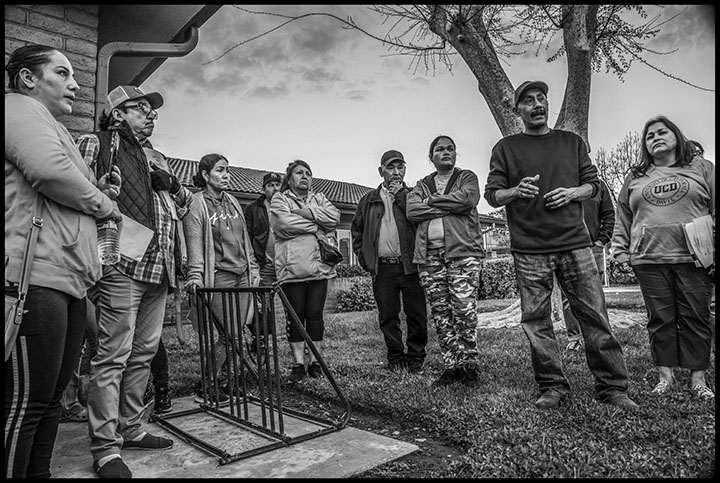


Lidia Torres and other evicted farmworkers listen to Hector Hernandez of the Unidad Popular Benito Juarez, outside a meeting of the Tulare County Housing Authority.
 

Two community organizations, the Central Valley Empowerment Alliance (CVEA) and the Unidad Popular Benito Juarez (UPBJ), say they've gathered documentation[DB2][DB2] from over fifty families evicted or threatened with eviction from the Linnell and three other Tulare County camps.  In February they held two community hearings, and then went to a board meeting to demand that the families be reinstated.
 
In a letter[DB3][DB3] to the commissioners, the organizations charge that housing authority personnel verbally abused residents, threatened them with calling immigration agents, disqualified them from Section 8 rent subsidies, and entered their homes without permission.  They demanded that the board fire Ken Kugler, TCHA's executive director, and reassign Carter and her superior, area manager Leticia Esparza.  "This is a basic violation of peoples' right to housing," CVEA co-director Mari Perez told the board.

Similar enforcement actions could affect thousands of other farmworker families, far beyond Tulare County.  "People have been telling us about evictions like this in other parts of the valley," said UPBJ executive director Hector Hernandez in an interview.  "It's not visible, but it feels like a wave."  Increasing the potential for an eviction wave is a law passed during the Trump administration.  An amendment to Section 514 (f)(3)(A) of the Housing Act of 1949 makes it possible for growers to use the nationwide system of farm labor camps, not for farmworkers who have worked and lived in the U.S. for years, but as barracks housing for contract temporary labor under the exploitative H-2A visa program.

Tulare County manages 495 units of housing for farmworker families in six labor camps, including Linnell.  The U.S. Department of Agriculture provides funding both for construction of the camps and rent subsidies for residents.  According to a USDA Rural Development spokesperson[DB4][DB4], families get rental assistance in 5,466 units in California, and in over 12,000 units nationwide.  
 
To rent an apartment in one of the camps, a family member has to show that she or he works in the fields, meets USDA low-income guidelines, and is a U.S. citizen or legal resident.  The camps are filled with farmworker families who reflect the demographics of the farm labor workforce.  Nationally, the USDA estimates that over 40 percent of farmworkers don't have legal immigration status, and that this is higher in California.  The families living in camp apartments are often mixed, with some members having legal status and others without it.  
 
Torres' children, for instance, were born in the U.S.  When Carter questioned her status, she asked that her son, living with her and attending college, sign the rental agreement instead.  Carter said he'd have to go work in the fields to qualify.  "I would never take him out of school and put him in the fields," Torres told her.
 
In the workplace, farmworkers without papers face the same problem of showing documents about immigration status.  Federal law, since 1986, has required employers to check workers' papers before hiring them.  In a workforce of 2.4 million nationally, hundreds of thousands of farmworkers provide what employers need, sometimes borrowing or buying the necessary ID's.  And it's not just farmworkers.  All of the estimated 11 million undocumented people in the U.S. have the same problem when they get hired.  
 
According to the U.S. Customs and Immigration Services, however, once a permanent resident card (green card) is accepted by a prospective employer, future reverification is not required.  Given the demographics, constant reverification in the fields would mean a million workers in agriculture losing their jobs.
 
USDA and Housing Authorities could follow the process established in employment law, where reverification is barred once the original documents showing legal status are accepted.  There is no requirement for yearly reverification in the USDA-supported labor camps, written into the language of Section 514.  And as Torres says, camp managers understand the reality, and in the past didn't ask to reverify immigration papers once a family signed their first rental contract.  As the years went by, tenants simply signed new rental agreements every year.  
 
But suddenly, in Tulare County, the Housing Authority changed the rules.


Mario Padilla and Concepcion Vargas protest during a housing authority meeting.
 

Mario Padilla and Concepcion Vargas, a couple in their 60s, signed their first Linnell rental contract 19 years ago, after arriving from Sinaloa and getting work in Tulare County's grapevines and orange orchards.  "I showed what I had to," Padilla says.  "No one raised a question about it.  The people in the office see our tax returns every year, and they could see that I was filing with a TIN, so they knew we didn't have a good Social Security number."  The IRS allows people without Social Security numbers to use Temporary Identification Numbers (TINs) instead.
 
"All of a sudden," he recalled, "we were told that our old papers were no good, and that they'd investigate us.  We felt intimidated, but we protested.  We have a right to our home, because of our years living and working here."
 
At the community hearings and subsequent Housing Authority board meetings, most of the farmworkers said they'd been evicted over the immigration question.  But some testified that they'd been told to leave because their children made noise, left toys outside or had therapy equipment for disabilties in their apartments.  Almost any small question raised by Carter and Esparza led to eviction.  
 
Fabiola Cortez, who'd lived in her apartment at the Woodville camp for eight years, couldn't work because she was pregnant.  She was told she no longer qualified as a farmworker and was evicted.  "We had to leave in three days, when all the storms were pouring rain.  We stayed in the parking lot in front of my mother's apartment in my van, me with my three kids," she recalls.
 
One possible explanation for the rush to evict residents surfaced at a March Housing Authority meeting, when board members revealed that the USDA told them[DB5][DB5] of a third immigration status that makes it possible to rent space in the labor camp.  Workers with H-2A visas also qualified, the board announced.
 
The number of H-2A workers in the U.S. is increasing rapidly.  Last year growers received 371,619 certifications allowing them to bring in contract laborers, about a sixth of the country's farm labor workforce - a number that has doubled in 5 years and tripled in eight.  These workers, whose pay is set close to minimum wage, can only work for the grower who recruits them, usually in Mexico, and must leave the country after their work contract ends.  They can be fired for protesting, organizing or simply working too slowly.  Fired workers lose their visa and must leave the country, and then are usually blacklisted by recruiters. This makes them very vulnerable to pressure and illegal conditions. 



Fabiola Cortez and her three children Adrian (7), Gabriel (4) and David (2) were evictedd from the apartment where they'd lived for eight years, and then lived in a van in the labor camp parking lot.


Cortez' son Adrian hugs the wall of his old apartment, which is now vacant.
 

The regulations governing H-2A visas require growers to house the workers for the duration of their stay, limited to less than a year.  That housing requirement has been bitterly opposed by agribusiness because of its cost, and because the existing rural housing is very limited.      
 
Farmworker housing is in crisis in rural California, as in almost every agricultural state.  Despite $100 million budgeted for it in 2021, grape pickers in the San Joaquin Valley still sleep in cars during the harvest.  Yearly earnings for agricultural laborers in the state average $20,500, making it virtually impossible to rent homes at market rates.  The consequence is severe overcrowding, which had deadly effects during the pandemic.
 
One study by the California Coalition for Rural Housing found that "Most households of farmworkers interviewed included non-family members who were for the most part other farmworkers. There are consistently stunningly high rates of residences that are above the severely crowded condition of 2.0 people per room.  ... Often more than 5 people per bathroom."  Another study stated, "San Joaquin Valley communities face increasing housing challenges, yet there are ever fewer State and Federal resources that support the development of needed affordable housing."
 
As they bring in increasing numbers of H-2A workers, growers are competing for housing against local workers, even taking over small motels in many rural towns.  In one Tulare County town, Porterville, the rundown Palm Motel became the housing for Porterville Citrus' contract laborers during the pandemic.  When the company abandoned it after worker protests, notices appeared on some of the windows, warning that the rooms had been quarantined and needed to be disinfected.  In Santa Maria the city council passed an ordinance to stop growers from packing H-2A workers into rented houses, after resident farmworkers began having trouble paying the rents that rose as a result.
 
To subsidize their costs, growers have tried to access public housing funds.  In Washington State they won a fight in 2016, allowing them to use state funds for farmworker housing to build barracks for their H-2A workers.  California passed AB 1783 to stop growers from using the Joe Serna Farmworker Grant Housing Program for the same purpose.
 
Ilene Jacobs, Director of Litigation, Advocacy & Training for California Rural Legal Assistance, says that programs like the Tulare County labor camps "were designed to provide housing for farmworkers and their families here.  It's a crisis for every low-income family, but farmworkers are among those who need housing the most.  It defeats the purpose of these programs to let employers use them for H-2A workers.  It's really a double subsidy - growers get the benefit of the H-2A program, and the added benefit of using public housing."
 
There are no H-2A workers living in Tulare County camps, Macareno said.  But when I asked if the housing authority had talked at any point with growers about housing their H-2A workers, I received no reply.  "If we got any applications we'd look around and see what's available," HATC general counsel Julia Lew told me.  Rudy Flores, a young activist living in the Linnell camp, says the units where families were evicted are still standing vacant.  Macareno confirmed that there are 31 vacant units in six county-run camps, with 107 families still on waiting lists.
 
In one of its meetings packed with protesters, board president John Hess said the Housing Authority had received permission from USDA to allow the families, evicted because of immigration status, to sign new 1-year contracts.  They could move back in, at least until those contracts expire and they once again might have to show their papers.  "In effect, they [USDA] were not going to enforce the rules, at least temporarily," Hess told me.  But Flores says he knows of no families who have been permitted to return to the Linnell camp, as of the end of March. 


CVEA co-director Mari Perez and UPBJ director Hector Hernandez speak to evicted residents after a housing authority meeting.
 

"The Linnell camp is a product of struggle," CVEA co-director Mari Perez told me.  She pointed to photographs taken by Dorothea Lange, when she and her husband Paul Taylor documented farm laborers sleeping in cars and tents at the height of the Depression.  Their pathbreaking report with her photos, An American Exodus, convinced the New Deal administration to set up the first Federally-funded camp for farmworkers in neighboring Kern County.  Taylor became its director.
 
In 1964 Linnell's residents organized an historic rent strike against bad camp conditions and high rents.  The following year the organizers who cut their teeth in that conflict converged on Delano, where they helped start the 5-year grape strike in which the United Farm Workers was born.  "It should be no surprise to anyone that we are not going anywhere," said Perez.  "We will fight these evictions, like our people fought before."
 
But fighting the competition with growers over farmworker housing will be more difficult.  The Biden administration seems intent on continuing policies from the Trump administration favoring the H-2A program.  
 
At an April 2017 White House meeting Trump told growers that, although he was targeting undocumented people for deportation, he would make the H-2A program easier for them to use.  In that meeting Steve Scaroni, CEO of Fresh Harvest, one of the nation's largest contractors of H-2A workers, told Trump he would bring even more of them to the San Joaquin Valley if he could find places to house them.
 
The following year Congress passed the amendment to Section 514 (f)(3)(A) of the Housing Act of 1949 that allowed USDA to open the camps for growers to use for their H-2A workers.  Trump signed the bill.  While he was still in the White House in 2019 Bruce Lammers, head of USDA's Rural Development division, wrote a set of instructions[DB6][DB6] to housing authority managers, advising them on regulations for implementing the new rule.  
 
A labor market study to determine the impact of increased competition for housing on local workers is not required, his memo says.  "Farmworkers who are admitted to this country on a temporary basis under the H-2A program, are now eligible to occupy ... units which are currently or becoming unoccupied or underutilized," it continues.  The one-year contracts all other applicants must sign will not be mandatory for H-2A workers, since they must leave within a year.  

Because H-2A workers arrive in the country needing housing right away, growers may sign the leases to guarantee payment, and housing managers are permitted to "work with the sponsor on providing housing for the incoming H-2A workers."  The memo tells housing authorities to track the H-2A applications using a specific code.  An FOIA request for the number, location and employers of H-2A workers in USDA-supported housing has not yet been answered.

Once President Biden took office, the administration began sending emissaries, including Vice-President Kamala Harris, to El Salvador, Guatemala and Honduras.  The intention was to provide alternatives for potential migrants, other than leaving in the migrant caravans, for which the administration has been attacked by Republicans.  One alternative was increasing corporate investment in the hope it would produce jobs.  The other is leaving, but with H-2A visas.

Samantha Power, former Obama advisor and now administrator of the U.S. Agency for International Development, thanked one meeting of growers at USDA last September for working with the Biden administration on "a critical priority - expanding the pool of H-2 farmworkers from Central America, specifically from El Salvador, Guatemala, and Honduras."

"We have got your back," she promised them.  "We are committed to helping maintain a strong pipeline of experienced farmworkers to support you."  A recent policy brief by the Migration Policy Institute even recommends paying growers' costs of transporting the workers to and from the U.S.

Since these policies will add to the numbers already being brought by growers from Mexico, the competition over scarce farmworker housing will undoubtedly grow as a consequence.  Growers themselves are reluctant to spend money to build any new housing for H-2A workers.  Only two sizeable projects have been built in the last decade, in Salinas.  For agribusiness, competing for the existing housing stock is easier, cheaper and quicker.

The evictions at the Tulare County labor camps may be only the beginning of a much longer and bigger fight. 


Evicted residents of the Linnell farm labor camp.


Evicted residents speak before a meeting of the Tulare County Housing Authority

The names of undocumented people have been changed to protect their identities.

Sunday, March 19, 2023

WHEN WE SPOKE OUT AGAINST WAR

WHEN WE SPOKE OUT AGAINST WAR -

Unearthing the history of protest against the wars in Iraq and Afghanistan

Photographs © by David Bacon


March 19, 2023, is the 20th anniversary of the start of the U.S. war in Iraq in 2003.  The war in Afghanistan was already underway, having begun a year and a half earlier.  Both wars marked a generation, and the war in Iraq is still going on, at least in terms of the ongoing presence of U.S. soldiers.


Today war continues to be a fact of life in the world, and in the lives of the people of California.  The anniversary of the Iraq war gives us a moment when we can look back at the way our community responded when these conflicts started.  Then, as now, people did not accept the reality of endless war or its normalization.   They sought to change it.


These are images from the protests against the wars as they unfolded between 2001 and 2007.  While the protests against the Vietnam War has entered history as the massive events they were, the protests against the wars in Afghanistan and Iraq also brought thousands of people into the streets of San Francisco and Oakland.  But unlike the protests of the Vietnam era, these marches and demonstrations have been virtually erased from the historical record.


These photographs, taken by David Bacon, document them.  They demonstrate the depth of opposition, and the diverse faces of those involved.  


People didn't just show up once and go home; they came out again and again from 2001 to 2007.  The images show that the protesters were overwhelmingly young.  They were very diverse racially and nationally, especially the highly visible and vocal presence of African Americans and Asian Americans.


This is not surprising, since the Bay Area is home to Congresswoman Barbara Lee, who was the one vote in Congress against the military authorization bill that sanctioned the start of the wars.  While she may have been a lone voice in Congress, these photographs make clear how popular her opposition was.  African American civil rights leaders rallied around her.  The marches featured actors, singers and celebrities who sought to add their voices to hers.


The images show an extraordinary cultural diversity.  Signs and banners spoke in many languages.  Korean drummers walked with contingents that started in Chinatown's Portsmouth Square.  Dancers danced.  Elaborate banners created a colorful atmosphere.  The determination of demonstrators is obvious in their acts of civil disobedience, and the photographs show the emotion in young faces as they were arrested.


The photographs were originally taken on film, and have been scanned and digitized in a cooperative project with the Green Library of Stanford University, where David Bacon's photography archive is housed


This presesntation coincides with the 20th anniversary of the start of the Iraq war, on March 19, 2023.  Participants in these protests can identify themselves and each other, comment on the images, and add their own observations about the war and the impact of the protests, by responding to David Bacon at dbacon@igc.org.


https://www.flickr.com/photos/56646659@N05/52759801492/in/album-72177720306862427/


Wednesday, March 8, 2023

OAKLAND'S ENCAMPMENT EVICTION BETRAYS THE HUMAN RIGHT TO HOUSING

OAKLAND'S ENCAMPMENT EVICTION BETRAYS THE HUMAN RIGHT TO HOUSING
By David Bacon
Truthout, 3/7/23
https://truthout.org/articles/eviction-of-300-person-encampment-in-california-shows-scorn-for-right-to-housing/

 
The Wood Street encampment of unhoused people under a freeway and railroad overpass was home to over 300 people. Volunteers helped residents try to resist eviction.


The words "housing is a human right" used to appear in bright colors on a painted placard at the gateway to Wood Street Commons, which until recently was the largest unhoused encampment in northern California. But this February, the California Department of Transportation (Caltrans) demonstrated how vehemently it disagrees.

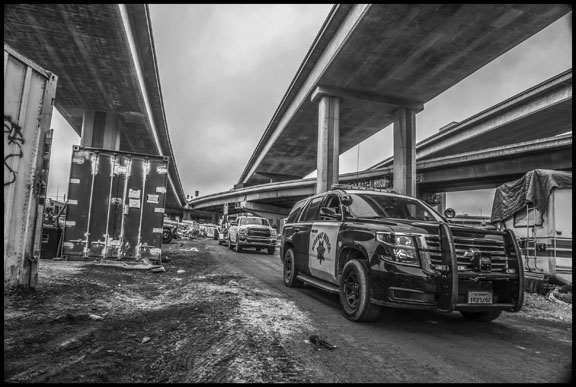
Caltrans, which owns the land under an enormous freeway interchange called the Macarthur Maze, has evicted more than 300 people who had lived there for years. The U.S. Constitution does not recognize a right to housing, Caltrans asserts.  

In the end, Federal Judge William Orrick came down on the side of the state.  For months an order he issued last July had prevented Caltrans from evicting the camp dwellers.  He even endured criticism from California Governor Gavin Newsom, who said the order would "delay Caltrans' critical work and endanger the public."  But last October the judge finally accepted the agency's argument.  "I don't have the authority-because there is no constitutional right to housing-to allow Wood Street to stay on the property of somebody who doesn't want it," he admitted.

Since October the last residents living on Caltrans' land were forced to leave.  The strip of land occupied by RVs, tents and informal homes, extending for 25 city blocks, was reduced to a barren expanse of bare dirt and concrete.

The evicted occupiers are part of Oakland's homeless population, which has increased 24% over the last three years. As of early 2022, more than 5,000 people were sleeping on the streets, but the city only has 598 year-around shelter beds, 313 housing structures and 147 RV parking spaces.  All are filled.  

Nevertheless, Judge Orrick stated in his final removal order, "Though the eviction will inevitably cause hardship for the plaintiffs, that hardship is mitigated by the available shelter beds and the improved weather conditions."  The atmospheric rivers that have dumped flood-level torrents of rain on northern California all winter returned within days of the order.

The now-empty camp had a long and storied history.  It lined Oakland's abandoned Wood Street, where houses were cleared in the 1950s to build the freeway maze leading to the Bay Bridge.  Seven years ago,, as gentrification and the city's housing crisis grew increasingly acute, displaced people began setting up what became Oakland's oldest settlement of the unhoused.  

Some folks drove RVs and trailers into the huge space next to an old railroad trestle, used decades ago to move boxcars between the port and the main rail yard.  Other home seekers set up tents or other informal housing as the settlement spread.  One individual even built a room high up under the trestle beams, twenty feet off the ground.  In an environment a camp resident compared to the wild west, it provided safety and peace during the night.
 
In one small section residents and supporters erected several small homes and a common area for meetings, entertainment and other collective activities.  They built the structures of cob - a mixture of straw, clay and sand - and Cob on Wood became one of the camp's nicknames.  Other residents call the encampment Wood Street Commons.

In recent years, however, fires on Wood Street became frequent - over 90 in 2021.  Last April one man lost his life when a blaze filled his converted bus with smoke and he couldn't get out.  The worst conflagration broke out in July 2022.  Propane cylinders used for cooking and heating exploded in flames so hot that vehicles parked under or near the trestle were incinerated.  Residents fled.  


Benjamin Choyce died from smoke inhalation in a fire in this converted bus where he lived. 


Jason, a resident, looks over the remains of homes and belongings on July 20, 2022, after the big fire.


A car burned in the last big fire. When cars were burning Caltrans had to close the freeway above.


Firefighters responded to the fires, but there is no hydrant near Wood Street.  To reach the informal homes the bomberos had to stretch hoses over hundreds of feet.  Yet Wood Street wasn't the only camp to suffer blazes.  A city audit documented 988 fires in 140 encampments over the two years between 2020 and 2021.  

After the July fire Caltrans announced it would evict the residents.  Lawyers for the unhoused people convinced Judge Orrick to bar the action, and last summer he seemed sympathetic.  When he asked authorities to detail their intentions for providing replacement housing, no agency could come up with a plan.  
 
In 2022 the state gave Oakland a $4.7 million grant to house 50 of the 300 people living on Wood Street, yet the city didn't use the funds to create alternative housing.  Instead, as evictions proceeded, Oakland administrators announced that if the land was not cleared the city would lose funding to subsidize non-profit developers it claimed were planning to build 170 units of housing on the site - 85 for sale and 85 rentals.  While Oakland needs housing desperately, virtually none of the evictees would ever have been able to buy or rent one of the units.

John Janosko, a leader of the effort by residents to block the eviction, pointed to empty land just across the railroad tracks.  "We want our community to stay intact," he explained.  "And it wouldn't be hard for us to move there, especially if the city helped us build small houses and a center and community kitchen where we could have services and meetings to keep ourselves organized."  

The last 60 residents still hang on to a small patch of land between a park and the now-empty Caltrans. According to Jon Sullivan, an unhoused student and housing activist at Oakland's Laney College, "they continue to resist, and are hoping that they can negotiate some solution with the city."

When City Council member Carroll Fife proposed Janosko's solution in October, however, the city bureaucracy condemned the idea.  Moving people would cost too much, and the land might have toxic contaminants, city administrator Ed Reiskin claimed, but refused to apply to the State Department of Toxic Substances for a waiver allowing the site to be used.  Fife, a rent strike activist and organizer of Moms for Housing before she was elected, said she was "disgusted."

So Caltrans created a huge, windswept emptiness where Dustin Denega had built a tipi next to his trailer under the freeway.  Not far away Jake had created a room without a roof between two trestle pilings, complete with sofa, table and work space for an artist.  That was gone too.

Denega, an unemployed musician, said that in the four years he'd lived on Wood Street he felt safe and protected from violence that often affects people sleeping on sidewalks.  Even in the "tuff shed" cubicles the city provided for the camp dwellers, calling them alternative housing, a man was shot and killed last winter.  "That city housing is surrounded by a fence.  You can't have visitors, and it feels like a prison.  And it's not safe," he said.  


Furniture sits in the living room or artist studio built under the trestle at Wood Street.


Jake, who built a comfortable space under the railroad trestle, says he gets angry when people steal belongings, but it is still safer there than living on the streets.


A resident prepares to leave the Wood Street encampment, packing his belongings into his old truck.


Some residents and volunteers built small homes with straw and mud, called cob, in a section of the camp they called Cob on Wood.


Dustin Denega built a tipi for shelter in warmer weather, and in colder weather he slept in a trailer in the camp.


In 2018 United Nations Special Rapporteur on Adequate Housing Leilani Farha visited Oakland.  She told reporter Darwin Bondgraham, "I find there to be a real cruelty in how people are being dealt with here," and compared Oakland to what she observed in Manila, Jakarta and Mexico City.  In those cities, she observed, homelessness is basically tolerated, while in the U.S., a far wealthier country, being unhoused is criminalized.

Judge Orrick's finding that there were shelter beds available was not a statement of a real fact, but a requirement for eviction given earlier legal precedents.  In 2019 Judge Marsha Lee Berzon on the Ninth Circuit Court of Appeals held in Martin v. City of Boise that "criminal penalties for sitting, sleeping, or lying outside on public property for homeless individuals who cannot obtain shelter" were unconstitutional.  The Eighth Amendment bars cities from punishing anyone "for lacking the means to live out the 'universal and unavoidable consequences of being human.'"

The court's decision was no real protection for Wood Street, as the eviction proved, but it did at least acknowledge that being unhoused with no money was a consequence of social conditions, not a crime or personal choice or deficiency.  

The eviction pulled the bones of capitalism into plain sight.  The right to property is enshrined in law, and the legal structure of the state will enforce it, even if it leaves people on the street with no place to sleep or live.  Land is a commodity, to be bought and sold.  If the right to live on it comes first, the property of any landowner is in danger.  A clean empty space under a freeway, while people sleep in tents on sidewalks, is a preferable alternative to land occupations.

As the last of the people living on the Caltrans site were removed, following Orrick's decision permitting it, a group of day laborers appeared, taking away belongings and discarding the trash left behind.  They were some of Oakland's lowest-paid workers - Mexican and Central American jornaleros who daily look for work on city sidewalks and parking lots.  While they hauled out debris, another group of impecunious Oaklanders - the unhoused people who would soon be joining them on those sidewalks - watched.

In this last twist, according to a foreman on the site, a Caltrans contractor had hired a labor broker, who in turn went out to day labor sites to find workers to clean out the camp for the lowest wages possible.  To keep those labor costs low, the distasteful work of eviction had been contracted out - one more aspect of municipal neoliberalism, in this liberal city in this progressive state.


After BNSF Railroad and Caltrans announced they would force people to leave notices were put on vehicles warning of the impending eviction.


According to the Caltrans notice, Wood Street residents were trespassing on state property, and any possessions left behind after the eviction would be removed and destroyed.


Adam Davis lived in this trailer for several years before the Caltrans eviction notice appeared by his door.


Adam Davis poured water into a tank in his car to get it ready to move to another location after he was evicted.  "I think I have a place where I can park for awhile," he said, "but it's pretty temporary.  Basically, I'll be back living on the street."


Jeremy packed up his American flag with his other possessions as he got ready for the eviction.


Heavy equipment is brought into the Wood Street encampment to frighten residents into leaving without more protest.


The Highway Patrol escorted in workers to clear part of the encampment.


As a resident watches, a forklift hoists a resident's SUV and takes it out of the camp under the freeway.


Day laborers are brought to clear the encampment.


The day laborers brought to clear the encampment are Mexican and Central American workers, who find temporary jobs waiting on Oakland sidewalks to get hired.


Residents and supporters write their last appeals and post them on a fence they built to protect their meeting area.


A volunteer brings in sound equipment for one last jam before the eviction.


Day laborers in long lines bring items to the dumpster to be trashed.


Day laborers hoist a sofa left behind into a dumpster to get trashed.  On the freeway overpass above trucks leave the huge port of Oakland.


Dolls and a flag are ironic comments left on a vehicle under the freeway, about to be towed away.

Monday, March 6, 2023

ACROSS THE TRACKS

ACROSS THE TRACKS
By David Bacon
The Nation, 3/6/23
https://www.thenation.com/article/society/across-the-tracks/

 
The tracks divide downtown from west Fresno, and a man crosses as the rain begins.  


In the San Joaquin Valley, the most productive agricultural area in the world, poverty is endemic.  Fresno, crisscrossed by irrigation canals and railroad tracks, is the working-class capital and largest city of California's San Joaquin Valley, a city where people speak Spanish as readily as English.  

Here the polarization of rich and poor is a constant theme in its history, and the story of its present.  The banks and growers of the valley built ornate office buildings and movie palaces when the downtown was their showplace.  Now, as developers abandoned it for the suburbs, the theater entrances and building doorways have become sleeping spaces, refuges from the rain for those with no fixed home.


Crossing the tracks to the neighborhood where many of the unhoused people in Fresno live.


Fresno has one of the oldest Mexican barrios in a state where the Mexican presence goes back decades.  Here the abandonment is visible in closed theaters and dancehalls, leaving their marquee as evidence while small tacquerias try to survive.  Today the street in front of the Azteca Theater is hauntingly empty at night, but older residents remember when Cesar Chavez and a column of grape strikers stopped in front on F Street in 1966.  The strikers were marching from Delano to Sacramento, and hundreds turned out to hear Chavez speak in the street outside.

Bisecting downtown are the railroad tracks and the old Highway 99, a defining geography for the settlements of unhoused people.  Here community activists and the homeless themselves have pressured a normally-intransigent city government to provide at least enough housing to keep the dream of life off the streets alive.   In 2019 Fresno had a larger percentage of "unsheltered" homeless people than any other city in the country - that is, people sleeping on sidewalks, in cars or in places the government calls "not suitable for human habitation."


Through the Community Alliance newspaper, Mike Rhodes has been one of the most vocal opponents of the campaign by police and sherriffs to drive unhoused people from Fresno.


People try to survive no matter their circumstances.  In Fresno they often win community support as they fight for living space in a hard, bare-knuckle city.  Mike Rhodes co-founded Community Alliance, one of California's longest-lived community newspapers in California, and spent 18 years denouncing the city for its abuse of homeless people.

Rhodes' book, Dispatches from the War Zone, recounts the many efforts for years by the city to drive encampments off the streets, and the community's resistance.  At one point he asked the city manager, "With about a thousand homeless people in the downtown area, and inadequate shelter space available, what is the city going to do with people who are homeless?"  With no answer about where people should go, Lisa Apper, with the Saint Benedict Catholic Worker, stood in front of the garbage trucks where people's possessions would have been thrown, saying, "We have got to take a stand for justice."


The theater showed movies every weekend, and after it closed the entrance became a shelter to sleep out of the rain.


In the latest Community Alliance, Bob McCloskey reports that city Homeless Assistance and Response Teams "relentlessly push [people] daily to move on with no place to go."  The City Council turned down a proposal to allow people living on sidewalks in freezing temperatures to seek shelter in the city Convention Center.  Gloria Wyatt told council members, "I am not used to being homeless, but I cannot cover rent. Our tent was torn down this morning, and we have no place to go. I am scared."  

The new Mexicans in Fresno are indigenous migrants from Oaxaca and the south, as poor as their migrant predecessors, but who bring with them the cultures and celebrations of their home towns.  Rufino Dominguez, a Oaxacan migrant with roots in Mexico's leftwing social movements, started the Organization of Exploited and Oppressed People in Fresno and Madera, and led strikes when he arrived in the 1980s.  For Dominguez, a leader in the Oaxacan community until his death in 2017, keeping indigenous culture alive has been a means to survive. 


This Mixtec boy was born in Fresno, and his mother brings him to the celebration of her hometown in Oaxaca.


"Beyond organizing and teaching our rights," he said in an interview before he died, "we would like to save our language so that it lives and continues. Losing your culture is much easier in the US.  We come to the U.S. to work because there's no alternative.  We know the reasons we have to leave. Even though 509 years have passed since the Spanish conquest, we still speak our language and rescuing what we lost in terms of our beliefs."  

These photographs recreate an atmosphere of people living in an abandoned downtown, or on the wrong side of the tracks - older residents without homes.   Newer residents, lighting votive candles in a garage before going to work, bring a different culture from the south.  The images are a reality check, telling a story of poverty and migration.  They force acknowledgement of true conditions, and show survival itself as a form of resistance.


Overhead the 99 freeway, the central artery of the San Joaquin Valley, runs next to the tracks, while under it two unhoused people make the journey back from downtown.


Danny Alfiro burns paper in a trash basket to stay warm in a December night.


Along the tracks someone has abandoned a shopping cart with a few belongings.


Larry Collins was an activist living on the streets, and won a living unit when public pressure forced the construction of a small housing complex for unhoused people.   


Community activists painted a mural of the faces of people in the downtown barrio.


Joseph and his partner made a home out of the rain in a boarded up downtown doorway.


Hardy's Theater, built in 1917 in the years when the downtown was the center of Fresno's life, was abandoned, and its interior destroyed by an evangelical church.


The Chinatown Smoke Shop, in the old barrio.


At night the taco truck stayed open, even at the height of the pandemic, waiting for workers at the Amazon fullfillment center to come by after their shift.


The Tecolote, or Night Owl, dance hall and cafe, in the old strip of clubs, bars and the Azteca Theater.


In a west Fresno garage a Mixtec woman pours atole (Mexican oatmeal) into cups for people coming early in the morning for her hometown's saints day.


Before leaving for the fields a young farmworker lights a candle to honor St. Michael, the patron saint of his hometown in Oaxaca, San Miguel Cuevas.


In the downtown barrio next to the tracks, the Mexican bus station lists the towns in Mexico people might be returning to, and the towns in Washington State where they might be going to work.


The Mexican bus gets ready to leave, while a mother and her children wait to get on.