TREATING MIGRANTS AS THE ENEMY PROVIDES NO VISION FOR THE
FUTURE
The alternative: a new bill that would allow anyone in the
country for seven years to apply for legal status.
By David Bacon
Foreign Policy in Focus | August 19, 2024
https://fpif.org/treating-migrants-as-the-enemy-provides-no-vision-for-the-future/
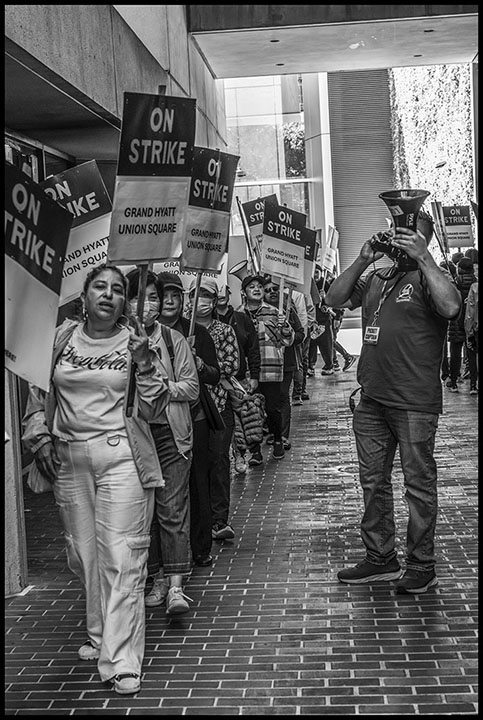
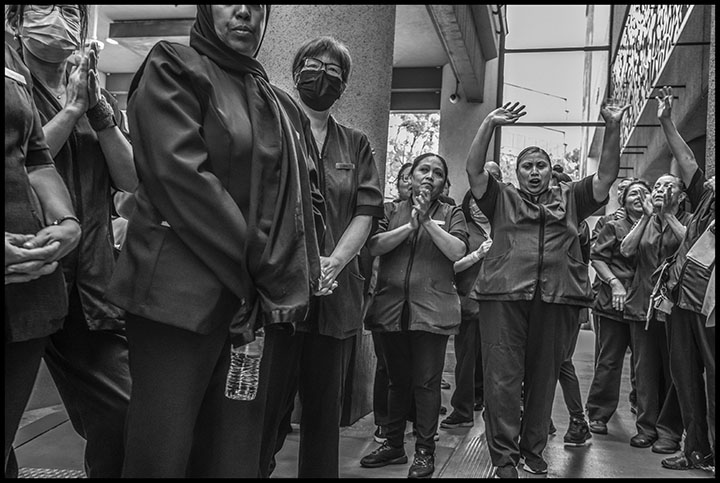
SAN FRANCISCO, CA - 7AUGUST23 - Migrant farmworkers,
domestic workers and their supporters march and rally at the Federal Building
to call for passage of the Registry Bill, which would allow undocumented people
to gain legal immigration status.
On August 17, a group of committed migrant activists set
forth on a three-day march from Silicon Valley to San Francisco, highlighting
the choices for progressive candidates in the coming November election. Should
their campaigns amplify the hysteria about an immigration “crisis,” or should
they speak the truth to the American people about the border and the roots of
migration? Even more important, these marchers are providing a practical way
for activists and political leaders to advocate for rights as they work to
defeat the threat of MAGA racism.
The question at hand is whether to support the compromise
immigration enforcement bill negotiated between centrist Democrats and
Republicans last year, and to campaign against Donald Trump from the right,
attacking him for undermining Republican support for the enforcement measures
it contained.
In that bill, President Joe Biden agreed that he would close the
border to asylum applicants if their number rose beyond 5,000 per day, while
making it much harder to gain legal status for those even allowed to apply.
Biden said he would cut short the time for screening asylum applicants by
asylum officers, which would make winning permission to stay much more
difficult.
To keep people imprisoned while their cases are in process,
instead of releasing them, Biden proposed an additional $3 billion for more detention centers, a
euphemism for immigrant prisons. There are already over 200, according to the
group Freedom for Immigrants.
Under a law signed by President Obama, Congress required that 34,000 detention beds be
filled every night. At the end of 2023, those beds held 36,263 people, and
another 194,427 were in “Alternatives to
Detention,” which required wearing the hated ankle bracelets that bar
travel for more than a few blocks. Over 90 percent of these jails are run for
profit by private companies like the Geo Group, (formerly the Pinkerton
Detective Agency).
These proposals respond to a media-driven frenzy that
constantly refers to an immigration “crisis” and calls the border “broken.”
That media coverage, and the response by centrist Democrats and Republicans,
treats migrants as criminals, as an enemy. Political operatives in Washington
then take polls, announce that the public wants draconian enforcement, and
advise candidates that going against this tide will lead to election losses.
Yet this accepted political “wisdom” in Washington is not
actually based on facts.
Let’s Look at the Numbers
Department
of Homeland Security statistics show that over the decades the number of
people crossing the border, and subject to deportation, rises and falls, while
displacement and forced migration remain constant. In 2022, about 1.1 million
people were expelled after trying to cross, and another 350,000 deported. In
1992, about 1.2 million were stopped at the border and 1.1 million deported.
Over a million people were deported in 1954 during the infamous “Operation
Wetback.” Arrests at the border have totaled over a million in 29 of the last
46 years.
Last year the number arrested at the border was higher:
about 2.5 million. But the reality is that the migration flow has not stopped
and will not stop anytime soon. What, then, is the “crisis”? New York Times
reporter Miriam Jordan says, “In December alone, more than 300,000
people crossed the southern border, a record number.” They all believe, she
says, that “once they make it into the United States they will be able to stay.
Forever. And by and large, they are not wrong.”
In fact, the number of refugee admissions in 2022 was
60,000. In 1992, it was 132,000. According to Jordan, applicants are simply
released to live normal lives until their date before an immigration judge.
That will certainly be news to families facing separation and the constant
threat of deportation. But this is what Republicans and anti-immigrant
Democrats call an “invasion” and threaten to “shut the border.”
Criminalizing the Undocumented
Should Trump win election in November, he promises to
reinstitute the notorious family separation policy. Children who survive the
crossing might easily be lost, as so many were, in the huge detention system.
Senator James Lankford (R-OK) wants to reintroduce the
“Remain in Mexico” policy, under which people wanting asylum were not allowed
to enter the United States at all, to file their applications. The Mexican
government was forced to set up detention centers just south of the border to
house them while they waited.
Trump and other Republicans would imprison all migrants who
face a court proceeding that allows them to apply to stay or stop a
deportation. Pending cases now number in the millions, because the immigration
court system is starved for the resources for processing them.
Texas Governor Abbott has pushed through a law that makes
being undocumented a state crime. Republicans in Congress last year proposed to build more border walls, create
barriers to asylum, force the firing of millions of undocumented workers, and
permit children to be held in detention prisons with their parents. Centrist
Democrats are very willing to agree to modified proposals like these.
No money, running from something or someone, trying to keep
a family together and give it a future, or just needing a job at whatever
wage—these are the commonalities of the thousands who arrive at the U.S. border
every year. Winning public understanding of immigration is the only way to
decisively defeat this anti-immigrant hysteria, rather than caving into its
illogic, and to the media frenzy and the onslaught of Republicans and MAGA
acolytes.
Roots of Migration
President Obama made some acknowledgement of the poverty and
violence that impels people to come but drew the line at recognizing this
migration’s historical roots, much less any culpability on the part of the U.S.
government. President Biden sent Vice President
Kamala Harris, now the Democratic candidate for president, to Central America
in his first year in office with a similar message—don’t come.
So far, the new presidential campaign of Vice President
Kamala Harris has not taken a different direction. In Arizona she gave a speech
recommitting to the Biden-brokered compromise and criticizing Trump for killing
it. In a new TV ad, she promised to hire thousands of additional border patrol
agents. The three enforcement arms of the Department of Homeland Security—the
Border Patrol, Customs and Border Protection, and Immigration and Customs
Enforcement today account for 52,300 officers, making it the largest law
enforcement agency in the country. The numbers mushroomed by 22,000 in
the past 20 years; the Border Patrol alone tripled from 2,700 to 8,200.
The rationale for this huge increase is that immigrants must
be met with deterrence and enforcement to stop them from coming. Today an
unwillingness to look at U.S. responsibility for producing displacement and
migration is starkest in relation to Haitians and Venezuelans, who have made up
a large percentage of the migrants arriving at the Rio Grande in the last two
years.
After Haitians finally rid themselves of the U.S.-supported
Duvalier regime and elected Jean Bertrand Aristide president, the United States
put him on an outbound plane in 2004, as it did with Miguel Zelaya in Honduras.
A string of U.S.-backed corrupt but business-friendly governments followed,
which pocketed millions while Haitians went hungry and homeless by the tens of
thousands after earthquakes and other disasters. The treatment of Haitian
migrants is a form of institutionalized racism.
Survival in Venezuela became impossible for many as its
economy suffered body blows from U.S. political intervention and economic
sanctions. If the United States moves further to increase sanctions in response
to the recent elections, it will produce even more migration.
These interventions produce migrants and then criminalize
them. In 2023, the Border Patrol took 334,914 Venezuelans into custody, along with 163,701 Haitians. And while
promoting military intervention in Haiti and regime change in Venezuela, the
Biden administration put people on deportation flights back home, in the hope
that this would discourage others from starting the journey north.
The disconnect is obvious to anyone born south of the
Mexican border. Sergio Sosa, a Guatemalan exile who heads the Heartland Workers
Center in Omaha, observes: “People from Europe and the U.S. crossed borders to
come to us, and took over our land and economy. Migration is a form of fighting
back. We’re in our situation, not because we decided to be, but because we’re
in the U.S.’s backyard.” While President Clinton was the author of many
anti-immigrant measures, he did recognize this historic truth, and apologized
to the Guatemalan people for the U.S. support of the military dictatorships
that massacred thousands.
The Democrats have to tell people the truth, and political
campaigns are the times when this is most important. Agreeing with Trump that
immigrants are the enemy to be detained at the border, and then only
disagreeing on the numbers and methods, contradicts any commitment to a
fact-based policy, while making immigrant communities scapegoats.
As they march from Silicon Valley, immigrant rights
campaigners are reminding the Democratic Party of this truth and are calling
for a commitment to the welfare of the 11 million people already in the United
States who lack legal immigration status. That commitment has been all but lost
in the border “crisis” hype.
An Alternative Approach
The goal of these marchers is to win support for a bill that
could make a profound difference in the lives of millions of people. Today,
anyone who entered the United States without a visa before January 1, 1972, can
apply for legal permanent residence. From 2015 to 2019, however, only 305
people received legal status this way because over 90 percent of undocumented immigrants
came after that date. As the years go by, ever fewer numbers qualify.
Known as the Registry Bill, HR 1511 would allow anyone in
the country for seven years to apply for legal status. Emma Delgado, a leader
of Mujeres Unidas y Activas (United and Active Women) in San Francisco says, “I
haven’t seen my children in many years because there is currently no way for me
to apply for legal residency.” She called the family separation produced by
current immigration law “immoral.”
Angelica Salas, director of the Coalition for Humane
Immigration Reform in Los Angeles, challenges the idea that Democrats can’t
campaign for it during an election year, and that a Republican majority in the
House dooms it. “Think of all the millions of U.S. citizens who have immigrant
parents,” she urges, “and how many have had their fathers or mothers deported.
All over the country. Immigrant workers are a big part of the workforce.
They’re all part of a base that can force change. We can’t depend on political
winds or what people tell us is possible.”
No matter how many walls and migrant prisons the government
builds, people will come. Over the years they will become part of communities
here, and with progressive immigration policies, eventually voting citizens.
Democrats need a long-term vision that sees the future in organizing and
defending them, in turning those old anti-immigrant arguments around, rather
than reinforcing them.